
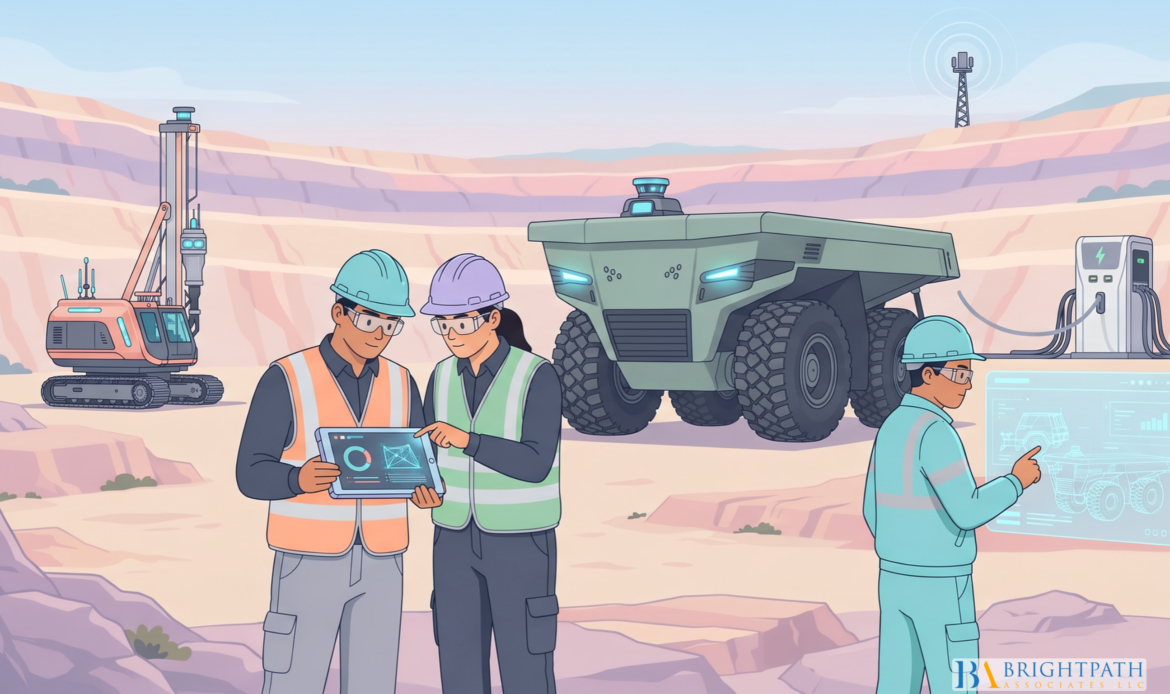
Mining 4.0 Skill Gap: Upskilling Your Workforce for Digital Age for Metal and Mining Industry is not simply a training issue. It is a leadership, operating-model, and talent-planning issue. A mine can purchase #AutonomousEquipment, advanced sensors, remote operations tools, or predictive-maintenance software. It cannot obtain the intended value if operators, maintainers, supervisors, and engineers cannot safely interpret the information those systems produce.
For metal and mining leaders, the harder question is not whether technology will change work. It already is. The practical question is which work changes first, which employees can grow into redesigned roles, and which capabilities must be hired from outside the organization. The U.S. Department of Energy’s National Energy Technology Laboratory identifies automation, remote operations, advanced sensing, data analytics, and electrification as technologies creating a workforce modernization need in mining. NETL’s Mining and Critical Minerals Workforce Hub frames this directly: modern mining technologies require an upskilled U.S. workforce.
Table Of Contents
The Skill Gap Is A Task Design Problem
Build A Role Based Mining 40 Competency Matrix
Create A Training, Redeployment, And Hiring System
Key Takeaways
Frequently Asked Questions
Resources And Citations
The Skill Gap Is A Task Design Problem
Mining 4.0 is the application of connected, automated, and data-driven technologies to ore extraction, metal processing, maintenance, safety, and mine planning. In practical terms, it can include autonomous haulage systems, remote operating centers, industrial IoT sensors, electrified fleets, machine learning models, and digital twins.
#DigitalTransformation changes tasks before it changes job titles. That distinction matters. A haul-truck operator may still be called an operator, but the role can shift from direct machine control to system monitoring, exception response, communication with control-room personnel, and following automated safety protocols. A maintenance technician may still repair pumps, conveyors, crushers, or mobile equipment, yet now also needs to validate sensor signals, use diagnostic software, and recognize when a network or control issue is being mistaken for a mechanical fault.
The available evidence does not support a single national number for the U.S. mining skills shortage between 2023 and 2026. Executives should be cautious of overly precise return-on-training claims. What is clear is that technical requirements are expanding while experienced personnel remain difficult to replace. Deloitte’s U.S. mining analysis notes that field workers need stronger digital literacy and that field leaders need enough digital understanding to support technology adoption. Deloitte’s digital mining analysis supports the case for training both frontline employees and the leaders who direct their work.
The Leadership Risk Behind The Skills Gap
A technology rollout often fails in the gap between a dashboard alert and a safe operating decision. That gap is usually managed by supervisors. They translate sensor readings, fleet-management alerts, maintenance priorities, and production targets into work instructions for crews.
For a mine manager or president, this creates four executive questions:
- Which tasks will automation remove, simplify, or make more complex?
- Which employees can be upskilled within the implementation timeline?
- Which roles require reskilling or redeployment rather than incremental training?
- Which leadership and specialist vacancies create unacceptable operational risk if left open?
A prolonged vacancy in a maintenance manager, process-control engineer, reliability leader, metallurgy leader, or automation superintendent role can slow the adoption of mining technology. It may also create a quieter problem: capable hourly employees receive inconsistent guidance because no one owns the transition between technology, maintenance, production, and safety.
Four Terms Leaders Should Keep Separate
| Term | Meaning | Best Fit | When It Is Not Enough |
|---|---|---|---|
| Upskilling | Adding capabilities to a current role | An operator learns fleet software or a mechanic uses condition-monitoring tools | The worker’s core task set disappears |
| Reskilling | Preparing a worker for a substantially different role | A truck operator transitions toward remote-operations support | The new role requires credentials or expertise unavailable in the timeframe |
| Redeployment | Moving an employee into another needed role | Automated tasks reduce headcount needs in one area but increase needs elsewhere | There is no viable receiving role or the employee does not meet requirements |
| New-hire pipeline | Building external talent supply | The mine needs automation, cybersecurity, controls, or metallurgy expertise not held internally | The organization ignores retention and relies only on external recruiting |
Upskilling is appropriate when the role remains recognizable. Reskilling is appropriate when the work itself has changed. Redeployment is a workforce decision, not a promise that every job can remain unchanged.
This distinction also protects trust. A study published in the South African Journal of Human Resource Management found that some mining employees reported inadequate preparation for robotic and Fourth Industrial Revolution changes. The employee-perception study is not U.S. workforce data, but it is a useful warning: when workers hear about robotics before they receive a credible training and transition plan, job security concerns can become an adoption barrier.
Build A Role Based Mining 40 Competency Matrix
A broad digital-literacy course is rarely enough. We recommend starting with tasks, equipment, decisions, and failure modes rather than job titles alone. The goal is to identify what an employee must do differently on a real shift.
For example, a predictive-maintenance system may identify an abnormal vibration pattern. The technician needs more than software access. They need to understand the equipment context, verify sensor quality, inspect the asset safely, document findings, and decide whether the alert warrants continued operation, planned repair, or immediate escalation.
A Practical Competency Matrix
| Role Group | Mining 4.0 Work Change | Core Competencies | Readiness Evidence |
|---|---|---|---|
| Operators | Monitor automated or semi-automated equipment | Human-machine interface use, alarm response, situational awareness, radio discipline | Simulator scenario and observed field task |
| Maintainers | Diagnose connected assets and predictive alerts | Sensor basics, industrial networking awareness, diagnostic software, root-cause analysis | Fault-isolation exercise and maintenance record review |
| Control-Room Staff | Coordinate remote operations and exceptions | System monitoring, escalation logic, communication, cyber hygiene | Timed simulated incident response |
| Supervisors | Turn data into safe work decisions | Risk interpretation, coaching, shift prioritization, cross-functional communication | Observation during shift planning and incident review |
| Engineers And Metallurgists | Improve process performance using operational data | Process control, data quality, model limitations, change control | Project review tied to a production or recovery question |
A competency matrix should measure demonstrated performance, not attendance. Completing eight hours of e-learning does not establish that an employee can respond to a communication failure in an #AutonomousHaulageSystem or distinguish a faulty sensor from a failing component.
The matrix should include three levels for each skill:
- Awareness: The employee can describe the system and recognize basic risks.
- Working capability: The employee can complete routine tasks using the system under normal conditions.
- Independent decision capability: The employee can manage exceptions, validate data, and escalate appropriately.
That third level should be limited to roles that actually make operational decisions. Overtraining everyone to the same level wastes time. Undertraining people who control exceptions creates safety and production risk.
The Maintenance And Data Infrastructure Gap
Mining innovation often receives attention at the operator interface. Yet many digital projects depend on less visible capabilities: sensor installation, calibration, industrial networks, programmable logic controllers, software version control, control-system troubleshooting, and cybersecurity-adjacent discipline.
A predictive-maintenance program is only as reliable as its data chain. A sensor may be installed correctly but transmit poor data because of a connectivity problem, configuration issue, time mismatch, or damaged cable. Without staff who can investigate those conditions, the mine may lose confidence in the technology for the wrong reason.
This is where hiring strategy becomes more selective. A reliability manager with traditional fixed-plant experience may be highly qualified, but a digital transformation phase may also require familiarity with condition monitoring, process control, operational technology, and data governance. The same principle applies to metallurgy leadership when metal processing decisions depend increasingly on instrumentation, process analytics, and automated control loops.
For a helpful related view of the technology context, see Mining Technology Driving Innovation and Efficiency. Technology choices should inform the competency matrix before recruiting begins, not after a new leader is hired.
Create A Training, Redeployment, And Hiring System
#TrainingDelivery should match the consequence of the task. Classroom instruction can explain a concept. Simulation can test response to rare or hazardous conditions. On-the-job learning can confirm that the employee performs correctly in the actual mine environment.
Engineering and Mining Journal reports that mining training increasingly combines simulation and virtual tools with technical capability, communication, risk interpretation, and adaptability. Engineering and Mining Journal’s training coverage supports using digital simulation as part of a broader capability model rather than treating it as a stand-alone solution.
Match The Learning Method To The Risk
| Learning Method | Best Use | Avoid Using It Alone When | Suggested Measure |
|---|---|---|---|
| Classroom or digital module | Definitions, system purpose, policy, cyber basics | Workers must execute complex actions under pressure | Knowledge-check score |
| Simulation | Emergency response, machine guidance, control-room exceptions | The simulator does not match local procedures | First-pass scenario completion rate |
| On-the-job coaching | Routine work on live equipment | The task has severe consequences for an unprepared learner | Supervisor observation record |
| Apprenticeship or internship | Building a long-term technical pipeline | The mine needs immediate specialist capacity | Completion and role-placement rate |
| Micro-credential | Narrow, repeatable skill upgrades | A role requires integrated judgment across systems | Demonstrated task assessment |
The OECD describes specialized degrees, apprenticeships, internships, micro-credentials, and competency-based assessment as flexible approaches that can help mining workers adapt to technological change. OECD’s Mining for Talent report also supports industry and education pathways that connect formal learning with practical work experience.
Build A 90-Day Skills Baseline Before Buying More Training
We suggest a 90-day baseline process for small and mid-sized mining and metals businesses. It is intentionally narrow. A large digital academy may be useful for a multinational producer, but it can be excessive for a smaller operation with one processing plant, a limited maintenance team, or a remote site.
- Days 1 through 30: Map changed tasks. Identify equipment, workflows, systems, and safety decisions affected by automation, remote operations, advanced sensing, or analytics.
- Days 31 through 60: Assess current capability. Use supervisor interviews, work samples, practical observations, and simple competency tests. Do not rely only on self-ratings.
- Days 61 through 90: Choose the response. Categorize each gap as upskilling, reskilling, redeployment, outside hiring, or a combination.
Training should be purchased against a measurable operating problem. Before selecting a simulator, course provider, or learning platform, establish the baseline for time to competency, first-pass assessment rate, unsafe interventions, unplanned downtime related to human error, rework, or post-training error frequency.
There is no validated universal U.S. schedule for reassessing Mining 4.0 competencies. A reasonable operating approach is to reassess when software changes, equipment is commissioned, procedures are revised, an incident exposes a skill gap, or annually for recurring high-risk tasks. Consider a control-room team that receives a major software update in October. Waiting for an annual refresher the following summer may leave an avoidable capability gap for months.
Where Executive Search Fits
Executive search is not a substitute for workforce development. It is most useful when a business needs leadership capability that cannot be developed quickly enough from within, when the role combines rare domains, or when confidentiality and assessment depth matter.
A mining executive search for an automation leader, mine manager, plant manager, VP of operations, metallurgy executive, or reliability leader should evaluate more than sector tenure. The search criteria should test whether candidates can:
• Lead safety decisions when automation changes normal work patterns.
• Build credibility with operators, technical staff, and maintenance teams.
• Translate data and process signals into operating priorities.
• Make realistic choices between developing internal talent and recruiting specialized talent.
• Work across ore extraction, metal processing, maintenance, technology, and workforce planning.
The best digital leader is not necessarily the person with the most software credentials. It is the person who can improve operational decisions without weakening safety discipline.
Traditional recruiting may struggle when job descriptions are copied from pre-digital roles. A search for a “maintenance manager” can attract capable candidates while missing the industrial-networking, predictive-maintenance, and change-leadership capabilities the site now needs. Defining those requirements upfront reduces the risk of a technically credible hire who is mismatched to the #TransformationAgenda.
For smaller organizations, training does not need to be centralized or expensive to be disciplined. Industrial Automation Training for Small Teams offers a relevant framework for prioritizing focused capability development. The key is to protect time for practice, assessment, and coaching rather than treating digital training as an optional extra after production demands are met.
Finally, assess technology investment and talent investment together. Maximizing Mining Tech ROI is relevant because return on mining technology depends not only on procurement and installation, but also on the workforce’s ability to use the system consistently.
Key Takeaways
• Mining 4.0 changes tasks, decisions, and accountability before it changes job titles. Map the work at task level.
• Operators, maintainers, supervisors, control-room personnel, engineers, and metallurgists require different digital competencies. One generic digital course will not close every gap.
• Supervisors are the translation layer between data and safe work. Their capability should be assessed early.
• Use upskilling for changed roles, reskilling for substantially different roles, redeployment for workforce transitions, and external hiring for scarce expertise.
• Measure training through demonstrated performance. Attendance is not readiness.
• Treat employee trust as an operating variable. Clear transition plans are more credible than vague assurances about automation.
• Executive hiring criteria should reflect the mine’s technology roadmap. A legacy job description can produce a legacy hire.
Frequently Asked Questions
What Does Mining 4.0 Mean For Skills In A U.S. Mine?
It means more employees must work with connected equipment, data, automation, remote systems, and digital procedures. The required skill is not advanced coding for every worker. It is role-specific competence in using systems safely, validating information, responding to exceptions, and communicating across teams.
Which Digital Skills Matter Most For Operators And Maintainers?
Operators need interface use, alarm response, automated-workflow awareness, and communication discipline. Maintainers need diagnostic software, sensor basics, industrial networking awareness, data interpretation, and structured troubleshooting. The priority depends on the mine’s equipment and operating model.
How Can A Mining Company Identify Its Workforce Skill Gap?
Start with changed tasks, not broad job titles. Identify what workers must now monitor, decide, inspect, maintain, or escalate. Then compare those tasks with demonstrated capability through observations, simulations, practical assessments, and supervisor review.
When Should A Company Reskill Rather Than Upskill An Employee?
Reskill when the employee’s current core work is removed or substantially redesigned by automation. For example, a role that moves from direct equipment operation to remote-system coordination may require reskilling if the decision-making, tools, and work setting are fundamentally different.
What Training Is Needed For Autonomous Haulage And Remote Operations?
Training should cover system purpose, safety boundaries, human-machine interface use, communication protocols, exception handling, emergency response, and escalation authority. Supervisors also need training because they must interpret system status and coordinate people working around #AutomatedEquipment.
How Should Supervisors Support Digital Adoption Without Compromising Safety?
They should explain why procedures change, verify that workers can perform new tasks, stop work when data and field conditions conflict, and document recurring issues for engineering or technology teams. Supervisors should not be expected to improvise technical fixes outside their competence.
How Often Should Mining 4.0 Competencies Be Reassessed?
Reassess after major software, equipment, or procedure changes; after incidents or recurring errors; and at least annually for high-risk recurring tasks. Frequency should reflect operational consequences, not a generic calendar rule.
What Should A Smaller Mining Company Do If It Cannot Fund A Large Digital Academy?
Start with the highest-risk and highest-value workflow. Use a 90-day skills baseline, short role-specific modules, supplier training, local technical-school partnerships, simulation where consequences justify it, and competency checks. A smaller program with visible operating measures is more useful than a large catalog with no proof of performance.
Resources And Citations
- US Department of Energy National Energy Technology Laboratory + Mining and Critical Minerals Workforce Hub — https://www.netl.doe.gov/business/rwfi/cmm-wf
- OECD + Mining for Talent — https://www.oecd.org/content/dam/oecd/en/publications/reports/2025/06/mining-for-talent_ca2ef39b/d89677f7-en.pdf
- Deloitte US + Digital Transformation in Mining Industry — https://www.deloitte.com/us/en/Industries/energy/perspectives/digital-transformation-mining-industry.html
- Engineering and Mining Journal + Mind the Knowledge Gap — https://www.e-mj.com/features/mind-the-knowledge-gap/
- South African Journal of Human Resource Management + Between Opportunity and Uncertainty: Mining Employees’ Perceptions of the Fourth Industrial Revolution — https://sajhrm.co.za/index.php/sajhrm/article/view/3862/5919
- BrightPath Associates: Global Trade and Metal Prices Reshaping Strategic Planning: https://brightpathassociates.com/global-trade-and-metal-prices-reshaping-strategic-planning/
Find your next leadership role in Metal and Mining Industry today!
Stay informed with the latest insights on Metal and Mining Industry!