
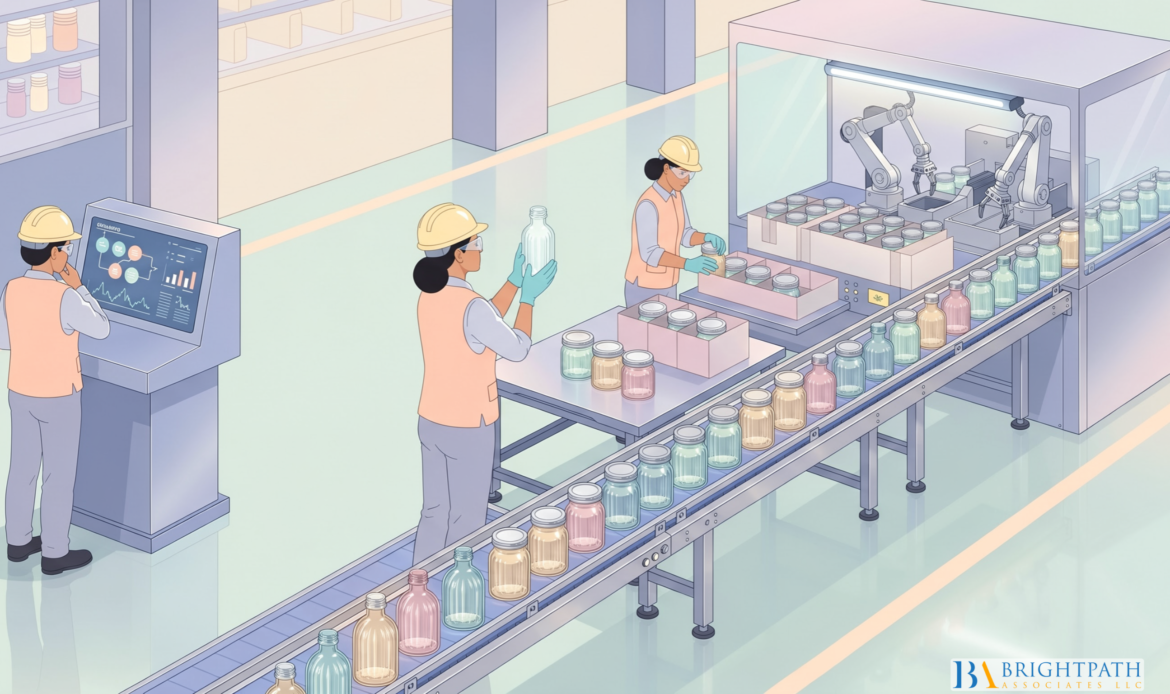
#DrivingInnovation in Glass Packaging: Customer Success Story for Glass, Ceramics & Concrete Industry begins with a hard business reality: an attractive glass container has limited value if it cannot be sourced reliably, run on the production line, survive distribution, or meet the sustainability expectations of customers and regulators. For executives, packaging innovation is not only a product development question. It is also a leadership, operations, procurement, and talent question.
Table Of Contents
• Innovation Must Solve A Business Problem
• What Customer Success Stories Actually Show
• Why Packaging Innovation Changes Executive Hiring
• A Practical Validation Framework For Glass Packaging
• Key Takeaways
• Frequently Asked Questions
• Resource and Citation
Innovation Must Solve A Business Problem
Define Innovation Beyond A New Bottle Shape
Glass packaging innovation is a measurable improvement to the container, the manufacturing process, the supply chain, or the protective shipping system. A new bottle shape, embossing detail, or premium closure finish may support product differentiation. Yet a packaging project becomes commercially meaningful only when it improves a defined business outcome.
For a glass, ceramics, or concrete manufacturer, that outcome may be reduced material use, lower breakage, better pallet stability, more reliable supply, stronger brand positioning, or easier handling on a customer’s line. The best decision depends on the constraint. Lightweighting may make sense when transportation weight and material intensity are the central problems. A stronger container may be the better choice when damage during distribution creates more cost and waste than additional glass mass.
This is why leaders should resist treating sustainable building materials and packaging sustainability as simple material substitution exercises. Glass is durable, reusable in some systems, and widely recyclable. Those advantages do not automatically establish that every glass package is the lowest impact option in every market. Distance traveled, recycled content, furnace energy, container weight, recovery rates, and product loss all affect the lifecycle comparison.
The same discipline applies across advanced ceramic manufacturing and concrete production efficiency. A material innovation must work under real operating conditions, not only in a design presentation. The operational questions are direct:
| Decision Question | What To Measure | Why It Matters |
|---|---|---|
| Can the package be supplied? | Lead time, supplier capacity, minimum order quantity | A design cannot generate revenue if containers are unavailable. |
| Can it run at speed? | Changeover time, line stoppages, rejects | A beautiful bottle can become an expensive bottleneck. |
| Can it survive shipment? | Breakage, abrasion, pallet movement, return rate | Product damage can erase material savings. |
| Is it genuinely more sustainable? | Material mass, transport profile, recycled content, recovery pathway | Sustainability needs a lifecycle comparison, not a single attribute. |
| Does it earn customer preference? | Trial feedback, repeat orders, channel fit | Packaging must support the product’s market position. |
Separate Primary Packaging From Secondary Packaging
Primary packaging is the glass bottle, jar, or container that holds the product. Secondary packaging protects, groups, stores, or ships that container. Confusing the two can lead executives to solve the wrong problem.
A primary-packaging redesign addresses container mass, geometry, closure compatibility, filling performance, label area, and shelf appearance. A secondary-packaging redesign addresses corrugated inserts, dividers, carton dimensions, warehouse space, packing speed, and e-commerce damage. Both may improve sustainability, but the mechanisms are different.
For example, a lighter bottle may reduce material use and freight weight. It may also create a new failure risk if the wall thickness, shoulder design, or handling conditions increase breakage. A redesigned corrugated insert may leave the bottle unchanged while lowering damage rates and reducing plastic film use. The smarter investment is the one that targets the actual failure point.
This distinction also affects #LeadershipRequirements. Product development leaders need container-design, closure, and manufacturing knowledge. Operations leaders need to understand conveying, filling, warehousing, and pallet behavior. Procurement leaders need supplier-risk visibility. A CEO who assigns all packaging innovation to one functional owner may miss the tradeoffs that occur between those disciplines.
Customer Feedback Is Product Development Data
Customer feedback should shape package design before tooling is finalized. Buyers may identify issues that laboratory testing does not reveal: a bottle that is difficult to grip, a closure that is frustrating to open, a carton that consumes too much shelf space, or a returnable format that is impractical for a distributor.
The most useful feedback is specific and comparable. Instead of asking whether customers “like” a package, ask whether it protects the product, fits the shelf, stacks safely, communicates quality, and performs in the intended channel. Feedback from e-commerce fulfillment teams may matter more than retail feedback when direct-to-consumer shipments drive the damage profile.
For leaders evaluating the glass industry’s digital transformation, product and process data should be connected rather than isolated. Design specifications, supplier capacity, production rejects, shipment claims, and customer feedback become more valuable when decision-makers can compare them in one operating view.
What Customer Success Stories Actually Show
Supply Continuity Can Be The Innovation
One of the clearest customer-success lessons is that supply resilience can be as important as container design. During pandemic-era disruption, Yo Mama’s Foods encountered glass shortages, transportation constraints, supplier minimums, capacity issues, and rising prices. TricorBraun’s Yo Mama’s Foods case study reports that a more competitive glass supplier was secured in approximately two weeks.
The case later described a contract for more than five million containers across a 25-ounce tomato-sauce jar and a 13-ounce salad-dressing bottle. Those figures matter because they show the commercial scale of a sourcing problem. A package redesign may be technically sound, but a company that cannot meet a supplier’s minimum order quantity can still face delayed launches, stockouts, or margin pressure.
Small and mid-sized manufacturers should treat container supply as a design input, not a procurement detail. Before approving a container, leaders should ask whether at least two qualified sourcing paths exist, what volume commitments are required, how long tooling will take, and whether freight economics change at different order quantities.
A practical supply-risk playbook has four steps:
- Map the current container, closure, decoration, and secondary-packaging suppliers.
- Identify single-source components, long lead-time items, and supplier minimums that exceed forecast demand.
- Prequalify alternatives before a shortage forces a rushed switch.
- Build contingency language into commercial plans, including approved substitutions and lead-time triggers.
This approach is especially relevant to companies pursuing ceramic industry growth or advanced concrete technology. Specialized materials often have fewer qualified sources, longer qualification cycles, and tighter technical tolerances. Leadership teams need enough operational depth to recognize that risk early.
Energy Innovation And Container Innovation Are Different Levers
brightpathassociates.com is energy intensive, so sustainability strategy cannot stop at the package itself. Demand response is a program in which large electricity users reduce or shift consumption during periods of grid stress. It does not redesign a bottle. It changes how a plant manages energy exposure.
Enel North America’s Ardagh Glass Packaging case study states that Ardagh Glass Packaging–North America used demand response as part of its energy strategy while operating in the glass-container sector. That is a useful distinction for executives: container innovation and energy-management innovation can support the same sustainability agenda, but they require different owners, metrics, and investment decisions.
A container-design team may track glass mass, closure performance, consumer handling, and filling-line compatibility. An operations or energy leader may track electricity demand, production scheduling, furnace constraints, and grid-response participation. Both functions influence cement industry sustainability and glass industry innovation, but neither can substitute for the other.
Protection And Inventory Simplification Can Work Together
E-commerce is where fragile products often expose hidden packaging weaknesses. Smurfit Westrock reported that a paper-based insert was designed for Edrington to protect glass bottles across 10 different bottle sizes in one system. The company also reported that the approach reduced the need to stock separate packaging lines for each supported size.
The business lesson is not that one insert will suit every product family. It is that multi-format packaging deserves operational testing. A universal pack may reduce packaging inventory complexity and warehouse space, but it can fail if packing speed slows, smaller bottles move inside the carton, or fulfillment teams use the insert incorrectly.
A separate supplier account involving Vintimtim reported a redesign that increased capacity from one wine glass to three glasses using a recyclable corrugated insert. The numerical change is simple, but it illustrates a broader principle: packaging performance is often improved by redesigning the system around the product, not by adding more material.
For a related manufacturing perspective, BrightPath Associates discusses sustainable practices in glass facilities. The executive question remains practical: can sustainability improvements be measured alongside cost, throughput, quality, and supply continuity?
Why Packaging Innovation Changes Executive Hiring
The Leadership Profile Is Becoming More Cross-Functional
A packaging executive once could succeed with deep expertise in procurement, plant operations, engineering, or commercial sales alone. That depth remains valuable. But innovation projects increasingly require leaders who can connect those functions without oversimplifying tradeoffs.
The strongest packaging leaders translate technical constraints into commercial decisions. They understand why a closure finish affects filling equipment, why an embossed bottle can change forming complexity, why a lighter container may alter line behavior, and why a new supplier may introduce qualification risk.
This does not mean every business needs to hire one executive with every specialty. In many small and mid-sized companies, that profile may be unavailable or unaffordable. The better question is whether the leadership team collectively covers five capabilities:
• Product and process engineering
• Supply-chain and sourcing strategy
• Manufacturing and quality control
• Sustainability measurement
• Commercial and customer insight
When one capability is missing, innovation can stall. A technical team may approve a design that procurement cannot source. A commercial team may promise a launch date that operations cannot support. An operations team may reject a concept that could work with modest equipment changes because it lacks a full cost model.
Specialized Searches Need A Different Brief
Conventional recruiting can struggle when the job description lists broad terms such as “innovation,” “sustainability,” and “operations excellence” without defining the operating context. A candidate may be strong in consumer packaging but have little experience with furnaces, glass-container forming, ceramics, concrete materials, industrial quality systems, or B2B distribution.
A specialized leadership search starts with the business problem, not the title. If the immediate risk is supplier concentration, prioritize sourcing and commercial negotiation. If the problem is repeated line disruption, prioritize plant leadership and packaging-line compatibility. If the company is entering premium retail or direct-to-consumer channels, prioritize product development, customer insight, and protective #PackagingKnowledge.
This is where executive search may add value when internal networks do not reach the relevant technical and leadership talent pool. The case for using a search partner is stronger when the role combines uncommon requirements, confidentiality, or significant vacancy risk. It is weaker when the organization has a clear internal successor or when the position can be redesigned into a more realistic scope.
For companies whose innovation agenda overlaps with materials science, advanced ceramics in the industrial market offers useful context. Advanced ceramic manufacturing, glass packaging, and concrete technology differ in process details, yet all depend on leaders who can balance quality, cost, safety, production discipline, and commercial timing.
Vacancy Risk Is Often Operational Risk
A prolonged vacancy does not always cause immediate harm. Some organizations have capable deputies and stable processes. Others depend heavily on a single leader to approve suppliers, qualify materials, resolve customer escalations, or coordinate capital decisions.
A vacancy becomes more consequential when it overlaps with a package launch, a capacity expansion, a quality issue, or an energy-cost challenge. In those cases, interim leadership, project-based technical support, or a staged hiring plan may be more prudent than leaving critical decisions unowned.
Hiring speed should not override role definition. A rushed executive hire can create a second vacancy when the leader lacks the authority, technical context, or support needed to succeed.
A Practical Validation Framework For Glass Packaging
Use A Four-Gate Test Before Full Rollout
Innovation programs need a repeatable way to decide whether a concept should advance. We recommend treating the first production run as a learning stage, not proof of success. The following four gates help leaders expose risks before committing to full-scale tooling, inventory, or market launch.
| Gate | Core Test | Evidence Required | Common Failure Mode |
|---|---|---|---|
| 1. Feasibility | Can the concept be made and sourced? | Supplier capability, tooling assumptions, lead times | A design depends on capacity that is not available. |
| 2. Compatibility | Can it run through current operations? | Filling, labeling, conveying, packing, and pallet testing | The new geometry creates jams or slow changeovers. |
| 3. Protection | Can it reach customers intact? | Transit testing, damage tracking, warehouse trials | Secondary packaging does not control movement or abrasion. |
| 4. Economics And Impact | Does it improve the full business case? | Unit cost, freight, waste, lifecycle comparison | Material savings are outweighed by breakage or complexity. |
Measure Before And After, Not Just At Launch
A credible scorecard compares baseline and trial results using the same conditions whenever possible. Breakage rate, reject rate, line speed, changeover minutes, freight weight, inventory count, and customer complaints should be tracked before and after a packaging change.
Leaders should be cautious about declaring success from a short pilot. A package can perform well in a controlled trial and fail later because of a different distribution route, colder weather, pallet configuration, warehouse crew, or customer handling practice. Fair warning: no public case-study source reviewed here provides a universal acceptable breakage threshold or a comparable standard cost-saving range. Each business should set thresholds based on its product value, channel, and current loss profile.
Operational handling also deserves attention. Aetna Group’s Refresco Italia case study reports that packaging-line technologies were used to reduce bottle wear, improve pallet stability, and optimize bottle reuse. The reported outcomes are supplier-published, not independent audit results, but they reinforce the right measurement focus: handling quality and logistics performance matter alongside container design.
Ask For Evidence Quality, Not Just Results
Supplier case studies are useful starting points, especially when they describe a clear customer problem and a defined implementation. They should not be read as independent proof that a result will transfer to another facility or product category.
Executives should ask four questions before using any packaging case study as a decision basis:
- Who measured the result, and was the measurement independently verified?
- What was the baseline, time period, and operating environment?
- Which costs and risks were included or excluded?
- What conditions would make the result less likely to transfer to our business?
The most trustworthy customer success story explains both the reported result and the conditions required to reproduce it. That level of rigor improves product decisions and creates a clearer leadership mandate for the #ExecutivesResponsible for delivery.
Key Takeaways
What Executives Should Prioritize
• Treat glass packaging as an operating system, not a standalone container. Design, sourcing, energy, production, transport, and customer use are connected.
• Choose lightweighting when lower material use and freight weight can be achieved without creating unacceptable performance risk. Avoid it when testing shows higher breakage, poor line behavior, or expensive secondary-packaging offsets.
• Use secondary packaging innovation when the main problem is transit damage, warehouse complexity, or e-commerce fulfillment. Do not redesign the bottle first if the bottle itself is not the failure point.
• Build supply resilience before a shortage occurs. Supplier minimums and capacity constraints can turn a technically sound package into a commercial risk.
• Define leadership roles around the constraint the business needs to solve. A sourcing challenge, a plant-performance challenge, and a premium product-development challenge require different executive capabilities.
The Central Leadership Lesson
Innovation succeeds when technical, commercial, and operational decisions have clear ownership. That is true in glass packaging, advanced ceramic manufacturing, construction materials recruitment, and concrete production efficiency. The leadership question is not whether innovation matters. It is whether the business has assigned the right people, measurements, and decision rights to make it repeatable.
Frequently Asked Questions
What Does Innovation In Glass Packaging Mean?
It means improving the container, manufacturing process, supply chain, or shipping system to solve a measurable business problem. Examples include lightweighting, new closure finishes, better recycled-content strategies, demand response, protective corrugated inserts, and multi-size e-commerce packaging.
When Is Lightweighting Better Than Switching Materials?
Choose lightweighting when glass remains important for product protection, premium presentation, recyclability, or customer preference and testing confirms acceptable strength and line performance. Consider other formats only after comparing lifecycle impacts, supply continuity, #CustomerRequirements, and total system cost.
How Can Smaller Companies Secure Glass Supply?
Start by documenting forecast volume, acceptable alternatives, lead-time needs, and supplier minimums. Smaller buyers may need distributors, intermediaries, or prequalified alternate sources when direct minimum orders exceed demand. Supply continuity should be reviewed before finalizing a package design.
What Must A Supplier Know Before Designing A New Glass Container?
The supplier needs product fill volume, closure requirements, filling method, pressure or thermal conditions, label and decoration needs, target channels, pallet configuration, annual demand, quality requirements, and sustainability goals. Missing any of these details can delay tooling or create compatibility issues.
How Should A Company Measure Packaging Sustainability?
Use a lifecycle comparison that considers material use, manufacturing energy, recycled content, transport, reuse potential, recycling access, breakage, and product loss. Do not rely on one attribute, such as container weight or recyclability, as a complete sustainability conclusion.
What Is The Difference Between Bottle Redesign And Shipping-Pack Redesign?
Bottle redesign changes the primary glass container and can affect filling, closures, branding, and material use. Shipping-pack redesign changes the protective system around it and can affect damage, packing speed, warehouse space, and plastic-film use. The right choice depends on where the problem occurs.
What Should A Trustworthy Customer Success Story Include?
It should identify the original problem, the solution, the measurement method, the time period, the reported outcome, and the limits of transferability. If results come from a supplier, the story should say so rather than implying independent validation.
Resources And Citations
TricorBraun — Yo Mama’s Foods Case Study
Enel North America — Ardagh Glass Packaging Case Study
Aetna Group — Refresco Italia Packaging Innovation And Efficiency
https://www.aetnagroup.com/en/case-studies/refresco
BrightPath Associates — Ceramics 4.0: Powers of Smart Manufacturing: https://brightpathassociates.com/ceramics-4-powers-future-of-smart-manufacturing/
Find your next leadership role in Glass, Ceramic, Concrete Industry today!
Stay informed with the latest insights on Glass, Ceramic, Concrete Industry!