
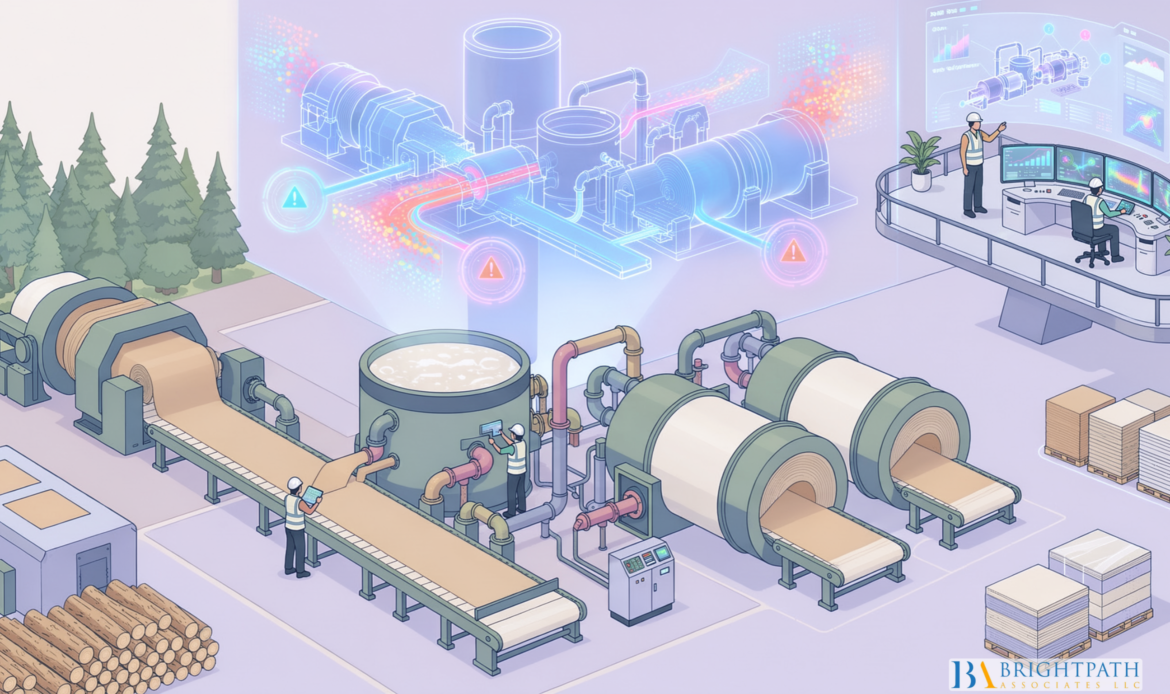
Digital Twins in Food Safety: Simulating Risks Before They Happen for Industrial Automation Industry is not a promise that software can eliminate contamination. It is a more practical idea: use production data, process models, and #RiskSimulation to identify unsafe conditions early enough to hold product, adjust a process, investigate a batch, or prevent a small deviation from becoming a larger event.
For food manufacturers, the appeal is clear. A plant may already have SCADA systems, PLC programming, industrial machine vision, robotics integration, laboratory testing, and quality records. Yet those systems often describe what has happened. A well designed digital twin can help teams test what may happen next if a temperature drifts, a sanitation cycle changes, a supplier lot behaves differently, or a cold chain delay extends beyond plan.
The central leadership question is not whether a digital twin is technically impressive. It is whether the organization has the controls, data discipline, engineering leadership, food safety authority, and operating model needed to act on its warnings responsibly.
Table Of Contents
• What A Food Safety Digital Twin Actually Does
• Building A Minimum Viable Twin Around A Real Food Safety Decision
• Turning Predictions Into Safe Automation Decisions
• Frequently Asked Questions
• Resources And Citations
What A Food Safety Digital Twin Actually Does
It Is More Than A Dashboard Or A Simulation
A #DigitalTwin is a continuously updated virtual representation of a physical asset, process, product, or supply chain. In food safety, it connects observed production conditions to a model that estimates risk under current and possible future conditions.
A dashboard may show that a cooler is at a certain temperature. A digital twin can use that temperature, duration, product type, batch history, equipment state, and other inputs to estimate how a temperature excursion could affect product condition. It can then run scenarios: What changes if the excursion lasts another 20 minutes? What if airflow is reduced? Which lots share the same exposure history?
Research on food-industry digital twins describes their ability to combine sensor data and process models for real-time control, troubleshooting, optimization, and what-if risk analysis. That distinction matters. Monitoring reports a condition. A twin interprets conditions through a model and tests consequences.
| System | Primary Function | Food Safety Limitation When Used Alone |
|---|---|---|
| SCADA system | Monitors and supervises equipment | Usually does not estimate product risk across changing conditions |
| MES | Tracks work orders, batches, and production records | May preserve genealogy without simulating hazard development |
| HACCP software | Documents hazards, limits, monitoring, and actions | Does not necessarily predict a future deviation |
| Digital shadow | Receives physical data in one direction | May visualize operations without modeling interventions |
| Digital twin | Links data, models, and scenario analysis | Requires validation before teams rely on its outputs |
A digital twin is a decision-support system, not a substitute for a validated food safety plan.
That point should guide executive expectations. A model may flag a higher probability of a problem, but it does not automatically prove that a biological, chemical, or physical hazard has been controlled. Hazard analysis, preventive controls, critical limits, verification, corrective actions, and records remain essential.
Which Risks Can Be Simulated?
The most credible applications are focused on measurable process conditions and known product behaviors. Food safety twins can model temperature exposure, humidity, residence time, refrigeration performance, storage conditions, cleaning cycles, and batch genealogy. Depending on available science and data, they may also estimate microbial growth, quality changes, spoilage risk, or remaining shelf life.
A 2025 article on digital twins in food supply chains explains that these models can represent microbiological, biochemical, and sensory conditions at batch and individual-product levels while integrating measurement events into standards-based IT systems.
The distinction between possible and reliable matters. A plant can often model temperature abuse more readily than it can predict an unexpected pathogen event. Temperature is measurable, time stamped, and linked to established product behavior. Contamination risk may involve raw materials, environmental conditions, employee practices, equipment design, sanitation effectiveness, and lab evidence that no single model fully captures.
For example, a ready-to-eat food producer could use a twin to combine cooler temperature, dwell time, lot identity, and shipping exposure history. The output may classify lots for normal release, additional review, or a temporary hold pending quality approval. That is a defined operational question, not an unsupported claim that the system can detect every hazard.
Why Hybrid Models Are Often More Useful
A #HybridModel combines mechanistic equations with data-driven inference. In plain terms, it uses known process science alongside patterns found in sensor and production data.
This approach is useful because food systems are not purely mechanical. A conveyor speed may be deterministic, but microbial growth, ingredient variability, packaging behavior, and ambient conditions are not. The 2026 Frontiers review of hybrid food twins reports that hybrid workflows can combine sensor quality control, mechanistic models, data-driven inference, exposure histories, remaining-shelf-life forecasts, and threshold-risk probabilities.
A useful output is not always a single score. It may be a range, such as a probability that a product condition will exceed a defined threshold. The same review notes examples of threshold probabilities such as P(Nt > Ncrit), which represents the estimated likelihood that a modeled measure exceeds its critical threshold.
Uncertainty is a food safety feature, not a weakness. If sensor readings are missing or a new supplier changes ingredient behavior, the twin should communicate reduced confidence instead of producing a falsely precise answer.
Building A Minimum Viable Twin Around A Real Food Safety Decision
Start With One Critical Process Window
Plant-wide models can become expensive, slow to validate, and difficult for operators to trust. We recommend starting with one process step where four conditions exist:
- The food safety consequence is meaningful.
- The process has measurable inputs.
- The plant has a clear intervention available.
- Results can be compared against actual outcomes.
Possible starting points include a thermal process, metal detection zone, refrigerated staging area, cooling step, allergen changeover, or cold-chain shipment lane. The goal is not to create a digital replica of everything at once. The goal is to reduce uncertainty around a specific decision.
For example, a twin for a post-process cooling step might ingest product temperature, airflow, line speed, batch size, equipment status, ambient conditions, and timestamps. It could estimate whether the process stayed inside its expected operating window and identify batches that need review.
A 2024 review of food supply-chain twin implementation notes that digital twins can support scenario analysis, disruption prediction, IoT-enabled visibility, and contamination-source investigation during recalls or outbreaks. For executives, the operational value lies in narrowing the question: Which lots, conditions, and decisions deserve attention first?
Treat Data Lineage As A Control Requirement
A twin cannot be more trustworthy than the data used to update it. Data lineage means teams can show where a reading came from, when it was collected, which device created it, whether the device was calibrated, and whether the record was changed.
This has direct food safety implications. A temperature sensor mounted near an evaporator may not represent the product zone. A PLC timestamp that differs from an MES timestamp may join a temperature excursion to the wrong batch. A failed gateway may create a data gap that looks like normal operation.
Use a structured data review before modeling:
• Sensor placement: Confirm that instruments measure the condition that matters to the product or process.
• Calibration status: Link calibration records to the devices supplying safety-relevant data.
• Time synchronization: Use consistent timestamps across PLCs, SCADA systems, MES records, laboratory systems, and shipping events.
• Batch and lot identifiers: Ensure every model event can be tied to product genealogy.
• Missing-data rules: Define whether the twin estimates, flags, or rejects an incomplete record.
• Access controls: Record who can change model parameters, thresholds, and data mappings.
For leadership teams, this is also a talent question. Automation leaders need enough knowledge of control systems and data architecture to work effectively with quality, regulatory, operations, cybersecurity, and process engineering leaders. A strong PLC programming service provider may understand controls logic deeply, but food safety model governance requires broader cross-functional ownership.
Validate Before Relying On Alerts
#ModelCalibration is the adjustment of model parameters against measured data. Model drift occurs when model performance declines because the physical process changes.
Recipe changes, supplier changes, equipment replacement, seasonal temperature shifts, packaging updates, and new sanitation chemistry can all affect a twin’s reliability. An accurate model in January may be less accurate after a major production change in July.
A practical validation approach includes:
- Define the intended use, such as advisory alerts for cooler excursions.
- Compare historical predictions against known process and quality outcomes.
- Test edge cases, including sensor failure, delayed data, abnormal line speed, and out-of-range operating conditions.
- Set acceptance criteria for alert usefulness, response time, and false-alert review.
- Establish change control for recipes, equipment, thresholds, and model versions.
- Schedule recalibration and require human review when performance degrades.
There is no universal published performance threshold that makes a food safety twin suitable as an autonomous release authority. That is why model warnings should initially support review and verification, rather than replace established control procedures.
Turning Predictions Into Safe Automation Decisions
Map The Output To HACCP And Preventive Controls
A digital twin is most useful when its output leads to a documented decision. The model should not simply send an alert that says “risk elevated.” It should identify the applicable process, product, lot, confidence level, likely driver, and required review path.
| Twin Output | Appropriate Initial Response | Food Safety Record To Review |
|---|---|---|
| Temperature exposure exceeds modeled window | Place affected lot under review or hold | Temperature records, lot genealogy, corrective-action record |
| Sensor data missing during a critical period | Escalate data-integrity exception | Calibration status, system audit trail, monitoring record |
| Model confidence falls after recipe change | Suspend automated recommendations | Change-control documentation, validation evidence |
| Repeated deviation pattern appears | Investigate process cause and preventive control | Trend review, maintenance, sanitation, and verification records |
A prediction should trigger a defined decision workflow, not an improvised reaction.
In a U.S. facility, that workflow should fit the site’s HACCP or preventive-controls program. A warning may lead to additional monitoring, a product hold, intensified sanitation, targeted sampling, rework review, or traceability analysis. The correct response depends on the hazard analysis and the plant’s validated procedures.
The leadership lesson is straightforward: do not ask automation teams to design #FoodSafety authority alone. Quality and food safety leaders must define the decision rules. Operations leaders must ensure the rules are workable during live production. Controls engineers must ensure the technical system executes only authorized actions.
For related workforce and compliance considerations, Compliance and Leadership in Food Manufacturing Industry provides useful context on why leadership accountability cannot be separated from regulatory discipline.
Advisory Alerts Come Before Closed-Loop Control
Closed-loop control means a system uses model output to change a physical process automatically. It may adjust refrigeration, conveyor speed, a valve position, or another operating variable.
Closed-loop control may be appropriate for bounded, well-understood process adjustments. For example, a refrigeration control loop may respond to a verified temperature measurement within established operating limits. It is much harder to justify automatic product release, automatic disposal, or a major shutdown solely from a model prediction.
We advise a staged approach:
- Observe: Run the twin in parallel with current operations.
- Advise: Send alerts to designated operators and quality reviewers.
- Recommend: Present specific response options with supporting data.
- Automate limited actions: Use only validated, fail-safe actions within approved ranges.
- Review performance: Audit alert quality, response times, overrides, and missed conditions.
Automation should fail safely when data are stale, missing, tampered with, or outside the model’s validated range.
Cybersecurity is part of this design. If a twin reads from industrial control systems or sends recommendations into control workflows, protect sensor gateways, user accounts, parameter changes, network connections, and audit logs. Unauthorized changes to a threshold can be as consequential as a faulty sensor.
The Executive And Talent Implications
Digital twins change the leadership profile needed in food automation. The work sits between food safety, OT cybersecurity, process engineering, manufacturing automation, data governance, robotics integration, SCADA systems, and quality assurance.
That does not mean every plant needs a new executive title. It does mean leaders should test whether current roles have clear authority and enough technical depth. A plant manager may own response execution. A food safety leader may own hazard and release decisions. An automation leader may own data capture and PLC or SCADA integration. A technology leader may own architecture and cyber controls.
The scarce capability is not simply analytics. It is the ability to turn a model warning into a safe, auditable operating decision.
When executive hiring is necessary, job descriptions should avoid asking for vague “digital transformation” experience. Specify the actual operating environment: regulated food production, control systems, batch genealogy, quality systems, OT security, vendor management, and cross-functional change control. That precision also helps clarify whether the need is an executive hire, a specialized automation manager, a contract controls engineer, or external project support.
Food safety technology does not reduce the need for training. It raises the stakes for it. Teams implementing predictive monitoring should connect technical rollout plans with Food and Beverages Safety Training so operators understand both the alert and the required response.
Key Takeaways
• Digital twins improve foresight when they connect reliable operational data to a validated model and a defined action.
• A food safety prediction is not, by itself, proof that a hazard has been controlled.
• Start with one measurable process window and one high-value decision before attempting a plant-wide twin.
• Sensor placement, calibration, timestamps, and lot identifiers are core safety requirements, not technical housekeeping.
• Advisory workflows are generally a safer first step than autonomous product-release or shutdown decisions.
• Leadership teams need explicit ownership across food safety, operations, controls engineering, data governance, and cybersecurity.
• Traceability becomes more valuable when it links predicted exposure to a precise batch, process history, and response plan.
For manufacturers extending risk simulation beyond the plant, Advance Modern Food Supply Chain Efficiency addresses the operational importance of better supply-chain coordination and visibility.
Frequently Asked Questions
What Is A Digital Twin In Food Safety?
A food safety digital twin is a dynamic model of a product, process, asset, or supply chain. It combines operating data with process logic or predictive models to estimate risk, test scenarios, and support decisions such as holds, inspections, process adjustments, or traceability reviews.
How Is A Digital Twin Different From SCADA Or MES?
SCADA collects and displays equipment data. MES manages production records and batch execution. A digital twin can use information from both systems, then apply models to simulate likely outcomes under different conditions. It complements those systems rather than replacing them.
Can A Digital Twin Predict Microbial Contamination Before Lab Results?
It can estimate risk when measurable conditions are linked to validated #MicrobiologicalModels. It cannot reliably replace laboratory confirmation or validated preventive controls. Use it to prioritize review, sampling, holds, or investigation rather than treat it as proof of contamination or proof of safety.
What Data Is Needed For A First Food Safety Twin?
Most initial projects need time-synchronized process readings, batch or lot identity, product and recipe context, equipment state, calibration records, and quality or laboratory outcomes for validation. The exact inputs depend on the process being modeled.
Should A Twin Automatically Control Equipment?
Only in limited, validated circumstances. Automatic adjustments may be appropriate when actions are bounded, reversible, and fail-safe. Human authorization is generally more appropriate for product release, destruction, recall decisions, or actions outside established operating limits.
What Happens When Sensors Fail Or Data Are Missing?
The system should flag the data gap, reduce confidence, and follow a predefined exception workflow. It should not silently assume normal conditions. Missing data can require added review because it weakens the evidence used for product and process decisions.
Is A Plant-Wide Digital Twin Necessary?
No. A narrowly scoped twin around a critical control point, preventive control, cold-storage zone, or shipping lane is often more useful at the start. Broader models should follow only after the first use case shows dependable data, actionable outputs, and manageable governance.
Resources And Citations
• Springer — Digital Twins & Industry 5.0 On Food Management: https://link.springer.com/chapter/10.1007/978-3-031-76758-6_7
• Taylor & Francis — Implementation of digital twins in the food supply chain: a review: https://www.tandfonline.com/doi/full/10.1080/00207543.2024.2305804
• Springer — Digital twins in the food supply chain: from concept to application: https://link.springer.com/article/10.1007/s00003-025-01588-y
• Frontiers — Digital twins for food processing and shelf-life: https://www.frontiersin.org/journals/food-science-and-technology/articles/10.3389/frfst.2026.1813819/full
• PubMed Central — Can a Byte Improve Our Bite? An Analysis of Digital Twins in the Food Industry: https://pmc.ncbi.nlm.nih.gov/articles/PMC8747666/
• BrightPath Associates — Compliance and Leadership in Food Manufacturing Industry: https://brightpathassociates.com/compliance-and-leadership-in-food-manufacturing-industry/
Find your next leadership role in Industrial Automation Industry today!
Stay informed with the latest insights on Industrial Automation Industry!