
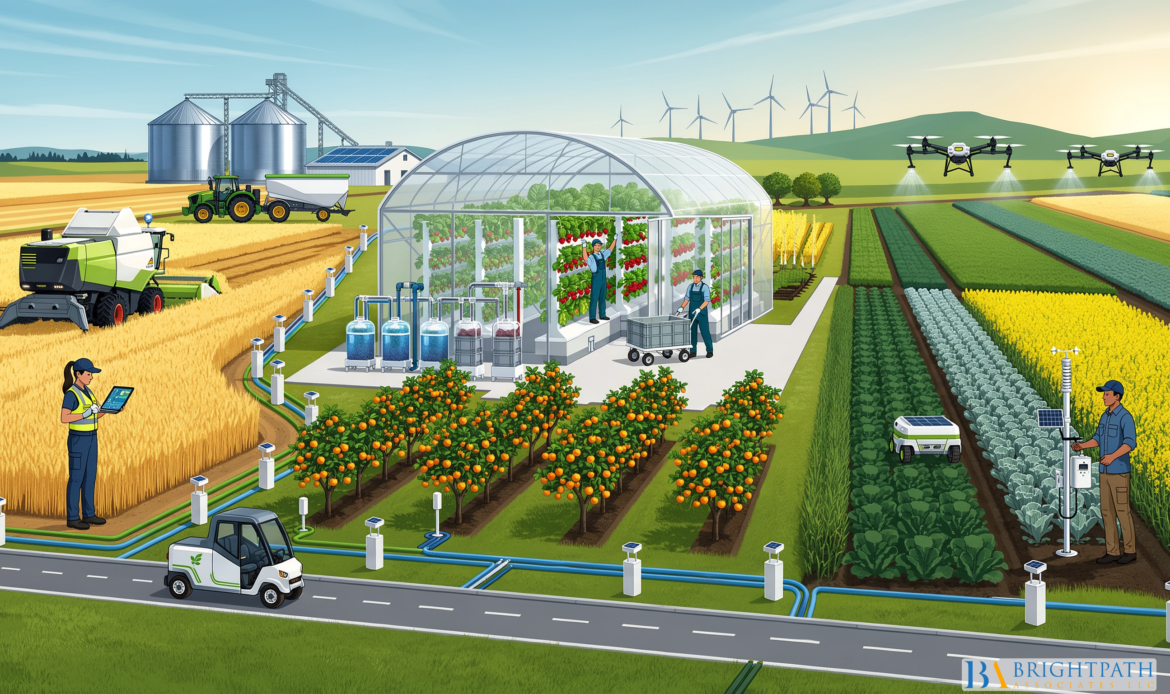
The Next Decade of Agribusiness: Consolidate, Specialize, or Optimize for Farming Industry is not a simple choice between getting bigger, finding a niche, or buying more technology. For many U.S. farm businesses, the harder question is whether the organization has the capital discipline, #LeadershipCapacity, labor model, and market access to make any of those moves pay off.
U.S. agricultural output has grown while land, labor, and other inputs have remained relatively steady, reflecting changes in technology, inputs, and farm organization, as outlined by the USDA ERS overview of farming and farm income. That history supports optimism about agricultural innovation. It does not mean every expansion plan, specialty venture, or digital farming investment will create stronger margins.
Table of Contents
- Key Takeaways
- The Strategic Choice Facing Agribusiness
- Choosing Consolidation, Specialization, or Optimization
- The Leadership Challenge Behind Farm Strategy
- Frequently Asked Questions
- Resources and Citations
Key Takeaways
• Optimization is often the first move. A farm does not need to add acres or enter a new market before fixing weak asset utilization, inconsistent operating data, labor bottlenecks, or input decisions.
• Consolidation works only when scale improves unit economics. More acres, livestock, or facilities can spread fixed costs, but they can also increase debt exposure and management complexity.
• Specialization requires more than a high value product. It depends on reliable channels, quality control, post harvest capacity, labor, and a clear customer base.
• Leadership capacity is a strategic constraint. A farm may have access to land or capital yet lack the operations, finance, supply chain, or technology leadership needed to manage a larger enterprise.
• Executive hiring should follow strategy, not precede it. A general manager, chief financial officer, operations leader, or technology executive must be selected against the farm’s actual operating model and #RiskProfile.
The Strategic Choice Facing Agribusiness
Scale Is Not the Same as Economic Strength
Consolidation means fewer, larger, or more connected farm businesses. It can take many forms: buying land, leasing acreage, acquiring a neighboring operation, combining entities, adding livestock capacity, or using shared service arrangements. The practical aim is usually to lower unit costs, improve equipment use, or create greater purchasing and selling power.
The strongest case for consolidation appears when a farm has underused machinery, available management capacity, dependable labor, and a balance sheet that can withstand a weaker price cycle. A grain operation, for example, may gain from spreading machinery depreciation, agronomy oversight, insurance administration, and transportation planning across more acres. But the benefit is not automatic. If the additional acres are scattered, require new equipment, or add another layer of supervision, cost per acre may rise rather than fall.
Income concentration also matters. A U.S. House Agriculture Committee testimony from Secretary Thomas J. Vilsack noted that approximately 7% of U.S. farms typically receive 85% of overall farm income. This does not prove that every smaller farm should consolidate. It does show that the sector’s economic rewards are uneven and that scale can reinforce advantages in capital access, purchasing, management systems, and market reach.
National Forecasts Are Context, Not a Farm Plan
National farm income figures are useful because they show the broader earnings and liquidity environment. Yet they should not be treated as a forecast for a specific farm. Commodity mix, geography, debt structure, insurance coverage, land tenure, #MarketingDecisions, and labor availability can create very different outcomes inside the same national year.
The USDA ERS Farm Sector Income Forecast provides a national baseline for evaluating expansion, specialization, and liquidity decisions. It is best used as a pressure test. If farm income softens, can the business still meet debt payments? If capital costs stay high, can an expansion project still earn an adequate return? If margins improve, does the farm have the operating structure to capture the opportunity?
The Often Missed Constraint: Management Bandwidth
Land availability is visible. Leadership bandwidth is not. Yet management capacity can be the limiting factor in a growing agricultural enterprise.
A farm that adds 3,000 acres may also add more landlord relationships, field records, crop insurance exposure, vendor negotiations, maintenance demands, and seasonal hiring. A dairy that adds a processing or direct marketing component takes on food safety, scheduling, quality assurance, customer service, and logistics responsibilities. These are not side tasks. They require accountable leaders with clear decision rights.
This is where succession planning becomes part of strategy. If the owner is still the chief operator, lender contact, equipment decision maker, HR lead, and salesperson, the business may be larger than its leadership design can support. Before pursuing growth, executives should ask a direct question: Who will own the new complexity every day?
Choosing Consolidation, Specialization, or Optimization
Start With a Minimum Viable Scale Analysis
There is no universal acreage, herd size, or revenue threshold at which consolidation becomes profitable. Minimum viable scale depends on the enterprise and its cost structure. Instead of asking whether the farm is “large enough,” measure whether a specific expansion will improve the economics of constrained resources.
| Decision Area | Consolidation Test | Specialization Test | Optimization Test |
|---|---|---|---|
| Capital | Can debt service hold under lower prices or yields? | Can the business fund processing, quality, or channel requirements? | Can the investment be staged without straining liquidity? |
| Labor | Is there enough supervisory capacity for more volume? | Are specialized production and post harvest skills available? | Does the tool reduce a real labor bottleneck? |
| Assets | Will existing equipment, storage, and facilities be used more fully? | Does the product require new dedicated assets? | Are current assets producing reliable operating data? |
| Market Access | Are there multiple buyers and transport options? | Is demand proven beyond one buyer or contract? | Will better information improve marketing or input decisions? |
| Risk | Can the business absorb weather, price, or financing volatility? | Is risk concentrated in one commodity, customer, or disease exposure? | Is the expected return greater than software, training, and support costs? |
For a row crop operation, additional acreage may make sense if existing machinery can cover it without a new equipment cycle. For a specialty crop business, the better question may be whether packing, cooling, grading, and customer commitments can support higher volume. For a livestock operation, throughput may be limited by feed supply, labor, environmental requirements, or processor access rather than by physical capacity alone.
Fair warning: a spreadsheet that assumes every added unit receives the same margin as current production can mislead. Expansion commonly changes freight, labor, repair, financing, and management costs at the margin. Build the model with conservative yield, price, interest rate, and #UtilizationAssumptions.
Specialization Can Raise Margin and Raise Exposure
Commodity specialization occurs when one commodity or commodity group represents at least half of a farm’s production value. It can create expertise, better processes, clearer branding, and stronger buyer relationships. It can also increase dependence on a narrow set of price, weather, disease, regulatory, and customer conditions.
The financial outlook can differ materially by enterprise. The USDA ERS highlights from the 2026 farm income forecast shows that projected income varies among crop, specialty crop, and animal product farm businesses. The implication is straightforward: “specialize” is not a complete strategy. Leaders need to specify which enterprise, which channel, and which risk controls.
A move into organic farming, branded products, controlled environment production, seed multiplication, or value added processing can be sound. But the product itself is only one part of the model. A specialty operation must be able to meet specifications, manage quality failures, preserve product after harvest, deliver reliably, and avoid becoming dependent on one customer.
Consider a farm that shifts from bulk production to a premium food product. The selling price may be higher, but rejection rates, packaging, inventory, sales cycles, and customer service can consume the premium. The right metric is not gross revenue per unit. It is risk adjusted margin after labor, quality, working capital, and channel costs.
Dairy supply chain resilience is especially relevant to this question because a specialized dairy strategy can be undermined when processing, transport, feed, or buyer dependencies are not visible in the operating plan.
Optimize Before Committing to Major Capital
Optimization is the discipline of increasing return from resources already under management: acres, animals, equipment, labor hours, water, fertilizer, energy, working capital, and data. It is not simply maximizing yield. A yield improvement that requires expensive equipment, additional passes, software subscriptions, maintenance, or new technical labor may not improve return on invested capital.
A sensible sequence for agricultural technology adoption is usually staged:
- Measure the baseline. Track field, herd, labor, maintenance, input, and marketing data consistently enough to identify actual variance.
- Fix process gaps. Standardize maintenance, scheduling, inventory control, application records, and work instructions before adding complex technology.
- Pilot a defined use case. Test precision agriculture, farm management software, sensors, or automation against one measurable constraint.
- Validate adoption and economics. Review training time, data quality, operating disruption, support needs, and financial return.
- Scale only after proof. Expand the system when it improves a decision, reduces a cost, or prevents a measurable loss.
This approach is particularly important when liquidity is tight. The Federal Reserve Bank of Kansas City has identified labor shortages, technology adoption, capital costs, and widening efficiency differences as factors that may shape consolidation in agriculture over the next decade. Its 2026 Agricultural Economic Summit analysis is a useful reminder that technology can be a response to #LaborConstraints, but it is not a substitute for operating discipline.
For a mid sized dairy, sensors and analytics may help identify animal health, feeding, or production exceptions earlier. Yet the value depends on whether someone reviews alerts, changes routines, and follows through. AI-driven dairy herd management illustrates why the operating model and the technology decision must be considered together.
The Leadership Challenge Behind Farm Strategy
Executive Roles Are Becoming More Hybrid
#AgribusinessLeaders increasingly need to connect production decisions with finance, workforce planning, supply chain resilience, sustainability requirements, and technology governance. That does not mean every farm needs a large corporate leadership team. It does mean that a single operations leader may need stronger financial and data fluency than the role required a decade ago.
The executive requirements vary by strategy:
| Strategy | Leadership Capability Needed | Hiring Risk if Missing |
|---|---|---|
| Consolidation | Integration planning, lender communication, multi site operations, labor supervision | Acquired scale becomes harder to manage and margins erode |
| Specialization | Market development, quality systems, compliance, customer relationship management | Premium product lacks reliable channels or consistent specifications |
| Optimization | Data governance, process improvement, vendor evaluation, change management | Technology is purchased but not adopted or measured |
| Vertical Integration | Supply chain leadership, working capital discipline, food safety, commercial execution | New downstream activity creates unplanned overhead and customer risk |
For small and mid sized companies, these capabilities may sit in one senior role, be shared across leaders, or be supported by external advisers. The structure matters less than accountability. Someone must own the economic outcome, not merely the technology or project timeline.
Why Conventional Recruitment Can Miss the Mark
A conventional hiring process often starts with a familiar title and a list of preferred credentials. That can be too narrow for agriculture. A strong candidate from a large integrated company may understand sophisticated systems but lack comfort with hands on decision making. A respected production leader may know the operation deeply but need support in capital allocation, enterprise reporting, or commercial strategy.
We recommend defining the search around outcomes rather than pedigree alone. For example, an operations executive hired after a farm acquisition may need to integrate payroll, maintenance scheduling, safety practices, crop records, and supervisors within the first year. A technology leader may need to improve data reliability and decision speed, not simply implement a new platform.
The hiring brief should identify:
• The enterprise strategy and time horizon
• The decisions the leader will own
• The operational constraints the leader must work within
• The financial measures that define success
• The leadership team, succession context, and reporting relationships
• The capabilities that can be developed internally versus those that must be hired now
Maximizing farm tech ROI provides a useful strategic lens here: a technology investment and the leadership role supporting it should be evaluated as one business case, not two separate purchases.
Treat a Prolonged Vacancy as an Operating Risk
A vacant executive role can delay decisions on land, capital equipment, contracts, workforce structure, and customer commitments. The impact is often indirect. Supervisors may carry extra responsibility, routine work may crowd out planning, and decisions may revert to an already overextended owner.
Executive search can be appropriate when the position is specialized, confidential, geographically constrained, or essential to a major transition. It is not automatically the right answer. A business should first determine whether the role is genuinely executive level, whether expectations are realistic, and whether compensation, authority, and governance match the desired candidate profile.
The best recovery step after a failed search is not to repost the same description. Reassess the strategy, decision rights, reporting structure, and candidate market. Sometimes the answer is a different role design: a finance leader before a chief operating officer, a fractional executive before a permanent hire, or an internal successor paired with targeted support.
Frequently Asked Questions
Should A Farm Consolidate, Specialize, Or Optimize First?
For many farms, optimization should come first because it reveals whether current assets, labor, and processes are being used well. Consolidation is stronger when added volume clearly lowers unit costs. Specialization is stronger when the farm has proven demand, operational capability, and more than one viable path to market.
What Size Does A Farm Need To Benefit From Economies Of Scale?
There is no universal threshold. The meaningful test is whether additional volume spreads existing fixed costs without forcing a major increase in machinery, facilities, labor, or management layers. Evaluate scale by enterprise economics, not by acreage or revenue alone.
Does Consolidation Reliably Improve Profitability?
No. It can improve profitability when asset utilization, purchasing, logistics, and management systems improve faster than debt and complexity. It can weaken profitability when expansion requires expensive assets, adds dispersed operations, or creates excessive reliance on a limited number of buyers or suppliers.
Which Enterprises Are Most Attractive For Specialization?
The best opportunities depend on local production advantages, labor availability, buyer access, processing capacity, and the farm’s tolerance for concentrated risk. Higher revenue per unit is not enough. The enterprise must also support quality control, working capital needs, and a dependable #SalesChannel.
How Should Leaders Calculate Technology Payback?
Start with a defined constraint, such as excess fertilizer use, equipment downtime, labor hours, animal health losses, or delayed reporting. Compare the expected annual benefit with purchase, financing, subscription, training, integration, maintenance, and management time. Review results after a pilot before scaling the investment.
Should Farms Buy Autonomous Or Precision Equipment Now?
Buy when the equipment addresses a measured bottleneck and the farm has the labor, data, maintenance, and workflow readiness to use it. Wait when the use case is vague, financing would reduce resilience, or management cannot commit to implementation and measurement.
Can Small And Mid Sized Farms Compete Without Matching Large Farm Scale?
Yes, but usually not by copying the largest operators. They may compete through disciplined optimization, specialized production, #ServiceQuality, regional relationships, flexible contracting, value added products, or strong cost control. The strategy must match the business’s real advantages.
Resources and Citations
- USDA Economic Research Service — Farming and Farm Income. https://www.ers.usda.gov/data-products/ag-and-food-statistics-charting-the-essentials/farming-and-farm-income
- USDA Economic Research Service — Farm Sector Income Forecast. https://www.ers.usda.gov/topics/farm-economy/farm-sector-income-finances/farm-sector-income-forecast
- USDA Economic Research Service — Highlights From the Farm Income Forecast. https://www.ers.usda.gov/topics/farm-economy/farm-sector-income-finances/highlights-from-the-farm-income-forecast
- Federal Reserve Bank of Kansas City — 2026 Agricultural Economic Summit: The Business of Agriculture Amid Structural Change. https://www.kansascityfed.org/center-for-agriculture-and-the-economy/agricultural-economic-summit/2026-agricultural-economic-summit-the-business-of-agriculture-amid-structural-change/
- U.S. House Committee on Agriculture — Testimony of Secretary Thomas J. Vilsack. https://docs.house.gov/meetings/AG/AG00/20240214/116838/HHRG-118-AG00-Wstate-VilsackT-20240214.pdf
- BrightPath Associates resource: AI-driven dairy herd management for mid-sized farms, referenced above in the technology and operating-model discussion.
Find your next leadership role in Farming Industry today!