
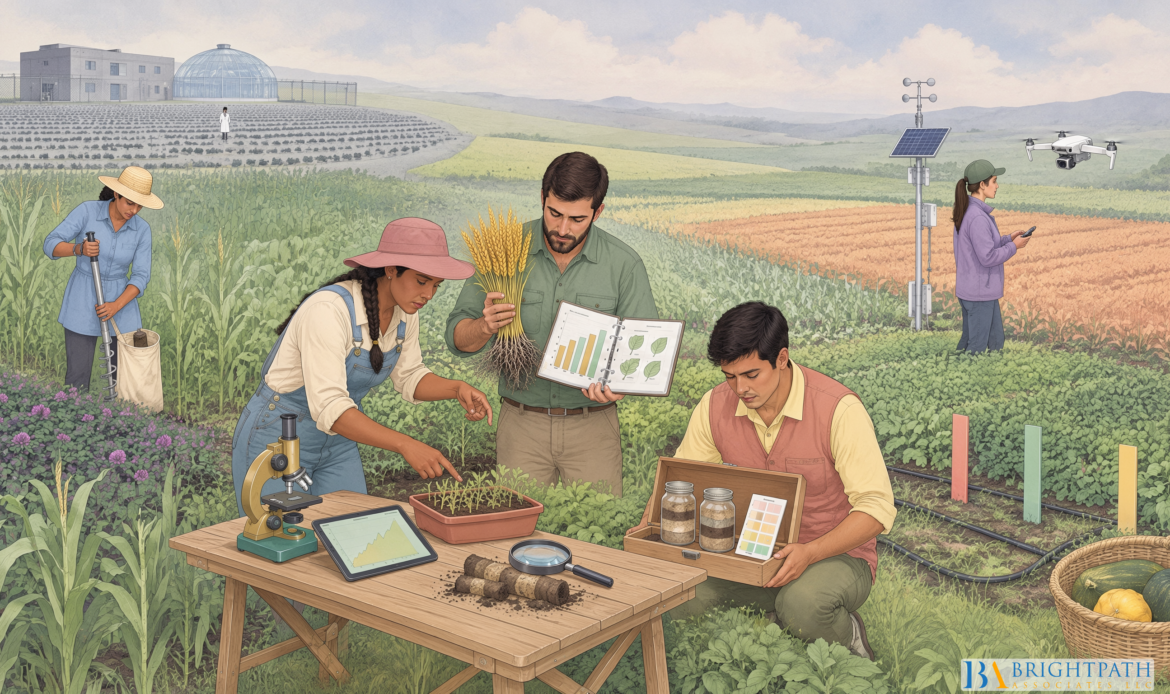
Farm authority is shifting because the #FarmingIndustry needs evidence that works in a real field, with real equipment, labor limits, weather pressure, input costs, and production risk. Redefining Farm Authority: Why Peer-Led Research Outperforms Institutional Trials for Farming Industry is not an argument against universities, Extension, or public research. It is an argument for giving farmers a larger role in deciding which questions deserve to be tested and how results should influence investment.
For executives in agricultural technology, food production, sustainable farming, precision agriculture, and farm management software, this distinction matters. A product can perform well in a controlled setting and still fail to fit a farm’s labor plan, cash flow, soil conditions, or operating system. The strongest evidence often comes from a hybrid model: farmers define the problem, trials occur in working fields, and research partners bring discipline to design and analysis.
Table Of Contents
• Why Farm Authority Is Being Redefined
• What Makes Peer-Led Evidence Credible
• How To Build Trials That Influence Decisions
• What This Means For Agricultural Leadership
• Key Takeaways
• Frequently Asked Questions
Why Farm Authority Is Being Redefined
The Question Is Not Who Has More Authority
Peer-led research means producers help identify a production problem, shape the trial, host the work, observe outcomes, and interpret what the evidence means for a farm business. Institutional trials usually take place at experiment stations or through formal research programs with greater control over variables, measurement, and protocols.
Neither approach is automatically superior. Experiment stations are often better suited to questions requiring tight controls, early-stage safety work, basic biology, or highly specialized equipment. On-farm trials are often better suited to questions about adoption: whether a nitrogen strategy, biological product, seed treatment, digital farming tool, or precision agriculture practice improves results under actual operating conditions.
The better question is: What decision must this evidence support? If a farm is deciding whether to change a practice across 3,000 acres, proof from a field managed under comparable constraints may carry more decision value than a result from a single controlled site.
USDA Agricultural Research Service work in Washington describes effective on-farm research as a process that connects farmer-prioritized challenges with testable hypotheses and executable designs. That is the crucial distinction between a useful producer question and a casual field observation. USDA ARS guidance on farmer-prioritized, testable research questions supports this shared-authority model.
Relevance Is A Form Of Rigor
#ControlledResearch reduces noise. That is valuable. Yet working farms introduce the conditions that determine whether an innovation can create value: variable soils, changing weather, machinery limitations, labor availability, field history, crop rotations, financing, and customer requirements.
Consider a soil-health product that shows a yield response in a tightly managed plot. A farm operator still needs answers the plot may not provide:
• Does the product work across different field zones?
• Can it be applied within the existing equipment schedule?
• Does it increase labor or recordkeeping burden?
• Does any yield gain exceed product, application, and financing costs?
• Does the result hold in a wet season, a dry season, or both?
This is why local relevance should not be dismissed as anecdotal. It becomes decision-grade evidence when the trial is designed to separate treatment effects from normal field variation.
The Nebraska On-Farm Research Network demonstrates this practical purpose. University of Nebraska–Lincoln Extension reports that producer-driven work can use replicated strips to examine local agronomic questions while adding yield and economic findings to a broader database. Nebraska’s on-farm research and economic-analysis approach shows how a local field can contribute to regional learning rather than remain an isolated result.
Distributed Replication Changes The Value Of A Trial
One farm is a case study. Many farms using a common protocol can become a research network.
Distributed replication means repeating a treatment across farms, locations, management systems, and ideally years. It does not eliminate variation. It uses variation to reveal when and where a practice works. That matters because treatment-by-environment interaction is common in agriculture: a practice may be profitable on lighter soils, neutral on heavier soils, or helpful only under a particular moisture pattern.
A Midwest participatory maize-breeding study illustrates the point. Between 2018 and 2021, farmer collaborators evaluated maize hybrids across Illinois, Indiana, and Wisconsin. The participatory maize-breeding evaluation across three Midwest states did more than collect farmer feedback. It expanded the environmental range in which hybrid performance could be assessed.
For agricultural innovation leaders, that is a different standard of proof. The goal is not simply an average result. It is an honest explanation of where the result appears dependable, where it does not, and what farm conditions may explain the difference.
What Makes Peer-Led Evidence Credible
Farmer-Led Does Not Mean Informal
A #PeerNetwork can create credible evidence, but trust alone is not enough. Farmers may reasonably trust another producer who faces similar conditions. That peer credibility can speed adoption. It can also create confirmation bias if only favorable results circulate or if a respected local operator’s outcome is treated as universal proof.
The safeguard is a minimum validity protocol. Before a result influences a major purchasing, production, or sustainable agriculture investment decision, the study should include the following elements:
| Validity Element | What It Requires | Why It Matters |
|---|---|---|
| Clear treatment definition | Exact product, rate, timing, equipment setting, and management practice | Prevents vague comparisons |
| Randomization | Treatments assigned by chance within a field where feasible | Reduces systematic placement bias |
| Replication | Repeated treatment strips or plots | Helps distinguish a true effect from field variability |
| Consistent measurement | Defined yield, quality, soil, labor, and cost measures | Makes results comparable |
| Prespecified analysis | Agreement on how outcomes will be calculated before results are known | Limits selective interpretation |
| Complete reporting | Positive, negative, and inconclusive outcomes retained | Reduces publication bias |
Fair warning: no universal rule defines the correct number of farms, strips, or years for every crop and question. A comparison between two nitrogen rates in a uniform irrigated field may be workable with several randomized strips in one season. A claim that a biological product improves resilience across a region needs more farms and more years because weather and soil differences are part of the question.
Economics Must Sit Beside Yield
Yield is a measurement, not a business case. Farm leaders should ask for a partial-budget analysis that compares added returns, reduced returns, added costs, and saved costs.
For example, a cover-crop approach may reduce erosion risk or improve a soil-health indicator but also add seed, fuel, labor, termination costs, and possible planting delays. A trial that reports only yield cannot tell an executive whether the practice improves operating margin or merely changes agronomy.
This applies equally to farm management software and digital farming tools. An analytics platform may identify field variability, but its economic value depends on whether staff can act on the recommendation. If implementing variable-rate decisions requires new data workflows, training, equipment compatibility, and extra seasonal labor, those costs belong in the evaluation.
Dairy operators face similar tradeoffs. Better production data can improve decisions, but only if the workflow fits the business. BrightPath Associates has discussed enhancing efficiency in dairy farm operations in the context of aligning operational improvements with daily farm realities. Peer-led evaluation gives those realities a formal place in the evidence.
Researchers Still Have An Essential Role
Peer-led research outperforms institution-only research when the question is primarily about real-world fit. It does not replace institutional expertise.
Researchers, statisticians, Extension professionals, and data specialists help define treatments, build randomization plans, select outcome measures, analyze results, and explain uncertainty. Farmers contribute operational knowledge: which question matters, what can realistically be tested, and which outcomes affect the business.
A 2026 USDA-linked publication on on-farm research notes that farmer-led trials can be statistically rigorous when they are collaboratively designed and repeated across farms and time. USDA ARS recommendations for rigorous collaborative on-farm trials supports the conclusion that the strongest model is shared authority, not a contest for control.
How To Build Trials That Influence Decisions
Start With A Decision, Not A Product
The weak starting point is, “Will this product work?” The stronger starting point is, “Will changing this practice improve profit, reliability, labor use, or #RiskManagement enough to justify adoption?”
A disciplined trial begins with a specific decision and a measurable hypothesis. For example: Will applying a biological treatment at the planned timing increase net return per acre compared with the current program under this farm’s conditions?
That formulation identifies the treatment, comparison, economic outcome, and operational boundary. It also makes it easier to determine when not to run a trial. If a product has unresolved regulatory, safety, or compatibility questions, controlled institutional testing should come first. A working farm should not be the first place where basic safeguards are settled.
Use A Practical Trial Workflow
- Define the decision and comparison. Specify the current practice, proposed practice, success threshold, and implementation constraint.
- Choose the unit of comparison. This may be a strip, field zone, herd group, irrigation set, or production block. The unit must match how the operation can manage treatments.
- Randomize and replicate. Alternate or randomly assign treatments in multiple comparable strips when possible. Avoid placing every treatment area on one side of the field.
- Record context. Capture planting date, crop history, soil type or zone, weather events, input rates, machinery, labor, deviations, and measurement method.
- Measure agronomic and business outcomes. Yield, quality, mortality, feed efficiency, water use, labor hours, input cost, and revenue can all matter depending on the question.
- Analyze before telling the story. Review average outcomes, variability, and partial-budget results. Do not promote a result until the data and exceptions are visible.
- Publish the full outcome. Report success, failure, and uncertainty. A negative result can prevent expensive mistakes.
Data Provenance Determines Whether Learning Scales
Data provenance means documenting where data came from and how it was collected. It sounds technical, but it decides whether multiple farm results can be combined responsibly.
If one farm reports cleaned yield-monitor data, another reports scale tickets, and a third records estimates from a combine display, those results may not be comparable without clear metadata. The same issue applies to soil sampling depth, sensor calibration, field boundaries, weather stations, and labor estimates.
Leaders in agricultural technology should treat metadata as part of product validation. A dashboard that aggregates numbers without showing measurement methods can produce false confidence. A simpler dataset with clear provenance may be more useful for decision-making.
USDA’s National Proving Grounds Network reflects this direction. Its model calls for a structured process that includes technology intake, readiness review, standardized field testing, and performance evaluation under diverse U.S. production conditions. USDA’s structured approach to agricultural technology evaluation reinforces the need to combine real farm settings with transparent evaluation standards.
What This Means For Agricultural Leadership
Authority Is Becoming A Cross-Functional Capability
The leadership challenge is not simply finding an agronomist, engineer, or operations manager. It is finding leaders who can connect science, farm economics, product development, data governance, and grower trust.
A chief operating officer at an agricultural technology company may need to decide whether a pilot program is creating meaningful evidence or merely collecting testimonials. A commercial leader must understand that peer credibility is valuable only if claims survive review. A farm enterprise leader may need to translate trial data into capital priorities, labor plans, and risk decisions.
These are #SpecializedRequirements. They can complicate executive hiring because candidates may have deep expertise in only one part of the system: research, crop production, software, commercial strategy, or regulatory affairs. The role definition should make the tradeoff explicit rather than assuming one executive will excel in every domain.
Prolonged Vacancies Can Slow Evidence-Based Growth
When a senior role remains open, trial governance can become fragmented. Product teams may move ahead without field validation. Agronomy teams may gather useful data without a commercial path. Operations may adopt tools without a clear owner for training, data quality, or return-on-investment review.
This does not prove that every company needs external executive search support. It does suggest that specialized searches require a more precise process than broad recruiting alone. Employers should define the evidence responsibilities attached to the role before beginning outreach.
For example, a vice president of product may need to establish farmer advisory structures, create multi-site validation standards, and decide how negative results are communicated. That is different from a conventional product-management mandate.
Workforce constraints also shape which innovations can be adopted. For farm businesses evaluating new practices, solutions for the modern farm workforce can provide useful context for assessing whether a research-backed practice is operationally realistic.
What Executives Should Change Now
Executives do not need to choose between farmer knowledge and institutional research. They need an evidence portfolio matched to risk.
| Decision Type | Best Starting Point | Reason |
|---|---|---|
| Basic safety, efficacy, or biological mechanism | Institutional trial | High control and specialized methods matter most |
| Field-practice adaptation | On-farm replicated trial | Local soils, equipment, and labor affect performance |
| Technology investment across regions | Distributed farmer network with standardized analysis | Reveals performance across diverse environments |
| Major enterprise rollout | Hybrid approach | Requires controlled evidence, local validation, and economic review |
For dairy and diversified food-production businesses, profit analysis should remain visible throughout the process. Discussions of actionable solutions for dairy farm profitability are most useful when they are tied to measured labor, input, production, and margin effects rather than broad claims about efficiency.
The practical implication for executive teams is straightforward: assign ownership for trial design, data quality, farmer participation, and economic interpretation. If no leader owns those handoffs, a promising pilot can become a collection of incompatible observations.
Key Takeaways
The Strongest Authority Is Shared And Testable
• Peer-led research is most valuable when a farm needs evidence about real operating conditions, not only controlled performance.
• Institutional trials remain essential for questions involving safety, basic mechanisms, early validation, and tightly controlled comparisons.
• Distributed replication across farms and years reveals whether a result holds across different soils, climates, and management systems.
• Yield alone is insufficient. Partial-budget analysis should show added costs, saved costs, added returns, reduced returns, labor effects, and risk.
• Strong data provenance allows local observations to become reusable evidence for agricultural innovation and sustainable farming decisions.
• Leadership teams should define who owns trial governance before investing heavily in a new practice, product, or digital farming platform.
Frequently Asked Questions
What Is Farmer-Led Or Peer-Led Agricultural Research?
It is research in which farmers help set priorities, host trials, observe outcomes, and interpret results. It becomes credible research when it uses a defined comparison, replication, consistent measurement, and #TransparentAnalysis.
Does Peer-Led Research Actually Outperform Institutional Trials?
Not universally. Peer-led research can outperform institution-only trials for questions about local fit, operating practicality, labor demands, and farm economics. Institutional trials usually remain stronger for highly controlled scientific questions. The best approach is often a hybrid model.
What Makes An On-Farm Trial Statistically Credible?
At minimum, the trial should have a clear treatment, a valid comparison, randomization where feasible, replication, consistent measurements, and a defined analysis plan. Reporting results from multiple farms or seasons improves confidence, especially when conditions vary.
How Many Farms Or Years Are Needed?
There is no universal number. The greater the expected field variability and financial risk, the more replication is needed. A farm can begin with replicated strips in one season, but a broad #RegionalRecommendation should usually rely on repeated results across sites and years.
Should Treatments Be Randomized Within Each Field?
Usually, yes. Randomization reduces the chance that one treatment benefits from being placed in a naturally stronger area of the field. When randomization is operationally impossible, the limitation should be documented and conclusions should be more cautious.
What Should Be Recorded Besides Yield?
Record treatment details, timing, field history, weather events, soil conditions, equipment settings, labor hours, input costs, crop quality, protocol deviations, and how each measure was collected. These details explain why results may differ between farms.
Can Peer-Led Trials Evaluate Biologicals, Fertilizers, Seed, Or Farm Technology?
Yes, provided the question is appropriate for on-farm testing and the trial is designed safely and consistently. Products with unresolved safety, legal, or basic efficacy questions should undergo controlled evaluation before broad #FarmTesting.
How Should Farms Report Negative Or Inconclusive Results?
They should publish them with the same discipline used for positive findings. A result may be negative because the treatment did not work, because conditions limited the test, or because the effect was too variable to identify. Each outcome can prevent costly overconfidence.
Resources And Citations
• USDA Agricultural Research Service + Practical recommendations for researchers engaging in on-farm research
https://www.ars.usda.gov/ARSUserFiles/30123025/Publications/2026/Rodgers%20etal%202026_AgronJournal_Recommendations%20for%20researchers%20engaging%20in%20on-farm%20research.pdf
• USDA + National Proving Grounds Network for AgTech
https://www.usda.gov/agtech
• University of Nebraska–Lincoln Extension + Nebraska Soil Health Testing: Opportunities, Programs and Field Learning
https://cropwatch.unl.edu/nebraska-soil-health-testing-opportunities-programs-and-field-learning/
• Food Systems Journal + Participatory breeding in organic systems: Experiences from maize case studies in the United States
https://www.foodsystemsjournal.org/index.php/fsj/article/download/1228/1193/2509
• USDA Agricultural Research Service + Northwest Sustainable Agroecosystems Research: Pullman, WA
https://www.ars.usda.gov/research/project/?accnNo=443240
BrightPath Associates — Sustainable Ag-Tech Reshapes Agricultural Lending: https://brightpathassociates.com/sustainable-ag-tech-reshapes-agricultural-lending/