
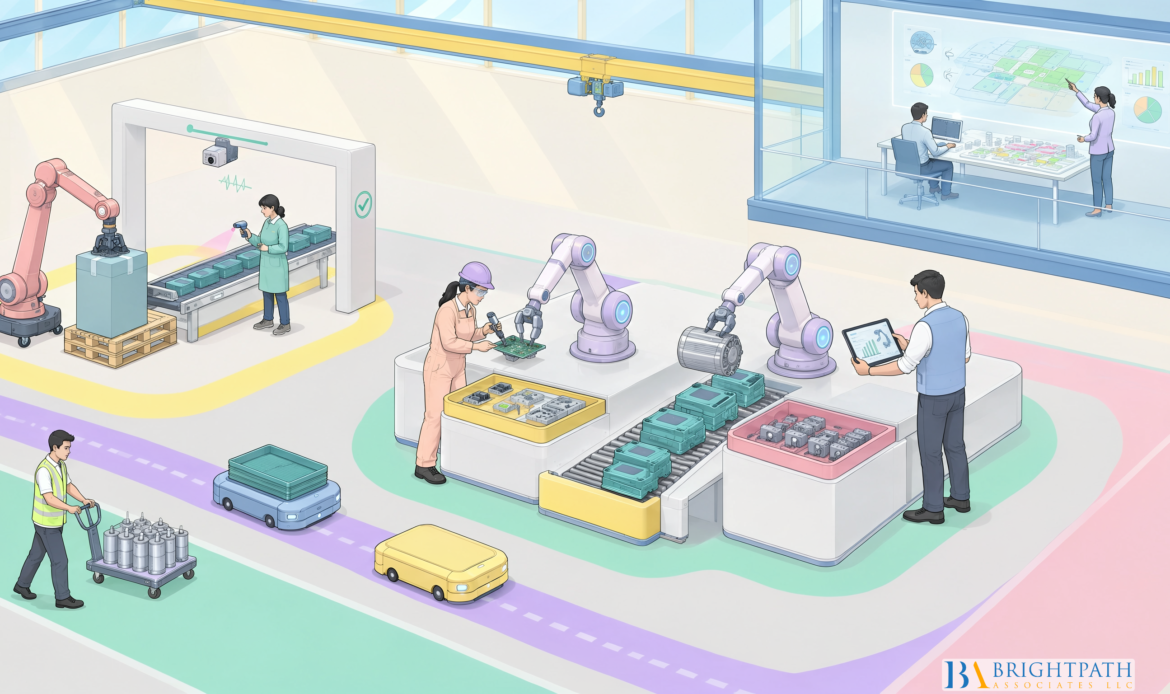
[Bethany, Connecticut – 26 October 2026] – BrightPath Associates highlights the growing importance of factory layout optimization as US machinery manufacturers adopt collaborative robotics to improve production performance, workplace safety, and manufacturing efficiency. As manufacturers face rising operating costs, changing customer demands, and pressure to increase output, integrating collaborative robots into existing production environments requires careful planning. By aligning equipment placement, employee workflows, material movement, and industrial automation solutions, manufacturers can create more flexible facilities that support long-term business growth.
For C-suite executives in the machinery industry, robotics integration is not simply a technology investment. It is an operational decision that can influence productivity, workforce requirements, equipment utilization, and future expansion. Factory layouts designed around traditional production methods may not accommodate collaborative robots effectively without adjustments to workstations, safety zones, production lines, and material-handling systems. BrightPath Associates examines how manufacturers can approach these changes strategically to achieve better results from automation investments.
Optimizing Factory Layouts for Collaborative Robotics Integration
Collaborative robots, commonly known as cobots, are designed to work alongside people in suitable applications. Unlike conventional industrial robots that often operate within dedicated safety enclosures, cobots can support tasks such as machine tending, component handling, assembly, inspection, and repetitive production activities when the application and risk assessment permit collaborative operation.
However, successful implementation depends on more than installing robotic equipment. Manufacturers must evaluate workstation dimensions, robot reach, operator access, material supply routes, and the movement of finished products. A poorly planned layout can create bottlenecks, increase unnecessary movement, and limit the productivity gains expected from automation. Reviewing these factors before installation helps businesses identify potential constraints and establish more efficient production workflows.
The article, Optimizing Factory Layouts for Collaborative Robotics Integration, explores the importance of coordinating factory design with collaborative robotics. Its central business implication is clear: manufacturers should evaluate automation as part of an integrated production strategy rather than treating robots as standalone equipment.
Balancing Safety, Maintenance, and Investment
Workplace safety must remain central to every collaborative robotics project. Although cobots are designed for applications involving interaction with people, they are not automatically safe in every environment. Manufacturers must conduct application-specific risk assessments and consider robot speed, payload, tooling, pinch points, surrounding machinery, and employee movement. Appropriate safeguards, training, and operating procedures are essential for safe integration.
Machinery maintenance also becomes increasingly important as factories connect robots with production equipment and digital control systems. Regular inspections, software updates, sensor calibration, and preventive maintenance can help reduce unexpected interruptions. Connecting maintenance planning with production schedules allows management teams to identify potential issues before they affect delivery commitments or product quality.
Financial planning is equally important. Machinery financing may help businesses manage the cost of acquiring cobots, upgrading existing equipment, and modifying production layouts. Used machinery may also provide opportunities for cost-conscious manufacturers, provided that compatibility, equipment condition, safety requirements, and integration costs are carefully evaluated. Executives should compare the total investment with expected benefits, including improved throughput, reduced manual handling, better equipment utilization, and lower operating costs.
Developing the Workforce for an Automated Manufacturing Future
Collaborative robotics changes how employees interact with industrial machinery, making workforce planning an important part of implementation. Manufacturing jobs increasingly require a combination of practical equipment knowledge, digital skills, troubleshooting ability, and familiarity with automated production systems. Training existing employees can help organizations build these capabilities while supporting a smoother transition to new operating methods.
Leadership teams must also ensure that automation projects have clear ownership and measurable objectives. Operations managers, engineering teams, maintenance specialists, safety professionals, and human resources leaders should work together to establish implementation priorities. Regular performance reviews can help determine whether the new layout is improving production flow, reducing downtime, and meeting business targets.
As demand for industrial automation solutions grows, executive search recruitment can help manufacturers identify leaders who understand both manufacturing operations and technology-driven transformation. The broader Machinery Industry will benefit from leadership that connects automation investments with workforce development, operational resilience, and sustainable growth.
About BrightPath Associates
BrightPath Associates is an executive search and recruitment firm that helps organizations identify leadership and specialized talent across multiple industries. The company supports businesses in addressing workforce challenges, strengthening leadership teams, and aligning recruitment strategies with long-term organizational goals. Through its industry-focused recruitment approach, BrightPath Associates aims to connect companies with professionals who can support innovation, operational excellence, and business growth.
Media Contact:
Name: Corporate Communications Team
Company: BrightPath Associates
Email: media@brightpathassociates.com
Website: https://brightpathassociates.com