
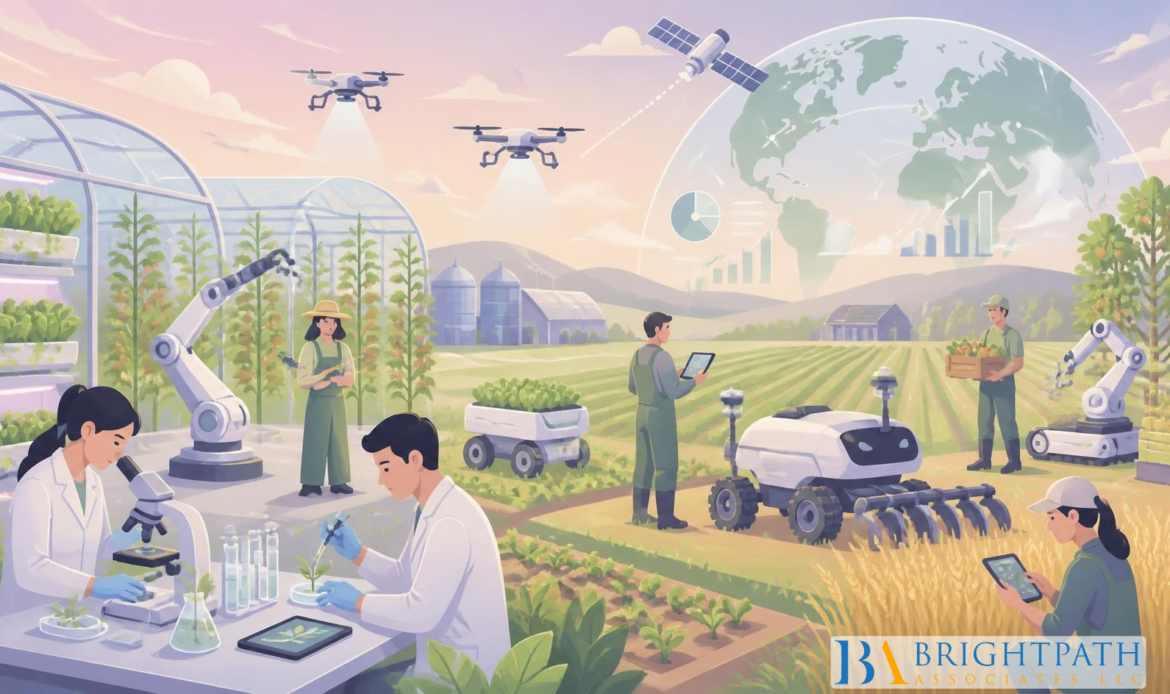
[Bethany, Connecticut – 07 October 2026] – BrightPath Associates is highlighting the emergence of Farming 5.0, a new approach to agricultural development that brings together biotechnology, robotics, digital technologies, and global macroeconomic trends. The latest industry analysis explores how these technologies can help agricultural leaders improve productivity, strengthen Food production, respond to changing economic conditions, and build more resilient and Sustainable farming operations.
Agriculture is undergoing a major transformation as producers face increasing pressure from climate change, resource constraints, labor challenges, changing consumer expectations, and global market volatility. Farming 5.0 moves beyond individual technologies by connecting multiple innovations into a broader operating model. For C-suite leaders, this creates an opportunity to rethink how investments in Agricultural technology can support long-term growth while maintaining Agricultural sustainability.
Farming 5.0 Connects Technology With Business Strategy
The latest BrightPath analysis explains that Farming 5.0 represents a shift toward a more connected and technology-driven agricultural ecosystem. Biotechnology can support improved crop characteristics and biological solutions, while robotics can automate labor-intensive activities such as planting, harvesting, monitoring, and crop maintenance. Together with data analytics and connected systems, these technologies can improve decision-making throughout the agricultural value chain.
The analysis describes Farming 5.0 as an approach that “synthesizes biotechnology, robotics, and global macroeconomics.” This combination is important because agricultural technology cannot be evaluated only from a technical perspective. Commodity prices, trade policies, interest rates, labor availability, energy costs, consumer demand, and climate conditions can all influence whether a technology investment delivers meaningful business value.
Executives can explore the full analysis on Farming 5.0: Synthesizing Biotechnology and Robotics for Modern Agriculture to understand how these forces are converging and creating new opportunities across the agricultural sector.
Precision Agriculture Supports Smarter Production
One of the most important elements of this transformation is Precision agriculture. Sensors, satellite imagery, drones, connected equipment, artificial intelligence, and data analytics allow producers to collect more detailed information about soil conditions, crop health, water usage, and field performance. This information can help farmers make more targeted decisions instead of applying the same treatment across an entire operation.
Digital Farming also gives agricultural leaders greater visibility into daily operations. Farm management software can bring together information related to equipment, field activities, inventory, labor, weather, crop performance, and financial planning. When these systems are connected effectively, executives can use real-time information to identify inefficiencies and improve resource allocation.
For the wider Farming Industry, these capabilities can support more efficient production while helping organizations respond to increasing expectations around traceability, resource management, and sustainability. Technology therefore becomes not only an operational tool but also a strategic asset.
Sustainability Becomes a Strategic Investment
Sustainable farming is becoming increasingly important as agricultural businesses seek to balance productivity with responsible resource use. Technologies that improve irrigation efficiency, reduce chemical inputs, monitor soil health, optimize fertilizer application, or automate field operations can contribute to more sustainable production models.
The same principle applies to Organic farming, where producers face strict production requirements and growing consumer demand for transparency. Digital tools can support monitoring, documentation, traceability, and operational planning. While technology alone cannot guarantee sustainability, it can provide agricultural businesses with better information for measuring and improving their environmental performance.
For C-suite executives, this creates a stronger case for Sustainable agriculture investment. Instead of viewing sustainability as a separate initiative, organizations can integrate environmental objectives into technology planning, capital allocation, and long-term business strategy. Agricultural innovation can then support both operational performance and broader sustainability goals.
About BrightPath Associates
BrightPath Associates is an executive recruitment and talent solutions firm helping organizations identify leadership and specialized professionals across industries in the United States. The company supports businesses with strategic talent acquisition and Executive search recruitment, connecting organizations with professionals who can contribute to growth, innovation, and long-term performance. BrightPath Associates is committed to helping companies build stronger teams and make more effective hiring decisions.
Media Contact:
Name: Corporate Communications Team
Company: BrightPath Associates
Email: media@brightpathassociates.com
Website: https://brightpathassociates.com