
Introduction
#AgricultureIndustry is entering a new phase of transformation. Farming has evolved from traditional, labor-intensive production toward mechanized agriculture, data-driven precision systems, and increasingly automated operations. The next stage, often described as Farming 5.0, brings together biotechnology, robotics, artificial intelligence, digital platforms, advanced analytics, and global economic intelligence.
This transformation is occurring against a complex global backdrop. Farmers and agricultural businesses must respond to climate variability, changing consumer expectations, labor shortages, volatile commodity prices, supply chain disruptions, resource constraints, and growing demand for food. At the same time, technological advances are creating new ways to improve productivity and resource efficiency. Modern Agricultural Technology is therefore becoming an important component of long-term agricultural competitiveness.
Farming 5.0 is not simply about replacing human labor with machines. It is about integrating biological knowledge, automation, data, and economic decision-making into a more connected agricultural ecosystem.
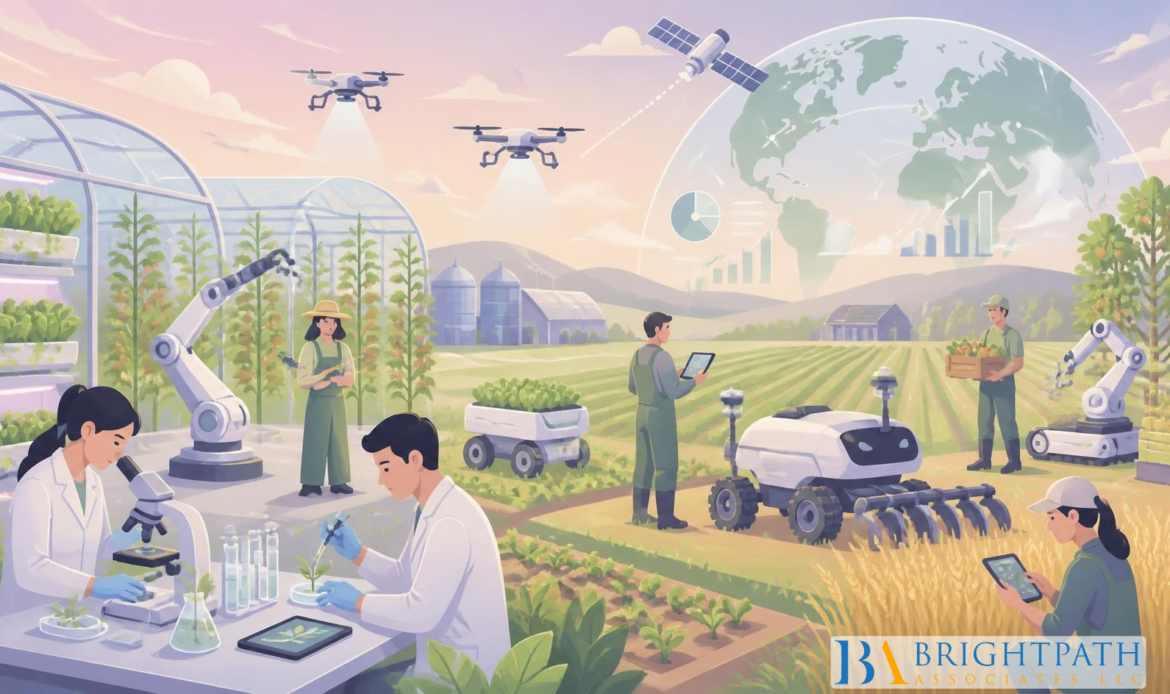
Farming 5.0 represents a convergence of several technological and operational developments. Biotechnology can improve crop genetics, disease resistance, and resource efficiency. Robotics can automate repetitive and precision-sensitive activities. Artificial intelligence can analyze enormous volumes of agricultural data. Digital platforms can connect farmers with suppliers, customers, financial institutions, and logistics providers.
The objective is to create agricultural systems that can make better decisions with fewer resources. Instead of treating fields as uniform production environments, modern systems can analyze differences in soil, moisture, crop health, weather conditions, and yield potential.
This shift is influencing the future of #FoodProduction, where efficiency and resilience are becoming equally important.
Biotechnology and the Future of Crop Productivity
Biotechnology is one of the most significant components of Farming 5.0. Advances in genetics, molecular biology, biological inputs, and crop science are helping researchers develop agricultural solutions designed for changing environmental conditions.
Biotechnology can contribute to crops with improved resistance to pests, diseases, drought, and other stresses. It can also support the development of crops with improved nutritional characteristics or enhanced resource efficiency.
However, technological development must be accompanied by responsible management. Farmers, regulators, researchers, and consumers need transparent information about how new biological technologies are developed and deployed.
The integration of biotechnology with #SustainableFarming can potentially increase productivity while reducing pressure on land, water, and chemical inputs.
Agricultural robotics is moving beyond experimental projects and becoming increasingly relevant to commercial farming. Autonomous tractors, robotic harvesters, automated irrigation systems, crop-monitoring drones, and robotic weed-control technologies are changing how agricultural tasks can be performed.
Robotics can be particularly valuable where agricultural businesses face labor shortages or rising labor costs. Machines can perform repetitive tasks consistently while collecting data about field conditions.
The objective is not necessarily complete automation. Human workers will continue to make important decisions, particularly where judgment and adaptability are required. Instead, robotics can augment human capabilities and allow agricultural professionals to focus on higher-value activities.
The development of #AgriculturalRobotics is therefore becoming closely connected to productivity, labor management, and operational efficiency.
Precision Agriculture and Data-Driven Decisions
Precision agriculture uses data and technology to manage agricultural resources more precisely. Sensors, satellite imagery, drones, GPS systems, weather platforms, and connected machinery can provide detailed information about field conditions.
Farmers can use this information to determine where crops require irrigation, fertilizer, pest management, or other interventions. Instead of applying identical inputs across an entire field, resources can be targeted according to actual requirements.
This can reduce unnecessary input use while potentially improving yields. The value of #PrecisionAgriculture comes from turning large volumes of field data into practical decisions that farmers can implement.
As technology becomes more affordable and accessible, precision systems are likely to become increasingly relevant to farms of different sizes.
Digital Farming extends the concept of precision agriculture by connecting agricultural operations through integrated digital platforms. Farm equipment, sensors, financial systems, weather information, supply chain platforms, and farm management applications can increasingly communicate with each other.
This creates a more connected agricultural ecosystem. Farmers can monitor operations remotely, track input usage, analyze production costs, and make decisions based on real-time information.
Digital platforms can also improve communication between farmers and downstream businesses. Buyers can gain greater visibility into production conditions, while farmers can access more information about market demand.
The expansion of #DigitalFarming is therefore changing agriculture from an asset-focused industry into an increasingly data-driven business environment.
The Role of Farm Management Software
Farm management software is becoming an important digital foundation for modern agricultural operations. These platforms can help organizations manage planting schedules, crop performance, inventory, labor, equipment, field activities, financial information, and compliance requirements.
As farms become more complex, manual recordkeeping can make it difficult to understand operational performance. Digital systems can bring information together and make it easier to identify inefficiencies.
Farm management software can also support long-term planning by allowing businesses to compare historical performance and identify recurring patterns.
The evolution of #FarmManagement technology is particularly important as agricultural businesses expand and adopt increasingly sophisticated production systems.
Sustainability is central to Farming 5.0 because agriculture depends directly on natural resources. Soil health, water availability, biodiversity, energy use, and climate conditions all influence long-term productivity.
Technology can help farmers improve resource efficiency, but sustainability requires more than technology alone. Agricultural businesses must consider soil management, crop diversity, water conservation, responsible input use, and ecosystem health.
Modern approaches to #SustainableFarming increasingly combine traditional agricultural knowledge with digital tools and scientific research.
The objective is to create production systems capable of maintaining productivity while preserving the resources required for future generations.
Organic Farming in a Technology-Driven Era
Organic farming and advanced agricultural technology are sometimes presented as opposing approaches, but they can increasingly complement each other. Digital monitoring, robotics, remote sensing, and data analytics can support organic production by improving crop monitoring and resource management.
For example, precision systems can help farmers identify areas requiring attention without automatically relying on broad field-wide interventions. Robotics can potentially assist with mechanical weed management, while sensors can improve irrigation efficiency.
Technology can therefore support the operational objectives of #OrganicFarming while maintaining the principles that distinguish organic production.
The combination of biological agricultural practices and digital monitoring may create new opportunities for efficient and transparent organic production.
Agricultural innovation is no longer limited to machinery manufacturers or seed companies. Technology companies, biotechnology firms, software developers, robotics businesses, financial institutions, logistics providers, and food companies are increasingly participating in the agricultural ecosystem.
This convergence is creating new business models. Farmers may access technology through subscription services rather than purchasing equipment outright. Data platforms can connect producers with buyers and financial providers. Robotics-as-a-service models can reduce the upfront investment required for automation.
The broader #AgriculturalInnovation ecosystem is therefore becoming more diverse and interconnected.
The Economics Behind Farming 5.0
Technology adoption is ultimately influenced by economics. Farmers must determine whether an investment can produce sufficient value through higher yields, lower costs, reduced risk, improved resource efficiency, or better market access.
Global macroeconomic conditions can influence these decisions. Interest rates, commodity prices, energy costs, currency fluctuations, trade policies, and supply chain disruptions can all affect agricultural investment.
When economic uncertainty increases, farmers may delay major capital investments. Conversely, rising labor costs or resource constraints may accelerate investment in automation and precision technology.
Understanding #AgriculturalEconomics is therefore essential for technology companies and agricultural businesses seeking to scale Farming 5.0 solutions.
Sustainable agriculture investment is increasingly attracting attention from investors, financial institutions, food companies, and governments. Investments may focus on water efficiency, regenerative practices, renewable energy, biological inputs, precision technology, robotics, and climate-resilient production.
However, investors increasingly require evidence that sustainability initiatives can produce measurable outcomes. Technology can help provide that evidence by generating data about resource consumption, soil conditions, emissions, productivity, and operational efficiency.
The growth of #SustainableInvestment in agriculture can therefore accelerate technological development while encouraging greater accountability around environmental performance.
Global Macroeconomics and Agricultural Resilience
Agriculture is deeply connected to global macroeconomics. Commodity prices, international trade, energy markets, geopolitical developments, currency movements, and transportation costs can affect farmers and food producers across the world.
Farming 5.0 can help businesses become more resilient by improving visibility and responsiveness. Digital systems can provide better information about production conditions, while automation can reduce dependence on certain labor inputs.
However, technology cannot eliminate macroeconomic risk. Instead, it can provide agricultural businesses with better tools for identifying and responding to changing conditions.
A resilient #AgriculturalEconomy will require both technological capability and strong financial and strategic planning.
Climate change is increasing the importance of agricultural resilience. Changing rainfall patterns, extreme temperatures, droughts, floods, and new pest pressures can create significant production challenges.
Data-driven agriculture can help farmers monitor environmental conditions and respond more quickly. Biotechnology can contribute to the development of crops adapted to changing conditions, while precision irrigation can help conserve water.
Agricultural sustainability therefore increasingly depends on combining multiple technologies rather than relying on a single solution.
The future of #AgriculturalSustainability will likely involve an integrated approach connecting biological science, automation, data, resource management, and economic planning.
The Importance of Skilled Agricultural Leadership
Farming 5.0 requires a workforce capable of understanding both agricultural operations and advanced technologies. Traditional agricultural expertise remains essential, but organizations increasingly need professionals who can interpret data, manage automation, evaluate technology investments, and understand changing markets.
Leadership teams must also be able to manage the cultural changes associated with digital transformation. Employees need training, new workflows need to be established, and technology investments need to align with business objectives.
This creates a growing need for specialized talent across agriculture and technology.
#ExecutiveSearchRecruitment can play an important role as agricultural companies build leadership teams capable of navigating technological transformation. Organizations may require executives with experience in agribusiness, biotechnology, robotics, digital transformation, supply chain management, sustainability, or agricultural finance.
The most effective leaders will need to connect technological possibilities with practical agricultural realities. They must understand that farmers are not simply technology consumers; they are business operators making investment decisions based on risk, return, productivity, and long-term resilience.
Strong Executive Search strategies can help agricultural businesses identify leaders capable of managing this increasingly interdisciplinary environment.
The Future of Farming 5.0
Farming 5.0 is likely to become increasingly integrated rather than technology-specific. Biotechnology will interact with data analytics. Robotics will connect with farm management software. Precision agriculture will use artificial intelligence. Digital platforms will connect production with markets, finance, and logistics.
The most successful agricultural businesses will not necessarily be those that adopt the greatest number of technologies. Instead, they will be those that integrate the right technologies into practical workflows and measure their economic and environmental impact.
The future of #FarmingInnovation will depend on the ability to combine technological capability with agricultural knowledge, responsible investment, and strategic leadership.
Conclusion: Building a More Intelligent Agricultural Future
Farming 5.0 represents a major transformation in how agriculture can be managed, financed, and developed. Biotechnology can improve biological productivity, robotics can address labor and efficiency challenges, precision agriculture can optimize resource use, and digital platforms can connect agricultural operations with broader markets.
At the same time, global macroeconomic conditions will continue to influence investment decisions. Commodity prices, energy costs, trade policies, labor availability, and climate risks will determine how quickly new technologies are adopted.
With responsible investment, strong data infrastructure, skilled leadership, and effective Executive Search, Farming 5.0 can help agricultural organizations become more productive, resilient, sustainable, and competitive. The next generation of farming will not simply be about producing more food. It will be about producing food intelligently while managing resources, technology, economics, and environmental responsibility as interconnected parts of the same system.
Find your next leadership role in Farming Industry today!