
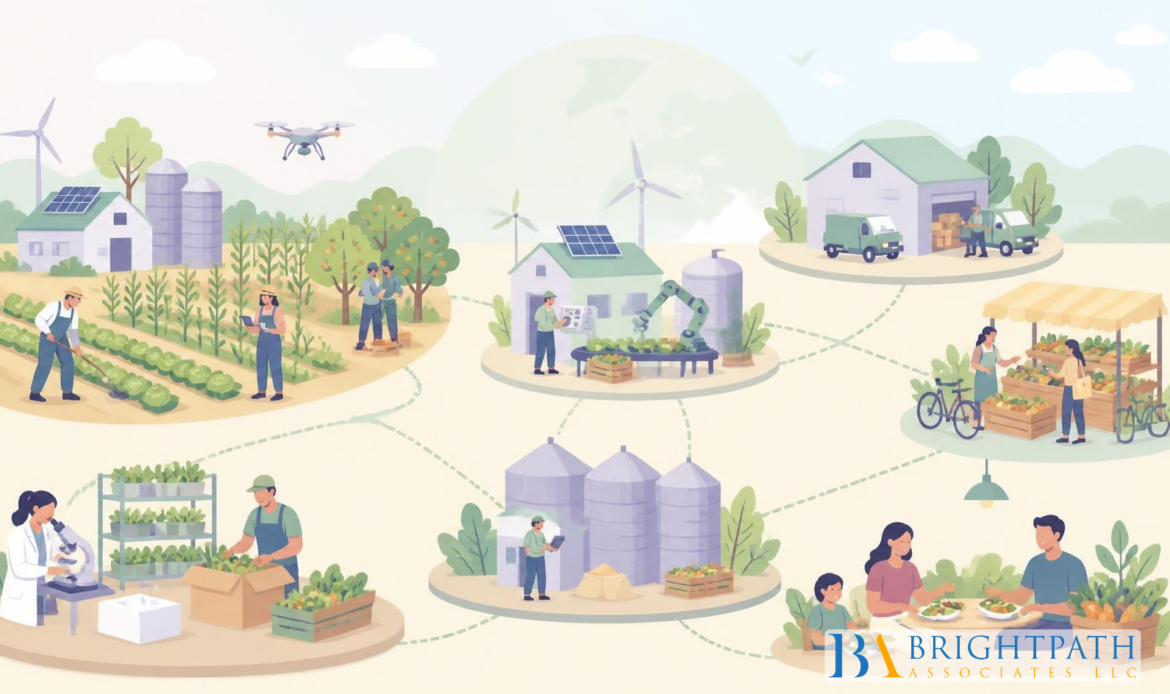
[Bethany, Connecticut – 02 October 2026] — BrightPath Associates has highlighted the growing importance of decentralized supply chains in strengthening food security and building more resilient agribusiness operations. The latest industry analysis examines how C-Suite leaders can combine regional sourcing, Agricultural Technology, Digital Farming, Precision Agriculture, and modern supply-chain infrastructure to reduce disruption risks while supporting sustainable growth. The approach responds to challenges including climate volatility, water scarcity, rising input costs, transportation disruptions, and changing consumer expectations.
Decentralized Supply Chains Reshape Food Production
Traditional agricultural supply chains have created important economies of scale through centralized production, processing, storage, and distribution. However, concentration can also create vulnerabilities when droughts, floods, disease outbreaks, labor shortages, infrastructure failures, or transportation disruptions affect a critical location. A disruption at one major hub can potentially affect producers, processors, distributors, and consumers across multiple markets.
BrightPath Associates’ analysis, “Future of Food Security: Why Agribusiness Needs Decentralized Supply Chain,” explains that a decentralized model can distribute production, processing, warehousing, and distribution capacity across multiple regions. As the article states, “Decentralization does not mean abandoning scale or efficiency.” Instead, it can create a more flexible operating structure capable of absorbing disruptions while maintaining continuity in Food production.
For executives, the opportunity is to create a balanced network rather than simply add more facilities. Regional farms, processing centers, warehouses, and distribution points can work alongside larger centralized facilities. This hybrid approach can help organizations maintain economies of scale while creating additional sourcing and logistics options.
Technology Enables a More Connected Agricultural Network
Agricultural technology is making decentralized operations more practical by connecting geographically dispersed farms and facilities. Sensors, satellite imagery, artificial intelligence, automation, cloud platforms, and Farm management software can provide executives with better visibility into crop conditions, production forecasts, inventory, transportation, and resource requirements.
Digital Farming can also support earlier responses to supply risks. Weather and production information can help procurement teams identify potential shortages and consider alternative sources before disruptions become severe. Precision agriculture further strengthens this model by using localized information about soil, irrigation, crop conditions, equipment, and inputs. These capabilities can improve productivity while supporting resource efficiency and Sustainable farming practices.
The strategy also creates opportunities for Organic farming and other production models within diversified regional networks. However, decentralization does not automatically guarantee sustainability. Multiple facilities can increase energy use and transportation complexity if they are poorly planned. For this reason, Agricultural sustainability requires thoughtful network design, efficient logistics, renewable energy integration, digital infrastructure, and appropriate technology investments.
Investment and Leadership Become Strategic Priorities
Building resilient food networks requires more than physical infrastructure. Sustainable agriculture investment increasingly needs to cover digital systems, precision agriculture, renewable energy, cold-chain capabilities, regional storage, automation, and workforce development. BrightPath Associates notes that executives should assess investments not only through immediate financial returns but also through their contribution to long-term resilience.
Leadership capability is equally important. Modern agricultural organizations increasingly require executives who understand operations, technology, sustainability, procurement, logistics, data analytics, and commercial strategy. Executive search recruitment can help agribusiness organizations identify leaders with these multidisciplinary capabilities and support the implementation of Agricultural innovation across increasingly connected supply networks.
Building the Future of Agricultural Resilience
The future of food security will depend not only on producing sufficient food but also on maintaining reliable production and distribution during disruption. Geographic diversification, regional processing, Digital Farming, Precision Agriculture, and connected data systems can provide agribusiness leaders with additional tools for managing uncertainty.
For C-Suite executives evaluating these priorities, the full analysis on Food Security Needs a Decentralized Supply Chain examines how technology, infrastructure, sustainability, and specialized leadership can work together to create more resilient food systems. Leaders can also explore industry-specific insights and workforce solutions for the Farming Industry as they evaluate future growth and talent requirements.
About BrightPath Associates
BrightPath Associates is an executive recruitment and talent solutions firm helping organizations identify specialized professionals and leadership talent to support sustainable business growth. The company works with businesses across multiple industries and provides solutions spanning workforce planning, leadership development, retention strategies, and recruitment. Its mission is to connect organizations with the right people while helping companies build stronger teams and achieve long-term growth.
Media Contact:
Name: Corporate Communications Team
Company: BrightPath Associates
Email: media@brightpathassociates.com
Website: https://brightpathassociates.com