
Introduction
#FoodSecurity is becoming one of the defining challenges for the global agribusiness sector. Population growth, climate volatility, water scarcity, geopolitical disruptions, changing consumer expectations, and rising input costs are placing increasing pressure on traditional food supply chains. For decades, agricultural systems have often relied on centralized models in which production, processing, storage, and distribution are concentrated in specific geographic regions. While these models can create economies of scale, they can also expose the food system to significant disruptions when a major production area, processing facility, transportation route, or distribution center is affected.
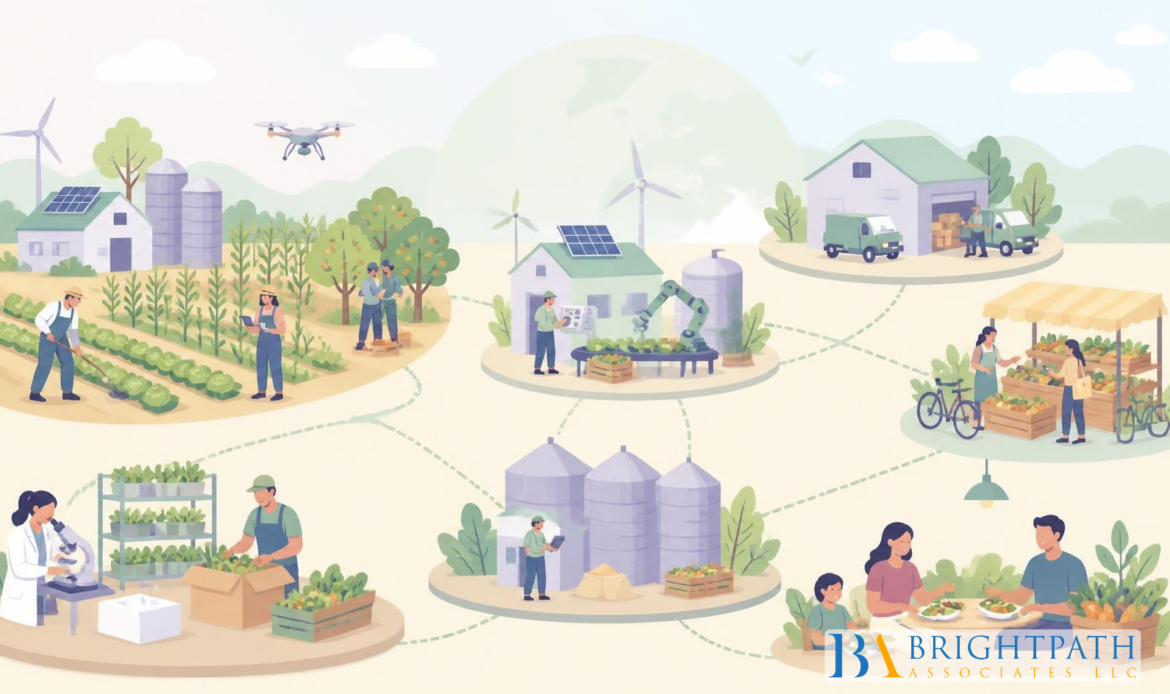
A decentralized supply chain offers a different approach. Instead of depending heavily on a limited number of large production and distribution hubs, agribusinesses can build interconnected networks of regional farms, processing facilities, warehouses, cold-storage centers, and distribution points. Supported by agricultural technology, digital connectivity, and data-driven management, these networks can improve resilience while supporting more responsive food production.
Decentralization does not mean abandoning scale or efficiency. Rather, it means creating a more distributed operating structure capable of absorbing disruptions and maintaining continuity. As agricultural innovation accelerates, decentralized supply chains are increasingly becoming an important component of long-term agricultural sustainability.
Traditional agricultural supply chains have generated considerable efficiencies. Large-scale production allows companies to standardize operations, consolidate purchasing, optimize transportation, and operate high-capacity processing facilities. However, concentration also creates points of vulnerability.
A drought affecting one major agricultural region can significantly reduce the availability of specific crops. Floods, extreme temperatures, disease outbreaks, labor shortages, or infrastructure failures can create similar consequences. Transportation disruptions can amplify these challenges when food and agricultural inputs must travel long distances before reaching consumers or processing facilities.
Centralized systems can therefore experience a multiplier effect. A single disruption at one critical location may affect producers, processors, distributors, retailers, and consumers across multiple markets. For agribusiness executives, this creates a strategic question: how can supply chains retain efficiency while reducing excessive dependence on individual locations?
Decentralized networks provide one potential answer by distributing production and logistics capacity across multiple geographic areas.
Decentralization and the Future of Food Production
The future of food production will increasingly depend on flexibility. Regional production networks can allow agribusinesses to source agricultural commodities from multiple locations rather than relying exclusively on one geographic cluster.
For example, a #FoodManufacturer sourcing a particular crop from several agricultural regions may be better positioned to maintain operations when one region experiences a weather-related production decline. Local or regional processing facilities can further reduce dependence on distant infrastructure.
This model can also support shorter supply chains. When food moves fewer miles between producers, processors, distributors, and consumers, companies may gain greater visibility over inventory and transportation requirements. Shorter networks can also create opportunities for regional food economies and improve responsiveness to changing demand.
However, decentralization must be strategically designed. Establishing multiple facilities without sufficient demand, technology, workforce, or logistics infrastructure can increase costs. The objective should therefore be intelligent distribution rather than simple geographic expansion.
Modern agricultural technology is making decentralized supply chains more practical. Connected sensors, satellite imagery, artificial intelligence, automation, and cloud-based platforms can provide businesses with visibility across geographically dispersed operations.
Digital Farming systems can collect information about crop conditions, weather patterns, soil characteristics, irrigation requirements, equipment utilization, and production forecasts. When this information is integrated across multiple farms and facilities, agribusiness leaders can make more informed decisions about sourcing, inventory, transportation, and processing.
Farm management software is particularly important because decentralized operations require coordination. Managers need to understand what is being produced, where it is being produced, when it will be available, and what resources are required to move it through the supply chain.
Real-time data can also help companies identify potential disruptions earlier. If weather information indicates that a particular production region is likely to experience severe conditions, procurement teams can evaluate alternative sources before supply becomes constrained.
Precision Agriculture and Regional Resilience
Precision agriculture can strengthen decentralized food systems by improving productivity at the farm level. Technologies such as GPS-guided equipment, remote sensing, soil monitoring, variable-rate application systems, and predictive analytics allow farmers to make decisions based on highly localized conditions.
This matters because decentralized systems depend on the productivity and reliability of multiple smaller or regional production units. Improving the efficiency of each unit can help compensate for the absence of massive centralized production facilities.
Precision agriculture can also support resource conservation. Farmers can use data to optimize irrigation, fertilizer, crop protection, and energy consumption. Better resource utilization can reduce operating costs while supporting Sustainable farming practices.
As climate conditions become less predictable, the ability to manage agricultural inputs with greater precision will become increasingly important for both farm profitability and supply-chain resilience.
Decentralized supply chains can complement sustainable farming when regional production is planned around local environmental conditions. Instead of applying identical production strategies across different regions, businesses can work with farmers to develop approaches suited to local soils, climates, water availability, and crop requirements.
Organic farming can also play a role within diversified regional food systems. While organic production has specific certification, input, and market requirements, integrating different production models into a decentralized network can give businesses greater flexibility in responding to consumer demand.
Sustainable agriculture is ultimately about balancing productivity with long-term resource availability. Decentralization can support this objective when it encourages companies to evaluate where food is produced, how resources are used, how products are transported, and how agricultural waste is managed.
The model is not automatically sustainable, however. Multiple warehouses or processing facilities may increase energy use if they are poorly designed. Similarly, fragmented transportation networks can increase costs and emissions. Sustainability therefore depends on network design, technology adoption, renewable energy integration, and efficient logistics.
Agricultural Innovation and Local Processing Capacity
Processing represents another critical component of decentralized supply chains. Agricultural commodities frequently travel to centralized processing facilities before reaching food manufacturers or consumers. Developing regional processing capacity can shorten supply routes and create additional flexibility.
Modern processing technologies can enable smaller facilities to operate more efficiently than was historically possible. Automation, robotics, digital quality control, predictive maintenance, and connected production systems can help regional facilities achieve greater consistency.
Local processing can also reduce post-harvest losses. Perishable commodities can be processed closer to production areas instead of being transported long distances before entering the processing system.
For #AgriBusinesses, this creates an opportunity to rethink infrastructure investments. Rather than focusing exclusively on massive facilities, companies can evaluate hybrid networks that combine high-capacity plants with strategically located regional processing centers.
One of the biggest advantages of decentralized supply chains is the opportunity to create a highly connected agricultural ecosystem. Digital Farming platforms can connect farmers, suppliers, processors, logistics providers, distributors, and retailers through shared information systems.
Data visibility becomes particularly valuable when supply sources are geographically dispersed. Companies can monitor production forecasts, inventory levels, transportation schedules, storage capacity, and market demand through centralized digital dashboards.
Farm management software can provide information from individual farms, while enterprise systems can combine that information with procurement and logistics data. Artificial intelligence can then help identify patterns and potential bottlenecks.
This creates a transition from reactive supply-chain management toward predictive management. Instead of waiting for shortages to occur, businesses can identify emerging risks and adjust procurement, transportation, production, and inventory strategies in advance.
Investment Priorities for Agribusiness Leaders
Building decentralized networks requires significant investment, but the investment strategy should extend beyond physical infrastructure. Sustainable agriculture investment increasingly needs to include digital infrastructure, data capabilities, renewable energy, automation, cold-chain systems, regional storage, and workforce development.
Companies should evaluate investments according to both financial returns and resilience benefits. A regional warehouse may not always have the lowest immediate operating cost, but it could provide significant strategic value if it reduces dependence on a vulnerable distribution corridor.
Similarly, investments in precision agriculture may improve crop productivity while reducing water and fertilizer consumption. These combined benefits can strengthen both economic performance and agricultural sustainability.
The strongest investment strategies will therefore consider the entire agricultural ecosystem rather than evaluating individual assets in isolation.
Technology and infrastructure alone cannot create resilient decentralized supply chains. Agribusinesses also need executives and specialized professionals capable of managing increasingly complex networks.
Leadership roles in modern agriculture increasingly require knowledge spanning operations, technology, sustainability, procurement, logistics, data analytics, and commercial strategy. Traditional agricultural experience remains valuable, but organizations also need leaders who understand digital transformation and interconnected supply-chain systems.
#ExecutiveSearchRecruitment can help agribusiness companies identify senior professionals with these multidisciplinary capabilities. The right leadership team can determine how effectively a company integrates agricultural technology, develops regional sourcing strategies, manages risk, and implements sustainability initiatives.
As decentralized models become more sophisticated, talent strategy will become an increasingly important part of agricultural innovation.
Challenges of Decentralized Supply Chains
Despite their potential benefits, decentralized supply chains present challenges. Multiple production and processing locations can increase management complexity. Companies must coordinate quality standards, food safety procedures, procurement contracts, technology platforms, transportation networks, and regulatory requirements across different regions.
Capital requirements can also be significant. Building regional infrastructure may require investments in warehouses, cold storage, processing facilities, renewable energy, digital systems, and skilled personnel.
Data integration represents another challenge. If different farms and facilities use incompatible systems, organizations may struggle to achieve real-time visibility. Standardized data architecture and interoperable technology will therefore be essential.
There is also a balance between resilience and efficiency. Excessive decentralization could create unnecessary duplication of infrastructure. Agribusiness leaders must determine which activities should remain centralized and which should be distributed.
The future is unlikely to be entirely centralized or entirely decentralized. A hybrid model can combine the advantages of both approaches.
Large centralized facilities can continue to provide economies of scale for high-volume processing and manufacturing. At the same time, regional farms, storage facilities, processing centers, and distribution hubs can provide flexibility and redundancy.
Technology can connect these different layers into one coordinated network. Centralized analytics can provide strategic oversight, while regional teams can make operational decisions based on local conditions.
This hybrid approach allows agribusinesses to maintain efficiency while reducing dependence on individual points of failure. It also creates opportunities to adapt supply networks according to changing climate conditions, consumer demand, agricultural productivity, and market dynamics.
Conclusion
Food security in the coming decades will depend not only on producing more food but also on creating systems capable of maintaining production and distribution during disruption. Decentralized #SupplyChains provide agribusinesses with a framework for achieving greater resilience through geographic diversification, regional processing, digital connectivity, and flexible logistics.
Agricultural technology, precision agriculture, Digital Farming, and farm management software are making it possible to coordinate increasingly distributed agricultural networks. At the same time, sustainable farming, organic farming, and broader agricultural sustainability objectives are influencing how production systems are designed and managed.
For business leaders, the central challenge is to develop supply networks that balance efficiency, resilience, sustainability, and cost. This will require targeted sustainable agriculture investment, continuous agricultural innovation, and stronger leadership capabilities.
The agribusiness companies that successfully connect regional production with intelligent technology, efficient infrastructure, and specialized talent will be better positioned to navigate an increasingly complex food system. Decentralization is therefore not simply a logistics strategy. It is becoming an important component of the long-term architecture of resilient food production and global food security.
Find your next leadership role in Farming Industry today!