
Introduction
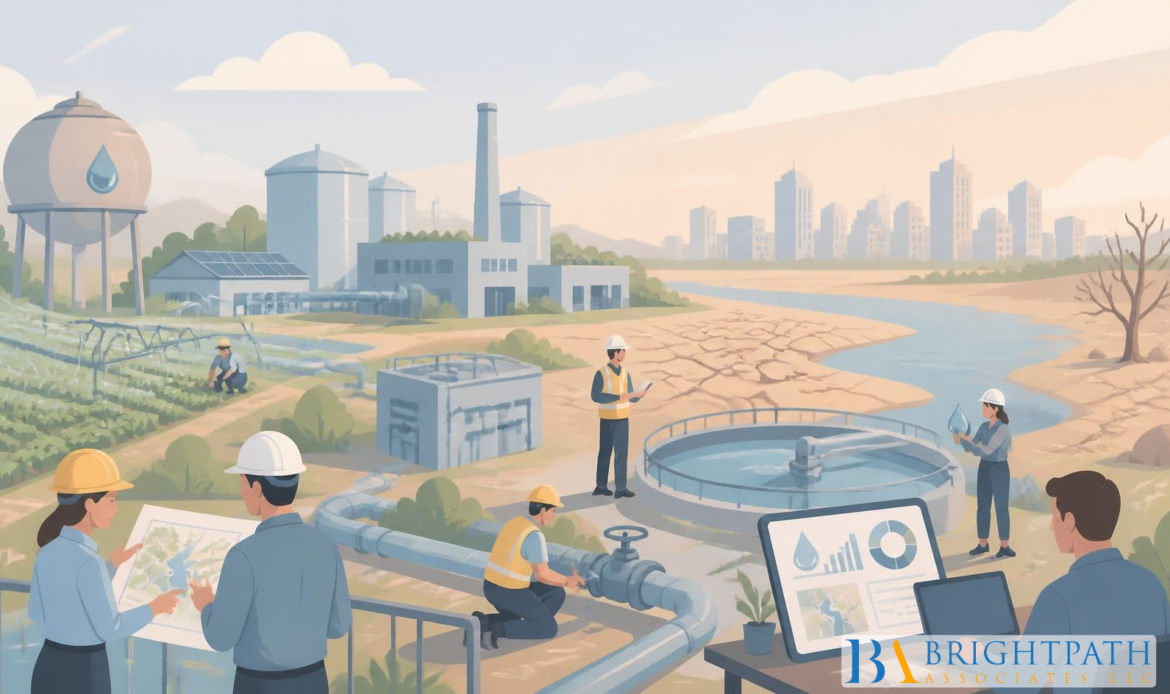
#WaterScarcity is increasingly becoming a strategic economic concern rather than an issue limited to environmental management. As populations grow, agricultural demand expands, industrial activity intensifies, and climate patterns become more variable, competition for freshwater resources is expected to influence food production, supply chains, infrastructure, investment decisions, and regional economic stability throughout the 2030s.
Agriculture sits at the center of this challenge because farming requires reliable access to water while simultaneously providing food, employment, raw materials, and economic activity across numerous sectors. A disruption to agricultural water availability can therefore extend far beyond farms. Reduced crop yields can influence food prices, processing industries, transportation networks, household spending, and international trade.
Building resilience will require more than expanding water infrastructure. Agricultural businesses and policymakers will need to combine technology, efficient resource management, improved farming practices, investment, and better data. Agricultural technology, Precision agriculture, Digital Farming, and Farm management software can help producers make more informed decisions about irrigation and resource utilization. At the same time, Sustainable farming, Organic farming, Agricultural innovation, and Agricultural sustainability can contribute to longer-term resource conservation.
Water scarcity can create economic pressure through several interconnected mechanisms. When water availability declines, agricultural productivity can fall, particularly in regions where irrigation is essential for maintaining crop yields. Lower production can increase food prices and place pressure on consumers and food-processing companies.
Reduced agricultural output can also affect exports, rural employment, agricultural incomes, and government revenues. Industries that depend on agricultural commodities may experience higher input costs, while businesses may need to find alternative suppliers or production regions.
The economic consequences can therefore spread through entire supply chains. A water shortage affecting one major agricultural region can influence commodity markets far beyond the affected area.
For businesses, resilience planning for the 2030s must therefore consider water availability as part of broader operational and financial risk management.
The Role of Agricultural Technology
Agricultural technology is becoming an important tool for managing water constraints. Modern technologies can help farmers measure soil conditions, monitor crop health, improve irrigation timing, and identify areas where water is being used inefficiently.
Sensors, satellite imagery, weather information, automated irrigation systems, and data analytics can provide farmers with more detailed information about field conditions. Instead of applying uniform amounts of water across an entire field, farmers can increasingly adjust irrigation according to crop requirements and local conditions.
Technology alone cannot solve water scarcity, but it can improve the efficiency of available resources. As water becomes more economically valuable, technologies that enable precise measurement and targeted application can become increasingly important to farm profitability.
Food production depends on the availability of reliable agricultural resources, with water being one of the most fundamental. As water scarcity intensifies, farmers and food companies may need to rethink how crops are selected, where they are grown, and how resources are allocated.
Crop varieties that require less water or tolerate periods of drought can become increasingly important. At the same time, improvements in irrigation efficiency can help maintain production without proportionally increasing water consumption.
Food processors and distributors also have a role in resilience planning. Businesses can evaluate their exposure to water-stressed agricultural regions and consider supplier diversification where appropriate.
A resilient food system therefore requires coordination between producers, processors, distributors, retailers, technology providers, and policymakers.
Sustainable Farming for Long-Term Resilience
#SustainableFarmingPractices can help improve the long-term resilience of agricultural systems. Soil health, crop diversification, water conservation, efficient irrigation, integrated resource management, and responsible input use can influence how effectively farms respond to environmental stress.
Healthy soils can support water retention and reduce vulnerability to periods of limited rainfall. Practices that reduce erosion and improve soil structure can also contribute to more stable agricultural productivity.
Sustainable farming should therefore be considered not only as an environmental objective but also as a long-term risk-management strategy. Farms that improve resource efficiency may be better positioned to manage rising input costs and changing climatic conditions.
Precision agriculture provides a practical framework for improving water-use efficiency. The approach uses data to understand differences within agricultural fields and adjust farming activities accordingly.
Sensors can measure soil moisture, while satellite and drone imagery can identify crop stress. Weather data can support irrigation scheduling, and automated equipment can deliver water to specific areas based on actual requirements.
This approach reduces reliance on generalized assumptions. Instead of treating an entire field as having identical water needs, precision agriculture enables farmers to identify areas with different requirements.
For large-scale agricultural operations, the resulting improvements in resource allocation can have significant economic implications. Reduced water waste can lower operating costs while helping maintain crop productivity.
Organic Farming and Resource Management
Organic farming is another area that can contribute to broader agricultural resilience, although its suitability and resource efficiency vary according to crops, geography, soil conditions, and management practices.
Organic systems generally emphasize soil health, biological processes, and reduced reliance on synthetic agricultural inputs. Building healthier soil systems can contribute to water retention and resilience under certain conditions.
However, water scarcity planning should evaluate agricultural systems using measurable outcomes rather than assuming that one production method is universally appropriate. Regional water availability, crop requirements, yields, soil characteristics, and economic conditions all influence the effectiveness of different farming approaches.
The broader objective is to develop production systems that maintain food availability while using scarce natural resources responsibly.
#AgriculturalInnovation will be essential as producers adapt to increasingly complex water constraints. Innovation can involve new irrigation technologies, drought-tolerant crops, controlled-environment agriculture, water-recycling systems, biological inputs, automated equipment, and improved farm-management practices.
Digital technologies can accelerate this process by allowing farmers and agricultural businesses to collect and analyze more information. Data can reveal relationships between water availability, soil conditions, crop performance, and economic returns.
Innovation should also extend beyond individual farms. Storage infrastructure, water distribution systems, agricultural processing, logistics, and market coordination all influence how efficiently water resources are converted into food and economic value.
Sustainable Agriculture Investment
The growing importance of water resilience is likely to influence Sustainable agriculture investment. Investors, agricultural businesses, governments, and financial institutions increasingly need to consider whether agricultural assets are sufficiently prepared for water-related risks.
Investment can support efficient irrigation infrastructure, water monitoring systems, improved soil management, resilient crop varieties, digital platforms, and technologies designed to reduce resource consumption.
However, investment decisions should consider local conditions. A technology that is effective in one agricultural region may have limited value elsewhere because of differences in climate, soil, infrastructure, crop selection, or water regulations.
Long-term investment planning should therefore combine environmental data with financial analysis and operational assessments.
Digital Farming is changing the way agricultural businesses monitor and manage operations. Connected sensors, cloud platforms, satellite data, mobile applications, automated machinery, and analytics can create a more detailed picture of farm performance.
For water management, digital systems can combine weather forecasts, soil-moisture information, irrigation records, crop-development data, and historical yields. Farmers can then use this information to adjust irrigation and production decisions.
Digital systems can also support communication across agricultural supply chains. Processors and buyers can gain greater visibility into expected production, helping them prepare for potential shortages or regional disruptions.
The value of digital farming therefore extends beyond individual farms. It can contribute to broader supply-chain resilience by improving information flow.
Farm Management Software and Operational Planning
#FarmManagement software can help convert agricultural data into operational decisions. Modern platforms can bring together information about fields, crops, irrigation, equipment, labor, inputs, production, and financial performance.
Water-related information can be incorporated into farm planning, allowing producers to monitor consumption and evaluate resource efficiency. Historical records can also help identify which fields, crops, or production practices require greater water inputs.
For larger agricultural businesses, centralized data can improve coordination across multiple farms and production regions. Managers can compare operational performance and identify areas where water-management practices can be improved.
As water scarcity becomes more significant, the ability to connect operational and environmental data will become increasingly valuable.
Agricultural sustainability requires balancing productivity with long-term resource availability. Water scarcity makes this balance particularly important because short-term increases in production can become economically unsustainable if they depend on excessive water extraction.
Agricultural sustainability therefore involves considering the long-term condition of water resources, soil, ecosystems, and farming communities alongside economic performance.
Businesses can incorporate water-related indicators into strategic planning, supplier assessments, capital investment decisions, and operational risk management. This approach can help identify vulnerabilities before they become major disruptions.
Sustainability also requires collaboration. Farmers, governments, researchers, technology providers, financial institutions, and food companies all influence agricultural resource use.
Workforce and Leadership for Water Resilience
Technology and infrastructure alone cannot create resilient agricultural systems. Organizations need professionals capable of interpreting agricultural data, managing technology investments, understanding environmental risks, and coordinating complex supply chains.
As agriculture becomes increasingly digital and technology-driven, leadership requirements are changing. Companies need managers who understand both traditional agricultural operations and emerging technologies.
#ExecutiveSearchRecruitment can support organizations seeking leaders with expertise in agricultural technology, sustainability, digital transformation, supply chain management, and resource strategy. Specialized leadership can help organizations translate long-term water risks into practical investment and operational decisions.
Resilience planning for the 2030s should begin with a realistic assessment of water exposure. Agricultural businesses need to understand where their production depends on vulnerable water resources and how changes in availability could affect yields, costs, suppliers, and customers.
The next step is developing multiple resilience pathways. These may include improving irrigation efficiency, diversifying sourcing regions, investing in water-monitoring technologies, adopting appropriate crop varieties, strengthening soil management, and improving digital visibility.
Scenario planning can also help organizations examine how different combinations of water shortages, commodity prices, energy costs, and supply-chain disruptions could affect their operations.
The objective is not to predict one specific future but to develop capabilities that remain useful across different scenarios.
Conclusion
Water scarcity is becoming an increasingly important economic consideration for agriculture and the wider food system. Its effects can extend from farm productivity to food prices, industrial supply chains, employment, investment, and regional economic stability.
Preparing for the 2030s will require coordinated action across technology, farming practices, investment, infrastructure, and leadership. Agricultural technology, Precision agriculture, Digital Farming, and Farm management software can improve resource visibility and efficiency, while Sustainable farming, Organic farming, Agricultural innovation, and Agricultural sustainability can contribute to longer-term resilience when appropriately adapted to local conditions.
Sustainable agriculture investment can help accelerate the adoption of resilient technologies and practices, but investment must be supported by reliable data and realistic assessments of regional water conditions.
Ultimately, water resilience will depend on the ability of agricultural systems to produce food efficiently while protecting the resources on which future production depends. Organizations that combine technology, sound resource management, strategic investment, and specialized leadership will be better positioned to navigate the economic pressures associated with water scarcity during the 2030s.
Find your next leadership role in Farming Industry today!