
Introduction
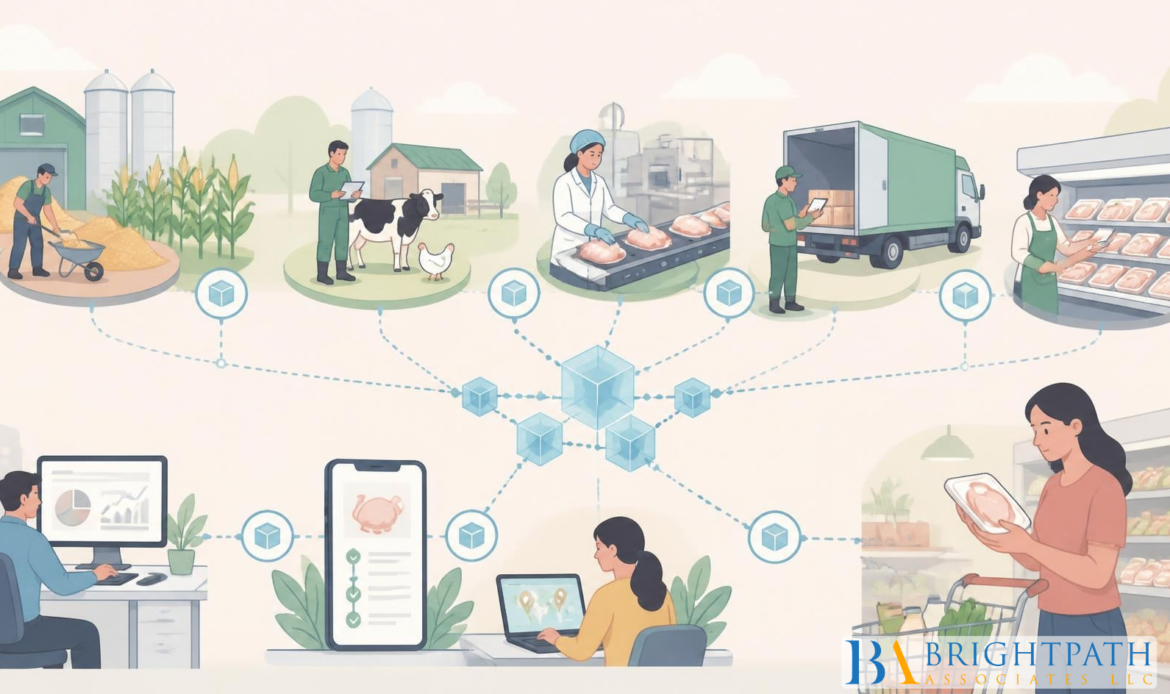
The #DairyIndustry operates through one of the most interconnected supply chains in the food sector. From feed cultivation and animal health management to milk collection, processing, packaging, distribution, retail, and consumption, every stage can influence the safety, quality, and value of the final product. As consumers, regulators, retailers, and food manufacturers increasingly demand greater transparency, dairy companies are exploring digital technologies that can improve visibility across this complex ecosystem.
Blockchain technology has emerged as one potential tool for strengthening traceability. By creating a shared digital record of transactions and supply-chain events, blockchain can help authorized participants establish a more consistent history of products as they move from their origin to the consumer shelf. When combined with sensors, cloud platforms, automation, and data analytics, blockchain can become part of a broader Dairy industry digital transformation strategy.
The objective is not simply to introduce a new technology. The real opportunity is to create a connected traceability framework capable of improving information accuracy, operational visibility, food safety, and consumer confidence.
Traditional dairy supply chains often depend on multiple databases, paper records, spreadsheets, enterprise systems, and manually exchanged documents. Although these systems can provide valuable information, fragmented data can make it difficult to establish a complete and consistent record across organizations.
Blockchain can provide a shared ledger in which authorized participants record relevant supply-chain events. Depending on the system design, information can include feed origin, farm identification, milk collection details, transportation conditions, processing batches, quality testing, packaging information, and distribution movements.
The technology does not automatically guarantee that every piece of information entered into the system is accurate. Data validation at the point of entry remains essential. Blockchain is therefore most effective when combined with reliable data-collection processes, authentication systems, and clearly defined responsibilities among supply-chain participants.
Connecting Feed Origin With Milk Production
Traceability begins before milk reaches the processing facility. Feed quality, sourcing, storage, and animal management can influence dairy production and are therefore relevant to a comprehensive traceability strategy.
Blockchain systems can potentially connect information about feed suppliers and batches with specific farms or production periods. When combined with digital farm-management systems, companies can create a more detailed record of the inputs associated with milk production.
This approach can support broader Sustainable dairy farming practices by improving visibility into agricultural inputs. Information regarding feed sourcing, farm practices, resource consumption, and environmental conditions can become part of a wider data ecosystem.
For dairy processors, better visibility into farm-level information can also strengthen supplier management and improve the ability to investigate quality issues.
Modern #MilkProductionTechnologies generate increasing volumes of operational data. Automated milking systems, milk-quality sensors, animal-monitoring devices, temperature sensors, and farm-management software can collect information throughout the production cycle.
Integrating these technologies with a blockchain-enabled traceability system can create a more connected record of production events. For example, relevant data could include collection time, temperature, quality measurements, farm identification, and transportation information.
The value comes from connecting these individual data points. Instead of viewing each measurement independently, processors can establish relationships between production batches and subsequent processing stages.
However, organizations must carefully determine which information should be stored directly on a blockchain and which information should remain in connected databases. Large volumes of raw sensor data may be more efficiently stored in conventional systems, with verified references or transaction records maintained through blockchain infrastructure.
The Role of Dairy Automation Technologies
Dairy automation technologies can significantly strengthen the reliability of traceability data. Automated systems reduce dependence on manual data entry and can capture operational information in real time.
Automated milk collection, digital weighing systems, automated quality testing, temperature monitoring, robotic processing equipment, and warehouse-management systems can generate data that is linked to specific production batches.
When these systems communicate with a central traceability architecture, dairy organizations can improve the speed and accuracy of information exchange. Automated records can also help reduce discrepancies between physical product movements and digital documentation.
The implementation of automation should nevertheless be approached strategically. Companies need compatible systems, standardized data structures, cybersecurity controls, employee training, and maintenance capabilities to ensure that automated traceability remains reliable over time.
Dairy supply chains involve multiple participants with different operational systems and business priorities. Farmers, cooperatives, collection centers, processors, logistics providers, distributors, retailers, and technology providers may each maintain separate records.
Dairy supply chain management can become more effective when these participants have access to consistent and appropriately permissioned information. Blockchain can provide a shared framework in which relevant supply-chain events are recorded without requiring every participant to operate an identical internal system.
This can improve coordination during routine operations and provide additional visibility during quality investigations or recalls. If a particular batch is identified as problematic, companies may be able to trace relevant movements more efficiently and determine which facilities, distribution channels, or product lots may be affected.
Strengthening Food Safety and Quality Management
#FoodTechnology is increasingly focused on using digital systems to improve safety, quality, efficiency, and transparency. Blockchain can contribute to this objective by strengthening the integrity and accessibility of traceability records.
In a conventional system, investigating a quality issue may require collecting records from several organizations and reconciling different formats. A connected traceability framework can make this process more structured by linking relevant events to product batches.
The technology can also support quality assurance by making it easier to establish when and where a product was processed, transported, or stored. Temperature-sensitive dairy products can particularly benefit from connected monitoring systems that record relevant environmental conditions during transportation and storage.
Blockchain should therefore be viewed as one component of a broader food-safety architecture rather than a replacement for established quality-control procedures.
Dairy product development increasingly depends on understanding consumer preferences, ingredient characteristics, processing conditions, nutritional requirements, and market trends. Traceability data can provide additional insight into the origins and characteristics of raw materials used in product development.
For example, processors developing premium dairy products may want greater visibility into farm practices, feed sourcing, geographic origin, or processing conditions. Connecting this information to finished products can support differentiated product positioning.
Traceability can also support innovation in specialty dairy categories where consumers place greater emphasis on sourcing, sustainability, quality, or production practices. A transparent information system can help companies substantiate relevant product claims when supported by appropriate evidence.
Creating Transparency for Consumers
Consumer expectations are changing across food markets. Customers increasingly want to understand where products originate, how they are produced, and what standards were followed throughout the supply chain.
Blockchain-enabled traceability can support consumer-facing systems that provide selected product information through digital interfaces. A package identifier or QR code could potentially connect consumers with information about production origin, processing batches, certifications, or other verified supply-chain data.
The amount of information presented should be carefully controlled. Consumers need useful, understandable information rather than overwhelming technical datasets. Companies should therefore translate complex supply-chain information into clear and relevant product stories.
Transparency must also be credible. Organizations should establish verification mechanisms to ensure that consumer-facing information accurately represents the underlying supply-chain records.
Dairy e-commerce is expanding the importance of digital product information. Online consumers often have less physical interaction with packaging and may rely heavily on descriptions, certifications, sourcing information, and brand claims when evaluating products.
Integrated traceability systems can provide digital platforms with structured information about product origin, batch characteristics, storage conditions, and other relevant attributes. This can strengthen the connection between physical products and their digital identities.
For dairy brands operating through multiple sales channels, a connected traceability framework can also support better inventory visibility and product authentication. This becomes increasingly valuable as companies manage direct-to-consumer sales alongside traditional retail distribution.
Advancing Dairy Industry Digital Transformation
Blockchain should not be implemented as an isolated technology project. Its greatest potential emerges when it is integrated into a broader #DairyIndustry digital transformation strategy.
Cloud computing, artificial intelligence, Internet of Things sensors, enterprise resource planning systems, warehouse platforms, automation, analytics, and blockchain can work together to create a more connected supply chain.
For example, sensors can collect production and transportation data, cloud platforms can manage large datasets, analytics can identify patterns, and blockchain can provide a trusted record of selected transactions or traceability events.
Organizations should therefore begin with business objectives rather than technology selection. The first question should be what traceability problem needs to be solved, followed by an assessment of which technologies can address it efficiently.
Blockchain implementation across the dairy sector involves technical, operational, financial, and organizational challenges. Different participants may use incompatible systems, have different levels of digital maturity, or be reluctant to share commercially sensitive information.
Data standards are another important consideration. If farms, processors, logistics companies, and retailers record information using inconsistent definitions, integrating that data becomes difficult.
Privacy and access control must also be considered. Not every participant needs access to every piece of supply-chain information. Permissioned blockchain models can provide more controlled access depending on the requirements of the network.
Implementation costs, employee training, cybersecurity, system integration, maintenance, and governance should also be included in the business case. A successful project requires long-term commitment rather than a one-time technology deployment.
Developing Dairy Industry Growth Strategies Around Traceability
Dairy industry growth strategies increasingly need to account for digital capabilities, consumer expectations, operational resilience, and supply-chain transparency. Traceability can become a strategic differentiator when it is connected to measurable business outcomes.
Companies can use stronger traceability to support premium product positioning, improve supplier relationships, strengthen quality management, respond more efficiently to recalls, and develop new digital customer experiences.
However, traceability should support the overall business strategy rather than becoming an objective by itself. Organizations should identify where transparency creates genuine commercial or operational value and prioritize those areas first.
Implementing advanced traceability requires specialized leadership capable of connecting agriculture, food manufacturing, technology, supply chains, and commercial strategy. Organizations may need professionals with experience in digital transformation, food technology, data management, automation, quality systems, and supply-chain operations.
Dairy industry executive search can help companies identify leaders who understand these interconnected requirements. As dairy businesses become more technology-driven, leadership roles increasingly require both industry knowledge and digital expertise.
#ExecutiveSearchRecruitment can also support organizations building transformation teams capable of managing large technology initiatives. Leaders responsible for these programs need to coordinate farmers, suppliers, technology providers, manufacturing teams, regulatory stakeholders, and commercial departments.
The Future of End-to-End Dairy Traceability
The long-term potential of blockchain in dairy will depend on how effectively it integrates with existing technologies and industry standards. Blockchain alone cannot create transparency. Reliable data collection, standardized processes, trusted participants, strong governance, and appropriate verification mechanisms are equally important.
Future traceability systems may increasingly connect farm-level sensors, automated processing equipment, logistics platforms, retail systems, and consumer applications. Artificial intelligence could analyze the resulting data to identify quality risks, forecast supply requirements, and improve operational planning.
This convergence could transform traceability from a compliance-oriented function into a strategic source of information.
Conclusion
Integrating blockchain for dairy traceability offers an opportunity to connect information across the complete journey from feed origin to consumer shelf. When combined with Milk production technologies, #DairyAutomationTechnologies, Food technology, and digital supply-chain platforms, blockchain can contribute to greater visibility and accountability.
The technology can support Dairy supply chain management, strengthen Sustainable dairy farming practices, improve product information, and create new opportunities within Dairy e-commerce. Its value can become even greater when integrated into broader Dairy industry digital transformation and Dairy industry growth strategies.
Successful implementation will require more than technological investment. Dairy organizations need standardized data, reliable processes, cybersecurity, effective governance, skilled employees, and experienced leadership. Dairy industry executive search and Executive Search Recruitment can play an important role in developing the leadership capabilities required for this transformation.
As the dairy sector becomes increasingly connected, traceability can evolve from a recordkeeping requirement into a strategic business capability. Organizations that build reliable connections between production data, processing information, logistics, and consumer-facing systems can create a more transparent and responsive dairy ecosystem capable of supporting long-term industry growth.
Find your next leadership role in Dairy Industry today!