
Introduction
The #ConstructionIndustry is undergoing a significant transformation as digital technologies reshape how buildings are designed, manufactured, and assembled. Among these technologies, generative design is emerging as an important approach for producing customized building components that balance structural performance, material efficiency, manufacturability, cost, and sustainability.
Traditional design processes generally begin with predetermined geometries and rely on engineers and architects to refine a limited number of alternatives. Generative design changes this approach by using computational algorithms to explore numerous potential configurations based on defined objectives and constraints. These systems can evaluate factors such as load requirements, available materials, manufacturing processes, spatial limitations, and environmental performance.
For construction companies and manufacturers, the implications extend beyond design. Generative design can influence the selection and use of Construction materials, manufacturing methods, Building supplies, project economics, and workforce requirements. As construction moves toward greater customization and off-site manufacturing, generative design can become an important connection between digital engineering and physical production.
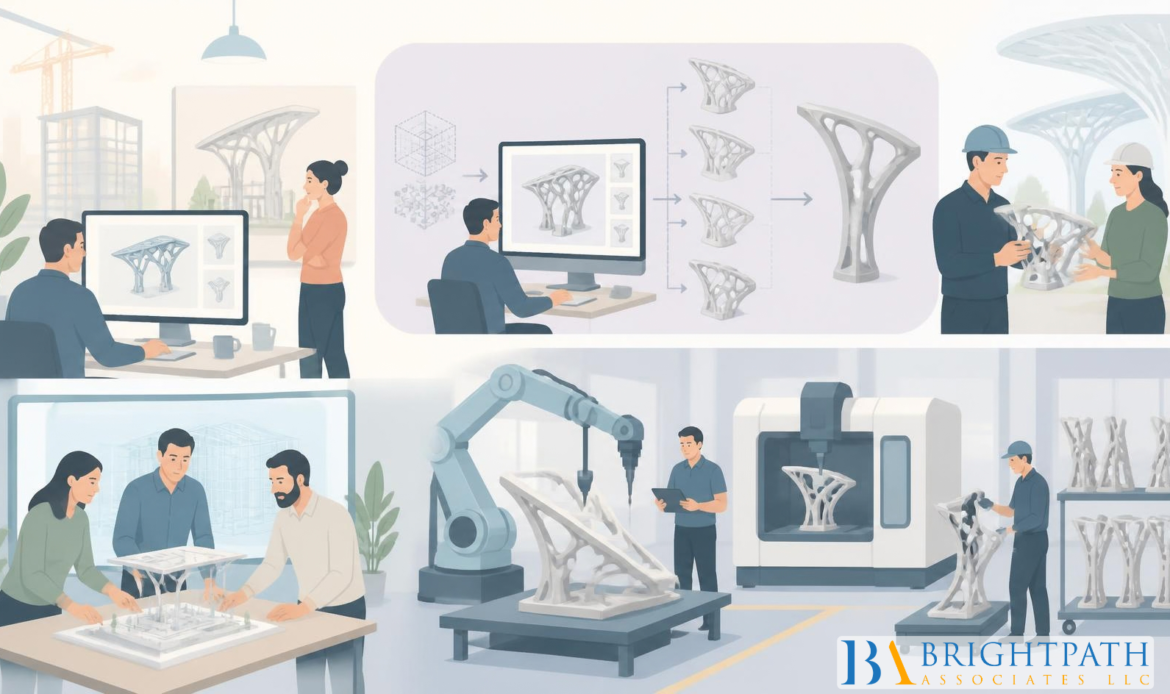
Generative design uses computational methods to create and evaluate multiple design possibilities rather than relying exclusively on a single manually developed solution. Designers and engineers establish parameters such as dimensions, loads, connection requirements, material properties, manufacturing limitations, and performance objectives. Software then explores potential configurations within those parameters.
In custom building component production, this approach can be applied to structural connections, façade components, beams, columns, wall systems, roof elements, brackets, panels, and other components.
The goal is not simply to create unusual shapes. A successful generative design process should produce components that can be manufactured efficiently, transported safely, assembled effectively, and maintained throughout their service life.
Improving the Efficiency of Construction Materials
Construction materials represent a significant portion of project costs and environmental impacts. Generative design can help engineers explore geometries that achieve required structural performance while reducing unnecessary material use.
For example, an algorithm may identify a component geometry that uses less material while maintaining required strength and stiffness. This can be particularly valuable for custom components where traditional manufacturing approaches may involve substantial material waste.
Material optimization can also improve transportation efficiency. Lighter components may reduce handling requirements and transportation loads, although the actual benefits depend on manufacturing processes, structural requirements, and project conditions.
The broader objective is to move from designing with fixed material quantities toward designing around performance requirements and optimized resource use.
The relationship between digital design and Building supplies is becoming increasingly important as construction companies adopt more advanced manufacturing processes. Custom components can be digitally modeled and connected directly to fabrication systems, creating a more integrated workflow between design and production.
Digital models can contain precise information about dimensions, connection points, material specifications, and manufacturing requirements. This information can reduce certain forms of manual interpretation between engineering teams and fabricators.
For suppliers, this shift can create demand for more flexible production capabilities. Instead of manufacturing standardized components in large quantities, some suppliers may increasingly support configurable or digitally customized products.
Supporting Sustainable Construction
#SustainableConstruction requires consideration of material efficiency, energy consumption, waste generation, building performance, durability, and lifecycle impacts. Generative design can contribute to these objectives by allowing environmental criteria to become part of the design process.
Design systems can potentially compare alternatives according to material quantity, embodied carbon, thermal performance, structural efficiency, and other measurable parameters. Engineers can then evaluate trade-offs between different design options.
This approach is particularly relevant when organizations are attempting to reduce construction waste. Custom components produced from optimized digital models may require fewer cutting operations or use material more efficiently than conventional fabrication methods.
Generative design does not automatically make a project sustainable. Its environmental benefits depend on the materials selected, production methods, transportation requirements, durability, and end-of-life strategy.
Concrete production presents an important opportunity for generative design because concrete components can be customized through advanced forming, prefabrication, and additive manufacturing techniques.
Generative algorithms can explore complex structural geometries that may reduce material requirements while maintaining performance. In suitable applications, digitally optimized components can be produced using specialized molds, automated fabrication systems, or concrete 3D-printing technologies.
The benefits need to be evaluated against practical manufacturing requirements. Highly complex geometries may increase fabrication costs or require specialized equipment. Therefore, generative design must account for production constraints from the beginning.
The integration of structural analysis, material science, automated fabrication, and quality control can help make customized concrete components more commercially viable.
Generative Design and the Lumber Industry
The Lumber industry is also being influenced by digital manufacturing and computational design. Wood-based components can be digitally optimized to account for structural loads, grain direction, dimensions, joints, and material availability.
Advanced CNC machining can translate digital designs into precisely manufactured wood components. This creates opportunities for customized timber structures and prefabricated systems.
Generative design can also help optimize the use of wood by accounting for the characteristics of individual pieces of material. In some applications, digital systems may support more efficient placement and cutting strategies, reducing waste.
As engineered wood products become more widely used, digital design can contribute to more efficient structural systems while supporting broader interest in renewable construction materials.
Generative design becomes more powerful when combined with Building technology such as Building Information Modeling, digital twins, robotics, cloud collaboration, artificial intelligence, and automated fabrication.
A digital building model can serve as a central source of information connecting architectural design, structural engineering, manufacturing, logistics, and construction. Generative algorithms can operate within this environment to explore alternatives while maintaining connections to the wider project model.
When a design is approved, manufacturing information can potentially be transferred directly to automated equipment. This creates a digital thread extending from initial concept through production and installation.
Such integration can reduce information gaps between project stakeholders and support more efficient workflows.
Addressing Building Regulations
#BuildingRegulations remain an essential consideration in any generative design workflow. A computationally optimized component is only commercially useful if it satisfies applicable structural, fire, safety, accessibility, material, and construction requirements.
Design systems should therefore incorporate regulatory constraints wherever possible. Engineers must still review and validate generated designs before construction because automated optimization does not eliminate professional responsibility.
Regulatory requirements can also affect the adoption of unconventional geometries. Authorities, insurers, contractors, and other stakeholders may require additional documentation or testing for unfamiliar component designs.
Successful implementation therefore requires close coordination between computational designers, engineers, manufacturers, and regulatory professionals.
Construction economics plays a central role in determining whether generative design moves beyond experimentation into mainstream adoption. A component may be structurally efficient but commercially impractical if its manufacturing, transportation, installation, or maintenance costs are too high.
Generative design can address this challenge by incorporating cost-related parameters into optimization. Material quantity, manufacturing time, machine utilization, assembly complexity, and transportation dimensions can potentially be evaluated alongside structural performance.
This creates the possibility of developing components that are not simply optimized for engineering performance but for overall lifecycle value.
For construction companies, the ability to evaluate multiple cost and performance scenarios can improve early-stage decision-making and reduce the risk of expensive design changes later in the project.
Material Recycling and Circular Construction
#MaterialRecycling is becoming increasingly important as the construction sector seeks to reduce waste and improve resource efficiency. Generative design can contribute to circular construction by considering disassembly, material recovery, and reuse during the design stage.
Components can potentially be designed with standardized connections that allow them to be removed and reused rather than demolished. Digital models can also retain information about material composition, dimensions, and previous applications.
In the future, generative systems could potentially incorporate recycled or reclaimed materials as design inputs. Instead of treating material availability as a fixed constraint, algorithms could optimize components around the characteristics of available recycled resources.
This approach could help move construction toward a more circular material economy.
Generative design is particularly compatible with off-site construction because digital manufacturing allows factories to produce customized components with repeatable processes.
Rather than requiring every component to be identical, manufacturers can produce variations based on specific building requirements while maintaining standardized production workflows.
This model can support modular construction, prefabrication, and mass customization. A factory can receive digital production information and manufacture components tailored to individual projects.
Off-site production can also improve quality control because manufacturing occurs within controlled environments. However, transportation and installation requirements must be considered when designing customized components.
Impact on Construction Jobs
The increasing use of generative design and digital manufacturing will influence Construction jobs across the industry. Traditional roles will continue to be important, but demand is likely to expand for professionals who can work across design, engineering, manufacturing, data, and technology.
Architects and engineers may increasingly need computational design skills, while manufacturing teams may require expertise in CNC equipment, robotics, automation, and digital quality systems.
The technology does not simply eliminate human involvement. Instead, it changes where expertise is applied. Professionals can focus more heavily on defining objectives, evaluating alternatives, validating designs, managing risks, and making strategic decisions.
Training and workforce development will therefore become important as companies adopt increasingly digital construction workflows.
Technology adoption requires leadership capable of integrating digital tools with established construction practices. Companies implementing generative design may need executives with experience in engineering, manufacturing, construction technology, operations, sustainability, and digital transformation.
#ExecutiveSearchRecruitment can support organizations seeking leaders with these cross-functional capabilities. Senior professionals can help determine where generative design creates genuine business value and how it should be integrated into existing operations.
Leadership is also important for managing organizational change. Digital transformation affects workflows, responsibilities, investment priorities, and employee skills. Effective leadership can help organizations establish realistic implementation strategies while maintaining project quality and commercial discipline.
Challenges to Generative Design Adoption
Despite its potential, generative design faces several challenges. Software costs, integration complexity, data quality, training requirements, manufacturing limitations, regulatory uncertainty, and resistance to workflow changes can slow adoption.
Another challenge is the interpretation of generated alternatives. Producing hundreds of design options does not necessarily improve decision-making if teams lack clear criteria for evaluating them.
Organizations therefore need well-defined objectives and validation processes. Generative design should support professional expertise rather than overwhelm teams with unnecessary complexity.
Data interoperability is another important issue. Different software platforms used by architects, engineers, manufacturers, and contractors must be able to exchange information accurately for the digital workflow to function effectively.
The future of custom building component production is likely to involve deeper integration between computational design, automated manufacturing, robotics, material science, and digital project management.
As manufacturing technologies become more flexible, customized components may become increasingly practical for both large and small projects. Artificial intelligence could also enhance generative systems by helping identify design patterns and performance relationships across large datasets.
The long-term opportunity lies in creating a connected workflow where design objectives, material characteristics, manufacturing constraints, regulatory requirements, cost considerations, and lifecycle performance are evaluated together.
Conclusion
Generative design has the potential to reshape custom building component production by connecting computational optimization with advanced manufacturing. Its value extends across Construction materials, #BuildingSupplies, Sustainable construction, Concrete production, and the Lumber industry, while also influencing Building technology and Construction economics.
By considering material efficiency, manufacturing constraints, regulatory requirements, recycling opportunities, and lifecycle costs during the design process, companies can move toward more integrated and responsive construction systems.
The successful adoption of generative design will depend on more than software. Skilled professionals, modern manufacturing capabilities, effective regulatory processes, workforce development, and strategic leadership will all be essential. Executive Search Recruitment can help organizations build the leadership capabilities required to manage this transition.
As construction becomes increasingly digital, the ability to customize components without sacrificing efficiency or quality could become a significant competitive capability. Generative design provides a pathway toward that future by transforming the traditional question of how to manufacture a predetermined component into a broader exploration of how the component can be optimized for its intended purpose, material, production process, and lifecycle.
Find your next leadership role in Building Material Industry today!
Stay informed with the latest insights on Building Material Industry!