
Introduction
#ManufacturingEnvironments are changing rapidly as customers demand greater product variety, shorter lead times, customized configurations, and consistent quality. Traditional automation has historically been most effective in high-volume production, where machines can perform the same repetitive operation for long periods. However, high-mix, low-volume manufacturing presents a different challenge. Products change frequently, production batches are smaller, and equipment must adapt to different processes without creating excessive downtime.
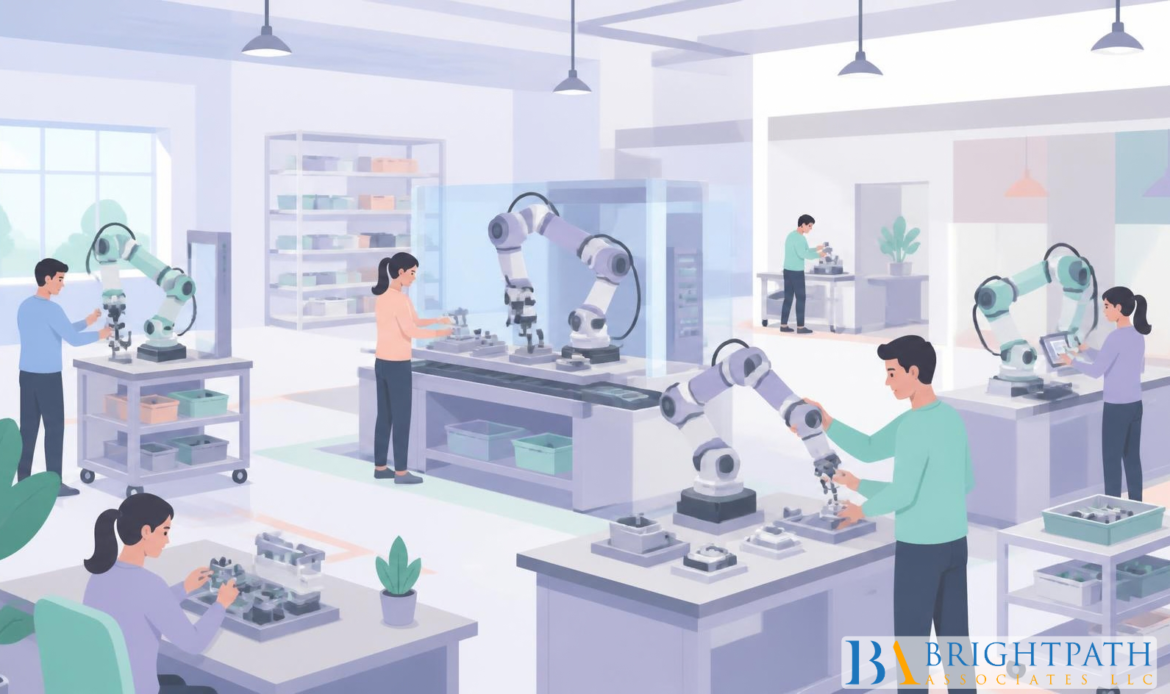
Flexible robotics is emerging as an important solution for this environment. Modern robotic systems can be reprogrammed, equipped with interchangeable tooling, integrated with vision systems, and connected to digital production platforms. Instead of being dedicated to a single product, these systems can support multiple operations and product variants.
The return on investment, or ROI, of flexible robotics therefore extends beyond direct labor savings. Manufacturers must consider Manufacturing efficiency, equipment utilization, quality improvement, changeover time, labor availability, product flexibility, and long-term scalability. For businesses operating in the Industrial machinery industry, understanding these factors is essential before committing capital to robotic automation.
High-mix, low-volume production involves manufacturing a wide range of products or configurations in relatively small quantities. This model is common in specialized Industrial machinery, aerospace components, medical equipment, custom automotive parts, and precision industrial products.
The production environment is more complex than a conventional high-volume assembly line. Operators may need to change tools, fixtures, programs, materials, and inspection procedures frequently. Equipment designed for a single product can become inefficient because setup time may consume a significant portion of available production hours.
Flexible robotics addresses this challenge by allowing a single robotic platform to perform different tasks. Depending on its configuration, a robot may handle machine tending, material movement, welding, assembly, inspection, packaging, or finishing operations.
The economic value comes from increasing the range of work that can be automated without requiring a completely separate automation system for every product.
Why Traditional Automation Can Struggle With Product Variety
Traditional automation is often designed around repeatability. A dedicated system may provide excellent performance when producing one product continuously, but changing product specifications can require mechanical modifications, new tooling, programming changes, or lengthy commissioning.
For high-mix manufacturers, these changes can reduce equipment utilization. A machine that is technically capable of high production rates may spend significant time waiting for setup or changeover.
Flexible robotics can reduce this limitation through software-driven configuration. Programs can be changed more quickly than mechanical production systems, while interchangeable end-of-arm tooling can allow the same robot to handle different components.
This does not mean robotics eliminates changeover costs. Instead, it can make changeovers more manageable and potentially reduce the amount of dedicated hardware required for different product families.
The ROI of robotic automation should be calculated using the total economic impact rather than labor savings alone.
The initial investment may include the robot, controller, tooling, safety equipment, sensors, machine interfaces, programming, integration, employee training, and facility modifications. Ongoing costs may include software updates, maintenance, replacement components, and technical support.
The financial benefits can include reduced direct labor requirements, higher equipment utilization, fewer quality defects, lower scrap, faster changeovers, improved throughput, reduced workplace exposure to repetitive tasks, and greater production consistency.
Manufacturers should also consider the opportunity cost of not automating. If skilled employees spend significant amounts of time performing repetitive material-handling tasks, the organization may be unable to deploy those employees to higher-value activities.
Improving Manufacturing Efficiency
One of the strongest economic arguments for flexible robotics is Manufacturing efficiency. Robots can perform repetitive operations consistently and can operate for extended production periods when appropriate safety and operational conditions are established.
In high-mix environments, the objective is not necessarily maximum robot speed. Instead, the objective is reliable performance across multiple products.
For example, a robotic machine-tending system may load and unload several different part types. Although each product may require different programs or fixtures, the underlying robotic platform can remain the same.
Improved utilization can increase the value of existing manufacturing assets. A robot that supports multiple machines may also provide greater economic value than a robot dedicated to one operation.
Precision machining is an important application for flexible robotics because machine tools often require consistent loading, unloading, inspection, and part handling.
Robots can tend #CNCMachines, move components between operations, and deliver finished parts to inspection stations. When integrated with appropriate software, they can support production scheduling and part identification.
For precision manufacturers, automation can also reduce variability associated with repetitive manual handling. Consistent part orientation and loading can help maintain process stability.
However, robotic machine tending must be carefully engineered. Fixtures, grippers, part tolerances, chip management, coolant exposure, machine interfaces, and safety systems all influence performance.
The ROI calculation should therefore include integration complexity rather than assuming that purchasing a robot automatically creates productivity gains.
Changeover time is a major consideration in high-mix production. Every minute spent switching between products reduces available production capacity.
Flexible robotics can help reduce changeover time through programmable movements, digital recipes, automatic tool changes, and standardized interfaces.
Vision systems can further increase flexibility by allowing robots to identify different components without requiring perfectly fixed presentation.
The economic benefit depends on how frequently product changes occur. A factory that changes production every few hours may gain considerably more from flexible automation than a facility producing the same component for several weeks.
Manufacturers should therefore analyze actual production schedules before investing.
The Role of Industrial Automation Solutions
#IndustrialAutomationSolutions increasingly combine robotics with sensors, machine vision, programmable controllers, manufacturing software, and data systems.
The robot itself is only one part of the automation architecture. Effective integration requires communication between machines and production systems.
For example, a flexible robotic cell may receive production instructions from a manufacturing execution system, identify a component using machine vision, select the appropriate program, complete the operation, and record production data.
This integrated approach can improve traceability and provide managers with better visibility into production performance.
For manufacturers, the strategic value of robotics therefore increases when it becomes part of a broader automation architecture rather than operating as an isolated machine.
Machinery maintenance is a critical component of robotic ROI. Automation equipment must remain available to deliver its expected financial return.
Preventive maintenance programs can reduce unexpected downtime. Manufacturers should monitor robot joints, tooling, sensors, cables, grippers, controllers, and associated machinery according to manufacturer recommendations and actual operating conditions.
Predictive maintenance can provide additional value where sufficient sensor and operational data are available. Monitoring equipment performance can help identify developing problems before they cause major production interruptions.
Lifecycle costs should be included in the original investment calculation. A system with a lower purchase price may become more expensive over time if spare parts, technical support, or maintenance requirements are significantly higher.
Manufacturers evaluating automation investments may also compare new robotic systems with Used machinery or refurbished equipment.
Used equipment can reduce initial capital requirements, particularly for companies testing automation for the first time. However, compatibility, software support, safety requirements, controller condition, and availability of replacement components must be assessed carefully.
For high-mix production, flexibility may be more important than acquisition cost. A less expensive machine that cannot adapt to multiple products may deliver lower long-term value than a more capable system.
The appropriate decision depends on production requirements, expected utilization, equipment condition, and the organization’s technical capabilities.
Financing the Automation Investment
#MachineryFinancing can influence the speed at which manufacturers adopt flexible robotics. The investment should be evaluated against expected cash-flow benefits rather than viewed only as an equipment purchase.
Financing structures can spread capital expenditure over time, allowing businesses to match payments with anticipated operational benefits. However, financing costs should be included in the overall ROI calculation.
Manufacturers should also consider the useful life of the robotic system, expected production volume, maintenance costs, software expenses, and potential future upgrades.
A well-structured financial analysis can help management distinguish between automation that creates measurable economic value and automation purchased primarily because of technology trends.
The relationship between robotics and Manufacturing jobs is an important consideration. Flexible robotics can reduce the amount of repetitive manual work required in specific processes, but it can also create demand for employees with new technical skills.
Manufacturers increasingly require technicians capable of programming robots, maintaining automated systems, interpreting production data, and troubleshooting integrated equipment.
Rather than viewing automation solely as labor replacement, companies can use it to redistribute human effort toward machine supervision, quality assurance, process improvement, maintenance, programming, and higher-value manufacturing activities.
Workforce development should therefore be included in the ROI calculation. Training employees can increase the long-term value of automation while reducing dependence on external technical support.
US Machinery manufacturers operate in an environment characterized by competition, labor constraints, supply-chain pressures, and demand for customized industrial products. Flexible automation can help manufacturers increase production capacity without requiring a proportional increase in workforce size.
For companies producing specialized equipment or components, flexibility can be particularly important because production volumes may vary significantly between product lines.
#RoboticSystems can also support domestic manufacturing by improving productivity and allowing manufacturers to compete more effectively on quality, delivery time, and customization.
However, automation alone cannot resolve every competitiveness challenge. Equipment selection, workforce skills, supplier relationships, process design, and production planning remain important factors.
Measuring Long-Term Business Value
The strongest ROI analysis considers both immediate and strategic benefits.
Short-term financial returns may come from labor savings, increased throughput, lower scrap, and reduced downtime. Longer-term value can come from greater production flexibility, faster response to changing customer requirements, improved data availability, and reduced dependence on a limited pool of specialized labor.
Manufacturers should establish performance measurements before implementing robotics. Production cycle time, changeover duration, machine utilization, quality rates, downtime, labor hours, and output per shift can provide a baseline.
After implementation, these metrics can be compared against the original baseline to determine whether the system is delivering the expected results.
Successful robotics programs require leadership that understands both manufacturing economics and technological capabilities. Management must determine where automation will have the greatest operational impact and ensure that projects remain aligned with business objectives.
As the Industrial machinery industry becomes increasingly automated, organizations need leaders with experience in robotics, engineering, production management, digital manufacturing, and capital investment.
#ExecutiveSearchRecruitment can help manufacturers identify senior professionals capable of leading automation transformation, managing technical teams, and connecting investment decisions with measurable operational outcomes.
Leadership also plays a role in workforce transition. Employees need clear communication, appropriate training, and opportunities to develop new skills as automation changes production processes.
Flexible robotics should be implemented as part of a broader automation roadmap. Manufacturers can begin with processes where repetitive handling, quality variation, labor availability, or changeover time creates a measurable business problem.
Once the initial application demonstrates value, the organization can expand automation to other processes.
Standardized robotic platforms, common communication protocols, reusable programming structures, and modular tooling can make future deployments faster and less expensive.
This approach creates an automation ecosystem rather than a collection of isolated robotic cells.
Conclusion
Flexible robotics can provide significant value in high-mix, low-volume manufacturing by combining automation with adaptability. Unlike highly dedicated systems, flexible robotic platforms can support multiple products and processes, making them particularly relevant to manufacturers facing frequent changeovers and customized production requirements.
The ROI should be evaluated across the full economic lifecycle. Labor utilization, Manufacturing efficiency, production flexibility, quality, downtime, maintenance, changeover time, and workforce development all contribute to the business case.
For US Machinery manufacturers and companies across the broader Industrial machinery industry, flexible automation can become an important tool for improving competitiveness and responding to changing customer requirements. However, successful implementation depends on appropriate process selection, integration, financing, maintenance, and employee development.
The most valuable robotic investment is not necessarily the fastest or most advanced system. It is the system that solves a clearly defined production problem, operates reliably within the existing manufacturing environment, and provides measurable value over its useful life. By approaching robotics as a strategic manufacturing capability rather than simply an equipment purchase, manufacturers can build more adaptable operations while strengthening productivity and long-term industrial resilience.
Find your next leadership role in Machinery Industry today!
Stay informed with the latest insights on Machinery Industry!