
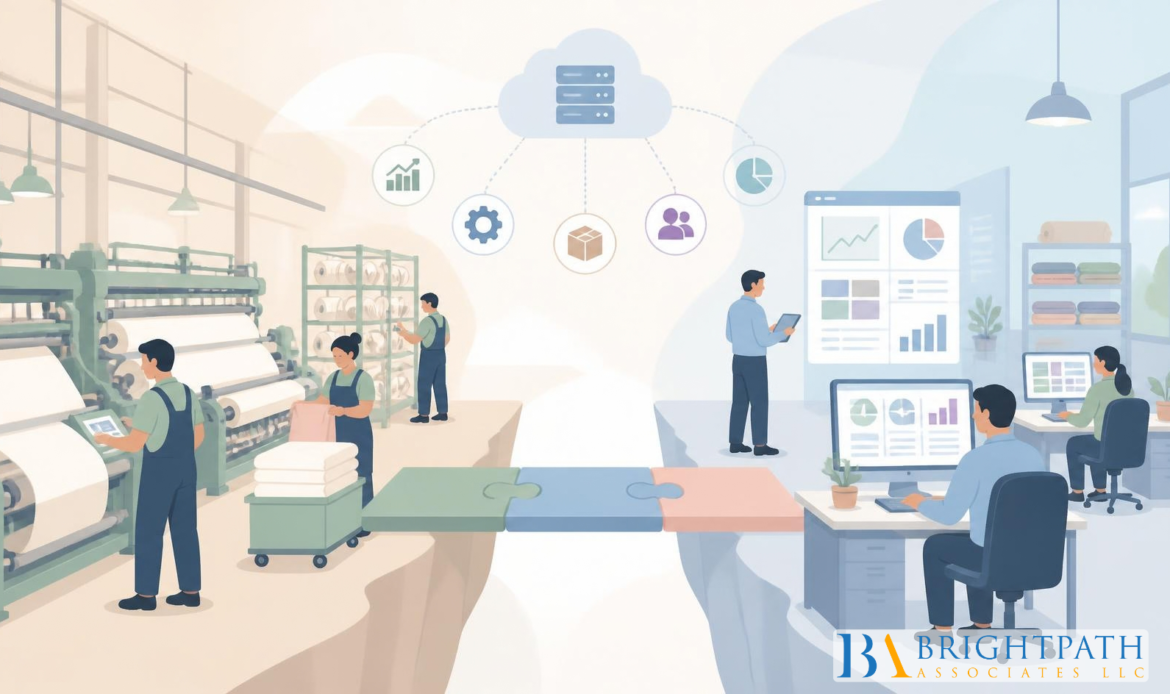
[Bethany, Connecticut – 25 September 2026] — BrightPath Associates has highlighted how small textile mills can use enterprise resource planning (ERP) systems to modernize operations, connect fragmented business processes, and improve decision-making. The latest industry insight examines how integrated ERP platforms can bring production, inventory, procurement, finance, sales, and supply chain information into one connected environment, helping C-Suite leaders address growing operational complexity while preparing their businesses for changing global market conditions.
ERP Integration Addresses Growing Textile Complexity
Small textile mills often operate with a combination of spreadsheets, standalone software, manual records, and legacy systems. While these tools may support individual functions, disconnected information can make it difficult for executives to obtain a complete view of production costs, inventory levels, order status, and supplier performance. ERP integration provides a way to connect these functions and create a more consistent flow of information across the business.
BrightPath Associates’ analysis, “Bridging the Gap: Integrating ERP Systems into Small Textile Mills,” examines how smaller manufacturers can approach ERP adoption without treating digital transformation as an all-or-nothing investment. The article emphasizes that integration should address specific operational gaps and create measurable business value. For leaders responsible for Textile business strategic planning, this approach can help align technology investment with production requirements, workforce capabilities, and long-term growth objectives.
The benefits extend across the Textile supply chain. When procurement, inventory, production, and order information are connected, management can identify material requirements more efficiently and improve visibility into production schedules. Better information flow can also help mills respond to changing customer demand and reduce delays caused by manual data transfers.
Data and Automation Strengthen Decision-Making
ERP systems can provide a foundation for Textile industry data analytics by bringing information from different departments into a centralized environment. Executives can use this information to monitor production performance, inventory movement, purchasing activity, costs, and sales trends. Instead of relying primarily on historical reports, leadership teams can gain a clearer view of current operations and identify areas that require attention.
This capability becomes increasingly important as mills evaluate Advanced textile manufacturing technologies. ERP platforms can serve as a central information layer connecting business processes with manufacturing equipment, automation systems, and other digital applications. Over time, mills can build a stronger digital infrastructure that supports automation while maintaining visibility across the organization.
The article also points to the importance of automation in improving operational efficiency. Technologies such as Cognitive automation in textile logistics can support repetitive activities involving inventory, purchasing, order processing, and logistics coordination. ERP integration can provide the structured data required for these applications to work effectively. This creates opportunities for smaller mills to adopt digital capabilities incrementally rather than attempting to transform every process simultaneously.
Supporting Resilience and Future Investment
Technology decisions in the textile sector increasingly intersect with broader Textile industry investment trends. Executives must consider not only immediate operational needs but also supply chain resilience, sustainability requirements, customer expectations, and international market conditions. ERP integration can provide a foundation for evaluating these priorities through more consistent operational data.
Connected systems can also support Textile industry closed-loop systems, in which information from production, quality, inventory, customers, and suppliers is continuously used to improve future decisions. Such systems can help organizations identify recurring inefficiencies and create a stronger feedback loop between operational performance and management strategy.
Emerging technologies may further expand the role of ERP platforms. Textile industry blockchain applications, for example, could support greater traceability across selected supply chain processes where secure transaction records and product information are valuable. At the same time, executives must consider Global textile industry geopolitical risks, including disruptions involving raw materials, international trade, transportation, and supplier networks. Integrated information can help leadership teams understand dependencies and respond to changes with better operational visibility.
Leadership and Talent Remain Critical
Successful ERP implementation requires more than selecting software. It also depends on leadership, workforce adoption, process redesign, and clear strategic objectives. Executive leadership in textiles plays an important role in determining which processes should be integrated first, how employees will adapt to new workflows, and how technology investments will be measured.
Talent strategy is therefore closely connected to digital transformation. Executive search recruitment can help textile organizations identify leaders with experience across manufacturing, technology, supply chain management, data, and organizational change. As ERP systems become more deeply connected to production and business planning, mills may increasingly require professionals who can translate digital capabilities into practical operational improvements.
For C-Suite executives evaluating modernization initiatives, the complete analysis on Integrating ERP Systems into Small Textile Mills provides additional insight into building a connected technology environment. Leaders can also explore BrightPath Associates’ resources for the Textile Industry when developing broader talent, technology, and growth strategies.
About BrightPath Associates
BrightPath Associates is an executive recruitment and talent solutions firm that helps organizations identify the leadership and specialized professionals needed to support sustainable business growth. The company works with organizations across industries, providing executive search recruitment and talent solutions aligned with business objectives. Its mission is to connect businesses with qualified leadership and specialized talent while supporting stronger organizational performance.
Media Contact:
Name: Corporate Communications Team
Company: BrightPath Associates
Email: media@brightpathassociates.com
Website: https://brightpathassociates.com