
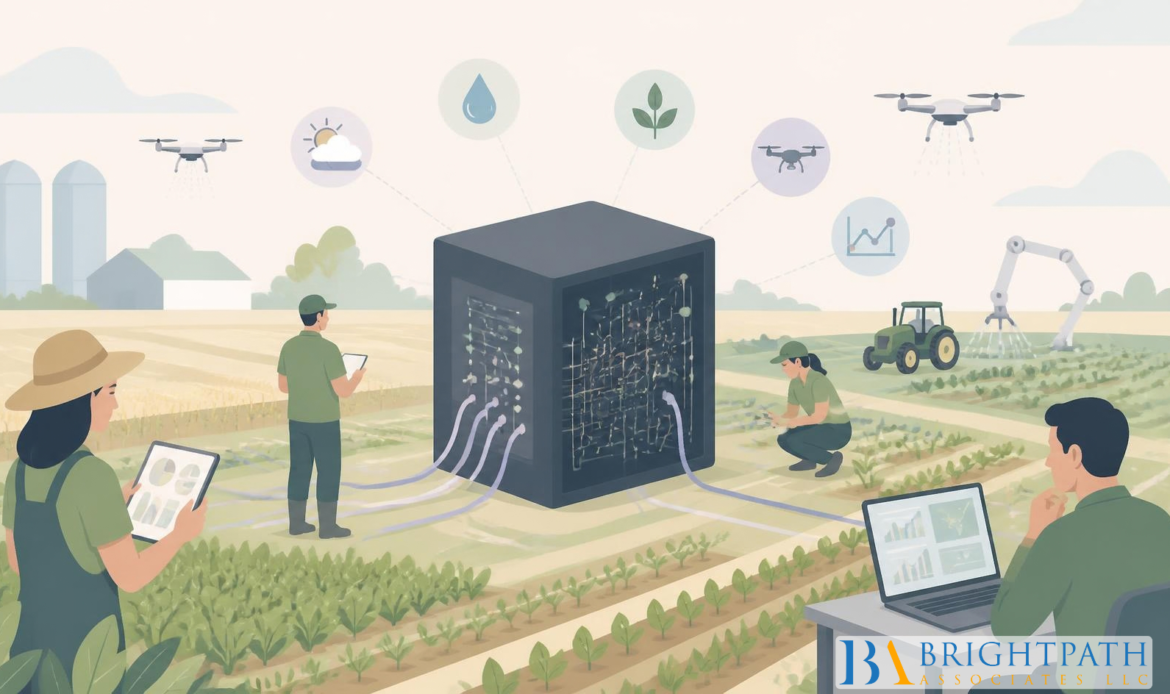
[Bethany, Connecticut – 23 September 2026] — BrightPath Associates has highlighted the growing need for responsible use of artificial intelligence and machine learning in modern agriculture, warning that over-reliance on difficult-to-explain “black-box” models can create operational, financial, and sustainability risks. The latest industry analysis examines how C-Suite leaders can balance Agricultural technology with practical farming expertise while using Precision agriculture, Digital Farming, and Farm management software to improve decision-making. The report emphasizes validation, monitoring, explain ability, and human oversight as agriculture becomes increasingly dependent on data-driven systems.
Agricultural Technology Is Reshaping Farm Decisions
Agriculture has traditionally relied on observation, experience, and adaptation. Today, satellite imagery, connected sensors, drones, automated machinery, predictive analytics, and artificial intelligence are changing how agricultural organizations monitor crops, manage resources, and respond to changing conditions. These technologies can process large amounts of information and identify patterns that may be difficult to detect manually.
However, the growing sophistication of these systems raises an important management question: how much authority should agricultural organizations give algorithms when their recommendations are difficult to understand? BrightPath Associates explains that a black-box model may produce a sophisticated recommendation without clearly showing which factors influenced its conclusion. As the article states, “A model can sometimes produce an accurate prediction while still being difficult to interpret.”
For C-Suite executives, this distinction is significant. Agricultural systems are exposed to changing weather, soil conditions, pests, crop varieties, water availability, and other variables that may not be fully represented in historical datasets. A model that performs effectively under familiar conditions may behave differently when circumstances change.
Digital Farming and Sustainable Agriculture Investment
As Digital Farming develops, AI-driven recommendations are increasingly being integrated into Farm management software. These platforms can bring together information about crops, fields, equipment, labor, finances, inputs, and production. While this integration can improve convenience and operational visibility, BrightPath Associates notes that automated recommendations can become embedded in routine workflows and may receive less scrutiny over time.
For executives making Sustainable agriculture investment decisions, technology governance therefore needs to extend beyond expected productivity gains. Organizations should consider how models perform when conditions change, how errors can be identified, how recommendations are validated, and when human approval should be required. Scenario testing, performance monitoring, and recalibration can help organizations manage model risk as agricultural conditions evolve.
The issue is particularly important for Food production because agricultural decisions can influence yields, resource consumption, costs, and supply-chain reliability. A poor recommendation at an individual farm can result in wasted inputs or lost production, while repeated errors across multiple operations could create broader consequences. This makes responsible technology governance an important part of Agricultural sustainability.
Leadership Will Shape the Future of Agriculture
The future of agriculture is expected to involve increasingly connected systems combining satellite data, sensors, weather information, machinery data, biological measurements, and historical records. These technologies can support Precision agriculture, Sustainable farming, and resource optimization, but their value depends on how effectively organizations manage their limitations.
This transformation is also changing leadership requirements. Agricultural organizations increasingly need executives who can understand farming operations alongside artificial intelligence, data governance, cybersecurity, sustainability, technology procurement, and workforce development. Executive search recruitment can help organizations identify leaders capable of managing this intersection and communicating effectively across technical, scientific, operational, and commercial teams.
BrightPath Associates’ analysis, Algorithmic Agriculture on Black-Box Models, provides further insight into responsible algorithm adoption, explainable AI, model monitoring, and human-in-the-loop decision-making. Organizations evaluating technology and leadership priorities can also explore resources for the Farming Industry as they prepare for the next stage of agricultural transformation.
About BrightPath Associates
BrightPath Associates is an executive recruitment and talent solutions firm that helps organizations identify the leadership and specialized professionals needed for sustainable growth. The company supports workforce planning, leadership development, retention strategies, workplace initiatives, and specialized recruitment across multiple industries. BrightPath Associates’ mission is to connect organizations with capable talent while helping businesses build stronger and more effective teams.
Media Contact:
Name: Corporate Communications Team
Company: BrightPath Associates
Email: media@brightpathassociates.com
Website: https://brightpathassociates.com