
Introduction
Paper has long been one of the world’s most established #RenewableMaterials, but its role in a circular economy increasingly depends on how products are designed before they ever reach a recycling facility. Packaging formats, coatings, adhesives, inks, labels, barrier layers, and fiber combinations can significantly influence whether a paper product can be efficiently collected, sorted, repulped, and converted into new materials.
The challenge becomes more complex when paper products are designed for international markets. Recycling infrastructure, collection systems, technical standards, consumer behavior, and regulatory expectations differ across countries. A package designed for efficient recycling in one market may encounter different limitations elsewhere.
Harmonizing design guidelines can help address this fragmentation. The objective is not to create a single manufacturing formula for every paper product, but to establish common principles that allow designers, converters, manufacturers, recyclers, and policymakers to work toward compatible outcomes.
This transition is creating new opportunities for Forest product innovation, Paper recycling solutions, Paper and pulp technology, and sustainable manufacturing. It also requires closer cooperation across the entire forest products value chain.
Recyclability is often discussed as a property of the finished product, but it is actually influenced by numerous decisions made throughout the product lifecycle. Fiber selection, additives, printing processes, coatings, adhesives, and packaging structures can determine how easily material can be processed after use.
Global brands face a particular challenge because they may manufacture similar packaging formats for multiple markets. When each region follows different recyclability expectations, companies may need to develop multiple product specifications, increasing complexity and cost.
Harmonized design principles can reduce this fragmentation. Common terminology and measurable criteria can help manufacturers understand which materials are broadly compatible with recycling systems and which design features may create processing challenges.
Such alignment can also support investment. Recycling facilities and paper manufacturers can make better-informed decisions when they have greater visibility into the types of materials expected to enter the recovery stream.
Fiber Selection and the Foundation of Paper Recycling
Fiber remains the fundamental resource within the paper recycling system. Recovered paper fibers can be processed into new products multiple times, although fiber quality gradually changes through repeated processing.
Virgin fiber also remains important because it can introduce fresh, strong fibers into the overall material cycle. Responsible sourcing therefore needs to be considered alongside recycling.
The relationship between virgin and recovered fibers is an important consideration for #PaperIndustryEconomics. Manufacturers must balance material availability, product performance, energy consumption, processing requirements, and market demand.
Design guidelines should therefore encourage fiber choices that support the intended product application while considering how materials will behave during recovery and repulping.
Advances in Paper and pulp technology are expanding the industry’s ability to recover fibers from increasingly complex products. Modern mills use sophisticated screening, cleaning, deinking, and separation processes to manage recovered materials.
However, recycling technology has practical limits. A material that can technically be processed under specialized conditions may not be economically or operationally recyclable at scale in every region.
This distinction is essential when developing global design guidelines. Designers should consider not only whether a product can be recycled under laboratory or specialized industrial conditions but whether it is compatible with the collection, sorting, and processing infrastructure commonly available in its target market.
Technology development can reduce some of these limitations, but better product design can reduce the burden placed on recycling systems in the first place.
Coatings, Barriers, and Composite Structures
Modern paper packaging increasingly incorporates coatings and barrier technologies to improve resistance to moisture, grease, oxygen, or other environmental factors. These properties can expand the applications of paper-based materials, particularly in food and consumer packaging.
At the same time, complex coatings and multilayer structures may make recovery more difficult. Designers therefore face a balance between product functionality and end-of-life performance.
This is an important area for Forest product innovation. Researchers and manufacturers are exploring fiber-based alternatives and coatings that can deliver necessary functionality without unnecessarily complicating recycling.
Design guidelines can encourage manufacturers to evaluate the full lifecycle impact of barrier materials, adhesives, and coatings. Rather than treating recyclability as an afterthought, it can become one of the design criteria considered alongside performance, cost, safety, and appearance.
Inks and adhesives may represent relatively small components of a paper product, but they can influence recycling outcomes. Certain formulations can create challenges during deinking, screening, or pulp processing.
As packaging becomes more visually sophisticated, designers are using increasingly complex printing effects, finishes, and adhesive systems. Global recyclability guidelines can encourage closer collaboration between packaging designers and material scientists to determine which combinations deliver visual and functional requirements while remaining compatible with recycling.
Standardized testing methods can also help manufacturers evaluate these components more consistently. A common testing framework can reduce uncertainty and allow businesses to compare material choices across suppliers and regions.
Learning from Forestry and Raw Material Supply Chains
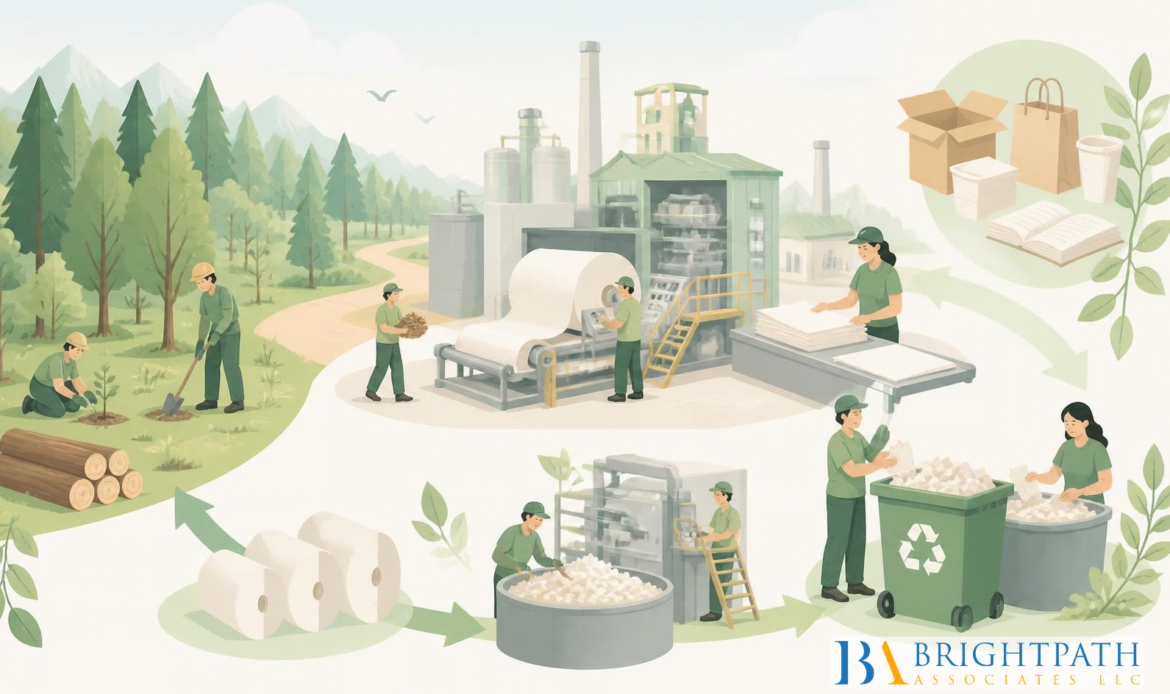
Recyclability cannot be separated completely from responsible forest management. Paper products depend on a supply chain that includes forests, harvesting operations, transportation, pulping, papermaking, converting, distribution, collection, and recycling.
Responsible #TimberHarvesting practices are therefore relevant to the broader circularity discussion. Sustainable forest management can support biodiversity, resource renewal, and long-term fiber availability when conducted under appropriate environmental and regulatory frameworks.
The relationship between forestry and manufacturing is also influenced by Forestry regulations, which vary considerably across countries. Differences in land-use rules, harvesting requirements, certification systems, and environmental protections can influence the availability and cost of raw materials.
Harmonized global recyclability guidelines should recognize these regional differences while maintaining clear principles for responsible material sourcing.
Developments in the broader forest products sector can influence paper manufacturing economics and material availability. Lumber industry trends are affected by construction demand, housing activity, energy markets, trade policies, forest conditions, and regional supply dynamics.
Changes within the lumber market can indirectly influence how forest resources are allocated across different applications. This reinforces the importance of understanding the forest products value chain as an interconnected system.
The paper sector also increasingly competes for sustainable biomass and fiber resources. Efficient resource utilization and improved recovery rates can help maximize the value generated from each unit of harvested material.
Automation in Paper Industry Manufacturing
Digitalization and Automation in Paper industry operations are creating new opportunities to improve manufacturing consistency and resource efficiency.
Automated production systems can monitor variables such as moisture, basis weight, coating application, machine speed, and energy consumption. Advanced sensors and analytics can identify deviations before they develop into significant quality problems.
Automation can also contribute to more consistent material specifications. Consistency matters for recyclability because unpredictable material compositions can create challenges for sorting and processing facilities.
Connected manufacturing systems can further improve traceability. Manufacturers can track raw materials, production conditions, and product specifications across different facilities, creating a stronger information foundation for global recyclability initiatives.
One of the biggest challenges to global harmonization is that recycling systems are not uniform. Some regions have advanced curbside collection and sophisticated sorting infrastructure, while others rely on different collection models or have limited recycling capacity.
A product’s recyclability should therefore be evaluated within the context of the infrastructure available in its intended market.
For multinational manufacturers, this may require designing products around common baseline principles while making region-specific adjustments where necessary. The objective should be to minimize unnecessary variation while recognizing genuine differences in recycling capabilities.
Digital product information could also support this process. Better material identification and standardized labeling may help consumers, collectors, sorters, and recyclers understand how specific products should be handled.
Sustainable Materials and Circular Product Development
The movement toward #SustainableMaterials is changing the way paper products are developed. Sustainability is no longer limited to choosing renewable raw materials. Companies are increasingly considering material efficiency, carbon impacts, manufacturing energy, recyclability, reuse potential, and end-of-life management.
Circular design requires manufacturers to consider what happens after the consumer has finished using the product. This means evaluating whether materials can remain within productive use rather than becoming waste.
For paper manufacturers, circular design can involve optimizing fiber utilization, minimizing unnecessary material complexity, improving recovery rates, and developing products that work effectively within existing recycling systems.
Harmonization has important economic implications. Different specifications for different markets can increase research, testing, procurement, manufacturing, and inventory costs. Common design guidelines could help reduce some of this complexity.
At the same time, implementing recyclable materials or redesigning packaging may require investments in equipment, supplier qualification, testing, and process modification.
The economics therefore depend on the entire value chain. Manufacturers need to evaluate material costs alongside waste reduction, processing efficiency, regulatory compliance, consumer demand, and long-term resource availability.
The business case for recyclability can become stronger when design improvements also generate operational benefits. Reduced material use, simplified structures, improved manufacturing consistency, and better recovery performance can contribute simultaneously to environmental and economic objectives.
The Role of Standards and Industry Collaboration
No single company can harmonize global recyclability practices independently. Designers, paper mills, converters, packaging companies, recyclers, equipment manufacturers, policymakers, and retailers all influence the outcome.
Industry associations and standards organizations can help establish common terminology, testing methodologies, and performance criteria. Manufacturers can then use these frameworks to evaluate new materials before commercializing them.
Collaboration is particularly important when developing new packaging formats. A design that appears recyclable from a manufacturing perspective may create challenges for sorting or pulping operations. Feedback from recyclers can therefore improve design decisions before products reach large-scale production.
A practical global framework should begin with clear definitions. Terms such as recyclable, repulpable, recoverable, compostable, and reusable should not be treated as interchangeable.
The next step is establishing measurable design criteria. These criteria can address fiber composition, coatings, adhesives, inks, barriers, additives, and other components that influence recovery.
Testing should then evaluate how products perform under realistic recycling conditions. Laboratory results can provide valuable information, but commercial-scale validation is important when assessing real-world performance.
Finally, manufacturers should create feedback mechanisms that allow recyclability information to influence future product development. As recycling technologies and infrastructure evolve, design guidelines should also be updated.
Talent and Leadership in a Changing Paper Industry
Technological and sustainability transformation requires specialized leadership. Companies need professionals who understand forest resources, paper manufacturing, automation, sustainability, supply chains, recycling technologies, and changing market expectations.
This makes #ExecutiveSearchRecruitment increasingly relevant within the forest products sector. Organizations pursuing major transformation initiatives may require executives capable of connecting technical innovation with commercial strategy.
Leaders who can coordinate multidisciplinary teams are particularly valuable because recyclability challenges cross traditional organizational boundaries. Product development, manufacturing, procurement, sustainability, engineering, and commercial teams must increasingly work together.
Conclusion
Global paper recyclability depends on more than improving recycling facilities. It begins with designing products that can move efficiently through collection, sorting, processing, and fiber recovery systems.
Harmonized design guidelines can help reduce unnecessary complexity, improve communication across the value chain, and provide manufacturers with clearer expectations. Advances in Paper recycling solutions, Paper and pulp technology, automation, and sustainable materials can further strengthen the industry’s ability to create circular products.
At the same time, responsible forestry, evolving Forestry regulations, changing Lumber industry trends, and developments in Wood product manufacturing must remain part of the wider conversation about resource management.
The future of paper circularity will ultimately depend on cooperation across the entire forest products ecosystem. By aligning design principles with recycling realities, manufacturers can move toward products that are not only functional and commercially viable but also better prepared for a circular economy.
Find your next leadership role in Paper & Forest Industry today!
Stay informed with the latest insights on Paper & Forest Industry!