
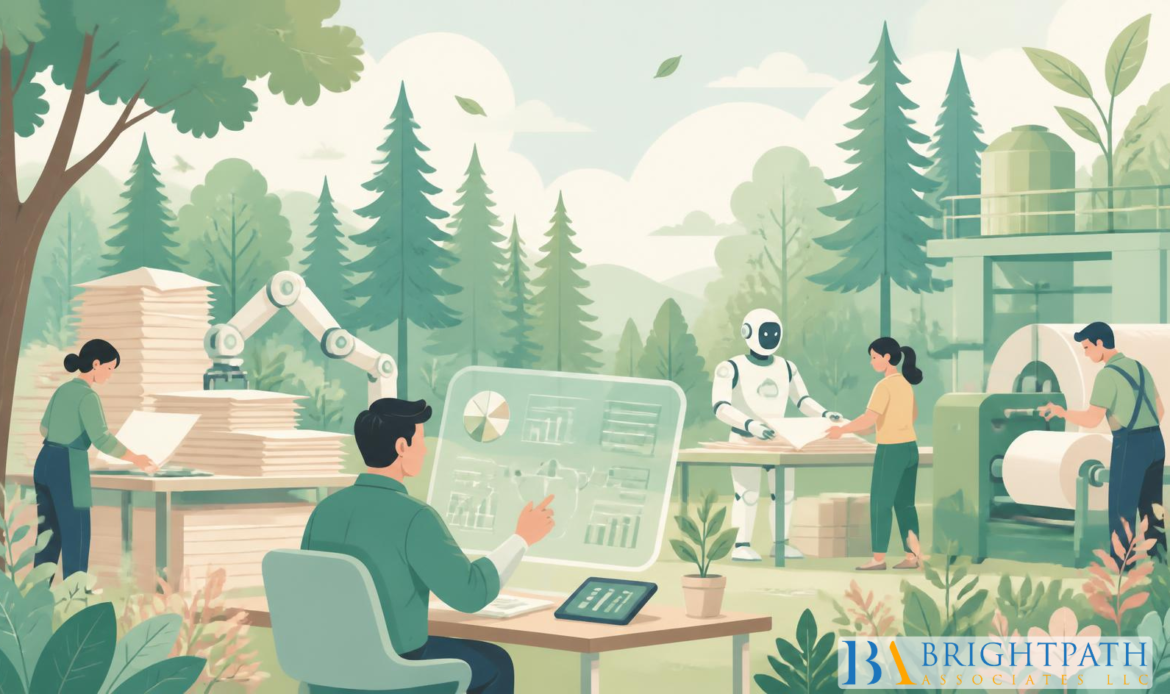
[Bethany, Connecticut – 16 September 2026] — BrightPath Associates has released a new industry analysis highlighting the growing importance of the human-machine orchestrator as paper, pulp, forestry, timber, recycling, and wood product manufacturers adopt increasingly connected technologies. The analysis explains why C-Suite leaders should consider professionals who can coordinate people, artificial intelligence, robotics, automation, industrial software, and real-time data rather than focusing on a single technical discipline. As companies navigate Forest product innovation, Paper recycling solutions, Sustainable materials, and advanced Paper and pulp technology, this emerging leadership capability can help connect technology investments with operational and business objectives.
A New Workforce Requirement for Industrial Organizations
Industrial automation is moving beyond isolated machines and repetitive tasks. Modern manufacturing environments increasingly combine sensors, robotics, artificial intelligence, analytics, automated inspection, enterprise software, and human decision-making. According to BrightPath Associates, this transition is creating demand for professionals who can manage the interaction between these systems and ensure technology supports practical production requirements.
The human-machine orchestrator is designed to fill this coordination gap. The role can connect engineering, operations, IT, maintenance, sustainability, and management while helping determine where automation should be applied and where human judgment remains essential. In a modern paper mill, for example, automated inspection can identify quality variations while sensors monitor production conditions and AI identifies potential equipment problems. Human professionals remain responsible for interpreting unusual situations and making important operational decisions.
BrightPath Associates’ analysis, Why Your Next Hire Should Be a Human-Machine Orchestrator, describes this professional as someone who coordinates “the interaction between employees, automated equipment, artificial intelligence systems, robotics, and industrial software.” This broader perspective is increasingly relevant for executives managing capital-intensive manufacturing operations where a technology decision can influence production, quality, energy consumption, workforce requirements, and profitability.
Connecting Automation With Business Performance
The rise of Automation in Paper industry operations creates both opportunities and management challenges. Advanced equipment can improve production consistency and machine performance, but technology investment alone does not guarantee better business results. Organizations still need professionals who understand how automation affects operating costs, labor utilization, production capacity, maintenance, waste, energy consumption, and product quality.
This business perspective is especially important as executives respond to changing Paper industry economics. A successful human-machine orchestrator can help management evaluate whether an AI platform, robotic system, predictive maintenance solution, or automated inspection technology is delivering measurable operational value. Rather than adopting technology simply because it is available, companies can connect technology decisions to specific commercial and manufacturing objectives.
The role can also support sustainability initiatives. Digital systems can track material flows, monitor energy consumption, identify waste, and support sustainability reporting. As demand for Sustainable materials increases, organizations can use connected technologies to integrate environmental objectives directly into manufacturing processes rather than treating sustainability as a separate corporate activity.
Executive Search for the Next Generation of Leadership
Finding professionals who can operate across technology, manufacturing, people, and business functions may require a broader recruitment strategy. BrightPath Associates notes that conventional hiring approaches can focus too narrowly on engineering credentials or technology experience. Executive search recruitment can instead help organizations identify candidates with combinations of manufacturing operations, automation, engineering management, digital transformation, maintenance, supply-chain systems, and industrial technology experience.
Communication and adaptability are also central to the role. A human-machine orchestrator may need to explain technology decisions to executives, translate operational requirements for technology teams, and help plant employees understand new systems. Experienced operators can remain valuable because their practical knowledge may identify conditions that algorithms do not recognize.
This workforce shift is particularly relevant as executives respond to changing Lumber industry trends and the increasing integration of technology across industrial operations. The objective is not simply to automate more tasks, but to create an environment where humans and machines perform complementary functions.
Preparing the Paper & Forest Industry for Connected Manufacturing
The emergence of the human-machine orchestrator reflects a broader transformation across the Paper & Forest Industry. Companies operating across forestry, pulp and paper, lumber, recycling, and wood products are increasingly required to coordinate technology investments with workforce capabilities, sustainability objectives, regulatory requirements, and commercial performance.
For C-Suite executives, the changing workforce model creates a new consideration when planning leadership teams. The organizations moving toward interconnected production environments will need professionals who can bring together information, technology, people, and processes. As BrightPath Associates explains, the future industrial workforce is not necessarily less human; it is increasingly digitally connected.
About BrightPath Associates
BrightPath Associates is an executive recruitment and talent solutions firm helping organizations identify skilled professionals and build strong leadership teams. The company provides workforce planning and strategy, leadership development, retention strategies, workplace safety, design and optimization, and recruitment solutions across multiple industries. Its mission is to connect organizations with the right talent while helping professionals find meaningful career opportunities.
Media Contact:
Name: Corporate Communications Team
Company: BrightPath Associates
Email: media@brightpathassociates.com
Website: https://brightpathassociates.com