
Introduction
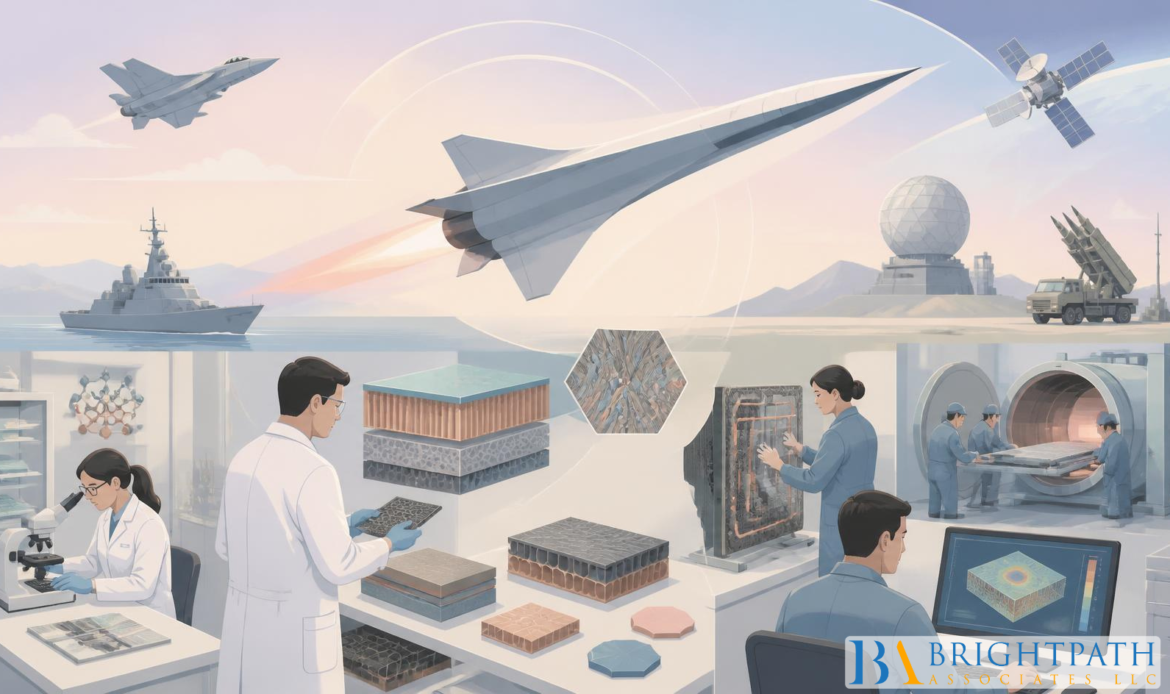
#HypersonicVehicles attract attention because of their extraordinary speed, maneuverability, and strategic importance. Yet behind every high-speed aerospace platform lies a less visible engineering challenge: controlling heat. As vehicles move through the atmosphere at extreme velocities, aerodynamic friction and compression generate intense thermal loads across leading edges, control surfaces, propulsion components, sensors, electronics, and structural interfaces.
The next stage of aerospace advancement is therefore not only about making vehicles faster. It is increasingly about making them capable of surviving, operating, sensing, communicating, and recovering under extreme thermal conditions. This is driving a quiet revolution in thermal management materials.
Advanced ceramics, high-temperature composites, thermal barriers, heat spreaders, ablative materials, metallic systems, and engineered interfaces are becoming strategically important. Their development intersects with Defense Space Policy, Defense Space Systems, Space Electronics, Space Robotics, and the broader Aerospace industry trends reshaping advanced manufacturing.
Why Thermal Management Has Become a Strategic Priority
Thermal management has historically been treated as a component-level engineering problem. In emerging aerospace platforms, it is becoming a system-level consideration. Heat affects structural integrity, propulsion performance, electronic reliability, sensor accuracy, communications, battery performance, and mission duration.
A vehicle can have advanced propulsion and sophisticated guidance systems, but excessive heat can limit the performance of the entire platform. Thermal constraints can determine where electronics are placed, how components are shielded, how materials are joined, and how long systems can remain operational.
This makes thermal engineering increasingly connected to mission architecture. Engineers must consider how heat is generated, transferred, stored, dissipated, or isolated throughout the vehicle rather than treating individual components independently.
For organizations developing Defense Space Systems, this systems-level perspective is particularly important. Spacecraft and high-speed atmospheric vehicles increasingly contain densely packed electronics and autonomous systems, creating thermal environments that are more complex than those of earlier platforms.
The technologies developed for extreme-speed atmospheric flight have applications beyond hypersonics. Spacecraft experience severe thermal cycling as they move between sunlight and shadow. Satellites must maintain sensitive instruments within specific operating temperatures while exposed to an environment with limited conventional heat-transfer mechanisms.
This creates demand for lightweight thermal-control materials, radiation-resistant coatings, thermal interface materials, heat pipes, conductive composites, and specialized insulation systems.
The same engineering principles can support spacecraft, launch vehicles, reusable systems, planetary exploration platforms, and autonomous Space Robotics. As robotic systems become more capable, their onboard computing requirements increase, creating additional heat-management challenges.
Thermal management is therefore becoming a common engineering language connecting atmospheric vehicles with space platforms.
The Rise of Advanced Thermal Materials
One of the most important changes is the increasing sophistication of materials themselves. Conventional metals remain important, but modern aerospace systems increasingly require materials that combine thermal stability with low weight, mechanical strength, electrical characteristics, and resistance to harsh environments.
Ceramic matrix composites can operate at temperatures that challenge conventional #MetallicMaterials. Carbon-based materials can provide advantageous thermal conductivity and lightweight characteristics. Advanced polymer composites can offer electrical insulation while managing heat transfer. Specialized coatings can provide thermal protection without adding excessive structural mass.
The challenge is not simply developing a material with excellent thermal performance. Engineers must ensure that it can be manufactured consistently, integrated with other materials, inspected, repaired, and qualified for demanding environments.
This is where Defense manufacturing becomes increasingly important.
Thermal Management and Space Electronics
The growth of Space Electronics is changing the thermal equation. Satellites, spacecraft, autonomous platforms, and high-performance aerospace vehicles require increasingly powerful processors, sensors, communications equipment, radar systems, and control electronics.
Higher computational capability generally creates higher heat loads. At the same time, electronics are becoming smaller and more densely integrated.
This produces a difficult engineering problem. Designers must remove heat from increasingly compact systems without creating excessive mass or consuming too much power. Thermal interfaces become critical because even a small resistance between a component and its cooling structure can reduce overall system efficiency.
Advanced thermal materials can help spread heat away from concentrated sources and distribute it across larger areas. In spacecraft, where traditional air-based cooling is unavailable, passive thermal-control systems and highly engineered conductive pathways become especially valuable.
Space Robotics adds another layer of complexity. Robotic arms, autonomous vehicles, inspection systems, and planetary exploration platforms must operate with limited opportunities for maintenance or intervention.
A robotic system may contain motors, actuators, processors, cameras, sensors, batteries, and communications equipment. Each generates or responds to heat differently.
Thermal management must therefore be integrated into robotic architecture from the beginning. Materials need to tolerate temperature fluctuations while maintaining dimensional stability and mechanical performance.
For Space Robotics, thermal reliability can influence mobility, precision, electronics performance, battery life, and mission duration. As robotic systems become more autonomous, their ability to monitor and manage their own thermal conditions may become an important part of onboard intelligence.
Thermal Engineering and Space Cybersecurity
At first glance, thermal materials may appear unrelated to Space Cybersecurity. However, modern aerospace systems increasingly connect physical performance with digital monitoring.
Sensors can measure temperature, pressure, vibration, and equipment performance. Software can use this information to detect abnormal conditions and predict failures. As these systems become networked, the integrity and availability of thermal-monitoring data become operational considerations.
A compromised or inaccurate sensor signal could potentially affect automated decisions about equipment operation. This illustrates how physical systems and digital systems are increasingly interconnected.
#SpaceCybersecurity therefore extends beyond communications and software protection. The broader challenge involves protecting the data and control systems that influence physical spacecraft operations.
Developing advanced thermal materials requires significant investment. Research, testing, qualification, specialized manufacturing, and integration can create long development cycles.
This is where Space Venture Capital can influence the pace of innovation. Investors increasingly look for technologies that address fundamental aerospace constraints rather than simply adding software features to existing platforms.
Thermal management can represent such an opportunity because it supports multiple applications. A material or manufacturing technique developed for one aerospace program may eventually find uses in satellites, launch vehicles, aircraft, robotics, energy systems, and high-performance electronics.
However, commercialization depends on more than technical performance. Companies must demonstrate repeatable manufacturing, supply-chain reliability, qualification readiness, and a realistic path toward production.
Regulatory Considerations Are Increasing
The development of advanced aerospace materials does not occur in a regulatory vacuum. Space Regulatory frameworks, export controls, safety requirements, environmental standards, procurement rules, and qualification procedures can influence how quickly new technologies move from laboratories to operational systems.
Material suppliers and aerospace manufacturers therefore need professionals who understand both technical requirements and regulatory environments.
This is particularly important as governments and commercial companies increasingly collaborate on space and defense programs. A material may demonstrate excellent laboratory performance but still require extensive testing before it can be incorporated into a mission-critical system.
Understanding regulatory requirements early can prevent costly redesigns and qualification delays.
The increasing sophistication of Defense Simulation is also changing how thermal technologies are developed. Engineers can increasingly model complex thermal environments before physical prototypes are manufactured.
Digital simulations can examine how heat moves through structures, how materials behave under changing temperatures, and how different configurations affect system performance.
Simulation does not eliminate physical testing. Instead, it can help engineers identify promising designs and reduce unnecessary prototype iterations.
The combination of simulation, advanced materials, sensors, and manufacturing creates a more integrated development process. Thermal engineering can become part of the digital design environment rather than an issue addressed near the end of a development program.
Manufacturing Challenges Behind Advanced Materials
The laboratory breakthrough is only the beginning. Manufacturing advanced thermal materials at aerospace quality levels requires process control, specialized equipment, inspection capabilities, and skilled personnel.
Manufacturers must control material composition, porosity, bonding, thickness, surface characteristics, and dimensional tolerances. Small inconsistencies can affect performance when components operate under extreme conditions.
This makes advanced #DefenseManufacturing dependent on workforce expertise. Engineers must understand materials science, production engineering, quality systems, nondestructive inspection, and aerospace qualification requirements.
Automation can improve repeatability, but experienced personnel remain essential for process development and problem-solving.
Changing Aerospace Industry Trends
Several Aerospace industry trends are converging around thermal management. Electrification is increasing the need for efficient heat removal from power electronics. Spacecraft are becoming more computationally intensive. Reusable vehicles face repeated thermal exposure. Autonomous platforms require more onboard processing. Smaller satellites are demanding compact and lightweight thermal architectures.
These trends suggest that thermal engineering will become increasingly integrated with electrical, mechanical, software, and materials engineering.
The industry is consequently moving toward multifunctional materials and integrated structures. Instead of using separate components for structural strength, thermal protection, electrical insulation, and heat spreading, engineers are increasingly exploring materials and architectures capable of performing several functions simultaneously.
Technology development ultimately depends on people capable of connecting specialized disciplines. Aerospace organizations may have excellent materials scientists, thermal engineers, software specialists, manufacturing engineers, and systems architects, yet still need leaders who can coordinate these capabilities.
This is creating a distinctive challenge for #ExecutiveSearchRecruitment.
The ideal candidate for advanced thermal-management programs may not fit a traditional job description. They may have experience spanning aerospace materials, defense programs, semiconductor thermal systems, advanced manufacturing, or spacecraft engineering.
More importantly, they need the ability to translate technical developments into operational and commercial outcomes. They must understand how a material decision affects manufacturing, how manufacturing affects cost, and how cost and qualification affect program timelines.
Building the Next Generation of Thermal Capability
The future of aerospace #ThermalManagement will likely involve a combination of advanced materials, simulation, embedded sensing, intelligent controls, and manufacturing innovation.
Materials may become more multifunctional. Structures may increasingly incorporate thermal pathways directly into their architecture. Sensors may continuously monitor thermal conditions. Software may predict thermal problems before they become failures.
These capabilities could support everything from high-speed aerospace vehicles to satellites and autonomous robotic platforms.
The most important change is that thermal management is moving from a supporting discipline toward a strategic design consideration.
Conclusion
Hypersonic speed may capture headlines, but thermal management is one of the engineering disciplines determining whether the next generation of aerospace systems can operate reliably.
Advanced thermal materials are influencing Defense Space Systems, Space Electronics, Space Robotics, and high-performance aerospace manufacturing. Their development is also connected to Defense Space Policy, Space Cybersecurity, Space Venture Capital, Space Regulatory requirements, and Defense Simulation.
The real revolution is not simply the creation of materials capable of surviving extreme heat. It is the integration of those materials into intelligent, lightweight, manufacturable, and increasingly autonomous systems.
As aerospace platforms become faster, smaller, smarter, and more computationally demanding, thermal performance will increasingly shape system architecture. Organizations that recognize this shift will need more than new materials. They will need advanced manufacturing capabilities, interdisciplinary engineering teams, digital simulation expertise, and leadership capable of connecting them.
That is why the future of aerospace may be defined as much by what controls heat as by what generates speed.
Find your next leadership role in Defense and Space Industry today!
Stay informed with the latest insights on Defense and Space Industry!