
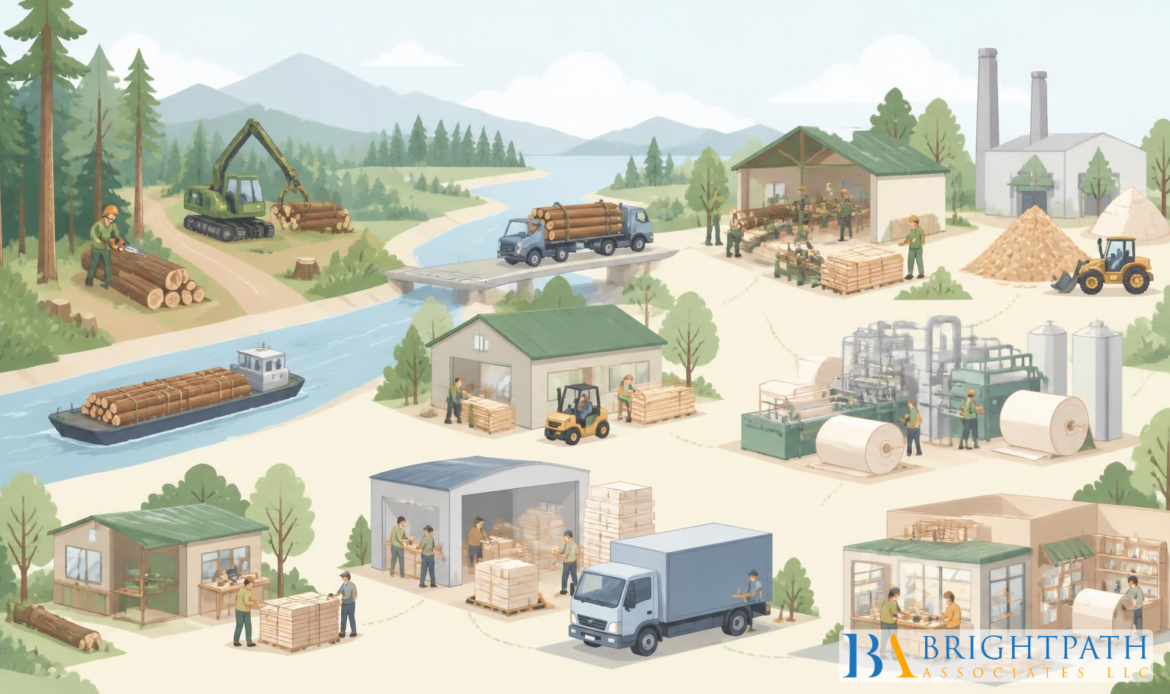
[Bethany, Connecticut – 15 September 2026] — BrightPath Associates has released new industry insights examining how companies across the Paper & Forest Industry can build stronger and more flexible wood supply chains by diversifying timber sourcing, expanding regional manufacturing capabilities, improving recycling, and investing in digital technologies. The analysis responds to growing challenges involving climate uncertainty, transportation disruptions, labor shortages, changing regulations, volatile raw material prices, and shifting customer demand. For C-Suite executives, the distributed supply chain model offers a strategic way to protect operational continuity while supporting long-term growth and innovation.
Building a More Resilient Wood Supply Chain
The global forest products sector is facing a major shift in how companies source, process, manufacture, and distribute wood-based products. Dependence on a single geographic region, supplier, transportation route, or processing facility can expose manufacturers to significant disruption. A distributed model creates alternatives by connecting multiple sourcing regions, suppliers, processing facilities, transportation options, and customer markets.
BrightPath Associates explains that resilience should not be viewed only as an operational issue. It is becoming a strategic capability as Forest product innovation, changing Lumber industry trends, sustainability expectations, and supply chain risks reshape the competitive environment. Companies that build flexibility into procurement and production can respond more effectively when regional shortages, severe weather, transportation delays, or other unexpected events affect operations.
The full analysis, Building Resilience: Designing a Distributed Wood Supply Chain, explores how executives can develop a supply network that can absorb disruption without allowing one weak point to threaten the entire business.
Technology, Recycling, and Sustainable Materials
Digital technology is becoming a key component of distributed supply chain management. Companies need better visibility into timber availability, inventory, transportation schedules, processing capacity, and customer demand. Digital platforms and predictive analytics can help executives identify potential shortages earlier and adjust procurement or production before disruptions become critical.
Advances in Paper and pulp technology can also improve efficiency within processing facilities. Automated controls, equipment monitoring, predictive maintenance, and digital production systems can help reduce unexpected downtime. Automation in Paper industry operations can further improve material handling, quality control, process consistency, and productivity while supporting facilities facing skilled labor shortages.
Resilience does not depend entirely on increasing virgin timber supplies. Paper recycling solutions can create an additional fiber source by recovering usable material from post-consumer and industrial waste streams. Better sorting, de-inking, pulping, and fiber recovery technologies can strengthen the broader supply network while supporting sustainability objectives.
For executives exploring these opportunities, BrightPath Associates’ insights for the Paper & Forest Industry provide additional perspective on the workforce and business challenges shaping the sector.
Sustainability and Regulatory Readiness
Demand for Sustainable materials is increasing across construction, packaging, furniture, consumer products, and industrial applications. Wood can play an important role in this transition when forests are responsibly managed and companies focus on efficient processing, waste reduction, recycling, and appropriate land management.
At the same time, Forestry regulations are becoming increasingly important to supply chain planning. Companies operating across different jurisdictions must understand requirements related to sustainable forest management, biodiversity, land use, harvesting practices, documentation, certification, and traceability. Digital tracking can improve visibility into where forest products originate and how they move through the supply chain.
A resilient network should therefore combine commercial flexibility with responsible sourcing. Strategic supplier relationships can support Forest product innovation by encouraging collaboration around new species, processing methods, recycling opportunities, and sustainable manufacturing practices. These partnerships can become especially valuable during disruptions because established relationships may provide faster access to information and alternative supply options.
About BrightPath Associates
BrightPath Associates is an executive recruitment and talent solutions firm that helps organizations identify the leadership and specialized professionals needed for sustainable growth. The company supports businesses through executive recruitment, workforce planning and strategy, leadership development, retention strategies, workplace initiatives, and industry-focused talent solutions. Its mission is to connect organizations with the right people while helping businesses build stronger and more effective teams.
Media Contact:
Name: Corporate Communications Team
Company: BrightPath Associates
Email: media@brightpathassociates.com
Website: https://brightpathassociates.com