
Introduction
The global wood and #ForestProductsSector is undergoing a fundamental transformation. Climate uncertainty, changing consumer expectations, transportation disruptions, labor shortages, regulatory requirements, and volatile raw material prices are forcing companies to rethink how they source, process, manufacture, and distribute wood-based products. A supply chain designed primarily for efficiency can become highly vulnerable when a single geographic region, supplier, transportation route, or processing facility experiences disruption.
Building resilience therefore requires a different approach. A distributed wood supply chain can reduce dependence on individual sources while creating greater flexibility across procurement, manufacturing, logistics, and customer delivery. Instead of relying on a centralized network, companies can establish multiple sourcing regions, processing locations, supplier relationships, and transportation options. This structure allows businesses to absorb disruptions while maintaining operational continuity.
The concept is particularly relevant as Forest product innovation, sustainable materials, advanced manufacturing technologies, and changing Lumber industry trends reshape the competitive landscape. Resilience is no longer simply an operational concern. It has become an important strategic capability for organizations seeking sustainable growth.
Understanding the Distributed Wood Supply Chain
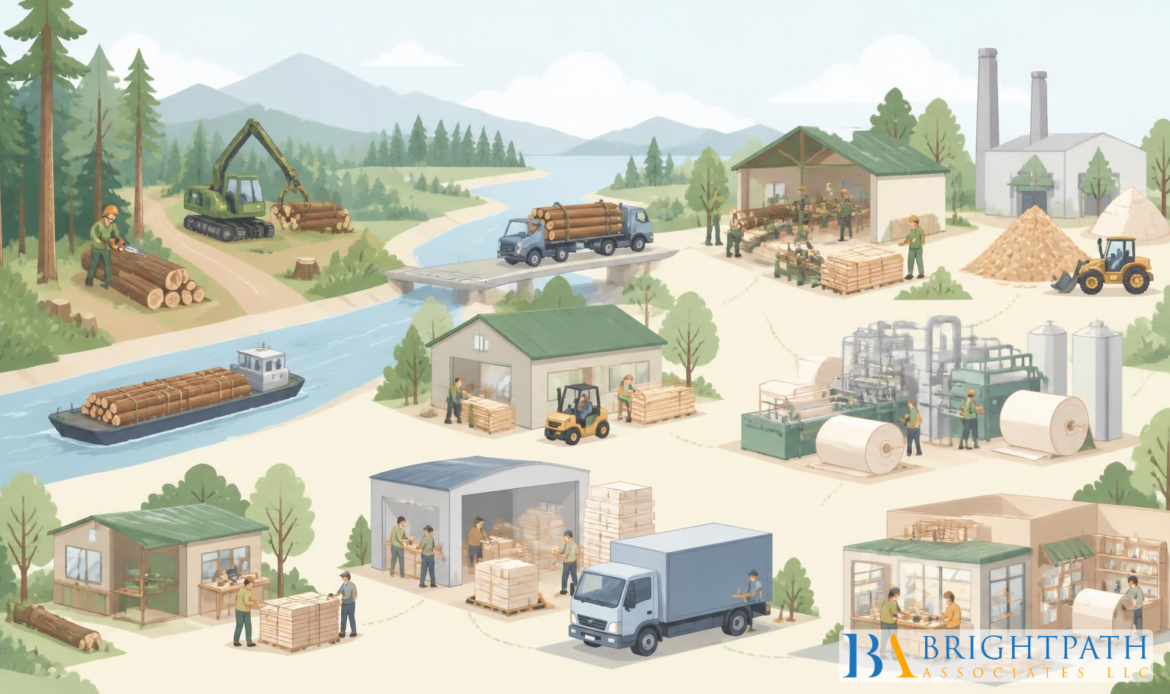
A distributed wood supply chain involves sourcing timber and forest products from multiple geographic regions and connecting them through a flexible network of suppliers, processors, manufacturers, distributors, and customers. The objective is not simply to increase the number of suppliers. Instead, the goal is to create alternatives that can be activated when one part of the network becomes constrained.
Traditional supply chains often prioritize consolidation because centralized purchasing and manufacturing can produce economies of scale. However, excessive concentration can create significant exposure. Severe weather, forest fires, transportation interruptions, regulatory changes, labor shortages, or changes in local timber availability can quickly affect production.
A distributed model creates redundancy. If one region experiences a shortage, another sourcing region may partially compensate. If one mill experiences an operational interruption, production may potentially be shifted to another facility. This flexibility gives companies greater control over uncertainty.
Diversifying Timber Sourcing
#TimberHarvesting is inherently connected to geography. Forest conditions, species availability, climate, land ownership, infrastructure, and Forestry regulations vary considerably between regions. Companies that depend heavily on one geographic sourcing area may therefore face substantial risks.
Diversifying procurement across several regions can reduce this exposure. A manufacturer might establish relationships with suppliers in different forestry regions while maintaining consistent standards for quality, sustainability, and traceability.
Diversification does not mean purchasing indiscriminately. Companies must evaluate forest health, transportation infrastructure, harvesting practices, supplier reliability, and long-term availability before adding a sourcing region. Strategic procurement can create a balanced supply network capable of responding to regional disruptions.
A distributed network may initially appear more expensive because managing multiple suppliers can involve additional logistics and coordination. However, evaluating resilience solely through short-term procurement costs can be misleading.
A supply interruption can generate much greater costs through production downtime, missed customer deliveries, emergency purchasing, and lost contracts. Companies should therefore evaluate the total economic impact of supply risk.
The economics of resilience can become particularly important as Paper industry economics and wood-product markets experience changing demand patterns. Maintaining several qualified sources can provide companies with greater pricing flexibility and reduce exposure to sudden market shocks.
Technology and Supply Chain Visibility
Technology is becoming increasingly important in managing distributed networks. Companies need visibility into timber availability, inventory levels, transportation schedules, processing capacity, and customer demand.
Digital supply chain platforms can help organizations monitor materials as they move from forests to mills and manufacturing facilities. Predictive analytics can identify potential shortages, while data-driven planning can help organizations adjust procurement before disruptions become critical.
Forest product innovation is also creating opportunities to improve traceability. Digital tools can connect harvesting information with processing and manufacturing records, allowing businesses to better understand the origin and movement of wood products.
Advanced Paper and #PulpTechnology can similarly improve operational efficiency within processing facilities. Better monitoring systems, automated controls, and predictive maintenance can help facilities maintain consistent production while reducing unexpected downtime.
Resilience does not depend exclusively on increasing virgin timber supplies. Recycling can provide an additional source of fiber and reduce pressure on forests.
Paper recycling solutions can help manufacturers diversify their raw material base by recovering usable fiber from post-consumer and industrial waste streams. This can create a complementary supply channel that is less dependent on conventional timber procurement.
For paper manufacturers, integrating recycled material can also support sustainability objectives while responding to growing demand for circular production systems. Improvements in sorting, collection, de-inking, pulping, and fiber recovery technologies are making recycling increasingly important within the broader forest products ecosystem.
The strategic value of recycling extends beyond environmental performance. A company with access to both virgin and recovered fiber may have greater flexibility when one source becomes constrained.
Wood Product Manufacturing and Regional Flexibility
Wood product manufacturing is another area where distributed strategies can improve resilience. Manufacturing capacity concentrated in a single location may provide operational efficiency but can also create a significant vulnerability.
Companies can reduce this risk by developing complementary production capabilities across different facilities. Not every facility needs to manufacture every product. Instead, facilities can specialize while retaining enough flexibility to support other product categories during periods of disruption.
For example, one facility may focus on structural lumber while another specializes in engineered wood products. If market conditions change, production schedules can be adjusted according to available raw materials and customer demand.
This approach also supports regional customer service. Manufacturing closer to major markets can reduce transportation distances, shorten delivery times, and potentially lower logistics exposure.
Automation can strengthen distributed supply chains by improving productivity and reducing dependence on manual processes. Automation in Paper industry operations, for example, can improve process monitoring, quality control, material handling, and production consistency.
Similar principles apply to sawmills, panel manufacturing, pulp facilities, and other wood-processing operations. Automated sorting and grading systems can improve material utilization, while advanced sensors can identify equipment conditions before failures occur.
However, automation should not be viewed as a substitute for workforce development. Skilled employees remain essential for operating, maintaining, and improving automated systems. The strongest model combines technology with human expertise.
Automation can also support resilience by allowing facilities to maintain production with smaller teams during labor shortages. At the same time, companies must invest in training employees to work effectively alongside increasingly sophisticated equipment.
Responding to Lumber Industry Trends
Lumber industry trends increasingly reflect changing construction demand, sustainability expectations, technological development, and market volatility. Construction cycles can significantly influence lumber consumption, while changes in housing activity can rapidly alter regional demand.
A distributed supply chain allows companies to respond more effectively to these fluctuations. Inventory can potentially be positioned closer to high-demand markets, while production can be adjusted across facilities depending on regional conditions.
Engineered wood products are also creating new opportunities. Innovations in cross-laminated timber, laminated products, advanced panels, and other engineered solutions can increase the range of applications for forest-based materials.
Companies that monitor these trends closely can align procurement and manufacturing strategies with emerging demand rather than reacting after market conditions have already changed.
#ForestryRegulations are becoming increasingly important in supply chain planning. Governments and regulators are placing greater emphasis on sustainable forest management, environmental protection, biodiversity, land use, and traceability.
Companies operating across multiple jurisdictions must understand how regulatory requirements differ between regions. A sourcing strategy that appears commercially attractive may create compliance challenges if harvesting practices, documentation, or certification requirements do not meet applicable standards.
Strong supplier qualification processes can help organizations verify compliance before materials enter the supply chain. Digital traceability can further strengthen accountability by providing greater visibility into the origin and movement of forest products.
Regulatory readiness can ultimately become a competitive advantage. Companies capable of demonstrating responsible sourcing may be better positioned to satisfy customers who increasingly demand transparency.
Sustainable Materials and Customer Expectations
Sustainable materials are becoming increasingly important across construction, packaging, furniture, consumer products, and industrial applications. Customers are looking beyond product performance and asking how materials are sourced, processed, transported, and ultimately disposed of.
Wood has an important role in this transition because responsibly managed forests can provide renewable raw materials. However, sustainability depends on responsible forestry, efficient processing, waste reduction, recycling, and appropriate land management.
A resilient supply chain should therefore integrate sustainability into its operating model rather than treating it as a separate initiative. Efficient transportation, improved material yields, responsible harvesting, recycling, and renewable energy integration can collectively strengthen both environmental and operational performance.
A distributed network works best when supplier relationships are strategic rather than purely transactional. Companies need suppliers that can provide consistent quality, transparent sourcing information, reliable delivery, and flexibility during periods of market disruption.
Long-term relationships can also encourage collaboration around Forest product innovation. Suppliers and manufacturers can jointly explore new species, processing methods, recycling opportunities, and sustainable production practices.
Partnerships can become especially valuable during disruptions because companies with established relationships may have greater access to information and alternative supply options than organizations that depend exclusively on spot-market purchasing.
Leadership and Talent in a Resilient Supply Chain
Technology, infrastructure, and supplier diversification are important, but resilient supply chains ultimately depend on people. Leaders must understand procurement, forestry, manufacturing, logistics, sustainability, technology, and commercial strategy simultaneously.
Organizations may therefore need executives who can manage complexity across multiple functions and geographic markets. #ExecutiveSearchRecruitment can help companies identify leadership professionals with experience in supply chain transformation, manufacturing strategy, sustainability, operations, and international market development.
Strong leadership is particularly important when implementing a distributed model because decentralization can create additional complexity. Leaders must establish common standards while allowing regional teams enough flexibility to respond to local conditions.
The future of the wood products industry will likely involve greater integration between physical supply networks and digital technologies. Companies will increasingly use real-time information, predictive analytics, automation, recycling technologies, and advanced manufacturing systems to manage material flows.
Resilience will also become more closely connected with sustainability. Businesses that reduce waste, improve material utilization, diversify raw materials, and strengthen recycling can simultaneously reduce environmental impact and supply risk.
A distributed supply chain provides the structural foundation for this transformation. It allows companies to respond to disruptions while creating opportunities for innovation and regional growth.
Conclusion
Building a resilient wood supply chain requires companies to move beyond traditional assumptions about centralized efficiency. Diversified timber sourcing, regional manufacturing, recycling, digital visibility, automation, strategic supplier relationships, and regulatory preparedness can collectively create a network capable of absorbing disruption.
The objective is not to eliminate uncertainty. That is impossible in an industry influenced by climate conditions, forestry policies, transportation markets, construction cycles, and global economic conditions. The objective is to ensure that a disruption in one part of the network does not compromise the entire business.
As Forest product innovation accelerates and demand for sustainable materials grows, companies that design flexible supply networks will be better positioned to compete. Resilience will increasingly become a defining capability within the wood, lumber, paper, and pulp industries, enabling organizations to protect continuity while pursuing innovation, efficiency, and sustainable long-term growth.
Find your next leadership role in Paper & Forest Industry today!
Stay informed with the latest insights on Paper & Forest Industry!