
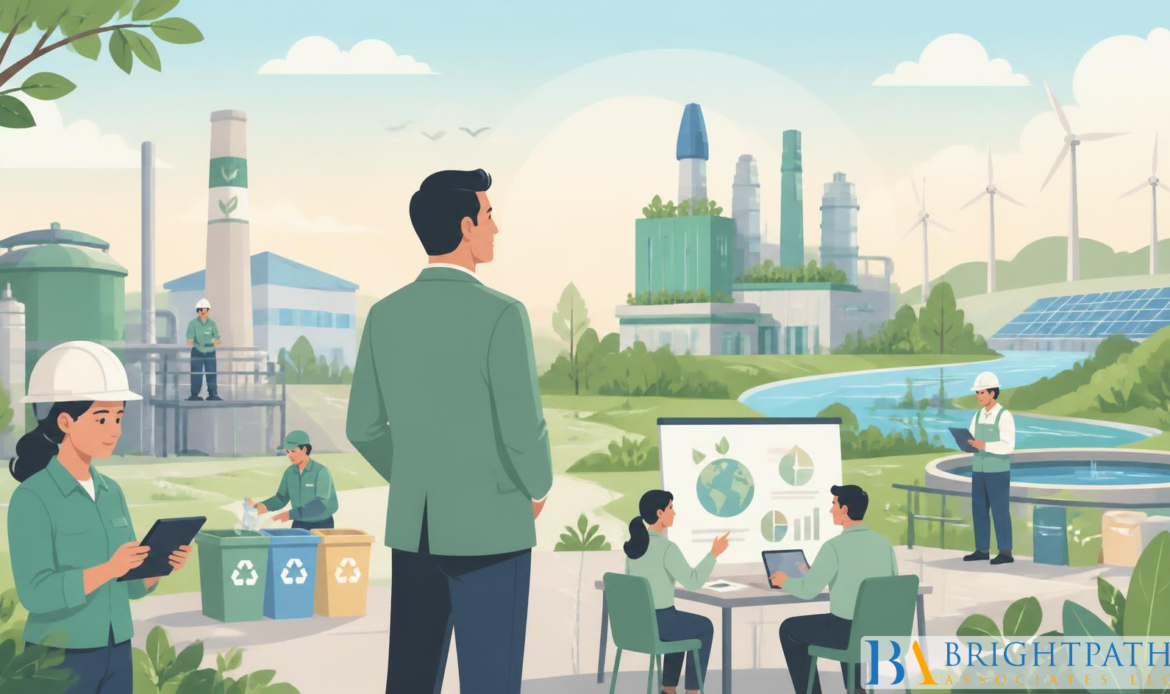
Introduction
#EnvironmentalTransformation is no longer a responsibility limited to sustainability departments, compliance teams, or environmental specialists. For modern industrial organizations, environmental performance is increasingly connected to operational resilience, technology investment, reputation, regulatory exposure, and long-term competitiveness. As climate risks, resource constraints, changing regulations, and stakeholder expectations reshape business conditions, chief executive officers are being asked to lead organizations through an increasingly uncertain environmental landscape.
The role of the CEO is particularly important because environmental transformation often requires decisions that extend beyond individual departments. Investments in cleaner technologies may affect capital allocation. Changes in production processes can influence operating costs. New environmental requirements may alter supply chains and facility strategies. Workforce capabilities may also need to evolve as companies adopt new technologies and environmental management practices.
Within the growing Environmental services ecosystem, these challenges are creating a new definition of leadership. CEOs must understand environmental risks while recognizing the commercial opportunities associated with innovation. The organizations that successfully navigate this transition will not simply respond to environmental pressure; they will integrate environmental thinking into their broader business strategy.
The CEO as the Architect of Environmental Strategy
Environmental transformation begins with leadership commitment. A CEO establishes the priorities that determine whether sustainability becomes a strategic business function or remains an isolated corporate initiative. When environmental objectives are integrated into business planning, operating teams are more likely to treat them as measurable performance goals rather than optional projects.
The CEO must establish a clear connection between Environmental sustainability and business resilience. Reducing energy consumption, minimizing waste, improving resource efficiency, and lowering emissions can potentially reduce operating costs while preparing companies for future regulations and market expectations.
However, effective leadership requires more than announcing ambitious environmental objectives. CEOs must ensure that environmental priorities are supported by investment, accountability, appropriate talent, and measurable operational outcomes. This requires organizations to understand where environmental performance creates the greatest strategic impact.
One of the greatest challenges facing executives is uncertainty. Environmental regulations continue to evolve across jurisdictions, while customers, investors, employees, and communities increasingly expect companies to demonstrate responsible environmental practices.
Environmental compliance therefore cannot be treated simply as a legal requirement. For CEOs, it represents a risk-management responsibility. Failure to understand changing regulations can lead to financial penalties, operational disruption, reputational damage, and costly last-minute investments.
A forward-looking CEO builds systems that allow the organization to anticipate regulatory developments rather than reacting after requirements become mandatory. This may involve strengthening environmental data collection, investing in monitoring technologies, improving reporting processes, and developing internal expertise.
The Environmental industry itself is also evolving as businesses seek specialized capabilities to navigate increasingly complex requirements. Companies that build strong relationships with environmental specialists can respond more effectively when regulatory expectations change.
Turning Environmental Innovation Into Competitive Advantage
Environmental transformation should not be viewed exclusively as a cost. It can also become a source of innovation and differentiation. Environmental innovation increasingly influences how companies design products, operate facilities, manage resources, and interact with customers.
CEOs can encourage innovation by creating an environment where environmental challenges are treated as opportunities for technological improvement. A company facing high energy consumption, for example, may investigate advanced energy-management systems. An organization dealing with industrial emissions may explore more efficient Air pollution control technologies.
The objective is not simply to adopt technology because it is considered environmentally progressive. Leadership teams should evaluate whether an innovation solves a meaningful operational problem while improving environmental performance.
This approach can turn sustainability from a compliance obligation into a business-development strategy.
Technology is becoming one of the most important tools available to CEOs pursuing environmental transformation. Clean technology can support more efficient energy use, lower emissions, improved resource utilization, and reduced environmental impact across industrial operations.
#GreenTechnology similarly offers opportunities across manufacturing, waste management, water systems, transportation, construction, and energy infrastructure. However, technology investments require careful evaluation because not every solution will deliver the expected environmental or financial benefits.
CEOs must therefore ask whether a technology is scalable, economically viable, compatible with existing infrastructure, and supported by the necessary workforce capabilities. The strongest investment decisions typically consider both immediate operational improvements and longer-term strategic value.
Leadership is also responsible for creating an environment in which experimentation can occur without compromising operational stability. Pilot programs, controlled implementation, and measurable performance assessments can help companies evaluate emerging technologies before deploying them across entire operations.
Environmental Transformation and Operational Resilience
Environmental strategy becomes more powerful when it is connected to operational resilience. Climate-related disruptions, resource shortages, energy volatility, and changing environmental requirements can affect production and supply chains.
A CEO must therefore understand environmental exposure as part of enterprise risk. Water availability, energy consumption, waste management, emissions requirements, and extreme weather conditions can all influence business continuity.
Water treatment provides an important example. Industrial organizations that rely heavily on water may face increasing pressure to improve consumption efficiency, reuse water, or upgrade treatment infrastructure. Investing in advanced systems can support environmental objectives while also protecting critical production capabilities.
Environmental transformation therefore becomes a form of resilience planning. Companies that prepare early may have greater flexibility when environmental conditions or regulatory requirements change.
CEOs cannot personally manage every environmental initiative. Their responsibility is to create organizational systems that make environmental accountability part of everyday decision-making.
This requires collaboration between operations, finance, engineering, procurement, human resources, technology, and environmental teams. When these functions operate independently, environmental initiatives may struggle to achieve meaningful scale.
For example, an engineering team may identify an opportunity to reduce emissions, but finance must evaluate the investment. Procurement may need to identify suppliers, operations may need to modify processes, and employees may require training. Environmental transformation therefore depends on cross-functional leadership.
The CEO’s role is to create alignment among these groups and ensure that environmental priorities remain connected to the company’s overall strategy.
The Talent Challenge Behind Environmental Transformation
Technology and strategy cannot succeed without appropriate talent. As environmental responsibilities become more complex, companies increasingly require professionals who understand regulations, engineering, data, sustainability, operations, and emerging technologies.
This is creating greater demand for specialized leadership capabilities. Environmental executive search is becoming increasingly relevant for organizations seeking executives who can combine environmental expertise with commercial and operational understanding.
#TraditionalEnvironmentalKnowledge alone may not be sufficient for senior leadership roles. Companies increasingly need leaders who can translate environmental objectives into financial, operational, and strategic outcomes.
CEOs should therefore treat talent planning as an essential component of environmental transformation. Recruiting the right environmental leaders can influence the organization’s ability to implement technology, manage compliance, identify risks, and create measurable sustainability improvements.
Environmental transformation also affects employees throughout the organization. New technologies may require different technical skills, while changes in production processes can create new operational responsibilities.
A CEO must therefore support workforce development alongside technology investment. Employees should understand why environmental changes are being introduced and how those changes affect their responsibilities.
Training can also reduce resistance to transformation. Workers who understand the operational benefits of new systems are more likely to participate actively in implementation.
The future workforce within the Environmental services and Environmental industry sectors will increasingly require interdisciplinary capabilities. Technical specialists will need greater awareness of business objectives, while business leaders will need a stronger understanding of environmental risks and technologies.
Measuring What Matters
Environmental transformation becomes difficult to manage when companies cannot measure progress effectively. CEOs need reliable information that connects environmental performance with business outcomes.
Metrics may include energy consumption, emissions, water use, waste generation, compliance performance, resource efficiency, and technology-related improvements. However, measurement should focus on meaningful outcomes rather than simply generating large volumes of data.
Executives should also consider whether environmental metrics are connected to financial performance and operational resilience. A reduction in energy consumption, for example, may simultaneously improve environmental performance and lower operating costs.
Strong measurement systems allow CEOs to identify successful initiatives, correct underperforming programs, and communicate progress with greater credibility.
Environmental transformation is also a communication challenge. Customers, employees, investors, regulators, communities, and business partners may have different expectations regarding environmental performance.
CEOs must communicate environmental objectives clearly while avoiding exaggerated claims. Credibility depends on demonstrating measurable progress and acknowledging areas where improvement is still required.
Transparent communication can strengthen trust, particularly when environmental transformation involves significant operational changes. Leadership teams should explain not only what the company is changing but why those changes matter to customers, employees, communities, and long-term business performance.
Creating a Culture of Continuous Environmental Improvement
Environmental transformation should not be treated as a one-time project. Environmental conditions, technologies, regulations, and stakeholder expectations will continue to change.
The most resilient organizations therefore develop a culture of continuous improvement. CEOs can encourage this culture by making environmental performance part of strategic reviews, operational discussions, capital planning, and leadership evaluations.
Continuous improvement also requires organizations to learn from failures. Not every sustainability initiative will produce the expected result. Companies that analyze unsuccessful projects can improve future decisions and avoid repeating costly mistakes.
This mindset transforms environmental strategy from a static corporate program into an ongoing process of organizational learning.
The Strategic Future of Environmental Leadership
The #EnvironmentalIndustry is likely to become increasingly interconnected with technology, infrastructure, manufacturing, energy, and corporate strategy. As environmental challenges become more complex, CEOs will need to understand how multiple systems interact.
Future leadership will require a combination of environmental awareness, technological literacy, financial discipline, and organizational adaptability. Executives who can connect these areas will be better positioned to identify opportunities while managing uncertainty.
The growth of Clean technology, advanced monitoring systems, improved Air pollution control, modern Water treatment, and other environmental solutions will create new markets as well as new operational expectations. Companies that build leadership teams capable of understanding these developments can turn environmental transformation into a source of long-term value.
Conclusion: Leading Transformation With Purpose and Discipline
Environmental transformation requires more than technology and compliance. It requires leadership capable of making difficult decisions under uncertainty while maintaining a clear long-term strategic direction.
The CEO’s role is to establish environmental priorities, allocate resources, develop talent, manage risk, encourage Environmental innovation, and ensure that Environmental sustainability is connected to the broader business strategy. By integrating Environmental compliance into enterprise risk management and investing selectively in Clean technology and Green technology, organizations can strengthen both environmental performance and operational resilience.
The transition will not always be predictable. Regulations will evolve, technologies will mature, costs will change, and stakeholder expectations will continue to develop. Yet organizations with strong leadership can turn uncertainty into an opportunity for adaptation.
Ultimately, environmental transformation is not simply about becoming greener. It is about building organizations that are more resilient, innovative, efficient, and prepared for the conditions of the future. That transformation depends on people as much as technology, making strategic talent decisions and #ExecutiveSearchRecruitment an increasingly important part of the environmental leadership agenda.
Find your next leadership role in Environmental Services Industry today!
Stay informed with the latest insights on Environmental Services Industry!