
Introduction
Precision machining is entering a new phase of #IndustrialTransformation. Advanced sensors, machine learning algorithms, robotics, computer vision, and connected production systems are changing how manufacturers design, produce, inspect, and maintain components. Artificial intelligence can now analyze production data, identify patterns, predict equipment behavior, optimize machining parameters, and support faster operational decisions. Yet even as these capabilities expand, one principle is becoming increasingly important: automation should not eliminate human judgment.
The human-in-loop automation model provides a practical framework for combining artificial intelligence with experienced professionals. Instead of allowing AI systems to operate independently, this approach keeps skilled employees involved in monitoring, validating, correcting, and improving automated decisions. For precision machining, where small deviations can result in significant quality, safety, or financial consequences, human oversight is particularly valuable.
For the modern Industrial machinery sector, the objective is therefore not simply to automate more processes. The objective is to build intelligent production environments in which technology and human expertise complement one another. This balance can help manufacturers improve Manufacturing efficiency while maintaining the flexibility and judgment required for complex machining operations.
Precision machining operates within extremely narrow tolerances. Components used in aerospace, automotive, medical equipment, energy, defense, and advanced industrial applications may require highly accurate dimensions and consistent surface finishes. Even sophisticated AI systems can encounter situations that were not represented adequately in their training data.
An algorithm may identify a statistical pattern suggesting that a machine should adjust its cutting speed or tool path. However, an experienced machinist may recognize another factor that the system cannot fully interpret, such as unusual material behavior, vibration caused by a fixture, a tool defect, or an environmental condition affecting the machining process.
This is where human oversight becomes essential. AI can process large quantities of information faster than people, but human operators can evaluate context, consequences, and exceptions. The combination creates a more resilient production environment than either technology or human decision-making could provide independently.
Understanding the Human-in-Loop Automation Model
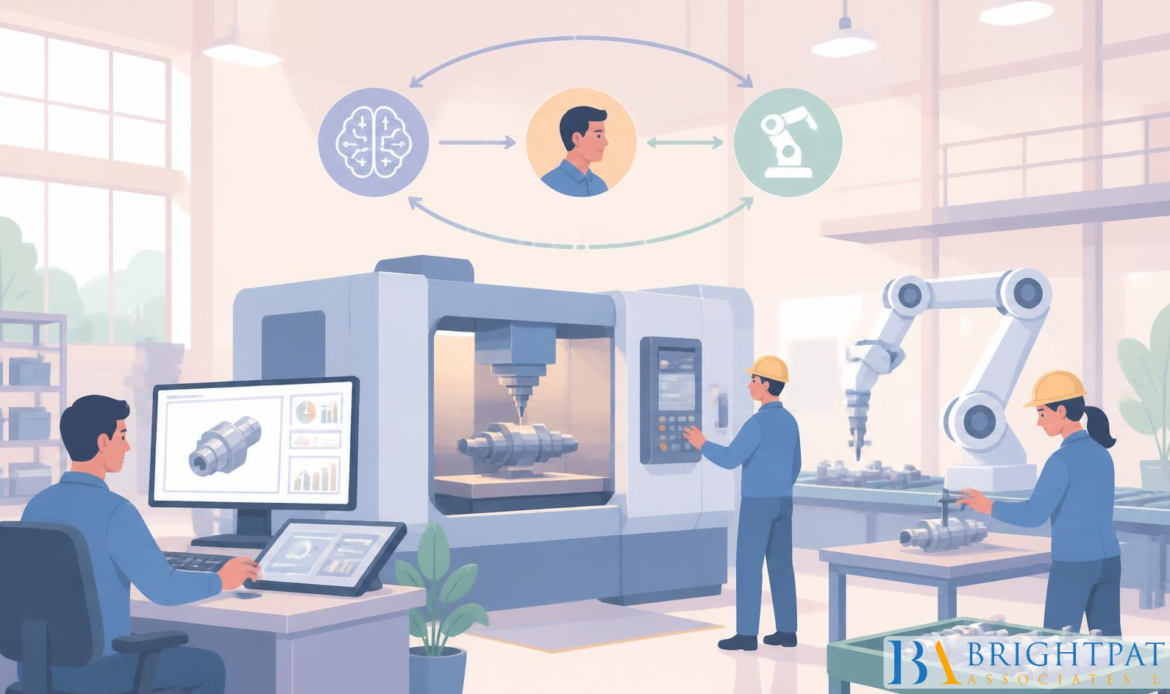
The human-in-loop model places people at specific decision points within an automated workflow. AI systems collect operational data, analyze it, identify potential issues, and recommend actions. Human specialists then review important decisions before they are implemented or intervene when the system detects an uncertain condition.
In a precision machining environment, this might involve AI monitoring spindle loads, cutting temperatures, vibration levels, tool wear, dimensional measurements, and production cycle times. When the system detects an unusual pattern, it can alert an operator or manufacturing engineer. Instead of automatically changing critical parameters, the system can provide a recommendation that a qualified professional reviews.
This approach creates a controlled feedback loop. The machine generates data, AI interprets the data, the human evaluates the recommendation, and the resulting decision becomes additional information for improving the system. Over time, this interaction can make automation more reliable while preserving human accountability.
One of the most important advantages of the human-in-loop model is that it changes how organizations think about AI. Rather than viewing artificial intelligence as a replacement for machinists and engineers, manufacturers can use it as an advanced decision-support capability.
AI is particularly effective at recognizing relationships across enormous datasets. A production system may monitor thousands of machining cycles and identify subtle correlations between tool wear, material characteristics, machine temperature, and dimensional accuracy. A human operator might not have the time to examine every data point individually.
However, recognizing a pattern does not necessarily mean understanding its cause. Human experts remain valuable because they can investigate why a pattern exists and determine whether an AI recommendation makes operational sense. This relationship is particularly important when manufacturers deploy Industrial automation solutions in complex production environments.
Improving Quality Through Collaborative Intelligence
#QualityControl is one of the strongest applications for human-in-loop automation. AI-powered inspection systems can analyze measurements and images at high speed, identifying deviations that might be difficult to detect consistently through manual inspection alone.
For example, machine vision systems can identify surface imperfections, dimensional inconsistencies, or unusual geometries. AI can then classify defects according to historical production data and determine whether they resemble known failure patterns.
Human specialists can remain responsible for reviewing ambiguous cases and determining whether a detected variation actually affects product performance. This reduces the risk of blindly accepting an AI classification that may be technically unusual but operationally acceptable.
The result is a collaborative quality system in which machines provide speed and consistency while skilled professionals provide interpretation and accountability.
The same principle applies to Machinery maintenance. Predictive systems can continuously monitor equipment and estimate the likelihood of component failure. Sensors can track vibration, temperature, pressure, electrical consumption, lubrication conditions, and other indicators of machine health.
AI can use this information to identify early warning signals and recommend maintenance actions. Instead of waiting for a machine to fail, manufacturers can schedule intervention before a serious breakdown occurs.
However, predictive maintenance decisions still benefit from human validation. A maintenance engineer may know that a machine is scheduled for a production changeover, that a replacement component has not yet arrived, or that a particular vibration pattern is normal under specific operating conditions.
Human oversight allows organizations to distinguish between genuine failure risks and false alarms. This can prevent unnecessary maintenance while ensuring serious problems receive immediate attention.
Supporting the Workforce Rather Than Eliminating It
Concerns about automation often focus on whether machines will replace Manufacturing jobs. In precision machining, however, the more realistic transformation is likely to involve changes in job responsibilities rather than complete elimination of human roles.
As repetitive monitoring and data analysis become increasingly automated, machinists may spend more time handling complex setups, process optimization, troubleshooting, quality decisions, and technology management. Engineers may increasingly work with production data, AI models, digital twins, and advanced control systems.
This shift requires workforce development. Employees need opportunities to learn how automated systems work, how to interpret AI recommendations, and how to recognize situations where human intervention is necessary.
For US Machinery manufacturers, developing this combination of technical and analytical expertise could become a major competitive advantage. Organizations that invest in both technology and people may be better positioned to capture the benefits of intelligent manufacturing.
The human-in-loop approach is not limited to new production equipment. Manufacturers operating Used machinery can also introduce intelligent monitoring and decision-support technologies without completely replacing their existing assets.
Older machines may lack the connectivity of modern equipment, but sensors and retrofit technologies can provide valuable operational data. AI platforms can then analyze this information to support maintenance, energy management, process monitoring, and production planning.
Human expertise becomes particularly important in these environments because legacy equipment may behave differently from newer standardized systems. Experienced operators often understand the specific characteristics of older machines that are not captured in digital documentation.
Instead of treating older equipment as a barrier to automation, manufacturers can combine retrofit technologies with employee knowledge to create a gradual path toward intelligent production.
Connecting Automation With Machinery Financing Decisions
Investment decisions are another area where human judgment remains essential. Modern automation technologies can deliver substantial productivity benefits, but acquiring advanced equipment requires careful financial analysis.
#MachineryFinancing decisions should consider production volumes, expected utilization, maintenance costs, workforce requirements, energy consumption, technology compatibility, and long-term return on investment. AI can help analyze these variables and model different scenarios, but leadership must ultimately determine whether an investment supports the company’s broader strategy.
For manufacturers operating with limited capital, a human-in-loop approach can prevent technology investment from becoming an exercise in chasing the newest equipment. Instead, decision-makers can use AI-generated insights to identify where automation is most likely to produce measurable operational value.
Manufacturing efficiency is not simply about producing more components in less time. In precision machining, efficiency must also account for quality, equipment reliability, material utilization, changeover requirements, worker safety, and customer specifications.
Fully autonomous systems may optimize a process according to predefined metrics, but those metrics do not always represent the complete business objective. Human oversight allows production teams to challenge automated recommendations when circumstances change.
For example, an AI system may recommend maximizing machine utilization, while an experienced production manager may prioritize completing a high-value customer order or preserving equipment capacity for a critical production run. Human decision-makers can balance these competing priorities.
This flexibility is one of the strongest arguments for maintaining human involvement in intelligent manufacturing systems.
Building Trust Between Employees and AI Systems
Technology adoption depends heavily on employee trust. Workers are unlikely to embrace AI if they believe the system is designed primarily to monitor them or eliminate their roles.
Manufacturers can improve acceptance by clearly defining the purpose of automation. Employees should understand that AI is being implemented to reduce repetitive work, identify problems earlier, improve safety, and support better decisions.
Transparency is also important. Workers need to know why an AI system generated a recommendation and what information influenced that recommendation. Explainable AI capabilities can help employees understand automated decisions rather than treating them as unexplained instructions.
When employees are involved in designing and improving automation workflows, AI becomes a collaborative tool rather than a threat to professional expertise.
The transformation of the Industrial machinery industry will increasingly depend on leadership decisions about how technology and talent should interact. Companies that simply purchase advanced machines without developing the organizational capabilities required to operate them may struggle to achieve their expected returns.
Leaders must determine where human intervention is essential, where automation can operate independently, and where AI recommendations require approval. These decisions should be incorporated into operational procedures, training programs, cybersecurity policies, and quality systems.
This also creates new demands for executive talent. Organizations need leaders who understand manufacturing technology while also recognizing the importance of workforce development, operational risk, and business strategy. Strategic recruitment therefore becomes increasingly relevant as companies build their next generation of intelligent manufacturing teams.
Why Human Expertise Will Remain a Competitive Advantage
AI systems will continue to become faster, more accurate, and more capable. Nevertheless, precision machining will remain a physical and highly contextual discipline. Materials behave differently, machines age, tools wear unpredictably, production requirements change, and unexpected conditions occur.
#HumanExpertise provides the ability to respond to these variables creatively and responsibly. AI can tell a production team that something is unusual; an experienced professional can determine what to do about it.
The strongest manufacturers will therefore focus on augmentation rather than substitution. They will use AI to expand what skilled workers can see, understand, and accomplish rather than attempting to remove human involvement from every decision.
Conclusion
The human-in-loop automation model represents a more balanced approach to industrial transformation. AI offers unprecedented capabilities for analyzing data, predicting machine behavior, improving quality, and optimizing production. Human professionals provide contextual understanding, accountability, creativity, and the ability to manage situations that fall outside established patterns.
For precision machining, this combination can create safer, more flexible, and more productive operations. It can improve Machinery maintenance, strengthen quality control, support Manufacturing efficiency, extend the useful life of Used machinery, and guide smarter technology investments.
As US Machinery manufacturers continue adopting intelligent production systems, the central question should not be whether humans or machines should control the factory. The more important question is how both can work together effectively.
The companies that answer that question well will have an important advantage in the evolving Industrial machinery industry. Their competitive strength will come not only from sophisticated machines and Industrial automation solutions, but from the people capable of supervising, interpreting, and improving those technologies. Building that combination of technology and talent will increasingly require thoughtful workforce strategy and, where necessary, #ExecutiveSearchRecruitment focused on leaders who can bridge manufacturing expertise with digital innovation.
Find your next leadership role in Machinery Industry today!
Stay informed with the latest insights on Machinery Industry!