
Introduction
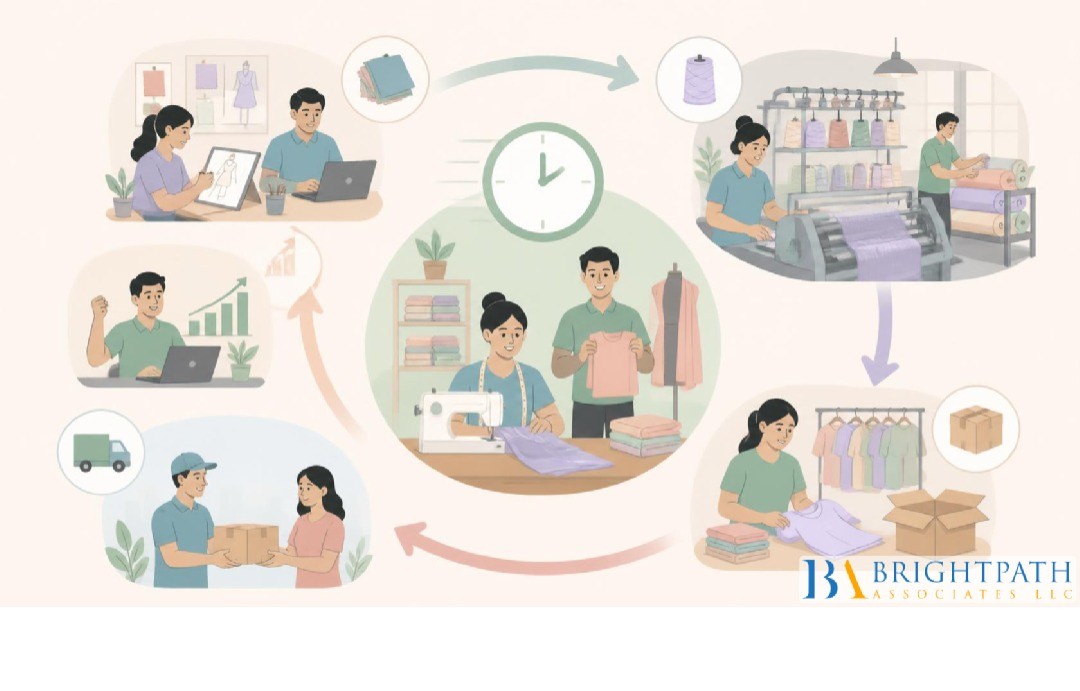
The #TextileIndustry is undergoing a fundamental shift in how orders are placed, produced, and fulfilled. Traditionally, textile businesses operated around relatively long production cycles, with manufacturers receiving orders well in advance and using those lead times to source raw materials, schedule machinery, allocate labor, and manage inventory. Today, buyers increasingly expect shorter lead times, smaller production runs, faster replenishment, and greater responsiveness to changing market demand.
This transformation is particularly significant for small textile businesses. Large manufacturers may have the capital, technology, and operational scale required to absorb shorter order cycles, but smaller businesses often operate with tighter margins and limited working capital. A reduction in order lead time can therefore create both a competitive opportunity and a serious operational challenge.
The modern Textile supply chain is becoming increasingly responsive, digitally connected, and demand-driven. For small textile businesses, surviving this transition will depend on their ability to coordinate production, procurement, inventory, technology, and decision-making at greater speed without sacrificing profitability.
Why Shorter Order Cycles Are Changing Textile Economics
Shortened order cycles fundamentally alter the economics of textile manufacturing. When buyers expect products faster, manufacturers have less time to plan production and correct mistakes. Decisions that previously could be made over several weeks may now need to happen within days.
This puts pressure on every stage of the manufacturing process. Fabric procurement, yarn sourcing, dyeing, finishing, cutting, stitching, quality inspection, packaging, and logistics must work together with greater precision.
For small businesses, the challenge is intensified by limited inventory buffers. Holding large quantities of fabric or yarn can tie up valuable capital, while holding too little inventory can make rapid fulfillment impossible.
The result is a delicate balance between responsiveness and financial discipline. Businesses that achieve this balance can compete on speed without destroying margins. Those that fail may experience higher overtime costs, production bottlenecks, excess freight expenses, and missed delivery commitments.
Shorter order cycles are also encouraging a move away from traditional large-batch manufacturing. Buyers increasingly want smaller quantities, customized products, frequent collections, and rapid replenishment based on actual demand.
This requires manufacturers to become more flexible.
Small textile businesses can sometimes benefit from this transition because their smaller organizational structures may allow them to make decisions faster than large, highly bureaucratic manufacturers. However, flexibility becomes commercially valuable only when supported by efficient production systems.
Advanced textile manufacturing technologies can help manufacturers reduce setup times, improve production visibility, automate repetitive processes, and respond more quickly to changing requirements.
Technologies such as digital production planning, automated cutting, connected machinery, computerized quality systems, and real-time production monitoring can help reduce the friction associated with shorter manufacturing cycles.
The objective is not automation for its own sake. The real objective is to make small production runs economically viable while maintaining consistent quality.
Inventory Management Becomes a Strategic Priority
Shorter order cycles create an unusual inventory challenge. Businesses must have enough raw materials available to respond quickly, but excessive inventory can create financial pressure.
This makes inventory intelligence increasingly important.
Small textile businesses need greater visibility into which materials are moving quickly, which fabrics are becoming obsolete, and which inputs can be sourced reliably. Historical sales information can help identify patterns, while real-time order information can provide insight into current demand.
This is where Textile industry #DataAnalytics becomes increasingly valuable. Instead of relying solely on historical assumptions, manufacturers can analyze order patterns, customer behavior, production performance, material consumption, and delivery timelines.
Better data can help businesses make more informed decisions about purchasing and inventory allocation.
For smaller companies, the value can be substantial because every unit of unnecessary inventory represents capital that could otherwise be used for machinery, workforce development, marketing, or business expansion.
The Textile Supply Chain Becomes More Interdependent
Shortened order cycles expose weaknesses in fragmented supply chains. A manufacturer may have efficient internal production but still struggle to meet customer expectations if its yarn supplier, dyeing partner, packaging provider, or logistics company operates on significantly longer timelines.
The modern Textile supply chain therefore needs greater coordination.
Supplier relationships become strategically important because reliability can be as valuable as price. A slightly more expensive supplier that consistently delivers materials on time may create greater economic value than a low-cost supplier with unpredictable lead times.
Small businesses can also benefit from developing multiple sourcing options for strategically important materials. This can reduce dependence on individual suppliers and provide greater resilience when disruptions occur.
The need for resilience becomes particularly important given Global textile industry geopolitical risks, which can influence raw-material availability, shipping routes, energy costs, trade policies, and international sourcing decisions.
The desire for faster production does not eliminate external risks. In many cases, it increases their impact.
When order cycles are compressed, a delayed shipment of yarn or fabric can immediately disrupt production. A longer lead time might previously have allowed a manufacturer to adjust its schedule. Under a shortened cycle, there may be little room for recovery.
Geopolitical tensions, trade restrictions, transportation disruptions, currency volatility, and changes in international regulations can therefore have disproportionate consequences for smaller manufacturers.
Businesses need to incorporate these risks into Textile business strategic planning rather than treating supply-chain disruption as an occasional emergency.
Strategic planning increasingly needs to consider supplier diversification, regional sourcing, safety-stock policies, alternative logistics routes, and production flexibility.
Blockchain and Traceability Gain Importance
Shorter cycles are occurring alongside increasing demands for supply-chain transparency. Buyers increasingly want to understand where materials originate, how products are manufactured, and whether suppliers meet quality and sustainability requirements.
Textile industry blockchain applications may contribute to this transformation by creating more traceable digital records across supply-chain transactions.
Blockchain is not a universal solution, and implementation costs and interoperability challenges remain important considerations. However, the underlying concept of verifiable supply-chain information is increasingly relevant.
For small textile businesses competing for larger customers, transparent documentation can become a differentiator. The ability to demonstrate material provenance, production records, certifications, and transaction histories can strengthen buyer confidence.
This is particularly relevant when smaller manufacturers want to participate in international or premium supply chains where traceability expectations are higher.
Cognitive Automation Can Compress Logistics Delays
The operational consequences of shorter order cycles extend beyond manufacturing. Logistics must also become faster and more intelligent.
#CognitiveAutomation in textile logistics can help organizations automate repetitive decision-making processes while using data to improve shipment planning, inventory allocation, order prioritization, and exception management.
For example, a digital system can help identify which orders require urgent processing, which shipments face potential delays, and where inventory should be allocated based on delivery commitments.
For a small business, these capabilities can reduce administrative workload and allow employees to focus on higher-value activities.
The real advantage comes from combining automation with human judgment. Employees can manage exceptions and strategic decisions while software handles repetitive information-processing tasks.
Closed-Loop Systems Reduce Waste and Improve Responsiveness
Shorter order cycles are also increasing interest in circular production models.
Textile industry closed-loop systems aim to reduce waste by recovering, reusing, recycling, or repurposing materials within production and consumption cycles.
For small textile businesses, this can create both environmental and commercial opportunities. Production scraps, returned products, excess inventory, and unused materials can potentially become inputs for other processes rather than simply becoming waste.
Closed-loop models can also reduce dependence on virgin materials over time, although implementation requires appropriate collection, sorting, processing, and quality-control capabilities.
As sustainability requirements become more prominent, businesses that can combine faster production with efficient resource utilization may be better positioned to meet customer expectations.
Shorter order cycles create a leadership challenge as much as an operational one.
When decisions must be made faster, management structures designed around lengthy approval processes can become a competitive disadvantage. Textile executives increasingly need to create organizations where relevant information reaches decision-makers quickly and employees have sufficient authority to respond.
This makes Executive leadership in textiles increasingly important.
Leaders must understand production economics while also being comfortable with technology, analytics, supply-chain risk, sustainability, and workforce development. They must determine where speed creates genuine customer value and where excessive acceleration simply increases operating costs.
The most effective leaders will therefore focus not simply on making production faster, but on making the entire decision-making system more responsive.
The Investment Question for Small Textile Businesses
The pressure to modernize raises an important question: how much should a small textile business invest in technology?
Not every business needs a highly automated factory. Investment decisions should be based on the specific bottlenecks affecting order fulfillment, profitability, quality, and customer retention.
This is where Textile industry #InvestmentTrends become relevant. Technology investments are increasingly shifting toward digital production management, automation, data analytics, traceability, energy efficiency, and flexible manufacturing.
For small manufacturers, phased investment may be more practical than attempting a complete digital transformation at once.
A business might first improve production data collection, then introduce digital scheduling, followed by targeted automation in the most labor-intensive process. Over time, these systems can become interconnected.
The objective should be measurable operational improvement rather than technological sophistication alone.
Strategic Planning Must Connect Speed With Profitability
Faster orders can increase revenue, but they can also increase costs if not properly managed.
A rush order may require overtime, expedited raw materials, premium transportation, production rescheduling, or additional quality inspections. If these costs are not incorporated into pricing decisions, higher sales volume can actually reduce profitability.
This makes Textile business strategic planning critical.
Businesses need to understand which customers and orders generate sustainable margins. They also need to distinguish between valuable responsiveness and costly urgency.
Data can support this decision by showing which products consistently require additional resources, which customers generate repeat business, and which order types create bottlenecks.
The goal is to create a business model where speed becomes a source of competitive advantage rather than a permanent operational burden.
Technology cannot deliver faster order cycles without the right people.
Small textile businesses increasingly require employees who understand both manufacturing processes and digital systems. Production planners need stronger analytical capabilities. Operations managers need to understand automation. Procurement professionals need supply-chain risk awareness. Senior leaders need the ability to interpret operational data and connect it to financial performance.
This creates a growing role for #ExecutiveSearchRecruitment within the textile sector.
Recruiting the right leadership becomes particularly important when a business is transitioning from traditional manufacturing toward digitally enabled production. The right executive can help establish priorities, evaluate technology investments, redesign processes, and build a workforce capable of operating in a faster environment.
Talent acquisition is therefore becoming part of digital transformation rather than a separate human-resources function.
Conclusion: Speed Will Reward Prepared Businesses
Shortened order cycles are not simply changing delivery expectations. They are changing how small textile businesses must think about production, inventory, technology, supply chains, investment, and leadership.
The companies best positioned to benefit will not necessarily be the ones that manufacture the fastest. They will be the ones that can coordinate their operations effectively enough to respond quickly without sacrificing quality or profitability.
The combination of Advanced textile manufacturing technologies, Textile industry data analytics, stronger supply-chain visibility, targeted automation, traceability, and flexible production can help smaller businesses compete in an increasingly demanding market.
At the same time, external pressures such as Global textile industry geopolitical risks mean that speed must be supported by resilience. Businesses need flexible suppliers, intelligent inventory strategies, capable leaders, and reliable data.
Ultimately, the shortening of order cycles is forcing small textile businesses to move from reactive manufacturing toward responsive manufacturing. The winners will be those that treat speed not as a standalone operational target, but as the outcome of better information, better systems, better talent, and better strategic decisions.
In the evolving textile economy, fast delivery may win the order, but operational intelligence will determine whether the order is profitable.
Find your next leadership role in Textile Industry today!