
Introduction
Food and #BeverageManufacturing is entering a period where scale alone is no longer enough to maintain competitiveness. Rising energy costs, labor shortages, changing consumer expectations, tighter quality requirements, supply-chain uncertainty, and increasing pressure for operational efficiency are forcing manufacturers to rethink how production ecosystems operate.
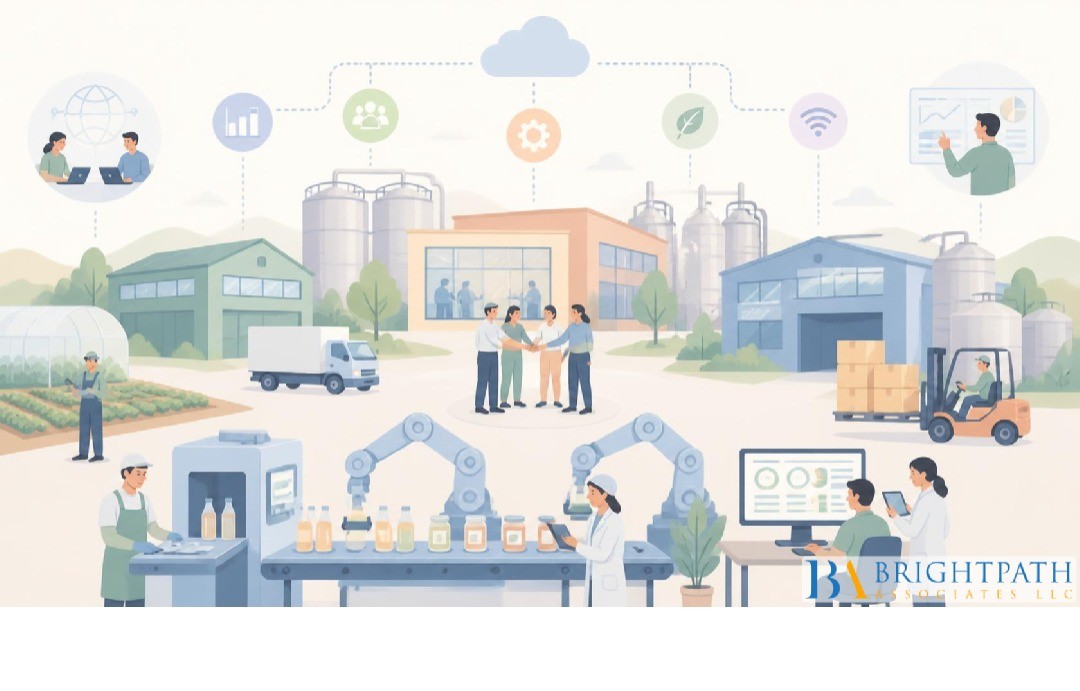
One of the most significant developments is the rise of collaborative digital transformation within food and beverage clusters. Instead of individual manufacturers independently investing in technology, infrastructure, skills, and operational improvements, geographically connected businesses are increasingly benefiting from shared capabilities, common technology ecosystems, and collaborative industrial infrastructure.
This model is particularly powerful because food and beverage clusters naturally bring together manufacturers, packaging companies, ingredient suppliers, logistics providers, equipment specialists, technology firms, and skilled workers. When these participants become digitally connected, the benefits can extend beyond individual factories and influence the competitiveness of the entire cluster.
The result is a shift from isolated factory modernization toward coordinated industrial transformation.
Why F&B Clusters Have a Structural Advantage
Food and beverage clusters already possess many of the characteristics required for successful digital transformation. Companies operating within the same region frequently share suppliers, transportation networks, labor pools, utilities, equipment vendors, and even customers.
Digital technologies can strengthen these existing relationships.
A manufacturer implementing Industrial automation may improve production speed and consistency within its own facility. However, when several manufacturers in the same cluster adopt compatible automation practices, the broader ecosystem can benefit from a stronger technical workforce, more capable maintenance providers, standardized processes, and greater availability of specialized technology expertise.
This creates a network effect. The value of transformation increases as more participants become digitally capable.
For smaller manufacturers, this can be especially important. They may not have the capital or internal expertise to develop every capability independently, but participation in a digitally mature industrial cluster can give them access to technology providers, engineering expertise, training resources, and shared knowledge.
Traditional automation typically focused on improving individual machines or production lines. Modern Manufacturing automation is moving toward connected systems that allow equipment, production processes, quality systems, and management platforms to communicate with each other.
This transition enables manufacturers to move beyond simple mechanization.
Automated equipment can collect operational information, identify production abnormalities, monitor equipment performance, and support more consistent quality control. When this information is connected across the production environment, managers gain greater visibility into how the factory is performing.
The implications for F&B manufacturers are substantial because production environments often involve complex combinations of ingredients, temperature controls, packaging requirements, sanitation procedures, and traceability standards.
Digital connectivity can help manufacturers manage these variables with greater precision while reducing dependence on manual monitoring.
Automation Solutions Manufacturing Is Becoming More Collaborative
The growing demand for #AutomationSolutionsManufacturing is creating a broader ecosystem of engineering firms, system integrators, technology providers, and specialized contractors.
Within F&B clusters, this ecosystem can become a competitive asset.
Rather than treating automation as a one-time equipment purchase, manufacturers are increasingly looking at automation as an ongoing capability. Equipment must be integrated with existing production systems, maintained effectively, upgraded when necessary, and aligned with evolving business requirements.
This creates opportunities for cluster-based expertise. A region with multiple manufacturers investing in automation can support a deeper pool of engineers, technicians, integrators, and technology specialists.
That talent concentration can make the entire cluster more attractive to manufacturers considering expansion or relocation.
PLC Programming Becomes a Strategic Capability
At the operational level, programmable logic controllers remain central to many automated manufacturing environments. A reliable PLC programming service can determine whether machinery operates efficiently, safely, and consistently.
For F&B manufacturers, PLC systems may control conveyors, filling equipment, packaging machinery, temperature systems, processing equipment, and other critical production functions.
As factories become more interconnected, PLC programming also becomes more complex. Engineers need to understand not only individual machines but how equipment communicates with supervisory platforms, sensors, databases, and enterprise systems.
Clusters that develop strong PLC and controls expertise can therefore create a significant competitive advantage. Manufacturers gain access to a deeper technical talent pool, while service providers benefit from a concentrated customer base.
Labor availability is becoming an important factor in food and beverage manufacturing. Repetitive, physically demanding, or highly standardized activities are increasingly suitable for robotics.
Robotics integration can support applications such as palletizing, packaging, material handling, picking, inspection, and repetitive assembly processes.
However, successful robotics deployment requires more than purchasing robotic equipment. Robots must be integrated with conveyors, sensors, control systems, safety equipment, vision systems, and production software.
This is another area where clusters can provide an advantage. When multiple manufacturers adopt robotics, local integrators and technical specialists develop deeper knowledge of common production challenges.
Over time, this creates an industrial knowledge base that can accelerate subsequent automation projects.
SCADA Systems Turn Factory Data Into Operational Intelligence
As automation expands, manufacturers need effective ways to monitor and interpret production information. #SCADASystems provide an important layer between automated equipment and management.
These systems can provide visibility into machine performance, production conditions, alarms, process variables, and operational trends.
For food and beverage manufacturers, this information can be particularly valuable because small deviations can have significant consequences. A temperature variation, equipment malfunction, or production interruption can affect quality, waste, throughput, and profitability.
SCADA-enabled visibility allows manufacturers to identify operational problems more quickly and build a stronger foundation for continuous improvement.
When multiple facilities within a cluster develop similar digital capabilities, benchmarking becomes increasingly valuable. Companies can compare operational performance, identify recurring issues, and learn from successful implementations.
Industrial Machine Vision Strengthens Quality Control
Quality assurance is another area where automation is transforming F&B production. Industrial machine vision can inspect products and packaging at speeds and levels of consistency that are difficult to achieve through manual inspection alone.
Vision systems can support applications involving product appearance, labeling, packaging integrity, positioning, and defect identification.
The strategic importance of machine vision extends beyond quality control. Automated inspection can generate additional production data, helping manufacturers understand where defects originate and how frequently they occur.
This allows quality management to become more proactive.
Instead of simply identifying defective products after production, manufacturers can increasingly use digital information to identify patterns and address the underlying causes of defects.
Modern Control systems are becoming increasingly interconnected. Sensors, PLCs, robotics, SCADA platforms, machine vision, manufacturing execution systems, and enterprise software can operate as components of a larger digital environment.
This interconnected architecture creates opportunities for real-time decision-making.
Production managers can gain better visibility into operational conditions, maintenance teams can respond to equipment issues more quickly, and executives can gain a clearer understanding of manufacturing performance.
However, connectivity also creates complexity. Businesses must ensure that systems are compatible, secure, properly maintained, and supported by employees with the necessary technical knowledge.
This is why digital transformation cannot be reduced to purchasing technology. It is fundamentally an organizational transformation.
The Workforce Is Becoming the Critical Infrastructure
Technology investments can transform production, but people determine whether those investments deliver value.
The rise of automation is increasing demand for engineers, controls specialists, robotics professionals, maintenance technicians, data specialists, and manufacturing leaders who understand digital systems.
This is contributing to the growth of #AutomationJobs across the industrial economy.
For F&B clusters, talent availability can become one of the most important competitive factors. A region may have modern facilities and strong infrastructure, but if manufacturers cannot recruit people capable of maintaining and improving automated systems, technology investments may fail to reach their potential.
This makes workforce development increasingly important.
Manufacturers, educational institutions, technology providers, and industry associations can collectively help develop the skills required by increasingly automated factories. The cluster model is particularly suitable for this because multiple employers can create sustained demand for specialized technical talent.
Executive Leadership Must Evolve With Automation
Automation also changes what manufacturers need from senior leadership.
Executives can no longer view technology as an isolated engineering responsibility. Digital transformation affects capital allocation, workforce planning, supply-chain strategy, productivity, quality management, and long-term competitiveness.
This is increasing demand for leaders who can connect operational technology with commercial objectives.
Executive search industrial automation is therefore becoming an increasingly specialized area as manufacturers compete for executives who understand automation strategy, digital transformation, manufacturing economics, and organizational change.
The right executive can help determine where automation should be deployed, how technology investments should be prioritized, and how employees should be developed alongside new systems.
For industrial clusters, leadership capability can become another shared competitive advantage because strong executives can accelerate transformation across multiple interconnected businesses.
Executive Search Recruitment Becomes Part of Cluster Strategy
The broader role of #ExecutiveSearchRecruitment is also changing within manufacturing ecosystems.
Traditional executive hiring often focused on functional experience. Today, manufacturers increasingly need leaders who can operate across disciplines. A manufacturing executive may need to understand automation, cybersecurity, data analytics, supply-chain resilience, workforce strategy, and financial performance simultaneously.
This creates a more complicated talent market.
F&B clusters that consistently attract and retain high-quality leadership can build stronger transformation capabilities over time. Experienced leaders also contribute knowledge that extends beyond their individual organizations, helping establish stronger standards and professional networks throughout the industrial ecosystem.
Talent therefore becomes part of the infrastructure supporting digital transformation.
One of the strongest arguments for cluster-based transformation is the potential to distribute the cost of developing industrial capabilities.
Not every manufacturer needs to build every capability internally.
A cluster can support specialized engineering providers, shared training initiatives, technology partnerships, technical service companies, and common infrastructure. Manufacturers can then access capabilities without duplicating every investment.
This can be especially beneficial for smaller and mid-sized businesses that face capital constraints.
The result is not simply lower costs. It can also reduce the risk associated with technology adoption because companies gain access to a broader ecosystem of expertise.
The rise of collaborative digital transformation signals a broader change in manufacturing economics. Competitive advantage is increasingly determined by the capabilities surrounding a factory, not simply by the machinery inside it.
A digitally mature F&B cluster can combine Industrial automation, robotics, PLC expertise, SCADA systems, Industrial machine vision, advanced Control systems, and skilled talent into a connected industrial ecosystem.
That ecosystem can improve productivity, strengthen quality, accelerate innovation, and make the region more attractive for future investment.
The most successful clusters will not necessarily be those where every manufacturer has identical technology. Instead, they will be ecosystems where businesses can access the expertise, infrastructure, talent, and partnerships required to continuously modernize.
Conclusion
The future of food and beverage manufacturing will increasingly be shaped by interconnected capabilities rather than isolated investments.
Automation will continue to transform individual factories, but the greatest competitive gains may emerge when manufacturers, technology providers, engineering firms, workforce institutions, and industry leaders transform together.
F&B clusters are uniquely positioned to make this happen because their geographic concentration already creates economic relationships that digital technology can strengthen.
The strategic opportunity is therefore much larger than installing automated machinery. It is about creating an industrial environment where automation knowledge, technical talent, data, engineering expertise, and leadership capabilities reinforce one another.
In that environment, digital transformation becomes more than a technology project. It becomes a source of regional industrial competitiveness.
The winning F&B clusters of the future will be those that recognize this shift early: the factory may be automated, but the ecosystem around the factory determines how far that automation can take the business.
Find your next leadership role in Industrial Automation Industry today!
Stay informed with the latest insights on Industrial Automation Industry!