
Introduction
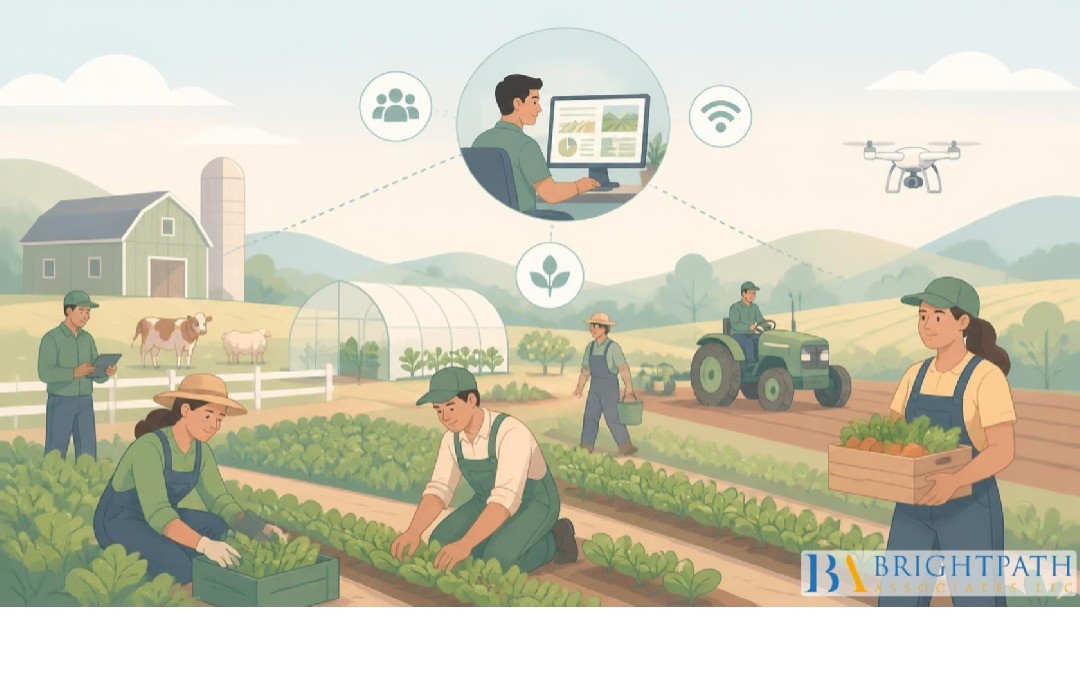
#ModernAgriculture is undergoing a fundamental transformation. Farms are no longer managed exclusively through physical presence, face-to-face supervision, and traditional knowledge passed from one generation to another. Increasingly, farm owners and agricultural enterprises are using connected devices, cloud platforms, automation, data analytics, and remote-management systems to coordinate operations across large and geographically dispersed properties.
This transition is creating a new workforce challenge. Technology can improve productivity, resource efficiency, and decision-making, but it can also change how employees communicate, collaborate, and identify with the organization. When managers operate remotely and employees work across fields, facilities, equipment stations, and processing locations, maintaining a strong organizational culture requires deliberate planning.
The future of farming therefore depends not only on adopting advanced Agricultural technology but also on redesigning the human systems surrounding it. Businesses that combine technology with communication, leadership, training, accountability, and employee engagement can create a workforce capable of supporting modern Food production while maintaining a strong sense of shared purpose.
Why Remote Farm Management Is Becoming More Common
Agricultural businesses increasingly operate across larger areas and more complex production systems. Farm managers may oversee multiple properties, specialized equipment, livestock operations, storage facilities, processing units, and distribution networks from a central office or even remotely.
Digital connectivity makes this possible. Managers can monitor soil conditions, irrigation systems, equipment performance, weather information, crop development, and operational activities through connected platforms. Instead of physically visiting every location to understand what is happening, managers can receive information through dashboards and mobile applications.
However, remote management changes the traditional relationship between supervisors and employees. Workers may have fewer informal interactions with management and may communicate primarily through digital platforms. Without an intentional culture strategy, employees can begin to feel disconnected from decision-makers.
The challenge is therefore to use technology to increase visibility without allowing it to replace human connection.
A strong agricultural workforce needs more than clearly defined job responsibilities. Employees need to understand how their work contributes to the broader purpose of the organization.
This becomes particularly important when employees are geographically separated. Farm workers operating machinery, monitoring crops, maintaining irrigation systems, handling livestock, managing storage, or supporting distribution may not see how their individual activities contribute to the organization’s overall performance.
Leadership can address this by communicating a clear mission centered on productivity, quality, environmental responsibility, employee safety, and long-term agricultural resilience.
Whether the organization focuses on conventional production, Organic farming, or advanced Sustainable farming practices, employees should understand the principles behind operational decisions. A shared mission can create alignment even when managers and employees rarely occupy the same physical space.
Agricultural Technology Is Changing Workforce Expectations
#AgriculturalTechnology is transforming the skills required across modern farms. GPS-enabled machinery, remote sensors, automated irrigation, drones, robotics, connected equipment, and digital monitoring platforms increasingly influence daily operations.
Employees therefore need to become comfortable working alongside technology. The modern farm worker may need to interpret equipment alerts, use mobile applications, monitor digital dashboards, collect field data, or operate sophisticated machinery.
This does not mean traditional agricultural knowledge is becoming irrelevant. Instead, technology and practical experience must complement one another. Experienced workers understand local soil conditions, weather patterns, crop behavior, equipment characteristics, and operational realities. Digital systems provide additional information that can improve those decisions.
Organizations that combine these capabilities can create a workforce that is both technologically capable and grounded in practical agricultural knowledge.
Precision Agriculture and Distributed Decision-Making
Precision agriculture provides a strong example of how technology can change workforce responsibilities. Instead of treating an entire farm as a uniform production environment, precision systems allow organizations to analyze differences in soil conditions, moisture levels, crop performance, nutrient requirements, and field productivity.
This creates opportunities for more targeted decision-making. Employees can use data to determine where irrigation, nutrients, crop protection, or other interventions may be required.
In a remote-managed environment, this information can also improve communication between field teams and managers. A worker can document an issue digitally, attach relevant data, and receive guidance without waiting for a manager to physically visit the site.
The result can be a more distributed decision-making structure in which employees have greater responsibility and access to information.
Digital Farming is not simply the use of software or connected equipment. It represents a broader operating model in which information becomes part of everyday agricultural decision-making.
For this model to succeed, employees must understand why data is being collected and how it will be used. If workers believe monitoring technology exists only to track their performance, resistance can develop.
Leaders should instead explain how digital systems can make jobs safer, reduce repetitive tasks, improve planning, identify equipment problems, and support better production outcomes.
Trust becomes especially important in remote environments. Employees need confidence that technology is being used to improve operations rather than simply increase surveillance.
A culture of Digital Farming should therefore emphasize transparency, shared learning, and continuous improvement.
Farm Management Software as a Collaboration Platform
#FarmManagement software can become an important communication layer between field teams and remote leadership. Modern platforms can consolidate information relating to crop activities, equipment, labor, inventory, weather, field conditions, and operational schedules.
When used effectively, these systems can reduce communication gaps. Managers can review operational information remotely while employees can update activities directly from the field.
However, software should support human communication rather than replace it. Digital records cannot always explain why a particular decision was made or what an employee observed that may not appear in the data.
Regular conversations, virtual meetings, site visits, and feedback sessions remain important. Farm management software should provide the information required for those conversations rather than becoming the only form of communication.
Creating Accountability Without Micromanagement
Remote management can create concerns about employee accountability. Managers may be tempted to use digital systems to monitor every activity, measure every task, and constantly evaluate worker performance.
This can damage culture if employees feel that technology is being used for excessive surveillance. A better approach is to establish clear outcomes and responsibilities.
Employees should understand what successful performance looks like, which decisions they can make independently, and when they should escalate issues. Digital tools can provide visibility into results while allowing workers appropriate autonomy.
This approach creates accountability based on outcomes rather than constant observation. It also encourages employees to take ownership of operational decisions.
Agricultural innovation often fails to deliver its full potential when organizations focus heavily on technology acquisition but underestimate workforce development.
Employees need structured training when new equipment, software, automation systems, or data platforms are introduced. Training should explain not only how a technology works but also why it is being adopted and how it changes daily responsibilities.
Continuous education is particularly important because agricultural technologies evolve rapidly. Workers who receive opportunities to develop new skills are more likely to view technological change as an opportunity rather than a threat.
Organizations can also create internal knowledge-sharing programs in which experienced employees teach practical agricultural skills while technologically proficient employees support digital capabilities.
This combination can strengthen organizational knowledge and reduce dependence on a small number of technology specialists.
Sustainable Farming Requires an Engaged Workforce
#SustainableFarming depends on operational discipline. Efficient water use, responsible soil management, reduced waste, optimized inputs, biodiversity considerations, and energy efficiency require consistent execution.
Technology can provide valuable information, but employees ultimately make many of the decisions that determine whether sustainability goals become reality.
When workers understand the environmental and economic reasons behind sustainability initiatives, they are more likely to participate actively. Managers should therefore connect sustainability targets with everyday activities rather than treating them as separate corporate objectives.
Agricultural sustainability becomes stronger when employees can see measurable results from their actions and understand how individual decisions contribute to long-term farm resilience.
Linking Sustainable Agriculture Investment with Workforce Strategy
Sustainable agriculture investment increasingly includes spending on technology, infrastructure, renewable energy, water management, soil improvement, automation, and data systems. Yet investments in physical assets alone cannot guarantee better outcomes.
Organizations must also invest in people. Employees need training, leadership support, appropriate tools, and opportunities to develop the capabilities required to operate modern agricultural systems.
Workforce planning should therefore be integrated into investment decisions. When a farm adopts automated irrigation, advanced machinery, or digital monitoring systems, management should simultaneously determine what skills employees need to operate and maintain those technologies.
This integrated approach ensures that capital investment produces sustainable operational value.
Remote-managed agricultural businesses need intentional mechanisms for maintaining connection. Employees should have regular opportunities to interact with managers and colleagues beyond task-specific communication.
Virtual meetings can provide operational updates, while periodic in-person gatherings can strengthen relationships. Recognition programs can also highlight employee contributions that may otherwise become invisible in a geographically distributed workforce.
Leadership visibility is particularly important. Even when managers cannot regularly visit every farm location, employees should know that leadership understands their challenges and values their contributions.
Culture is created through repeated behaviors. Consistent communication, fair decision-making, recognition, transparency, and responsiveness can maintain organizational cohesion even when teams are physically separated.
The Role of Leadership in Modern Farm Organizations
The transition toward technology-enabled farming requires a different type of leadership. Agricultural managers increasingly need to understand technology, data, sustainability, workforce development, financial management, and operational strategy simultaneously.
This creates challenges for agricultural businesses competing for experienced leadership talent. A technically capable farm manager may not necessarily possess the digital transformation or people-management skills required for a remote environment.
#ExecutiveSearchRecruitment can help agricultural organizations identify leadership professionals who combine industry expertise with modern management capabilities. Finding executives who understand both agricultural operations and digital transformation can be particularly valuable for organizations expanding their use of automation, analytics, and connected technologies.
Strong leadership can determine whether technology becomes an organizational advantage or simply another layer of complexity.
The future of Food production will require greater productivity while responding to changing environmental, economic, labor, and consumer expectations. Agricultural businesses will need to produce more efficiently while managing increasingly complex production systems.
Technology will play a major role, but people will remain central. Farms need employees who can operate advanced equipment, interpret information, adapt to changing processes, and collaborate across physical and digital environments.
The workforce of the future will therefore combine practical agricultural expertise with digital capabilities. Successful organizations will create career pathways that allow employees to grow alongside the technology being introduced into the workplace.
Conclusion: Designing a Human-Centered Digital Farm
The transformation of agriculture is not simply a technological revolution. It is a workforce transformation.
Agricultural technology, Precision agriculture, Farm management software, and Digital Farming can improve visibility and operational efficiency, but their success depends on people who know how to use these tools effectively. Remote management can provide powerful operational advantages, yet organizations must deliberately protect communication, trust, engagement, and shared purpose.
Businesses pursuing Sustainable farming and Agricultural sustainability should therefore view workforce development as an essential component of modernization. Investments in Agricultural innovation and Sustainable agriculture investment should be accompanied by investments in training, leadership, collaboration, and organizational culture.
The strongest agricultural organizations will not be those that simply adopt the most technology. They will be those that successfully connect technology with human capability. By building a workforce that is digitally confident, operationally skilled, and culturally connected, farms can create a resilient foundation for the future of food production.
Ultimately, redesigning the farm workforce means creating an environment where employees can work effectively whether they are standing in a field, operating machinery, analyzing data, or communicating with a manager hundreds of miles away. When technology strengthens rather than weakens human connection, remote-managed agriculture can become more productive, sustainable, and prepared for the demands of the next generation.
Find your next leadership role in Farming Industry today!