
Introduction
#AgricultureIndustry has always depended on experience, observation, and practical decision-making. Farmers have traditionally relied on field inspections, handwritten records, manual equipment checks, and knowledge developed over generations. These methods remain valuable, but the scale and complexity of modern agriculture are creating new demands.
Changing weather patterns, rising input costs, labor shortages, resource constraints, supply-chain pressures, and evolving consumer expectations are encouraging agricultural businesses to adopt technology. However, digital transformation does not have to mean replacing every existing system at once.
For many farms and agricultural businesses, a phased approach is more practical.
Modern Agricultural technology can be introduced gradually, beginning with the areas where digital tools can create the greatest measurable benefit. As systems mature, organizations can connect data, automate repetitive processes, and create more intelligent decision-making environments.
The objective is not automation for its own sake. It is to build an agricultural operation that is more productive, resilient, sustainable, and capable of responding quickly to changing conditions.
Why a Phased Digital Transformation Strategy Makes Sense
Digital transformation can appear overwhelming when viewed as one large project. A farm may need sensors, software, automated equipment, connectivity, data analytics, and new employee skills.
Attempting to introduce everything simultaneously can create unnecessary costs and operational disruption.
A phased strategy reduces these risks.
The first stage can focus on data collection and process visibility. The next can introduce targeted automation. Later stages can connect systems and use analytics to improve decisions.
This approach allows agricultural businesses to learn from each implementation before expanding.
For small and mid-sized operations, this can be especially important because capital resources may be limited.
A successful transformation should therefore progress according to business priorities rather than technology trends.
Before investing in advanced systems, agricultural businesses need to understand their existing processes.
How are production records maintained? How is equipment monitored? How are inputs tracked? How are field activities documented? How quickly can managers access information?
These questions reveal where manual processes create inefficiencies.
Data is the foundation of digital transformation.
Without reliable information, advanced analytics and automation systems cannot deliver their full potential.
Organizations should therefore begin by standardizing basic information and establishing consistent methods for recording operational activities.
This creates a foundation for later adoption of Digital Farming technologies.
Agricultural Technology as a Business Investment
Technology investments should be evaluated according to their operational value.
Agricultural businesses should identify specific problems before selecting technology.
For example, a farm struggling with irrigation efficiency may benefit from soil-moisture sensors and automated irrigation controls. A business facing labor shortages may prioritize automated equipment. An operation experiencing inconsistent production records may begin with Farm management software.
This problem-first approach helps prevent technology investments from becoming expensive experiments.
The goal should be measurable improvement in productivity, cost management, resource use, quality, or decision-making.
One of the easiest entry points into digital transformation is replacing paper-based records with digital systems.
Farm management platforms can organize information related to planting, harvesting, inputs, equipment, field activities, labor, and production.
#FarmManagementSoftware can provide a centralized information environment that makes records easier to access and analyze.
Digitization also reduces the risk of lost or inconsistent records.
Managers can compare current performance with historical information and identify trends.
This stage may not appear highly sophisticated, but it establishes the data infrastructure required for more advanced transformation.
The Second Stage: Introducing Precision Agriculture
Once reliable digital records are established, agricultural businesses can begin using more advanced monitoring technologies.
Precision agriculture uses data to understand variation across fields, crops, soil conditions, and production environments.
Sensors, satellite imagery, GPS systems, drones, weather data, and connected equipment can provide detailed information about agricultural conditions.
Instead of treating an entire field as uniform, producers can identify areas with different requirements.
This can support more targeted application of water, fertilizers, crop protection products, and other inputs.
Precision agriculture can therefore improve both efficiency and resource management.
Digital Farming expands the concept of precision agriculture by connecting multiple technologies into a broader operational system.
Real-time data can help producers understand field conditions, equipment performance, weather changes, and production activities.
The value of this information depends on how quickly it can be converted into action.
A dashboard that displays dozens of metrics is not necessarily useful if managers cannot determine which information requires attention.
Digital systems should therefore focus on actionable insights.
For example, a system might identify that a particular field requires irrigation because soil moisture has fallen below a defined threshold.
The technology creates visibility, while the management system determines the appropriate response.
The Third Stage: Targeted Automation
Once digital information is available, organizations can begin automating selected activities.
Automation can support irrigation, feeding, equipment operation, material handling, greenhouse management, harvesting, and other repetitive tasks.
The most effective approach is to start with processes that are predictable and measurable.
Automating a well-understood process can provide quick operational benefits while allowing employees to gain confidence with the technology.
Automation should also be introduced with workforce considerations in mind.
Employees need training to operate, monitor, troubleshoot, and maintain automated systems.
The transition should be positioned as an opportunity to change work rather than simply eliminate jobs.
The connection between digital transformation and #FoodProduction is becoming increasingly important.
Food businesses need reliable production, consistent quality, traceability, and efficient resource management.
Digital systems can help producers monitor production conditions and identify potential deviations earlier.
For example, connected sensors can provide information about temperature, moisture, equipment performance, or storage conditions.
This can help businesses maintain greater consistency throughout production.
For agricultural organizations supplying food processors or retailers, improved data visibility can also strengthen relationships with downstream customers.
Sustainable Farming Through Technology
Technology can support Sustainable farming by helping agricultural businesses use resources more efficiently.
Water, fertilizer, energy, fuel, and other inputs all have financial and environmental costs.
Digital monitoring can identify where resources are being overused or where processes can be optimized.
Precision irrigation can potentially reduce unnecessary water use. Data-driven nutrient application can help improve input efficiency. Equipment monitoring can help reduce fuel consumption and prevent unnecessary machine operation.
Sustainability should therefore be viewed as an operational objective rather than simply a marketing message.
Digital transformation is also relevant to Organic farming.
Organic producers operate under specific production requirements and may need detailed documentation related to inputs, field practices, sourcing, and certification.
Digital records can make this information easier to maintain and retrieve.
Technology can also help organic producers monitor soil conditions, crop performance, irrigation, and other variables without compromising their production principles.
The key is selecting technology that supports the farm’s operational model rather than forcing the farm to change its fundamental approach.
Agricultural Innovation and the Changing Farm
#AgriculturalInnovation is increasingly combining biological knowledge with digital technology.
Artificial intelligence, robotics, sensors, automation, satellite imaging, and predictive analytics are creating new possibilities for agricultural management.
However, innovation should remain connected to practical farm realities.
Technology that works in a controlled environment may face challenges in the field.
Weather, connectivity, terrain, equipment compatibility, employee capabilities, and maintenance requirements all influence implementation.
A phased strategy provides an opportunity to test technology under real operating conditions before making larger investments.
Digital transformation requires investment.
Sustainable agriculture investment should therefore be evaluated over the long term.
Businesses should consider not only the initial technology cost but also installation, training, connectivity, software subscriptions, maintenance, upgrades, and employee requirements.
The expected return should be connected to measurable outcomes.
If an automated system reduces labor requirements, improves yield, decreases waste, or reduces resource consumption, those benefits should be incorporated into the investment analysis.
SMEs should also avoid adopting technology simply because competitors are doing so.
The right technology investment is one that solves a meaningful operational problem and creates measurable value.
Connecting Systems for the Next Stage of Transformation
After individual technologies are implemented successfully, organizations can begin connecting them.
A Farm management software platform might integrate information from field sensors, equipment, weather systems, inventory records, and production databases.
This creates a more complete picture of operations.
Integrated systems can also reduce duplicated data entry and improve decision-making.
For example, managers may be able to compare weather information with irrigation activity and crop performance to identify relationships that would be difficult to see manually.
This is where digital transformation begins moving from individual technology projects toward a connected operating model.
The long-term goal of digital transformation is not simply automation. It is predictive management.
Once organizations have accumulated reliable historical and real-time data, analytics can identify patterns and potential future outcomes.
Equipment data can support predictive maintenance. Weather information can support production planning. Crop data can help identify potential performance changes.
This allows agricultural businesses to move from reacting to problems toward anticipating them.
Predictive capabilities can become especially valuable in environments where timing has a major influence on profitability.
Agricultural Sustainability and Operational Resilience
#AgriculturalSustainability involves maintaining productivity while protecting resources and ensuring long-term viability.
Digital transformation can support this objective by improving visibility and resource efficiency.
However, sustainability also requires resilience.
Agricultural businesses need to prepare for changing weather conditions, labor constraints, supply disruptions, input price fluctuations, and changing customer requirements.
Digital systems can provide better information for responding to these challenges.
A connected farm may be able to identify operational changes faster and evaluate alternative strategies more effectively.
Technology cannot transform an organization by itself.
Employees must understand why new systems are being introduced and how the technology will affect their work.
Training should therefore be part of every transformation stage.
Workers who have spent years relying on manual processes may initially be skeptical about new systems.
Leadership needs to demonstrate practical benefits and provide adequate support during the transition.
The strongest agricultural operations will combine human experience with digital intelligence.
Technology can identify patterns, but experienced professionals remain essential for understanding context and making complex decisions.
Executive Search Recruitment and Digital Leadership
As agriculture becomes more technology-driven, leadership requirements are changing.
#ExecutiveSearchRecruitment can help agricultural organizations identify executives capable of managing digital transformation while maintaining operational discipline.
The right leader may need experience across agriculture, technology, operations, sustainability, finance, and workforce development.
Digital transformation requires executives who can connect technology investments with business strategy.
They must understand not only what technology can do, but also when it should be implemented and how employees will adapt.
Strong leadership can prevent digital projects from becoming isolated technology initiatives.
Conclusion
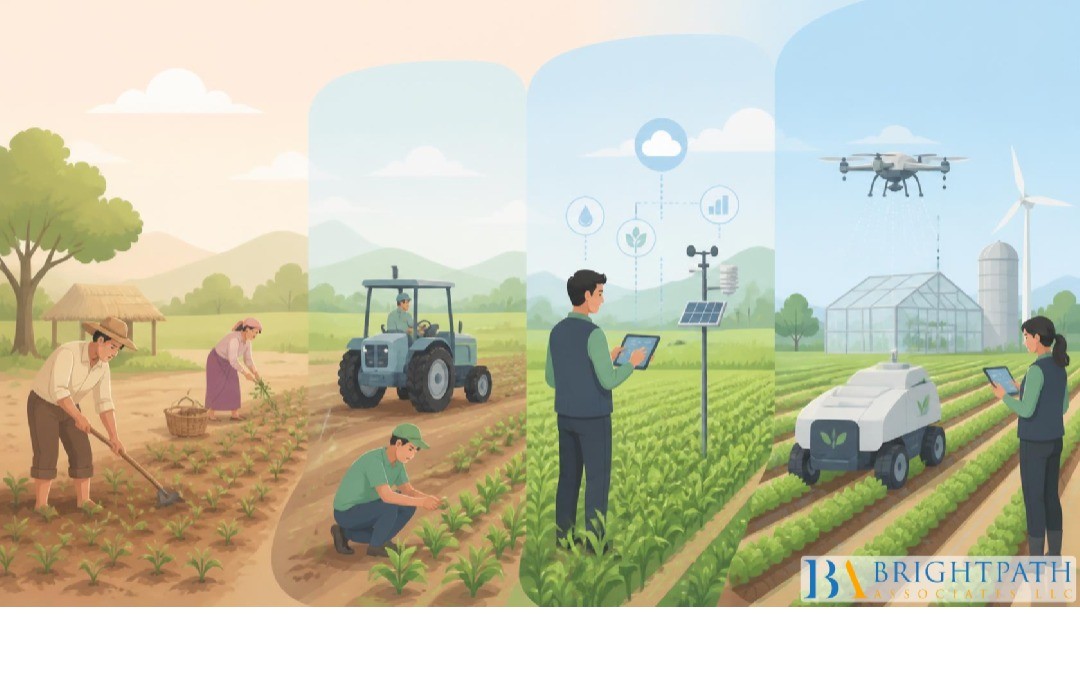
Moving from manual agriculture to automated operations does not require an overnight transformation.
A phased approach allows businesses to establish reliable digital records, introduce precision technologies, automate targeted processes, connect systems, and eventually develop predictive capabilities.
Agricultural technology can support Food production while Precision agriculture and Digital Farming can improve operational visibility. Farm management software can create the digital foundation required for more advanced systems.
At the same time, Sustainable farming, Organic farming, and Agricultural sustainability can benefit from technologies designed to improve resource efficiency and traceability.
The most important lesson is that digital transformation should follow business priorities.
Agricultural businesses should begin with the problems that create the greatest operational or financial impact, select appropriate technologies, measure results, and expand gradually.
The future of agriculture will not belong simply to farms with the most technology. It will belong to organizations that know how to integrate technology, people, data, and practical agricultural expertise into a smarter operating model.
With disciplined investment, effective change management, and strong leadership supported by Executive Search Recruitment, agricultural businesses can move from manual processes to automation without losing the knowledge and judgment that have always been at the heart of successful farming.
Find your next leadership role in Farming Industry today!