
Introduction
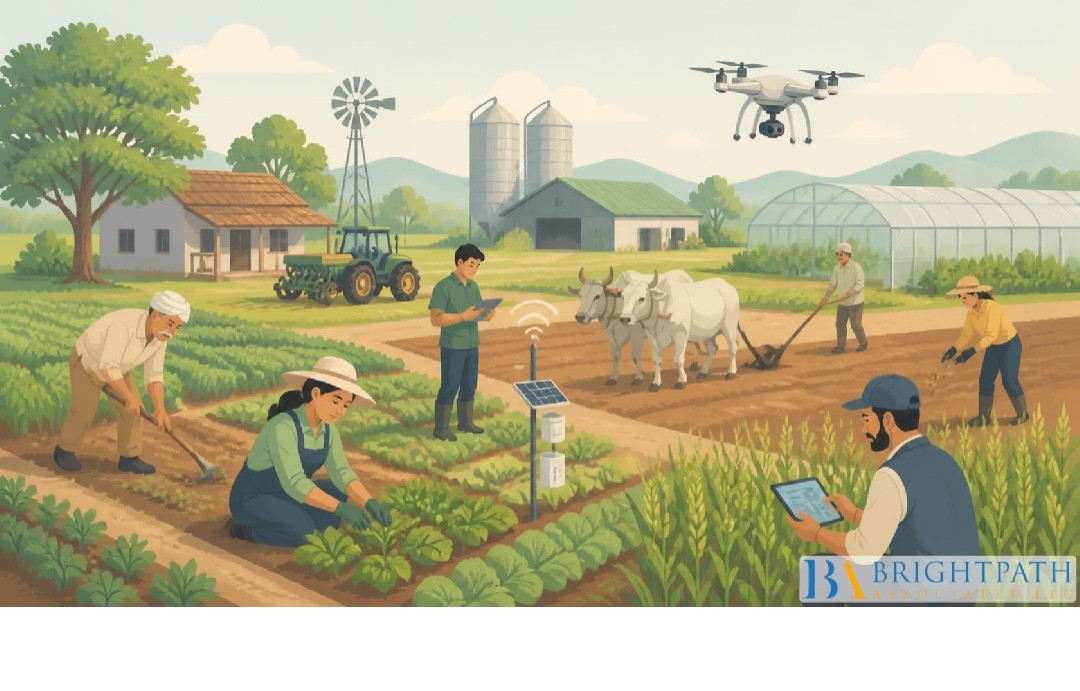
#AgricultureIndustry is entering a new phase of transformation in which traditional farming knowledge and advanced technology are increasingly becoming complementary rather than competing forces. Farmers and agricultural businesses are under pressure to improve productivity, manage rising input costs, address labor challenges, respond to changing climate conditions, and meet growing expectations around sustainability. At the same time, rapid advances in Agricultural technology are creating new opportunities to make farming more precise, data-driven, and efficient.
The challenge for executives is not simply deciding whether to adopt technology. The more difficult task is determining how modern tools can be integrated into established farming practices without disrupting the knowledge, relationships, and operational routines that have developed over generations. Successful transformation requires a balanced approach in which technology strengthens agricultural expertise instead of attempting to replace it.
For organizations involved in Food production, this balance has become particularly important. Modern consumers expect reliable supply, consistent quality, responsible resource use, and greater transparency. Businesses must therefore find ways to combine practical farming experience with digital capabilities. The most successful leaders will be those who can connect traditional knowledge with data, automation, analytics, and modern management systems.
Understanding the Value of Traditional Farming Knowledge
Traditional agricultural practices contain a significant amount of accumulated knowledge. Farmers understand local soil conditions, seasonal patterns, crop behavior, water availability, pest activity, and environmental changes through years of observation and experience. This knowledge can be difficult to reproduce through technology alone.
Technology can identify patterns and provide measurements, but experienced farmers often understand why those patterns matter. A sensor may indicate a change in soil moisture, while a farmer can interpret how that change relates to soil structure, weather conditions, crop development, or irrigation history.
Executives should therefore avoid positioning digital transformation as a replacement for traditional expertise. Instead, technology should capture, enhance, and scale the knowledge already present within an organization.
This approach can also improve employee acceptance. When workers see technology as a tool that strengthens their existing capabilities, resistance to change can decrease.
The first responsibility of agricultural leadership is to identify the operational problems that technology should solve. Businesses should not adopt technology simply because it is new or because competitors are using it.
A more effective strategy begins with questions about productivity, resource efficiency, labor, crop quality, equipment utilization, and operational visibility. Once these priorities are identified, executives can determine which technologies are appropriate.
For example, a farm experiencing inconsistent irrigation may benefit from sensor-based monitoring and automated irrigation controls. An organization struggling with production planning may gain greater value from Farm management software. A large-scale operation seeking better crop monitoring may consider Precision agriculture tools.
Technology should therefore follow business strategy rather than become the strategy itself.
Precision Agriculture as a Link Between Experience and Data
#PrecisionAgriculture provides one of the clearest examples of how traditional knowledge can be combined with modern technology. Instead of treating an entire field as a uniform environment, precision systems collect information about differences in soil conditions, moisture, crop health, nutrients, and other variables.
This data allows farmers to make more targeted decisions. However, data alone does not determine the correct action. Farmers still need to interpret the information within the context of local conditions and production objectives.
When these capabilities are combined, agricultural decisions become more informed without losing the practical judgment of experienced operators.
Precision agriculture can also improve resource utilization. Targeted applications of water, fertilizer, and other inputs can reduce unnecessary consumption while maintaining crop performance.
Digital Farming extends beyond individual sensors or machines. It involves connecting agricultural activities through digital platforms, equipment, data systems, and communication tools.
A digitally connected farm can provide managers with greater visibility into field conditions, equipment performance, labor utilization, crop development, inventory, and production schedules.
The objective is not to create an environment where every decision is made by software. Instead, Digital Farming should make relevant information available at the right time so that people can make better decisions.
Executives should also consider data integration when developing digital strategies. If each piece of equipment generates information that remains isolated, the organization may gain limited value. Connected systems can create a more comprehensive view of agricultural operations.
The Role of Farm Management Software
Farm management software can become the central information platform connecting many aspects of an agricultural business. Depending on the system, it can support field planning, crop records, inventory, equipment management, labor scheduling, financial analysis, and compliance documentation.
The value of Farm management software increases when employees actually use the information consistently. Executives should therefore prioritize usability and workforce adoption when selecting systems.
Implementation should also be gradual. Employees may need training and time to adapt to new workflows. Management should communicate why the system is being introduced and how it will reduce administrative work or improve decision-making.
When properly integrated, software can turn scattered operational information into a resource for strategic planning.
Sustainable farming requires businesses to balance economic performance with environmental responsibility. Technology can support this objective by improving resource efficiency and helping farmers make more precise decisions.
Water monitoring, precision irrigation, targeted nutrient application, energy-efficient equipment, and digital crop monitoring can all contribute to better resource management.
However, sustainability should not become a technology purchasing exercise. Executives need to evaluate whether a technology produces measurable environmental and economic benefits.
A sophisticated system that consumes significant energy or requires frequent replacement may not automatically be more sustainable than a simpler solution.
The strongest approach considers the full lifecycle of technology, including manufacturing, energy consumption, maintenance, operational benefits, and end-of-life management.
Organic Farming and the Role of Innovation
Organic farming presents another opportunity for combining traditional practices with Agricultural innovation. Organic producers often rely on methods such as crop rotation, biological pest management, mechanical weed control, and soil-health practices.
Technology can strengthen these methods through improved monitoring and precision tools. Sensors and machine vision can help identify crop conditions or weeds, while digital systems can improve recordkeeping and operational planning.
Automation may also reduce the labor burden associated with certain organic practices. For example, advanced equipment can support mechanical weed management or crop monitoring while allowing farmers to maintain their preferred production principles.
The objective should be to use innovation to strengthen agricultural practices rather than force every farm into the same technological model.
Technology adoption is ultimately a people issue. New systems can change responsibilities, workflows, decision-making processes, and skill requirements.
Executives must therefore prepare employees for change. Workers may need training in digital tools, data interpretation, equipment operation, or technology maintenance.
#LeadershipCommunication is critical. Employees should understand what the organization is trying to achieve and how technology will affect their roles.
Agricultural Innovation is most successful when employees are included in the transformation process. Farmers and operators often understand practical challenges that may not be obvious to technology developers or senior executives.
Their feedback can improve implementation and prevent expensive technology decisions based on unrealistic assumptions.
Investing in Agricultural Sustainability
Sustainable agriculture investment is becoming increasingly important as agricultural businesses seek to improve resilience while responding to environmental pressures. Investors and executives are evaluating technologies that can improve water efficiency, soil health, energy use, crop productivity, and supply-chain performance.
However, investment decisions should consider the economic realities of individual operations. The payback period for agricultural technology can vary depending on crop type, farm size, climate, labor costs, and market conditions.
Executives should establish clear performance indicators before approving major technology investments. These may include input savings, productivity improvements, labor efficiency, crop quality, resource consumption, and operational reliability.
A disciplined investment approach helps ensure that sustainability and profitability reinforce each other.
Agricultural sustainability is increasingly connected to business resilience. Farms that use resources efficiently may be better positioned to manage changing costs and environmental conditions.
Sustainability can also influence relationships with retailers, food companies, investors, and consumers. Businesses increasingly need to demonstrate how agricultural products are produced and what environmental impact is associated with their operations.
Digital systems can help document production practices and provide greater visibility into resource use.
Executives should therefore treat sustainability as part of long-term business planning rather than a separate environmental initiative.
Building a Workforce for Technology-Enabled Agriculture
The integration of technology is changing agricultural workforce requirements. Future agricultural professionals will need a combination of practical farming knowledge and digital capabilities.
Workers may increasingly interact with sensors, automated equipment, analytics platforms, robotics, and Farm management software.
This does not mean every employee needs to become a technology specialist. Instead, organizations need a combination of agricultural experts, technology professionals, equipment operators, data specialists, and managers who can work effectively together.
Training existing employees can be one of the most effective ways to build this capability because experienced workers already understand the organization’s production environment.
The complexity of agricultural transformation makes leadership increasingly important. Executives must understand farming operations while also evaluating technology, investment, sustainability, workforce development, and market expectations.
#ExecutiveSearchRecruitment can support organizations seeking leaders with experience across agriculture, technology, operations, food production, and sustainability.
The right executive can create a culture in which traditional knowledge and digital capabilities are treated as complementary assets.
Leadership teams should also encourage collaboration between agricultural specialists and technology professionals. When these groups operate independently, technology projects can become disconnected from operational realities.
Building a Scalable Ag-Tech Roadmap
Agricultural businesses should avoid attempting to transform every part of their operation simultaneously. A phased approach allows organizations to test technologies, measure results, and refine processes.
A practical roadmap might begin with data collection and visibility before moving toward automation and advanced analytics. Once reliable information is available, businesses can make more informed decisions about larger technology investments.
Executives should also establish governance around data ownership, cybersecurity, technology maintenance, and system integration.
A scalable technology strategy should remain flexible enough to incorporate future innovations without requiring the organization to rebuild its entire digital infrastructure.
Conclusion
The future of agriculture will not be defined by a simple transition from traditional farming to technology-driven production. Instead, the most successful agricultural businesses will combine the strengths of both.
Traditional knowledge provides context, judgment, and practical understanding. Agricultural technology provides data, precision, automation, connectivity, and new opportunities for efficiency.
Precision agriculture and Digital Farming can make farming decisions more informed, while Farm management software can connect operational information across the enterprise. Sustainable farming and Organic farming can benefit from targeted Agricultural innovation without abandoning established production principles.
#SustainableAgriculture investment can accelerate these capabilities when technology is selected according to measurable economic and environmental objectives. At the same time, Agricultural sustainability can become a long-term business strategy that strengthens resilience, resource efficiency, and market credibility.
For executives, the central challenge is not deciding between tradition and technology. It is creating an organization where the two can work together. That requires thoughtful investment, employee engagement, practical implementation, and strong leadership.
With the right workforce strategy and Executive Search Recruitment, agricultural organizations can identify leaders capable of managing this transition. The ultimate goal is a modern agricultural enterprise in which technology does not replace experience but amplifies it, enabling farmers and food producers to make better decisions, operate more efficiently, and build a more resilient and sustainable future for Food production.
ind your next leadership role in Farming Industry today!