
Introduction
#MiningCompanies have always operated at the intersection of geology, engineering, economics, and risk. Yet these disciplines have historically relied on different datasets, software environments, assumptions, and decision-making processes. Geologists focus on orebody characteristics and resource confidence. Mining engineers translate those characteristics into extraction sequences. Metallurgists assess recovery and processing performance. Finance teams evaluate capital requirements, operating costs, revenue, cash flow, and returns.
The difficulty arises when these perspectives are disconnected.
A geological change can alter the mine plan. A change in the mine plan can affect equipment requirements, processing volumes, operating costs, production timing, and ultimately project economics. Cloud-based mine planning is emerging as a way to connect these variables into a more collaborative planning environment.
Modern platforms increasingly combine geological, engineering, scheduling, operational, sustainability, and economic information so that teams can evaluate mine plans according to both technical feasibility and financial value.
For companies navigating evolving Metals industry trends, this integration can become an important competitive advantage.
The geological model is the foundation of a mining project. It determines what resources may exist, where they are located, their grades, geological continuity, and the level of confidence associated with estimates.
However, geological information does not automatically translate into economic value.
A deposit may contain substantial resources but still be difficult or expensive to extract. Ore may be located at significant depth, require complex infrastructure, involve difficult metallurgy, or generate processing challenges.
Finance teams need answers to very different questions. How much capital is required? When will production begin? What will operating costs look like? How sensitive is the project to commodity prices? What happens to project economics if recovery rates decline?
When geological and financial teams work from separate models, these questions can take considerable time to answer.
Cloud-based planning can help establish a common information environment where technical assumptions and economic implications can be evaluated together.
Cloud Technology Is Changing Mine Planning
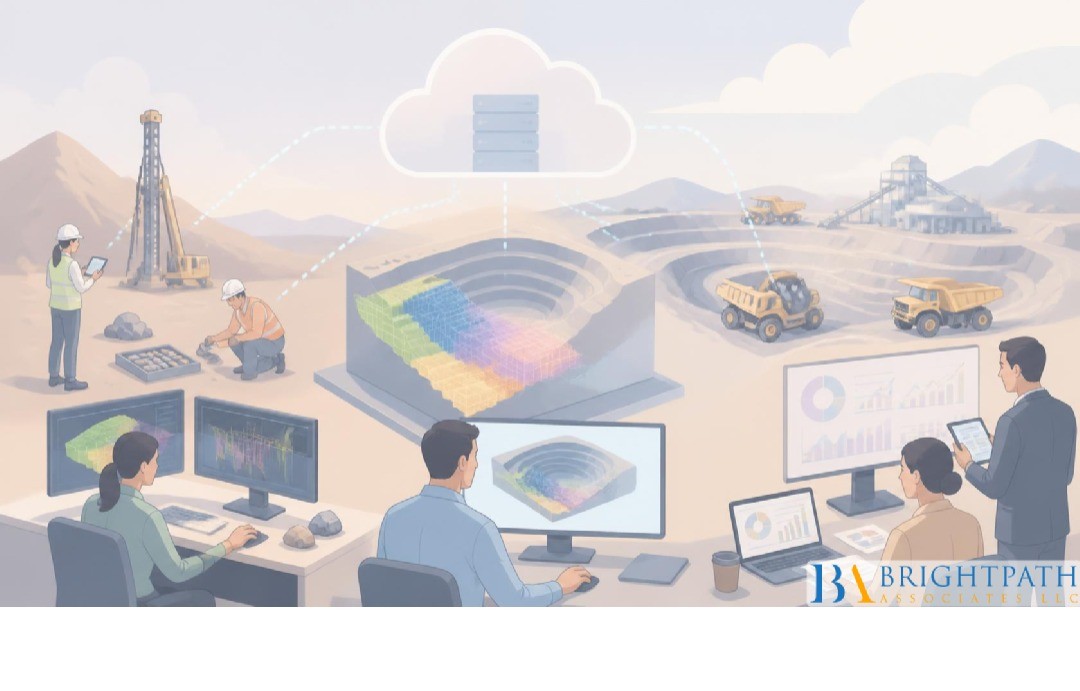
Cloud deployment is becoming increasingly relevant to Mining technology because it allows authorized teams to access centralized datasets, planning models, schedules, and analytical tools without depending entirely on local infrastructure.
Modern cloud-based mining environments can support collaboration between site and corporate teams, centralized data management, version control, and scalable computing resources.
This is particularly valuable for mining organizations with multiple sites, geographically distributed technical teams, external consultants, and corporate offices.
Instead of circulating multiple versions of spreadsheets or planning files, teams can work from a more controlled environment.
That does not eliminate governance requirements. In fact, cloud adoption makes data governance even more important. Companies need clearly defined permissions, audit trails, cybersecurity controls, data standards, and responsibility for model assumptions.
The objective is to create one trusted planning environment rather than simply move fragmented information to the cloud.
The most immediate opportunity is connecting geological information with mine design and production scheduling.
A geological model can provide information about grades, rock types, mineralization, and resource distribution. Mine planning systems can then use this information to develop extraction sequences and evaluate different production scenarios.
Modern planning platforms increasingly support workflows that connect geology, design, scheduling, and economic optimization.
This integration can help planners answer questions such as whether a particular extraction sequence maximizes economic value, how production timing affects cash flow, and what operational constraints could prevent a theoretical plan from being executed.
The result is a more realistic connection between what exists underground and what the business can actually produce.
Why Metallurgy Must Be Part of the Conversation
Geology alone does not determine the value of an orebody.
Metallurgy can have an equally significant influence.
Two deposits with similar grades may generate very different economic outcomes if their processing characteristics differ. Recovery rates, mineral associations, contaminants, grinding requirements, reagent consumption, and concentrate specifications can all influence project economics.
This makes the connection between mine planning and #MetalProcessing increasingly important.
A mine plan that maximizes tonnes extracted may not maximize economic value if those tonnes have poor recoveries or create processing bottlenecks.
Cloud-based planning environments can support scenario analysis that incorporates operational and processing assumptions. Instead of evaluating extraction independently from processing, companies can increasingly examine the value chain as an interconnected system.
The objective of Ore extraction is not simply to move material from the ground.
The objective is to create sustainable economic value while managing safety, environmental, technical, social, and financial risks.
This distinction is important.
A technically optimized mine schedule may not necessarily be the best business decision. A higher production rate could require additional equipment or infrastructure. Accelerating development could increase upfront capital expenditure. Delaying a particular area could reduce near-term output but improve long-term project economics.
Cloud-based scenario modeling allows decision-makers to examine these trade-offs before committing resources.
The most valuable question becomes not simply, “Can we mine it?” but “Which extraction strategy creates the strongest risk-adjusted value?”
Bringing Finance Into the Planning Cycle
Finance teams should not have to wait until a mine plan is completed before evaluating its economic consequences.
Ideally, financial considerations should be embedded into planning from the beginning.
Modern mining financial platforms can connect budgets, forecasts, operating assumptions, and life-of-mine plans within centralized environments. Some systems also support scenario analysis, multi-site consolidation, governed assumptions, and integration with mine planning tools.
This creates an opportunity for finance and technical teams to work from common assumptions.
If production volume changes, the potential financial impact can be evaluated. If a mine sequence changes, capital and operating requirements can be reassessed. If commodity prices change, teams can examine whether the existing strategy remains economically attractive.
This creates a much more dynamic planning process.
Scenario Planning Becomes a Strategic Capability
Mining projects operate under uncertainty.
Commodity prices change. Ore grades differ from expectations. Equipment availability fluctuates. Labor costs increase. Regulatory requirements evolve. Processing performance can vary. Infrastructure projects may experience delays.
A static mine plan cannot fully account for this complexity.
Cloud-based systems can make scenario analysis more accessible by allowing teams to compare different assumptions and planning alternatives.
For example, a company could examine the consequences of different production rates, commodity prices, recovery assumptions, equipment strategies, or development schedules.
This moves planning away from a single “best estimate” toward a portfolio of potential outcomes.
That capability is becoming increasingly important as #MiningInnovation shifts toward data-driven and adaptive decision-making.
Financial optimization is only one part of modern mining strategy.
Stakeholders increasingly expect companies to demonstrate progress toward Sustainable mining practices.
Environmental impacts, water consumption, energy use, emissions, waste management, land disturbance, rehabilitation, and community considerations can influence the viability of a mine plan.
Integrated planning environments can help organizations consider sustainability alongside technical and economic factors rather than treating environmental performance as a separate reporting exercise.
This approach can help executives evaluate trade-offs.
For example, a particular mining sequence might reduce haulage requirements but increase disturbance in another area. An alternative processing strategy might require greater capital investment but reduce energy consumption.
The important point is that sustainability decisions can increasingly be evaluated alongside financial and operational considerations.
The Role of Mining Policy and Regulation
Mining plans are also shaped by government policy and regulatory requirements.
Changes in permitting standards, environmental obligations, royalties, critical-mineral strategies, water regulations, reclamation requirements, and reporting expectations can alter project economics.
This makes Mining policy an increasingly important variable in long-term planning.
Cloud-based planning environments cannot eliminate regulatory uncertainty, but they can make scenario evaluation more systematic.
If a regulatory assumption changes, management can evaluate how that change might affect schedules, costs, capital requirements, and project economics.
This creates greater organizational agility.
The benefits of cloud-based mine planning depend heavily on data quality.
A sophisticated platform cannot compensate for inaccurate geological information, inconsistent cost assumptions, outdated equipment data, or poorly controlled production records.
Mining companies therefore need strong data governance.
Geological models should have clear ownership and validation processes. Financial assumptions should be documented. Planning parameters should be traceable. Changes should be recorded. Users should understand which datasets represent current conditions.
This is particularly important when multiple departments contribute information.
The goal should be a transparent chain from geological assumptions to operational plans and financial outcomes.
The Human Side of Digital Mine Planning
Technology changes workflows, but it does not replace the expertise of geologists, engineers, metallurgists, financial analysts, and operational leaders.
Instead, technology increases the importance of professionals who can interpret information across functional boundaries.
A mining executive who understands only finance may struggle to evaluate geological uncertainty. A technically strong engineer may not fully understand capital allocation requirements. A geologist may understand resource confidence without being responsible for the economic consequences of a production decision.
The future requires greater cross-functional fluency.
This is where Mining #ExecutiveSearchRecruitment becomes increasingly relevant.
Mining companies need leaders capable of connecting technical knowledge with business strategy, sustainability, technology, and financial performance.
The adoption of cloud platforms can expose another challenge: the shortage of professionals who understand both mining operations and digital systems.
Companies may need mine planners who can work with advanced scheduling technologies, geologists comfortable with integrated datasets, financial leaders who understand operational drivers, and technology executives who understand the unique requirements of mining environments.
This is one reason organizations increasingly turn to specialized mining and #MetalsRecruiters when hiring senior technical and commercial leadership.
Recruitment in mining is no longer simply about finding someone with years of industry experience. The strongest candidates may need to combine operational knowledge with data literacy, technology awareness, strategic thinking, and stakeholder management.
Preparing for the Next Generation of Mine Planning
The future of mine planning will likely involve greater integration between geology, engineering, finance, processing, sustainability, and operational data.
Artificial intelligence, predictive analytics, cloud computing, optimization algorithms, and digital twins may further accelerate scenario analysis and decision-making.
However, technology should remain a decision-support capability.
The strongest organizations will use advanced systems to evaluate uncertainty and expose trade-offs while keeping experienced professionals responsible for strategic judgment.
This is especially important because mining decisions often involve variables that cannot be reduced to a simple mathematical optimization problem.
Conclusion
Cloud-based mine planning represents more than a technology upgrade.
It offers mining organizations an opportunity to create a common planning environment where geological intelligence, extraction strategies, processing assumptions, operational constraints, sustainability objectives, and financial outcomes can be evaluated together.
For the modern mining company, the question is no longer simply how much ore exists.
The more important question is how that resource can be developed in a way that balances economic value, technical feasibility, environmental responsibility, #OperationalResilience, and long-term strategic objectives.
As Metals industry trends continue to emphasize digitalization, sustainability, critical minerals, productivity, and capital discipline, integrated planning will become increasingly important.
The organizations best positioned for this environment will combine sophisticated Mining technology with strong human expertise.
That means investing not only in cloud platforms and analytics but also in the geologists, engineers, metallurgists, financial leaders, technology specialists, and executives capable of turning complex information into confident decisions.
Find your next leadership role in Mining & Metals Industry today!
Stay informed with the latest insights on Mining & Metals Industry!