
Introduction
#IndustrialWaterScarcity is becoming an increasingly important operational and strategic concern for companies across manufacturing, energy, food processing, chemicals, mining, pharmaceuticals, and other water-intensive sectors. Water is no longer simply a utility expense. In many industrial environments, reliable access to water can directly influence production continuity, regulatory compliance, environmental performance, and long-term business resilience.
Traditional water-management practices often depend on historical consumption reports, manual inspections, fixed maintenance schedules, and reactive responses to shortages or equipment failures. While these approaches can provide basic visibility, they may not be sufficient when companies face unpredictable weather patterns, changing regulations, aging infrastructure, rising demand, and increasing competition for freshwater resources.
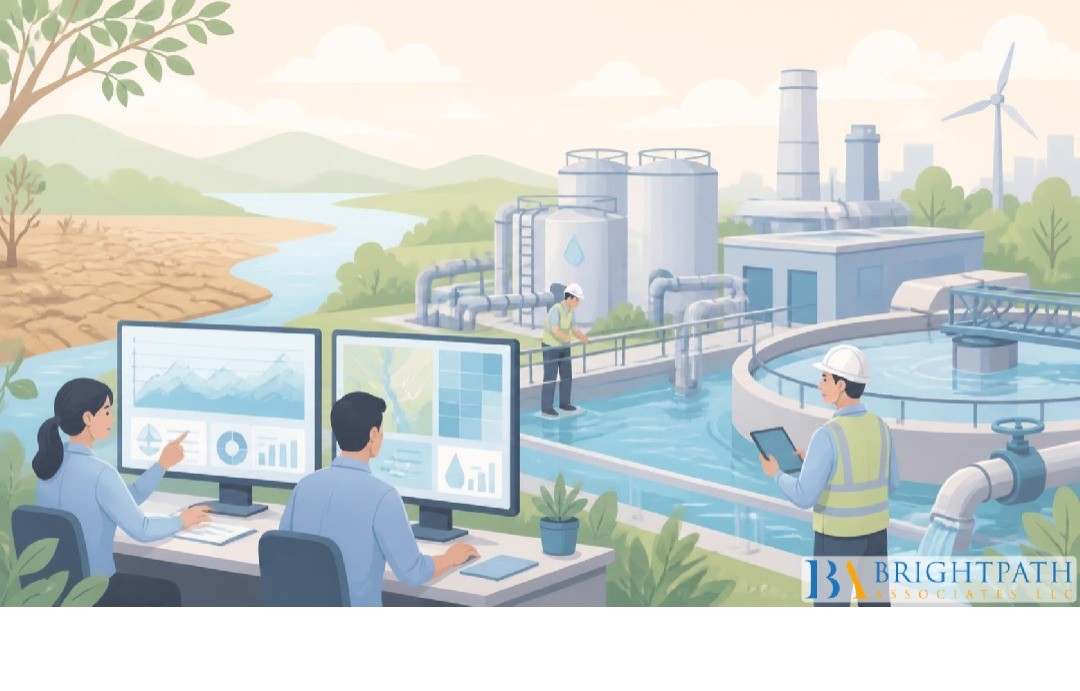
Predictive analytics is changing this equation. By combining sensors, historical consumption data, weather information, production schedules, equipment performance, and advanced analytics, industrial organizations can anticipate water demand and identify potential problems before they become costly disruptions.
For businesses operating within the Environmental services sector, this transformation represents both a challenge and an opportunity. Smart water management can help organizations improve resource efficiency while creating new solutions for customers seeking more resilient and sustainable industrial operations.
Why Industrial Water Scarcity Requires a New Approach
Water scarcity does not always mean that a facility has completely run out of water. It can also mean that the cost, quality, reliability, or availability of water has become uncertain enough to affect operations.
A manufacturing plant may have sufficient water today but face restrictions during a drought. A processing facility may have access to water but require significantly more energy to treat it. Another company may discover that aging pipelines are losing substantial quantities of water before it reaches production equipment.
These situations demonstrate why water management needs to move from reactive control toward predictive planning.
Companies must understand not only how much water they are consuming but also when, where, and why consumption occurs.
Predictive analytics uses historical and real-time information to identify patterns and estimate future conditions. In industrial water management, these capabilities can help organizations forecast consumption, identify abnormal usage, predict equipment problems, and evaluate potential shortages.
For example, a facility may collect information from flow meters, pressure sensors, treatment equipment, production systems, weather databases, and storage tanks. An analytics platform can compare this information against historical patterns.
If water consumption suddenly increases beyond the expected range, the system can flag the deviation for investigation.
This can help identify leaks, equipment inefficiencies, process changes, or operational abnormalities before they become major problems.
The objective is not simply to collect more data. It is to transform data into decisions.
Connecting Water Data With Production
Industrial water demand is closely connected to production activity. A plant producing at full capacity may consume significantly more water than the same facility operating at reduced production levels.
This creates an opportunity to integrate water-management systems with production planning.
If a company knows its expected production schedule, it can estimate future water demand more accurately. Managers can compare expected consumption with available water supplies, treatment capacity, storage levels, and regulatory restrictions.
This integration creates a more sophisticated approach to #IndustrialWaterManagement.
Rather than treating water as an isolated utility, organizations can incorporate it directly into operational planning.
Companies operating in Environmental services are increasingly helping industrial customers address complex water challenges. Their role can extend beyond traditional treatment and compliance services toward data-driven resource management.
Environmental service providers can help customers evaluate water balances, identify losses, improve treatment efficiency, monitor discharge quality, and develop reuse strategies.
Predictive analytics creates another layer of value by helping customers understand what may happen in the future.
This shift can transform environmental services from reactive problem-solving into proactive resource optimization.
Smart Sensors Create Real-Time Visibility
Predictive analytics depends on reliable information. Smart sensors are therefore becoming increasingly important in industrial water management.
Sensors can measure flow, pressure, temperature, conductivity, pH, turbidity, tank levels, and other variables depending on the application.
When these measurements are collected continuously, organizations can develop a more detailed understanding of water movement throughout a facility.
A sudden pressure drop may indicate a leak. Unexpected flow may suggest equipment malfunction. Changes in water quality may indicate treatment problems.
Without real-time monitoring, many of these conditions might remain unnoticed until they create operational or compliance issues.
Water treatment systems can benefit significantly from predictive analytics. Treatment processes often require careful management of chemicals, energy, filtration systems, pumps, membranes, and other equipment.
Analytics can help operators understand how treatment performance changes over time.
Instead of replacing components strictly according to fixed schedules, companies can use operating data to determine when maintenance is actually required. This can reduce unnecessary maintenance while helping prevent unexpected failures.
Predictive models can also support optimization of chemical dosing and treatment processes, potentially reducing resource consumption while maintaining required water quality.
The long-term objective is to create treatment systems that respond dynamically to changing operating conditions.
Water Reuse and Circular Resource Management
Water scarcity is increasing interest in reuse and closed-loop systems.
Rather than treating water as a resource that enters a facility and leaves after one use, companies can evaluate opportunities to recover, treat, and reuse water within their operations.
Industrial wastewater may potentially be treated for non-potable applications such as cooling, cleaning, process operations, or irrigation, depending on regulatory and technical requirements.
Predictive analytics can help determine where reuse provides the greatest value.
By understanding consumption patterns and treatment capacity, companies can identify opportunities to reduce freshwater demand and improve resource efficiency.
This supports broader #EnvironmentalSustainability goals.
Environmental compliance is another major application.
Industrial facilities may be subject to requirements concerning water withdrawals, wastewater discharge, water quality, and environmental monitoring. Failure to comply can result in financial penalties, operational restrictions, and reputational damage.
Automated monitoring systems can provide continuous information that helps organizations identify deviations earlier.
Predictive analytics can go a step further by identifying conditions that may increase the likelihood of future non-compliance.
For example, changes in treatment performance or process conditions could indicate that discharge quality may move outside acceptable limits.
Early warnings allow operators to investigate and correct problems before they escalate.
This makes predictive analytics a valuable tool for strengthening #EnvironmentalCompliance.
Clean Technology for Industrial Water Resilience
The growth of Clean technology is expanding the tools available for industrial water management.
Advanced membranes, smart pumps, energy-efficient treatment systems, automated controls, digital monitoring platforms, and water-recovery technologies can all contribute to greater efficiency.
However, technology selection should be based on operational requirements rather than novelty.
A sophisticated system may not provide value if the facility lacks reliable data infrastructure or employees capable of interpreting the information.
Successful implementation therefore requires alignment between technology, processes, workforce capabilities, and business objectives.
Green technology can support water resilience when environmental improvements also create operational value.
Reducing freshwater consumption can potentially lower water-purchasing costs. Improving treatment efficiency may reduce chemical and energy consumption. Detecting leaks can prevent product losses and unnecessary utility expenses.
These benefits demonstrate why water sustainability should not be viewed exclusively as an environmental initiative.
When properly designed, water-efficiency programs can contribute to both sustainability and financial performance.
This connection is becoming increasingly important for executives evaluating environmental investments.
Air Pollution Control and Integrated Environmental Management
Water management does not exist independently from other environmental systems.
Industrial companies may simultaneously manage wastewater, air emissions, solid waste, energy consumption, hazardous materials, and regulatory requirements.
For organizations providing air pollution control services, this creates opportunities to develop broader environmental management strategies.
The same digital infrastructure used to monitor air emissions can potentially be connected with water and energy monitoring systems.
An integrated platform provides executives with a more comprehensive understanding of environmental performance.
This supports better decision-making across the entire facility rather than optimizing individual environmental systems in isolation.
Technology alone cannot solve industrial water scarcity.
Organizations need leaders capable of understanding environmental risk, industrial operations, technology investment, regulatory requirements, and financial performance.
This creates increasing demand for professionals who can work across traditionally separate disciplines.
Environmental engineers may need stronger data-analysis capabilities. Operations executives may need deeper sustainability expertise. Technology leaders may need to understand environmental compliance.
The convergence of these skills is becoming an important component of #EnvironmentalInnovation.
The Role of Environmental Executive Search
For small and mid-sized companies, finding professionals with this combination of skills can be difficult.
Environmental executive search can help organizations identify leaders with experience across water management, environmental compliance, technology, sustainability, engineering, and industrial operations.
The right executive can help develop a long-term water strategy, evaluate technology investments, build cross-functional teams, and establish measurable environmental objectives.
As industrial water management becomes more data-driven, companies may increasingly need leaders who understand both environmental science and digital transformation.
This is where #ExecutiveSearchRecruitment becomes a strategic component of environmental resilience.
Building a Predictive Water Management Strategy
A successful predictive water strategy should begin with a clear understanding of current consumption and operational requirements.
Companies need to identify major water users, establish measurement systems, evaluate infrastructure, and determine where data gaps exist.
Once reliable information is available, organizations can introduce predictive models and automated alerts. Over time, these systems can become more sophisticated as additional historical data is collected.
The objective should be continuous improvement.
A facility may begin by detecting leaks and abnormal consumption. Later, it may forecast demand, optimize treatment operations, predict maintenance requirements, and support long-term water planning.
The financial case for smart water management can be substantial.
Reducing water consumption can lower utility costs. Detecting leaks can prevent waste. Predictive maintenance can reduce equipment downtime. Optimizing treatment can lower chemical and energy usage. Improving compliance can reduce regulatory risk.
Companies can also strengthen business continuity by reducing dependence on uncertain water supplies.
This creates a broader return on investment than simply measuring the cost of water.
Water resilience can become part of the organization’s overall #BusinessResilience strategy.
Preparing for the Future of Industrial Water
Industrial water scarcity is unlikely to be solved through one technology or one initiative. It requires a combination of conservation, monitoring, treatment, reuse, infrastructure improvement, predictive analytics, and strong leadership.
Companies that begin developing these capabilities early may be better prepared for future resource constraints and regulatory expectations.
Environmental service providers can play a critical role by helping industrial customers transition from reactive water management to predictive resource management.
The opportunity is particularly significant for organizations that can combine technical expertise with digital capabilities.
Smart water management is becoming an essential component of industrial resilience. As water scarcity, regulatory requirements, operational costs, and sustainability expectations increase, companies need better ways to understand and manage one of their most important resources.
Predictive analytics provides a pathway toward that goal. By connecting sensors, production data, treatment systems, environmental information, and operational analytics, companies can anticipate water demand, identify inefficiencies, improve treatment performance, detect potential compliance issues, and support greater water reuse.
For the #EnvironmentalIndustry, this creates an opportunity to move beyond conventional services and provide technology-enabled solutions that help customers manage water as a strategic resource.
The future will belong to organizations that can combine Environmental sustainability, Environmental innovation, Clean technology, Water treatment, and Environmental compliance with strong operational execution.
Yet the technology will only deliver its full potential when supported by capable people. Companies need executives and specialized professionals who can connect environmental strategy with industrial performance, digital transformation, regulatory requirements, and financial objectives.
Find your next leadership role in Environmental Services Industry today!
Stay informed with the latest insights on Environmental Services Industry!