
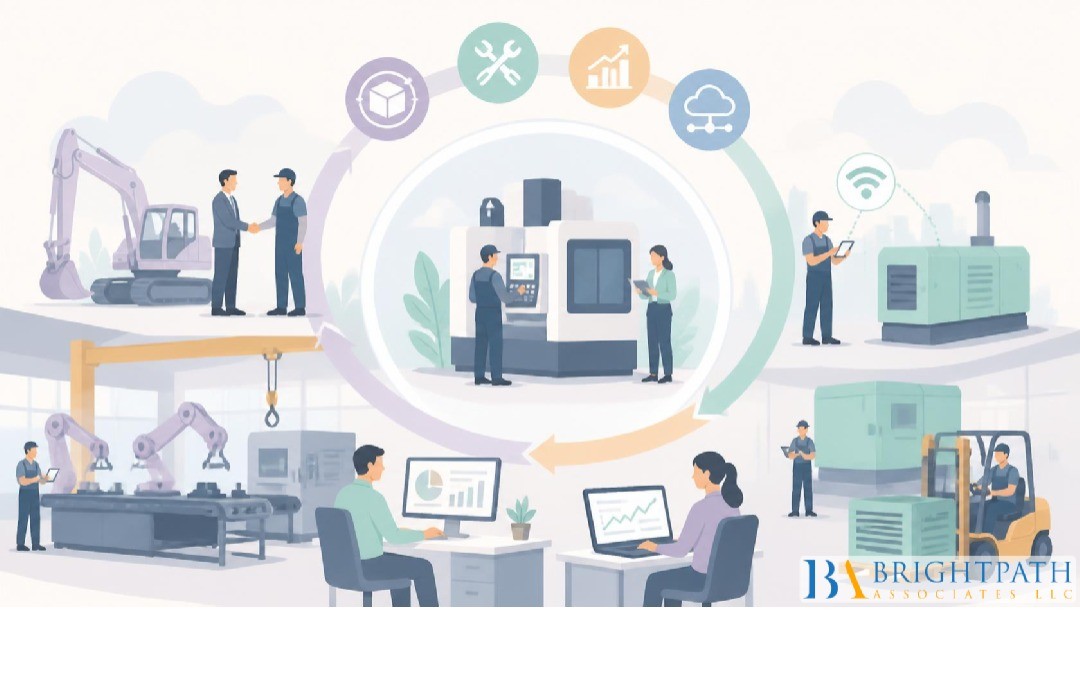
Introduction
The traditional #MachineryBusinessModel is built around a straightforward transaction: manufacture a machine, sell it to a customer, and provide support when necessary. For decades, this model has worked effectively across industrial markets. However, increasing competition, changing customer expectations, higher equipment costs, technological advancement, and unpredictable capital spending are encouraging manufacturers to rethink how they create and capture value.
One increasingly important approach is the Product-as-a-Service model, commonly associated with servitization. Instead of relying primarily on one-time equipment sales, manufacturers combine machinery with maintenance, monitoring, software, upgrades, technical support, financing, or performance-based agreements. Research published in 2026 describes this broader shift toward “everything-as-a-service” as a growing manufacturing business-model transformation, although implementation remains challenging for many companies.
For US Machinery manufacturers, the opportunity is significant. Product-as-a-Service can create recurring revenue, strengthen customer relationships, increase equipment utilization, and provide manufacturers with valuable information about how their machines perform in real-world environments.
Moving Beyond the One-Time Equipment Sale
Traditional equipment sales create a natural separation between the manufacturer and customer. Once the machine is delivered and commissioned, the commercial relationship may become largely transactional.
Product-as-a-Service changes that relationship.
Instead of asking only how much a machine costs, the manufacturer begins asking what outcome the customer actually needs. Does the customer need additional production capacity? Higher uptime? Lower maintenance costs? Greater precision? Reduced energy consumption? Predictable equipment availability?
This shift allows manufacturers to package equipment with services designed around those outcomes.
Servitization essentially moves the business from selling an asset toward delivering ongoing value through that asset. Industry research identifies services ranging from spare parts and repairs to advanced condition monitoring, customer support agreements, and outcome-based contracts.
Industrial customers increasingly face pressure to control capital expenditure while improving productivity. Purchasing expensive #IndustrialMachinery requires significant upfront investment, and ownership also creates continuing responsibilities for maintenance, spare parts, software updates, technical expertise, and equipment optimization.
A Product-as-a-Service arrangement can potentially reduce some of these barriers.
Customers may pay through subscriptions, usage-based contracts, service agreements, or performance-linked arrangements rather than purchasing every component outright. This can create greater predictability in operating expenses while transferring some equipment-related responsibilities to the manufacturer.
For manufacturers, the benefit is the creation of a longer relationship with the customer rather than a single transaction.
The Role of Machinery Maintenance
Machinery maintenance is one of the most natural entry points into servitization. Manufacturers already understand the equipment they build better than most external service providers. They understand common failure points, recommended operating conditions, replacement schedules, and performance requirements.
This knowledge can be transformed into recurring service offerings.
Instead of waiting for a customer to report a breakdown, manufacturers can provide scheduled maintenance, remote monitoring, condition assessment, spare-parts management, and predictive maintenance.
Connected equipment can make these services more proactive. Sensors and data platforms can provide information about machine performance, enabling manufacturers to identify potential problems and intervene earlier. Servitization research highlights remote diagnostics and predictive maintenance as important ways connected products can improve reliability and create additional customer value.
The growth of #IndustrialAutomationSolutions is closely connected to Product-as-a-Service. Modern machines can incorporate sensors, PLCs, robotics, machine vision, industrial networks, and software that generate valuable operational information.
When this information is securely collected and analyzed, manufacturers can understand how equipment is being used.
They can identify operating patterns, downtime events, production cycles, maintenance requirements, and potential efficiency improvements.
This information creates opportunities for new services. A machinery manufacturer could provide remote performance monitoring, optimization recommendations, automated service alerts, production analytics, or software upgrades as part of an ongoing commercial agreement.
The machine therefore becomes more than a physical product. It becomes a connected platform for delivering continuing value.
Predictive Maintenance as a Revenue Opportunity
Predictive maintenance can transform the traditional relationship between machinery manufacturers and customers.
Instead of generating revenue only when equipment fails and requires repair, manufacturers can create proactive maintenance agreements based on equipment condition and usage.
This creates benefits for both sides.
Customers may experience fewer unexpected breakdowns and better equipment availability, while manufacturers gain a recurring service relationship and greater visibility into machine performance.
The opportunity becomes even stronger when maintenance is combined with spare-parts planning and remote diagnostics. Manufacturers can potentially identify a developing issue, determine which component is required, and coordinate service before the failure causes significant disruption.
This turns #PredictiveMaintenance into both an operational service and a commercial opportunity.
For companies involved in Precision machining, the Product-as-a-Service concept can extend beyond machine availability.
Customers may care about accuracy, repeatability, throughput, tooling performance, scrap rates, and overall production efficiency. A manufacturer could potentially design service agreements around measurable production outcomes rather than simply machine ownership.
This requires manufacturers to understand how their equipment contributes to the customer’s broader production process.
A machine that operates continuously but produces excessive scrap is not necessarily delivering strong customer value. A Product-as-a-Service strategy encourages manufacturers to think about the complete performance equation.
This can create stronger differentiation in markets where competing machines may have similar specifications.
Creating New Revenue Through Software and Data
Software is becoming an increasingly important component of industrial equipment. Manufacturers can offer digital dashboards, equipment monitoring, analytics, remote support, software updates, and optimization tools through subscription-based arrangements.
Connected machinery also creates operational data that can support new services.
Manufacturers may use aggregated equipment information to improve product design, identify recurring problems, optimize service schedules, and understand customer usage patterns.
However, data ownership, cybersecurity, privacy, access rights, and customer consent must be clearly addressed.
The commercial value of industrial data should never be separated from responsible data governance.
Product-as-a-Service does not have to be limited to newly manufactured equipment.
Used machinery can also become part of a service-based strategy. Manufacturers and equipment providers can refurbish older machines, upgrade controls, install monitoring systems, and provide maintenance agreements.
This creates an opportunity to reach customers that may not have the capital budget for new equipment.
A refurbished machine combined with modern automation, remote monitoring, technical support, and a service agreement can become a compelling alternative to purchasing new equipment outright.
This approach can also help manufacturers maintain relationships with customers throughout a longer equipment lifecycle.
Machinery Financing and Subscription Models
#MachineryFinancing can play an important role in Product-as-a-Service. Financing structures can make expensive equipment more accessible while allowing manufacturers to develop predictable revenue arrangements.
Subscription models can potentially combine equipment access, maintenance, software, technical support, and upgrades into a single commercial package.
Usage-based models take this further by charging customers according to measurable consumption or equipment utilization.
However, these models require accurate tracking and sophisticated financial management. Manufacturers must understand utilization patterns, service costs, asset depreciation, replacement cycles, and contract profitability.
A successful Product-as-a-Service model is therefore as much a financial transformation as it is a technological one.
Product-as-a-Service can also influence the manufacturer’s own operations.
When a company remains responsible for equipment performance after the sale, it has a stronger incentive to design machines that are reliable, serviceable, energy-efficient, and easier to monitor.
Customer feedback becomes an ongoing source of product-development information.
Manufacturers can identify which components fail most frequently, which maintenance activities are expensive, and which operating conditions create performance problems.
That information can then influence future engineering decisions.
The result can be a continuous feedback loop connecting product design, manufacturing, service, and customer performance.
The Workforce Behind Product-as-a-Service
A successful servitization strategy requires new capabilities. Traditional manufacturing expertise remains important, but companies may also need professionals who understand software, data analytics, IoT, customer success, field service, contract management, finance, and digital transformation.
This creates new Manufacturing jobs and changes the requirements for existing positions.
A field-service technician may need to interpret sensor information. An engineer may need to understand remote diagnostics. A sales executive may need to sell long-term performance agreements rather than equipment specifications.
For smaller machinery companies, building this multidisciplinary workforce can be challenging.
Leadership becomes especially important when a machinery company shifts from product sales toward service-based revenue.
The organization may need executives capable of redesigning pricing models, restructuring sales incentives, developing service organizations, integrating technology, managing customer relationships, and evaluating recurring-revenue economics.
#ExecutiveSearchRecruitment can help manufacturers identify leaders with the combination of industrial experience and transformation capability required for this transition.
The ideal leader may understand machinery manufacturing while also having experience in digital services, aftermarket operations, customer success, or technology-enabled business models.
For small and mid-sized manufacturers, finding this combination of expertise can accelerate transformation while reducing the risks associated with entering unfamiliar markets.
Measuring the Success of a Product-as-a-Service Model
Manufacturers should avoid judging servitization solely by the number of service contracts sold.
Success should also be evaluated through customer retention, recurring revenue, equipment uptime, service profitability, contract renewal rates, customer satisfaction, maintenance costs, equipment utilization, and lifetime customer value.
These metrics provide a broader view of whether the business model is genuinely creating value.
The transition should also be gradual. Manufacturers can begin with maintenance contracts or remote monitoring before progressing toward advanced outcome-based agreements.
This staged approach allows the organization to develop operational capabilities before taking on greater performance responsibilities.
Conclusion
Product-as-a-Service represents a significant opportunity for the #MachineryIndustry to move beyond traditional equipment transactions and build longer-term customer relationships.
For US Machinery manufacturers, the model can create recurring revenue while helping customers manage equipment costs, improve uptime, and access advanced technical capabilities without relying entirely on internal resources.
The opportunity extends across machinery maintenance, industrial automation solutions, precision machining, used machinery, financing, software, analytics, and performance management.
However, servitization is not simply a new pricing strategy. It requires manufacturers to rethink product design, sales, finance, service, technology, data management, customer relationships, and workforce capabilities.
The manufacturers most likely to succeed will be those that understand what their customers truly value and then build commercial models around those outcomes.
Manufacturers exploring this transition should evaluate whether they have the technology, service infrastructure, financial model, and leadership talent required to make Product-as-a-Service commercially sustainable. The right strategy can transform machines from one-time sales into long-term revenue platforms—and turn customer relationships into a lasting source of competitive advantage.
Find your next leadership role in Machinery Industry today!
Stay informed with the latest insights on Machinery Industry!