
Introduction
The modern office is full of quiet performance levers—software, seating, acoustics, airflow—but few are as immediate and as underestimated as light. Walk into a space with harsh glare and flat illumination and you can feel attention start to fray; step into a well-lit environment and the mind seems to lock in. That reaction isn’t aesthetic preference. It’s biology, optics, and #HumanFactorsEngineering playing out in real time at the desk.
This article examines how lighting shapes employee focus, alertness, comfort, productivity, and wellbeing in contemporary workplaces. We’ll look at the underlying science—especially circadian rhythms and visual ergonomics—then translate that into workplace design choices and practical implications for the Office supplies industry, including how Procurement teams evaluate Business equipment, coordinate Office supply management, and work with Office supply vendors as Office technology trends and energy requirements evolve.
How Light Becomes Focus: The Neurobiology Behind Attention
Focus begins with a simple constraint: the brain can only process what the eyes deliver with clarity and stability. When lighting is inadequate or poorly controlled, the visual system compensates by increasing effort—widening pupils, adjusting accommodation, and repeatedly correcting for contrast. That effort is not “free.” It drains cognitive resources that would otherwise support sustained attention, working memory, and decision-making, especially during long stretches of screen-based tasks.
At the cellular level, light influences more than sight. In addition to rods and cones, the retina contains intrinsically photosensitive retinal ganglion cells (ipRGCs) that respond strongly to short-wavelength light and communicate with brain regions that govern arousal, mood, and circadian timing. This pathway explains why a workspace can feel mentally “awake” or “sedating” even when text is readable. Illumination quality alters the body’s state, not just the visibility of the page or the monitor.
In industrial terms, lighting is an input that conditions system performance. It affects error rates, reading speed, task persistence, and tolerance for monotony. The output is not merely “comfort,” but measurable behavior: how often employees look away from a task, how quickly fatigue accumulates, and how reliably teams maintain focus across the day in open plans, meeting rooms, and hybrid collaboration zones.
Circadian Rhythms in the Office: Why Timing Matters as Much as Brightness
Circadian rhythms are the body’s internal scheduling system, coordinating sleep, hormone release, temperature, and alertness. Light is the strongest environmental cue for setting that schedule. In a workplace context, this means the same employee can experience different levels of focus under identical task loads depending on when and how they are exposed to light—particularly in the morning hours when circadian signals are most sensitive.
Daytime exposure to sufficiently bright, appropriately distributed light supports alertness and can stabilize sleep quality later that night. The performance payoff shows up during the afternoon dip, when many knowledge workers experience a predictable decline in vigilance. When lighting is too dim, too uniform, or mismatched to the time of day, the body interprets the environment as “later” than it is. The result is a subtle, chronic drag on attention: more rereading, slower task switching, and reduced tolerance for complex problem-solving.
This is also where the Digital transformation in office intersects with biology. As work shifts to screens, the visual environment becomes more controlled by electric light and less by daylight. Screens add their own luminous load, but they rarely provide the kind of broad, vertical illumination that effectively stimulates circadian pathways. In practice, an office can be bright enough to see yet still biologically “dim,” which helps explain why some employees feel drained even in apparently well-lit spaces.
For organizations concerned with wellbeing and performance, circadian-aware lighting is less a wellness perk and more a risk management strategy. Reduced fatigue supports steadier concentration, and steadier concentration reduces mistakes, rework, and friction across teams. In competitive hiring environments, the physical workplace also becomes part of Talent acquisition strategies—an operational signal that the employer invests in conditions that let people do their best work, not merely occupy a seat.
Glare, Contrast, and Color Temperature: The Mechanics of Visual Comfort
If circadian lighting sets the background state of alertness, visual #ErgonomicsDetermines whether that alertness can be converted into reliable focus. Glare is the most common disruptor. It occurs when a bright source—an exposed luminaire, a sunlit window, or a reflection on a monitor—creates excessive contrast within the field of view. The eyes respond by constantly readjusting, and the employee responds by squinting, leaning forward, or repositioning the screen. Over time, those micro-adjustments accumulate into headaches, dry eyes, neck tension, and attention drift.
Glare is not only about brightness; it is about geometry and surfaces. Highly reflective desks, glossy monitors, and shiny whiteboards can turn acceptable lighting into a discomfort event. This is why lighting decisions cannot be separated from Commercial office furniture selections and finish standards. Matte work surfaces, appropriate monitor placement, and well-designed shades or diffusers reduce reflectance and stabilize contrast at the task plane.
Color temperature adds another layer. Cooler light (often described as higher Kelvin) can increase perceived crispness and support alertness, while warmer light can feel calmer and more restorative. But the goal in a modern office is not to pick a single “best” temperature—it is to match the light’s character to the work pattern and space type. Collaborative zones may tolerate warmer tones, while high-focus workstations and detail-oriented environments often benefit from a cleaner, more neutral appearance that supports legibility and reduces visual ambiguity on paper and on screen.
Importantly, “cool” should not become synonymous with “harsh.” Poorly designed LED systems can create high luminance hotspots, flicker artifacts, or uneven distribution that undermines both comfort and performance. When lighting causes discomfort, employees self-regulate by taking more breaks, avoiding certain seats, or working around the problem. That is a hidden productivity cost—one that rarely appears on a budget line, but shows up in output variability and reduced concentration over time.
Daylight Versus Artificial Light: Designing for Real Work, Not Just Code Compliance
Daylight is dynamic, broad-spectrum, and psychologically valued. Offices with access to windows often report higher satisfaction, and daylight exposure can support circadian stability when it is sufficient and well-timed. However, daylight is also uncontrolled: it produces heat load, sharp contrast, and seasonal variability. A bright winter morning can be an asset; a summer afternoon can turn into relentless glare. The high-performing workplace treats daylight as a resource to manage, not a decorative feature to assume will “just help.”
Artificial light, by contrast, can be engineered for consistency, but it can also become sterile or fatiguing when optimized only for watts and uniformity. The best outcomes come from layered lighting—ambient illumination that supports general orientation, task-appropriate light where precision work occurs, and controlled vertical illumination that supports facial recognition in meetings and reduces the cave-like feel that undermines alertness. The aim is a stable visual environment that keeps contrast ratios reasonable across screens, paper, and faces, so attention remains on the work rather than on coping strategies.
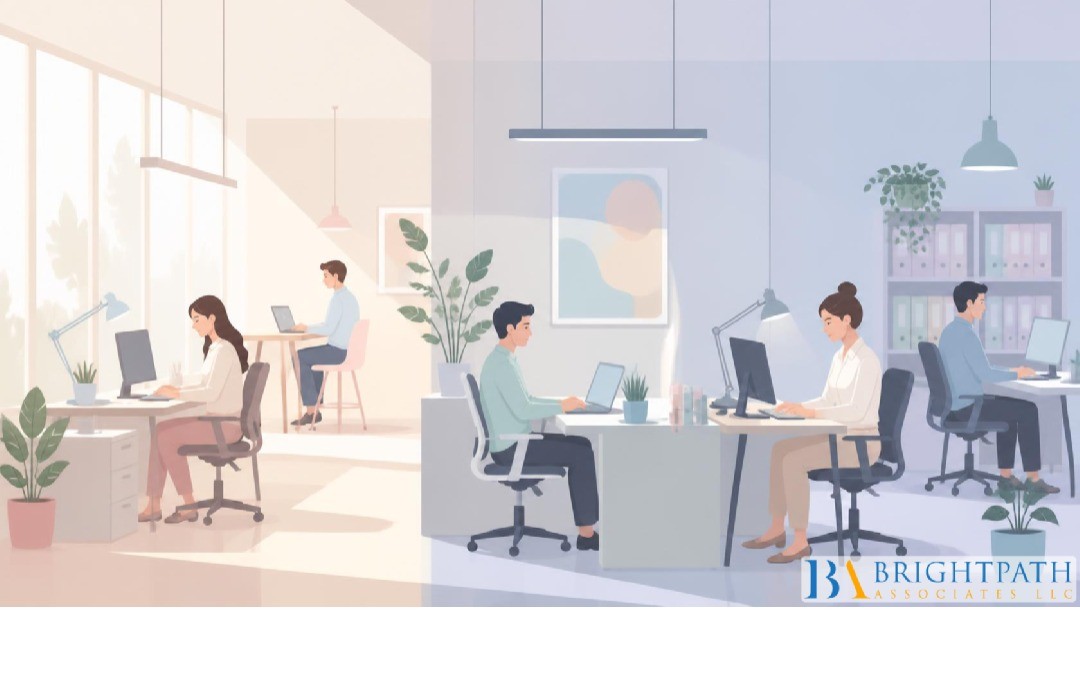
Workplace design also determines how light is experienced. Open offices require careful control of brightness and reflections across a large field of view; private offices can be tuned more precisely but can become biologically dim if users keep light levels low. Meeting rooms often fail by being too dark for attention yet too reflective for screens. Hybrid work patterns complicate this further because space utilization changes daily, meaning lighting needs to adapt without constant manual intervention.
Energy efficiency is not a competing goal; it is a design constraint that can strengthen the business case. LEDs, controls, and sensors can reduce consumption, but the procurement target should be “efficient delivery of quality light,” not merely low power draw. Poor lighting that saves energy but erodes focus is a false economy, because labor is typically the dominant cost in an office. An energy-efficient system that also improves comfort and concentration produces a compound return: lower utility costs and higher human performance.
This is where Office technology trends matter. Smart controls, occupancy sensing, daylight harvesting, and centralized monitoring have matured. They can stabilize lighting conditions, reduce waste, and provide data for facilities teams. Yet these systems also introduce dependencies: commissioning quality, user acceptance, and integration with broader building platforms. Lighting becomes part of Office equipment maintenance, requiring service plans, calibration cycles, and clear accountability—just like HVAC or network infrastructure.
What This Means for Procurement: Turning Lighting Quality into an Operational Standard
For the Office supplies industry, lighting is no longer an isolated facilities concern. It intersects with Business equipment decisions, workspace layouts, and the purchasing frameworks that govern everything from monitors to desk finishes. As Office supply management becomes more integrated, the practical question shifts from “What fixture should we buy?” to “What performance standard are we buying toward?” That standard should include glare control, appropriate light levels for screen work, thoughtful color temperature selection, and the ability to adapt across time of day and space type without creating user friction.
#OfficeSupplyVendors increasingly sit at the junction of these choices, especially when they bundle lighting with furniture packages, cable management, acoustic solutions, and collaboration equipment. The most effective vendor conversations are not about catalog features; they are about outcomes: fewer complaints, less screen reflection, steadier afternoon alertness, and reduced rework from visual errors. When vendors can translate lighting specifications into these operational effects, Procurement teams gain a clearer basis for total cost of ownership rather than a narrow comparison of unit price.
Procurement also has to manage trade-offs across departments. Facilities may prioritize energy and maintenance; IT may prioritize consistency for video calls; HR may prioritize wellbeing and retention; finance may prioritize capital discipline. A lighting strategy that is anchored in performance science helps align these stakeholders because it links the physical environment to measurable work behaviors. In that context, lighting becomes part of the employer value proposition—an ingredient in Talent acquisition strategies—especially for roles that require long periods of concentration, high accuracy, or sustained creative problem-solving.
There is also a people-market implication that often goes unstated: environments that support focus reduce burnout signals and improve day-to-day experience. When organizations compete for specialized talent, the workplace is evaluated as a system. Even in hybrid models, the office must justify the commute by offering conditions that are better than home for certain types of work. Lighting quality is one of the most visible proofs of that promise. It is not unusual for #ExecutiveSearchRecruitment partners to hear candidates talk about the “feel” of an office; translating that feel into engineering terms is what allows it to be designed and purchased reliably, rather than left to chance.
Finally, modern lighting choices should be treated as an operational asset. Controls and LEDs will age, settings will drift, layouts will change, and the workforce will rotate. Without ongoing governance, performance declines quietly. Integrating lighting checks into Office equipment maintenance routines—alongside display calibration, workstation audits, and facilities inspections—protects the original investment and keeps the workspace aligned with evolving needs during Digital transformation in office initiatives.
Conclusion: Lighting Quality Is a Performance Variable, Not a Finishing Touch
Employee focus is not only a matter of willpower and process; it is strongly conditioned by the physical inputs that shape alertness and comfort. The science is clear that light influences circadian rhythms, visual effort, and the stability of attention—especially in screen-heavy, high-cognitive environments. When glare is controlled, color temperature is chosen intentionally, daylight is managed, and electric light is delivered efficiently and consistently, productivity and wellbeing rise together because the workday becomes easier to sustain.
For modern workplaces, the practical lesson is straightforward: treat lighting as a performance specification. When Procurement decisions recognize lighting as part of the same system as Commercial office furniture, technology platforms, and workspace standards, the organization gains a quieter but durable advantage—employees who can concentrate longer, recover better, and deliver higher-quality output with less friction.
Find your next leadership role in Business Supplies & Equipment Industry today!
Stay informed with the latest insights on Business Supplies & Equipment Industry!