
Introduction
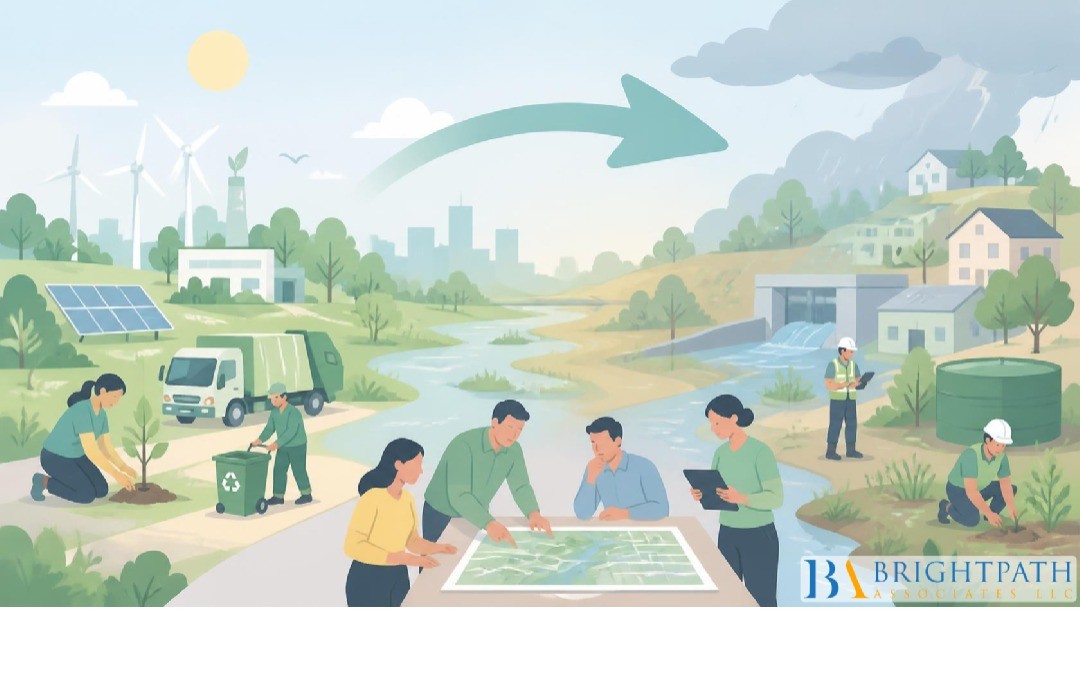
Mitigation has been the defining strategic theme of #EnvironmentalManagement for decades, shaping policy, investment, and technology roadmaps. Yet organisations across energy, manufacturing, utilities, and municipalities increasingly face a reality in which climate impacts are not future scenarios but present operating conditions. Heat stress, flood events, wildfire smoke, drought-driven water scarcity, and cascading supply disruptions are altering baseline assumptions about asset lifetimes, performance tolerances, and the feasibility of “business as usual.” In this context, resilience planning is not a departure from Environmental sustainability; it is the mechanism that keeps sustainability commitments viable when conditions become unstable.
The core strategic shift is that environmental performance is now judged not only by what an organisation prevents—emissions and pollution—but also by what it can withstand and recover from while maintaining public health protection and regulatory integrity. Environmental services providers, in particular, are being asked to deliver measurable outcomes under more extreme variability: stable Water treatment under flood or drought, dependable air pollution control during peak heat and wildfire seasons, and robust Environmental compliance when monitoring systems, logistics, and permitting timelines are under stress.
This whitepaper focuses on resilience planning as a practical strategic discipline for organisations operating in, or served by, the Environmental industry. It covers why adaptation matters now, how to embed resilience into long-term planning and operating models, and how sector capabilities are evolving through Environmental innovation, Clean technology, and Green technology. It also addresses leadership and capability-building, including the growing role of Environmental executive search and Executive Search Recruitment in assembling teams that can translate climate risk into engineered, compliant, and commercially durable solutions.
Background and Context: Climate Pressure Rewrites Environmental Risk
The logic of mitigation presumes a relatively stable operating context: decarbonise over time while improving resource efficiency and pollution controls. Adaptation challenges that premise by introducing non-linear stressors—threshold events that overwhelm design standards, disrupt inputs, and compress response timelines. For industrial operators, the climate signal increasingly appears as correlated risks: higher ambient temperatures reduce process efficiency and increase emissions potential; floods and storms interrupt waste handling and chemical supply; drought tightens water allocations while increasing intake temperatures and treatment complexity. These effects can degrade performance in air pollution control systems and Water treatment trains, pushing operations closer to permit limits and escalating Environmental compliance exposure.
At the same time, regulatory and stakeholder expectations are evolving from static compliance toward demonstrable risk management. Environmental regulators are strengthening monitoring, reporting, and enforcement where extreme events increase the likelihood of releases, bypasses, and uncontrolled emissions. Investors and insurers are also linking capital availability to credible resilience planning, expecting evidence that climate risks are quantified, governance is clear, and capital programs are aligned to material hazards. For Environmental services firms, this creates a dual imperative: deliver today’s compliance and sustainability outcomes while building the technical and organisational capacity to perform under more volatile conditions.
Environmental industry trends further reinforce this shift. Customers increasingly prefer partners that can provide integrated solutions across water, air, waste, and data, rather than isolated projects. They also expect technology-enabled delivery—remote monitoring, predictive maintenance, and scenario-based planning—because resilience is as much about decision speed and operational intelligence as it is about concrete and steel. As a result, Environmental innovation is moving toward systems thinking: pairing Clean technology and Green technology with operational redesign, resilient supply chains, and compliance-by-design approaches that reduce failure modes during disruption.
Why Adaptation Now Matters: Resilience as a Competitive and Compliance Advantage
Resilience planning has shifted from discretionary to essential because climate impacts now influence the core metrics executives manage: uptime, cost of service, safety incidents, regulatory nonconformance, and reputational trust. When a Water treatment facility faces drought-driven source degradation or flood-driven turbidity spikes, the challenge is not simply environmental; it is operational continuity and public health assurance. Similarly, extreme heat can increase fugitive emissions and strain air pollution control equipment, turning what appears to be a maintenance issue into a permit deviation with legal and financial consequences. The data suggests that as event frequency rises, organisations that plan only for average conditions effectively accept higher tail risk, with compounding impacts across production, workforce safety, and stakeholder confidence.
Adaptation also matters because climate volatility can undermine mitigation gains. A facility that invests in Clean technology for efficiency may still suffer emissions spikes during heat waves, grid disruptions, or emergency operating modes. Resilience planning closes this gap by designing for stable environmental performance across a wider operating envelope, ensuring that Environmental sustainability targets remain achievable even under stress. In this sense, resilience is not a separate agenda; it is the strategic substrate that protects the value of decarbonisation investments and keeps Environmental compliance intact when constraints tighten.
In the #EnvironmentalIndustry, resilience is increasingly a differentiator. Clients are selecting Environmental services partners based on their ability to anticipate disruption, maintain compliance, and deliver measurable outcomes in uncertain conditions. This is driving demand for integrated assessments that connect climate hazards to pollutant pathways, treatment capacity, monitoring resilience, and emergency response. The organisations that respond fastest are building repeatable resilience offerings—risk screening, adaptation roadmaps, and technology retrofits—supported by Environmental innovation that compresses time-to-insight and enables scalable delivery models.
Embedding Resilience into Long-Term Planning: From Projects to Portfolios
Resilience becomes operational when it is embedded into the same long-term planning mechanisms that govern capital, operating budgets, and risk oversight. Effective programs start with climate-informed asset criticality: identifying where service failure has outsized consequences, then stress-testing those assets against plausible hazard conditions over their design life. The objective is not perfect prediction but robust decision-making, using scenario ranges to prioritise upgrades that protect performance and compliance. For many organisations, this reframes capital planning from a backlog of replacements to a portfolio of risk-reducing investments, explicitly tied to outcomes such as reduced bypass probability, improved air emissions stability, or enhanced monitoring continuity.
#OperationalResilience requires equal attention. Long-term plans often underestimate the fragility of inputs and dependencies, including chemical supply, energy reliability, workforce availability, and data systems. Resilience planning therefore expands the boundary of environmental management beyond the fence line. For Water treatment, this may include raw-water diversification, on-site storage strategy, and treatment flexibility to handle quality swings. For air pollution control, it may include thermal management, redundancy in critical components, and control logic that maintains stable capture under variable loads. These moves align directly with Environmental compliance by reducing the likelihood that extreme conditions drive an organisation out of its permitted operating envelope.
Technology plays a central enabling role, but resilience is not achieved by technology alone. Clean technology and Green technology deliver most value when coupled with clear governance and decision rights. Organisations that succeed typically establish cross-functional ownership that connects environmental teams, operations, engineering, procurement, and risk leadership. This is where Environmental sustainability evolves into an enterprise capability: climate risk is translated into engineering standards, procurement specifications, contractor performance expectations, and operational playbooks. Over time, resilience planning becomes a continuous cycle of learning, using incident reviews, near-miss data, and performance metrics to refine both technical designs and operating discipline.
Environmental Innovation Under Pressure: Data, Design, and Decarbonisation That Holds
Climate pressure is accelerating Environmental innovation in three connected directions: sensing and analytics, adaptive process design, and resilient decarbonisation. First, sensing and analytics are moving from periodic measurement toward continuous operational intelligence. Remote monitoring, advanced instrumentation, and anomaly detection can provide early warnings of treatment upset, emissions drift, or equipment degradation, reducing the time between detection and corrective action. This is particularly valuable when extreme events compress response windows and create multiple simultaneous stressors across sites. For Environmental services providers, the ability to deliver these insights reliably becomes part of the commercial offering and a route to deeper, longer-term client partnerships.
Second, adaptive process design is increasingly favoured over single-point optimisation. For Water treatment, designs that can shift process paths, adjust dosing strategies, and handle rapid influent variability reduce risk during droughts, storms, and contamination events. For air pollution control, innovation focuses on performance stability, operational flexibility, and maintenance strategies that withstand temperature extremes and particulate surges. The strategic aim is to reduce sensitivity to external volatility, thereby keeping compliance performance stable and lowering lifecycle costs linked to emergency interventions and unplanned downtime.
Third, resilient decarbonisation recognises that low-carbon systems must perform under disruption. Electrification, alternative fuels, and efficiency upgrades can be undermined by grid instability, water constraints, or supply volatility. The next wave of Clean technology and Green technology therefore incorporates resilience requirements into specification and commissioning, ensuring that emissions reductions persist across seasonal extremes and operational contingencies. This integration strengthens the business case for Environmental sustainability by reducing the variance in outcomes, not just the expected average improvement.
Environmental Services Sector Evolution: From Compliance Delivery to Resilience Outcomes
The Environmental services market is expanding from traditional compliance delivery—monitoring, permitting, and remediation—toward outcome-oriented resilience models. Clients increasingly want partners who can link Environmental compliance to operational continuity and long-term risk reduction, converting compliance from a cost centre into a measurable contributor to business resilience. This is visible in the growing emphasis on integrated service bundles: combined water, air, waste, and data support aligned to climate risk profiles and performance obligations. It is also visible in contracting shifts, where performance-based arrangements and longer-term operations support become more attractive when volatility makes episodic project delivery insufficient.
#EnvironmentalIndustry trends also point to consolidation around capabilities that scale: digital platforms for multi-site oversight, standardised engineering solutions tailored to hazard regions, and specialist teams that can rapidly mobilise during events. In air pollution control, the sector is responding to wildfire smoke and temperature-driven chemistry by strengthening modelling, monitoring, and operational control strategies that reduce both emissions and exposure risks. In Water treatment, service models increasingly prioritise resilience of supply, treatment flexibility, and rapid recovery protocols after flooding or contamination. Across these domains, Environmental innovation is less about novelty and more about dependable performance under stress, with Environmental sustainability framed as an assurance function as much as a responsibility narrative.
Leadership and Capability-Building: Talent as the Hidden Constraint
Resilience planning is ultimately executed by people who can connect climate science, engineering realities, and regulatory expectations into decisions that hold under scrutiny. Many organisations find that their constraints are not only financial or technical, but also capability-based. The shift toward resilience increases demand for hybrid leaders: professionals fluent in Environmental compliance and risk governance, who can also sponsor Clean technology and Green technology deployments, manage operational change, and translate data into board-level narratives. This talent profile is scarce, particularly where industries compete for the same skill sets across utilities, infrastructure, manufacturing, and consulting.
Environmental executive search has therefore become a strategic lever, not a routine hiring function. By targeting leaders with experience in climate-informed asset management, operational resilience, and compliance systems under pressure, organisations can shorten the learning curve and reduce the probability of expensive missteps. Executive Search Recruitment is equally critical for building the enabling bench: water process specialists who can design flexible Water treatment trains, engineers and operators who understand air pollution control performance limits under extreme conditions, and compliance professionals who can modernise monitoring, reporting, and assurance systems for more volatile regulatory and operational environments.
Capability-building also requires intentional organisational design. Resilience planning works when accountability is clear, incentives reinforce preparedness, and learning is institutionalised. The most effective leadership teams invest in cross-functional roles that bridge environmental strategy and operational execution, ensuring that Environmental sustainability goals are translated into engineering standards, maintenance regimes, and crisis protocols. Over time, talent strategy becomes part of Environmental innovation, because the organisation’s ability to adopt and scale Clean technology depends on whether it can recruit, retain, and integrate specialists who understand both performance and risk in a changing climate.
Turning Resilience into an Executable Strategy
Organisations should treat resilience planning as a portfolio discipline embedded in governance and capital allocation, rather than a series of reactive projects. This means aligning climate hazard scenarios to asset criticality, service obligations, and compliance consequences, then prioritising investments that reduce the likelihood and impact of failure across water, air, and waste systems. Where possible, resilience upgrades should be designed to preserve or enhance #EnvironmentalSustainability outcomes, ensuring that mitigation investments remain durable under stress and do not degrade during emergency modes.
Organisations should also modernise operational intelligence as a core resilience capability. Continuous monitoring, robust data pipelines, and decision support can reduce response times and prevent minor deviations from becoming reportable incidents. Environmental services providers can differentiate by offering integrated monitoring and performance assurance that connects Water treatment reliability, air pollution control stability, and Environmental compliance reporting into a single operational view. This approach supports faster corrective action, clearer accountability, and stronger auditability during disruptive conditions.
Finally, organisations should explicitly build leadership and specialist capacity for the resilience era. This includes using Environmental executive search to secure senior leaders with demonstrated experience in risk-based planning and technology transformation, and using #ExecutiveSearchRecruitment to build a pipeline of technical experts who can implement resilient designs and maintain compliant operations during extremes. In a market where Environmental industry trends indicate rising competition for the same scarce capabilities, talent strategy is a direct determinant of resilience outcomes, not an administrative afterthought.
Conclusion
The shift from climate mitigation to resilience planning reflects a pragmatic recognition: the environmental operating context is changing faster than many legacy systems were designed to handle. Mitigation remains vital, but organisations that cannot maintain compliant performance through disruption will struggle to protect communities, sustain operations, or realise the value of Clean technology and Green technology investments. Resilience planning offers a strategic pathway to stabilise performance, reduce tail risk, and expand the market relevance of Environmental services through measurable outcomes in Water treatment, air pollution control, and Environmental compliance assurance.
For organisations investing in the future of the Environmental industry, resilience is not merely defensive. It is a growth and credibility strategy that aligns Environmental innovation with real-world reliability, converts Environmental sustainability commitments into durable operational practice, and strengthens stakeholder confidence in the face of volatility. The organisations that act now—pairing climate-informed planning with modern technology and targeted capability-building through Environmental executive search and Executive Search Recruitment—will be better positioned to lead as resilience becomes the defining expectation of environmental performance.
Find your next leadership role in Environmental Services Industry today!
Stay informed with the latest insights on Environmental Services Industry!