
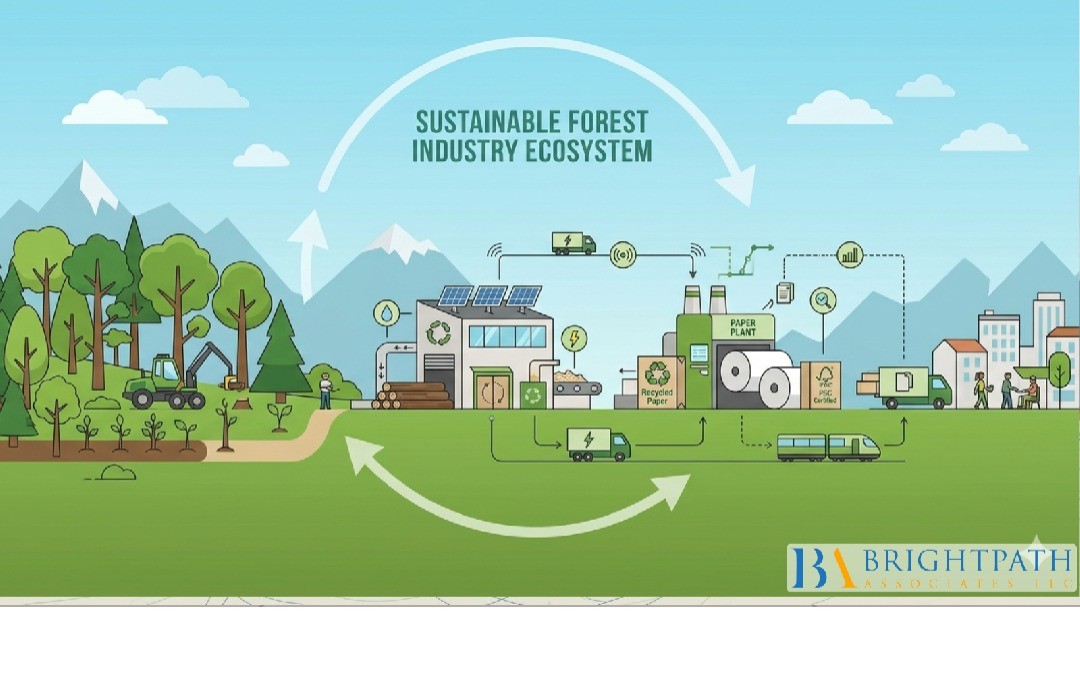
Introduction: Forests at the Heart of a Low-Carbon Economy
The global #ForestIndustry is moving through a decisive transformation. Pressured by climate imperatives, biodiversity risks, and the need for resilient rural economies, it is adopting new technologies, business models, and governance frameworks that link material prosperity to ecological stability. What was once a commodity-centric sector is rapidly becoming a sophisticated ecosystem of Forest product innovation, digital traceability, advanced Paper and pulp technology, and diversified Wood product manufacturing. This evolution is not just about reducing harm. It is about positioning forests and forest enterprises as strategic enablers of net-zero pathways, circular material flows, and nature-positive development.
Regulatory Momentum and Market Expectations
A new generation of Forestry regulations is reshaping the license to operate. Requirements for deforestation-free sourcing, legality assurance, and geolocation-based due diligence are redefining how timber and wood-derived products enter major markets. These frameworks, which extend and in some regions replace earlier timber legality laws, compel operators to verify origin at the plot level, demonstrate conformity with local laws, and prove that recent deforestation or degradation is not embedded in supply chains. For companies across the Paper industry, panel and construction materials, and furniture segments, this is amplifying the strategic value of spatial data, satellite monitoring, and chain-of-custody systems.
Market expectations are moving in lockstep with policy. Large brands, developers, and public procurers increasingly require certified sourcing, transparent life cycle assessments, and high-integrity product claims. Certifications remain influential, but they are being complemented by digital product passports, material-specific carbon disclosures, and continuous monitoring. This convergence of regulation and demand is steering the industry toward measurable outcomes, rigorous risk management, and verifiable sustainability performance.
Climate Pressures and the Case for Innovation
Forests are under intensifying stress from wildfire, pests, and drought, even as global wood production remains at historically high levels and demand projections point upward. The industry’s response is a pivot to innovation that marries productivity with stewardship. Precision forestry, engineered mass timber, and circular biorefinery models are examples of solutions that enable more value with less ecological footprint. Because the climate dividend of the sector depends on both avoided emissions and durable carbon storage, innovation must also address end-use substitution—replacing carbon-intensive materials in buildings, packaging, and chemicals with Sustainable materials derived from responsibly managed forests.
Precision Forestry and the Digital Forest
The operational backbone of the sector’s transformation is digital. #PrecisionForestry uses satellite time series, drone analytics, LiDAR, and artificial intelligence to deliver near real-time insights on stand health, growth, and risk. Where periodic plot inventories once guided Timber harvesting, managers now integrate multisource data to optimize harvest timing, tailor silviculture to micro-site conditions, detect disturbance early, and reduce waste. The result is higher yield per hectare, lower costs, and more resilient forests.
The benefits extend to compliance and brand protection. Geolocation data and remote sensing substantiate deforestation-free claims and support due diligence statements. Analytics can flag anomalies in sourcing patterns, track regeneration, and verify buffer zones around high-conservation areas. In addition to operational gains, this reduces legal exposure and reputational risk. The adoption curve is steepest where government agencies co-invest in monitoring and where supply chains are short and integrated, but even fragmented landscapes are beginning to benefit as service providers standardize methods and bring costs down.
Mass Timber and the Decarbonization of Construction
Cities are emerging as long-term carbon stores as mass timber scales. Cross-laminated timber, glued laminated timber, and laminated veneer lumber are displacing some steel and concrete in mid-rise and, increasingly, higher-rise buildings. When designed appropriately, mass timber can deliver substantial embodied-carbon reductions while storing biogenic carbon for decades, later enabling energy recovery or material recycling at end-of-life. Building codes in multiple jurisdictions now recognize these systems, and developers value the speed, precision, and weight advantages that factory-fabricated components provide.
The climate case for mass timber depends on robust sourcing and life cycle accounting. Forest management must sustain or increase landscape carbon stocks and biodiversity, and supply chains must ensure traceability from certified or demonstrably deforestation-free forests to finished components. Project-level assessments should include construction-phase emissions, hybrid structural solutions, and realistic end-of-life scenarios. The most forward-leaning firms pair Lumber industry trends—such as industrialized offsite construction and digital twins—with traceability and product-level disclosures. This positions mass timber as both a performance solution and a credible climate strategy for the built environment.
Biorefineries, Lignin Valorization, and Circular Paper Systems
On the process side of the industry, the modern pulp mill is evolving into an integrated biorefinery. Beyond cellulose pulp for Paper industry applications, mills increasingly valorize hemicelluloses and lignin into chemicals, resins, and bio-based fuels. Where black liquor has historically been burned to power mill operations, new pathways are exploring its role as a platform for liquid fuels. Lignin, once underutilized, is being refined into high-performance binders and chemical intermediates that can replace fossil phenols in adhesives and engineered wood products.
This evolution dovetails with the ascent of #PaperRecyclingSolutions. High recovery rates, improved fiber sorting, advanced deinking, and fiber-strength management are extending the lifespan of recovered paper across packaging and tissue applications. While fibers inevitably degrade after multiple cycles, smart blending of recycled and virgin fibers, paired with process innovations, reduces overall emissions and resource use. Paper and pulp technology is closing material loops within and across mills as residuals like sawdust and bark are transformed into heat, power, or feedstocks for panels and bio-based composites. Such circular integration reduces costs, buffers against volatile fossil prices, and strengthens climate performance.
Economics, Markets, and Capital Allocation
Sustaining momentum requires a compelling business case. Paper industry economics are being reshaped by three forces: tightening regulation and risk pricing, demand for low-carbon and recyclable packaging, and the margin potential of circular co-products. Mills that capture more value from side streams through chemicals, biofuels, and engineered materials can diversify revenue and hedge against cyclical pulp price swings. In construction, the premium for low-embodied-carbon buildings and the productivity gains from industrialized timber components bolster project economics and help scale capacity investments.
Capital allocation is increasingly tied to credible transition plans. Investors scrutinize exposure to deforestation risk, disaster vulnerability, and carbon intensity. Companies that demonstrate geolocated sourcing, climate-resilient forest management, and measurable progress on decarbonization—both operationally and through product substitution—improve their access to capital and reduce financing costs. Meanwhile, policy incentives for renewable heat, advanced biofuels, and green building materials can catalyze new projects, especially when paired with offtake agreements that stabilize revenue streams.
Social Legitimacy and Landscape Stewardship
#IndustrialPerformance is inseparable from social legitimacy. Effective engagement with local and Indigenous communities, clear benefit-sharing, and respect for tenure are necessary for durable operations and risk mitigation. At the landscape scale, sustainability requires mosaics that integrate production forests, ecological set-asides, riparian buffers, and restoration corridors. This is particularly important in biodiversity-rich regions and in areas highly exposed to wildfire and drought. Companies that co-design landscape plans and share monitoring data can align stakeholders, reduce conflict, and accelerate permitting. Joint initiatives with conservation groups and public agencies can also unlock blended finance for restoration and resilience projects that stabilize supply while improving ecosystem outcomes.
Traceability, Carbon Accounting, and Data Integrity
Credible carbon and biodiversity claims depend on robust measurement, reporting, and verification. Leading firms are integrating plot data with remote sensing to track biomass changes, regeneration, and disturbances with greater accuracy. Carbon accounting should reflect growth, harvest, and product pools, including rotation changes and substitution benefits in end-use sectors like construction. Life cycle assessments must be transparent about system boundaries, transportation, hybrid structures, and end-of-life pathways. In parallel, digital chain-of-custody solutions and product passports are linking batch-level identity to sourcing coordinates and process data, enabling auditable narratives from stump to store. These capabilities not only meet regulatory needs under evolving Forestry regulations but also differentiate brands in competitive markets.
Workforce, Leadership, and Talent Pipelines
As the #ForestSector transitions from commodity throughput to knowledge- and technology-intensive value creation, talent strategy becomes a competitive edge. Companies are recruiting data scientists, remote sensing specialists, process engineers, mass timber designers, and decarbonization leaders alongside traditional foresters and mill operators. #ExecutiveSearchRecruitment is becoming integral to assembling cross-functional leadership teams capable of translating digital and scientific advances into operational performance. The most successful organizations blend domain expertise with software fluency, safety culture, and stakeholder diplomacy, reflecting the sector’s increasingly interdisciplinary nature.
Strategic Priorities for the Decade Ahead
The next phase of the forest industry’s evolution will be defined by scale, integration, and proof. First, zero-deforestation and legal sourcing must be treated as foundational, supported by geolocation, continuous monitoring, and risk mitigation that can stand up to regulatory audits and civil-society scrutiny. Second, Precision forestry should become standard practice, not a pilot, with drones, satellites, and analytics mainstreamed into harvest planning, silvicultural treatments, and disturbance response. Third, mass timber must scale in a way that tightens, rather than loosens, the coupling between building materials growth and sustainable forest management, with traceability stitched into every panel and beam. Fourth, biorefinery upgrades should prioritize lignin valorization, hemicellulose utilization, and thermochemical integration that yield market-ready, fossil-displacing products. Fifth, Paper recycling solutions and Paper and pulp technology should be leveraged to push circularity from incremental to systemic, tying mill energy, materials, and water together for cumulative gains. Finally, transparency must advance in parallel with innovation, with consistent carbon accounting, biodiversity metrics, and data governance that allow credible comparison across products and companies.
Conclusion: From Compliance to Competitive Advantage
The forest industry stands at a moment of strategic choice. It can view rising expectations as compliance burdens, or it can use them to re-architect its value proposition around #SustainableMaterials, high-integrity supply chains, and diversified bio-based outputs. By committing to science-based management, precision tools, and verifiable results, the sector can help decarbonize construction, chemicals, and packaging, while safeguarding forest ecosystems and strengthening rural economies. The path to a sustainable future is industrial in its rigor, insightful in its use of data, and informative in the way it connects forests to the everyday products and infrastructures of modern life. If the industry aligns Timber harvesting, Lumber industry trends, and Wood product manufacturing with landscape stewardship and robust governance, it will not only continue to supply essential goods to the Paper industry and beyond, but also help anchor a circular, climate-resilient economy for decades to come.
Find your next leadership role in Paper & Forest Products Industry today!
Stay informed with the latest insights on Paper & Forest Products Industry!