
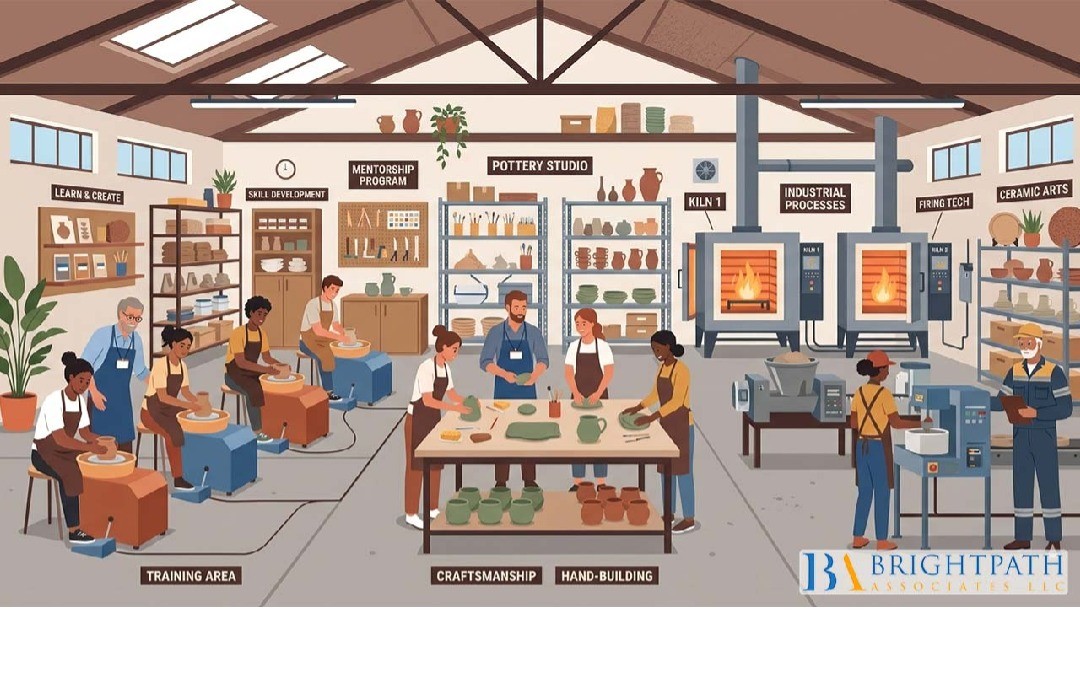
Introduction
The #CeramicIndustry, which ranges from tiles and sanitaryware to technical ceramics for demanding applications, is fundamentally a process industry where material science meets precision engineering. Its competitiveness depends on a workforce capable of handling body formulation, shaping, digital decoration, glazing, kiln operation, and rigorous, standards-driven quality control. Across many production districts, however, employers report persistent skill gaps. Operators can run automated glazing lines but struggle with root-cause analysis. Kiln firemen can supervise cycles but lack the statistical literacy to stabilize yield. Maintenance teams are fluent in mechanics but less so in PLCs, sensors, and data-driven diagnostics. In this context, training and apprenticeships are not merely human-resource instruments; they are strategic levers for productivity, safety, sustainability, and innovation. They connect to broader industrial transformations, from Ceramic manufacturing technology within the plant to Concrete industry trends, Glass market analysis, and Sustainable building materials across adjacent sectors that share materials, processes, and talent pools.
The Competency Architecture of Modern Ceramic Production
A credible training blueprint begins with a clear map of the knowledge and skills required along the value chain. Raw materials and formulation demand understanding of clays, feldspars, silica, frits, pigments, and additives, as well as discipline in moisture control, granulometry, and rheology for slips and spray-dried powders. Operators must collect representative samples, run inline tests for residue and viscosity, and act quickly to keep the body and glaze within specification. Shaping and forming across pressing, slip casting, and extrusion calls for competence in die changeovers, compaction control, binder behavior, and green strength management to prevent lamination, edge chipping, and warpage.
Drying and firing epitomize the sector’s need for skilled labor. Kiln technicians must understand heat transfer, sintering kinetics, and how cycle design and thermal gradients drive microstructure and final properties. They must set curves, balance burners and fans, manage oxygen, and maintain equipment to ensure consistent outcomes and energy performance. Decoration and glazing add another layer of complexity as digital inkjet printing and advanced frits proliferate. Technicians must manage ink rheology, printhead maintenance, color calibration, and glaze chemistry, diagnosing defects such as pinholes, crawling, and crazing with precision.
Process control and quality assurance knit the production flow together. Statistical process control, first-pass yield, capability indices, sampling plans, and standardized test methods for mechanical and surface properties must become everyday literacy. Mechatronics and automation underpin modern lines, requiring hands-on ability with PLCs, sensors, robotics, drives, and condition monitoring. Health, safety, and environmental stewardship remain central. Exposure to respirable crystalline silica is a signature hazard in ceramics, so training must emphasize exposure assessment, ventilation, wet methods, and personal protection. In jurisdictions using OSHA benchmarks, employers limit respirable crystalline silica to 50 micrograms per cubic meter as an eight-hour time-weighted average and act at 25 micrograms per cubic meter, anchoring training content that should be understood by apprentices and supervisors alike. Finally, sustainability and energy management are core competencies. Teams need to conduct energy audits, optimize kiln curves, recover heat, replace fuels or electrify, and valorize waste such as sludge and grog. These capabilities are tied closely to Cement industry sustainability, Sustainable building materials, and Advanced concrete technology, reflecting how materials and process know-how travel across ceramics, cement, glass, and concrete.
Why Apprenticeships Fit the Ceramic Context
Apprenticeships uniquely blend hands-on production learning, theory in materials and process engineering, and #SocialLearning through mentoring and multi-disciplinary teamwork. In ceramics, where tacit knowledge about body behavior, glaze fit, or kiln idiosyncrasies often resides with senior operators, apprenticeships shorten the time to competence and reduce error rates by codifying and transferring that know-how. Properly structured, they improve retention, enhance compliance with safety protocols, and align with quality systems such as ISO 9001, 14001, and 45001. They also make data literacy and problem-solving routine, enabling apprentices to stabilize processes, increase Concrete production efficiency analogously in cement-adjacent plants, and support Glass industry innovation and Ceramic industry growth with a capable talent pipeline.
International Anchors and Cluster Institutions
Countries with strong vocational traditions demonstrate that high-quality apprenticeships are built on clear standards, co-governance among employers and educators, and recognized credentials. Germany’s dual vocational training system integrates in-company training with vocational schools under standardized occupational profiles. Its strengths—consistent curricula, rigorous assessment, and industry–education cooperation—translate well to ceramic clusters that require uniform competence in kiln operation, glaze application, and SPC. Global guidance such as the ILO’s Quality Apprenticeships Recommendation provides guardrails around training quality, fair remuneration, and alignment with labor-market needs, helping governments and associations scale programs without diluting standards.
Regional institutes demonstrate how training and innovation reinforce one another. Spain’s Castellón ceramic cluster has long linked industry and academia through its Institute of Ceramic Technology, supporting R&D and specialized upskilling for technicians and engineers. In fast-growing clusters such as Morbi in India, where hundreds of units operate across tiles and sanitaryware, state skill missions and technical institutes supply operators, mechatronics technicians, and maintenance specialists calibrated to the sector’s needs. These ecosystems prove that competence building accelerates when shared labs, pilot kilns, and common curricula serve many firms at once.
Designing a Three-Year Apprenticeship for Ceramic Production
A robust apprenticeship in ceramics is best structured as a staged, competency-based pathway integrating plant rotations with academic modules. In the first year, apprentices build foundations in safety and environmental health, focusing on silica hazard recognition and control hierarchy, housekeeping, ventilation basics, hot-surface awareness, chemical handling, and lockout/tagout. Theoretical sessions in mineralogy, glaze chemistry, particle size, moisture behavior, and rheology pair with hands-on lab work preparing batches, running viscosity and residue tests, and making simple reformulations. Plant time emphasizes shaping and green handling, from press setup and dosing to casting parameters and extrusion, alongside introductions to sampling, visual standards, and basic SPC. Apprentices also develop digital fluency on HMIs, sensors, and data entry into quality systems.
The second year pivots to process integration and control. Apprentices learn drying and firing physics, kiln components, thermocouple placement, oxygen sensing, and fan balancing, then assist in curve design and heat mapping to reduce warpage and improve strength. In glazing and decoration, they manage slurry stability, application weight, and troubleshooting, while mastering digital color management and printhead maintenance. Maintenance and mechatronics become central, covering preventive maintenance, lubrication, belt and chain systems, introductory PLC logic, variable frequency drives, sensors, and calibration. #QualitySystems advance to capability analysis, root-cause methods, corrective and preventive actions, and internal auditing. Energy and environmental modules train apprentices to track specific energy consumption, implement compressed-air best practices, and minimize waste.
The third year consolidates optimization, leadership, and specialization. Advanced process control introduces design of experiments and multivariate analysis for body and glaze optimization, and apprentices learn to use inline monitoring tools to detect deviations earlier. Lean and TPM methods focus on setup reduction, overall equipment effectiveness, and reliability. Apprentices select a specialization—kiln and thermal processing, digital decoration and color science, formulation and testing, or mechatronics and automation—and deliver a capstone project with measurable impact, such as reducing defect scrap, increasing first-pass yield, or lowering fuel use. Supervisory skills include coaching, shift leadership, and basic production planning to ready apprentices for team lead roles.
Governance, Assessment, and Certification
Governance is as important as curriculum. A transparent competency framework tied to a logbook ensures that apprentices attain defined proficiencies and accumulate time-weighted exposure to critical operations. Joint assessment by mentors and instructors combines written exams on theory with practical tests such as setting kiln curves, calibrating application weights, or interpreting SPC signals. The capstone project is presented to a panel representing the employer and the training provider, reinforcing accountability for tangible outcomes. Certification should be stackable and recognized by industry associations and qualification frameworks: a first-year Operator Certificate, a second-year Technician Certificate, and, at completion, an Advanced Technician or Journeyman credential aligned to the chosen specialization. This signaling supports mobility, wage progression, and Construction materials recruitment by clearly describing skill currency to employers in ceramics and adjacent sectors.
Safety, Compliance, and Health as Core Learning Outcomes
In ceramics, safety is integral to professional competence, not ancillary to it. Apprentices must understand dust generation points in body preparation, dry finishing, fettling, and kiln cleaning, and they must be able to verify whether engineering and work-practice controls are effective. #PracticalTraining in local exhaust ventilation, wet methods, housekeeping standards, and respirator selection and fit-testing equips apprentices to help keep exposures below action levels and well under applicable permissible exposure limits for respirable crystalline silica. Recurrent refreshers in ergonomics, manual handling, hot work, and chemical safety for glazes, solvents, and inks round out health protection. Graduates who can read exposure results, recognize control failures, and trigger corrective actions strengthen compliance and reduce risk.
Digitalization, Data Literacy, and Industry 4.0 Integration
Contemporary ceramic plants are data-rich environments. Kilns stream multiple thermocouple and oxygen channels, presses log compaction cycles, dryers record humidity and temperature profiles, and vision systems track surface anomalies. Apprenticeships should cultivate data literacy so operators and technicians can interpret SPC charts, use dashboards for early alarms, and correlate process variables to defects. Training in edge connectivity, basic industrial protocols, and sensor health checks enables front-line personnel to identify drift before it becomes downtime. Predictive maintenance concepts in vibration and thermography build a culture of prevention. In decoration, digital color management using spectrophotometry and ΔE metrics turns subjective shade control into a measurable, repeatable practice. These capabilities echo requirements seen in Glass industry innovation, as furnaces, lehrs, and inspection systems in glass rely on similar sensor arrays and analytics, and they align with the wider march toward Advanced concrete technology where data-driven batching and curing are unlocking quality and carbon reductions.
Cluster-Level Strategies and Shared Infrastructure
#ClustersMagnify the impact of training by pooling resources. Shared training centers and laboratories can deliver common modules in safety, SPC, and materials science, and they can host specialized equipment such as color labs, pilot kilns, and inkjet test stands that smaller firms cannot justify alone. Industry groups can convene employers, unions, and training providers to develop standardized occupational profiles and assessments, ensuring credentials are portable and trusted. Co-operative projects that include body and glaze suppliers, frit and pigment producers, and machinery OEMs enrich the curriculum with upstream and downstream know-how. Public policy can align incentives for apprenticeships and completion with measurable outcomes such as placement rates, wage progression, and certification attainment. For talent acquisition functions, these standardized credentials make Executive Search Recruitment more effective, since hiring managers can quickly parse demonstrated capabilities across plants and regions.
Return on Investment and Program Maturity
To sustain executive commitment, apprenticeship programs should track production-grade performance indicators. Yield and scrap rates are primary: reductions in pinholes, warpage, shade variation, and chipping signal improved process stability. First-pass yield and rework trends demonstrate quality at the source. Energy intensity measured as kilowatt-hours per kilogram or per square meter captures thermal optimization benefits. Changeover time reduction quantifies lean progress, while maintenance metrics show declines in unplanned downtime. Safety performance through incident rates and silica exposure outcomes validates training efficacy. Talent metrics, including apprentice retention, internal promotion, and wage growth, capture the human capital dividend. As programs mature, benchmarking against peers and adjacent sectors can reveal new opportunities. For example, Concrete production efficiency gains through better moisture control and SCM integration, or insights from Glass market analysis on furnace efficiency and defect detection, can cross-pollinate ceramic operations. Similarly, Cement industry sustainability trajectories—alternative fuels, process electrification, and clinker substitution—foreshadow expectations now arriving in ceramics around fuel switching, electrified kilns, and recycled inputs, reinforcing the case for integrated upskilling in sustainability.
Practical Scenarios Illustrating Impact
Real plant scenarios illustrate how apprentices convert training into value. In kiln optimization, an apprentice may analyze zone temperature uniformity, deploy supplementary data logging, identify a persistent cold area causing glaze defects, and rebalance fans and burners, delivering both scrap reduction and fuel savings. In digital color stability, an apprentice can standardize spectrophotometry procedures across shifts, update printing profiles, and implement ΔE alarms at press-to-printer handoff, sharply reducing shade rework. In changeover performance, a team may map a glazing line’s setup sequence, pre-stage nozzles, standardize quick-connects, and time-load tasks to trim dozens of minutes from each changeover, freeing capacity without capital expenditure. These improvements echo methods used in continuous-process neighbors and support the broader ecosystem of #SustainableBuildingMaterials where stable, resource-efficient production is now a market prerequisite.
Pathways for Small and Medium Enterprises
Smaller firms often cite resource constraints as barriers to structured training. Several approaches overcome these limits. Consortium-based apprenticeships allow companies to share classroom instruction and rotate apprentices through different plants for exposure. Modular micro-credentials break the curriculum into short, stackable units—press setup, basic SPC, kiln safety—that fit around production peaks. Equipment OEMs can integrate training days into service agreements, enabling hands-on sessions on presses, kilns, and inkjet systems. Mentor stipends and train-the-trainer programs ensure consistent, effective coaching on the shop floor. Blended learning using simulations or VR can model kiln internals, hazard recognition, and maintenance procedures with minimal production disruption. These tactics keep training grounded in production reality while scaling quality instruction across resource-constrained environments.
Conclusion
The ceramic industry operates at the intersection of materials variability, high-temperature kinetics, aesthetic precision, and cost pressure. Training and apprenticeships transform that complexity into capability by fusing theory with practice, carrying tacit knowledge into the next generation, and embedding safety, quality, and sustainability disciplines into daily work. International models offer blueprints, cluster institutions multiply impact, and company-level programs deliver measurable gains in yield, energy, uptime, and retention. As Ceramic industry growth tracks infrastructure cycles and design trends, and as adjacent sectors—from glass to cement to concrete—retool around sustainability and digitalization, integrated, high-quality apprenticeships will define the winning plants. Skilled labor is not an interchangeable input to ceramic production; it is the system that converts raw materials, equipment, and data into reliable products and resilient competitiveness. In a market converging on greener, smarter, and faster operations, firms that invest in people through rigorous apprenticeships will set the pace for Ceramic manufacturing technology, contribute to Sustainable building materials, and align with Concrete industry trends while strengthening Construction materials recruitment and #ExecutiveSearchRecruitment outcomes across the wider materials ecosystem.
Find your next leadership role in Glass, Ceramic, Concrete Industry today!
Stay informed with the latest insights on Glass, Ceramic, Concrete Industry!