
Introduction: An Industry at an Inflection Point
#WoodProductManufacturing is undergoing a decisive shift as technology, sustainability imperatives, and market expectations converge. The acceleration of Forest product innovation, from engineered timber systems to digitalized production, is reshaping plant operations and product portfolios. At the same time, intensifying Forestry regulations, supply chain scrutiny, and customer-driven decarbonization goals set a demanding context in which manufacturers must deliver consistent quality, verified performance, and traceable sourcing. This essay examines the core innovations transforming the sector and the industrial challenges that will shape competitiveness over the next decade, while also situating developments alongside the Paper industry and Paper and pulp technology, Paper recycling solutions, Timber harvesting practices, Lumber industry trends, and the evolving economics of Sustainable materials.
Engineered Timber and the Rise of Mass Timber
Engineered wood products have moved decisively into mainstream structural markets. Cross-laminated timber, glulam, and mass plywood panels have demonstrated that predictable, factory-controlled performance can unlock new opportunities in mid- and high-rise construction. The introduction of modern fire design methodologies, supported by codified resistance ratings and calculation procedures, has been pivotal in enabling taller, more complex mass timber buildings. This shift reflects a broader alignment between Wood product manufacturing capability and prescriptive building code pathways that prioritize tested assemblies, reliable fire performance, and consistent quality.
From a manufacturing standpoint, this transition requires tighter management of lamella grading, moisture conditioning, and adhesive cure control, as well as investments in machining accuracy and surface preparation. As panel and beam sizes grow, the cost of variability rises; advanced metrology and closed-loop press control are no longer optional. For many mills, engineered timber has become a strategic hedge against commodity price cycles, permitting a value-added route for softwood fiber and establishing a platform for product differentiation.
Digitalization, Machine Vision, and Yield Intelligence
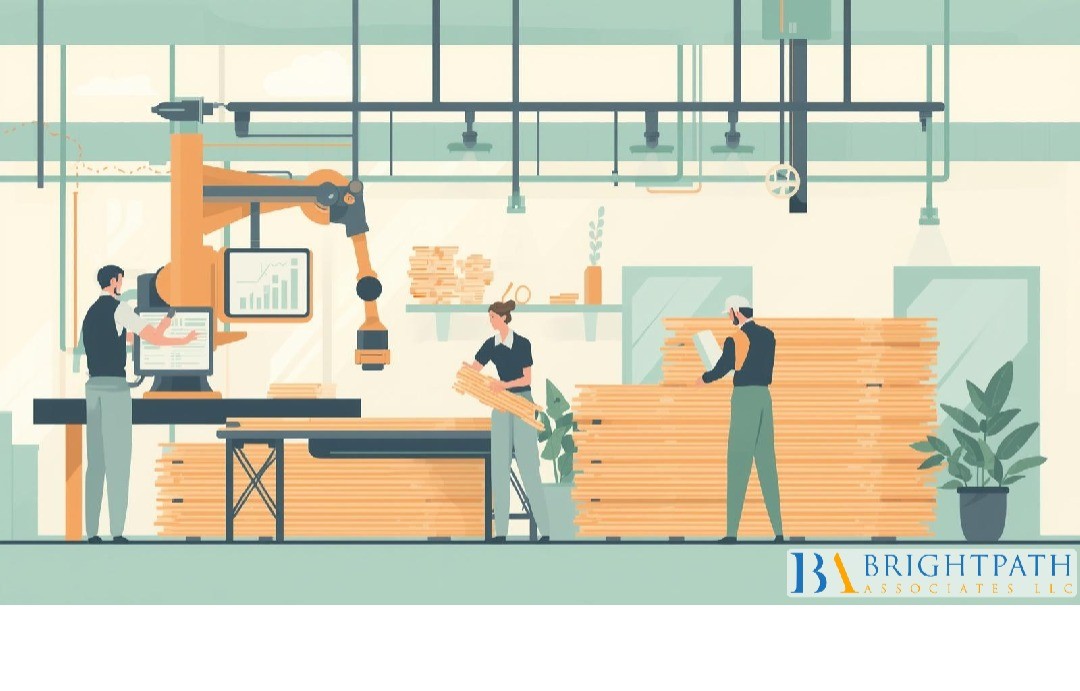
Industry 4.0 has arrived on the mill floor. High-speed machine vision and deep learning models trained for knots, checks, pitch pockets, and other surface defects are replacing manual inspection and rule-based systems, allowing continuous, real-time decisions that elevate yield and stabilize quality. When integrated with optimization software for ripping and crosscutting, this intelligence converts raw board variability into a value recovery opportunity, dynamically adapting cutting patterns to match actual defect maps.
Beyond grading, digital twins and integrated #MESSystems enable predictive kiln controls, press-cycle analytics, and energy dashboards that connect material flow with quality and cost key performance indicators. Plants deploying these technologies report fewer rejects, more consistent bonds, and tighter moisture distributions through thickness. Over time, data creates structural advantages, informing procurement specifications, maintenance schedules, and process recipes that maximize uptime and throughput.
Adhesives, Emissions, and Bio-Based Binders
Adhesive chemistry sits at the center of structural integrity and emissions compliance. Traditional urea-formaldehyde systems, long favored for economy and cure speed, have ceded ground to phenolic, melamine, PUR, and pMDI chemistries as manufacturers align with more stringent expectations for indoor air quality and occupational safety. The regulatory architecture in North America and other markets has institutionalized third-party certification and emissions labeling, reinforcing process discipline and continuous testing as everyday business requirements.
A notable vector of Forest product innovation is the rapid maturation of bio-based adhesives. Lignin, tannin, soy proteins, and carbohydrate-derived systems are advancing from laboratory promise to pilot-scale proof, aiming to reduce or eliminate formaldehyde content while retaining water resistance and mechanical performance. While not yet universal replacements across all panel classes and service conditions, these binders are steadily expanding the feasible envelope, particularly for interior applications and products designed for circular end-of-life pathways. The coupling of ultra-low-emitting resins with formaldehyde scavengers and robust process controls has become a practical route to compliant panels that can also tolerate higher levels of recycled furnish.
Wood Modification for Durable, Low-Toxicity Performance
Thermal modification and acetylation have redefined durability-by-design. Thermal modification reduces hygroscopicity and decay susceptibility by altering cell-wall chemistry under controlled heat, typically at 160–220°C. Properly executed, the result is improved dimensional stability and biological resistance suitable for cladding and decking, albeit with trade-offs in mechanical properties that must be engineered into section sizes and connection details.
Acetylation, by substituting hydroxyl with acetyl groups within the cell wall, drastically reduces swelling and shrinkage while resisting fungal attack. Commercial acetylated softwoods have demonstrated extended coating life and stable geometry in exposed environments, permitting longer maintenance intervals and precise joinery tolerances. One practical consideration is bonding behavior: some acid-curing resins underperform on modified substrates, necessitating adhesives with appropriate wetting, penetration, and cure kinetics. Even so, the combination of enhanced service life and non-biocidal chemistry aligns powerfully with the market’s growing appetite for #SustainableMaterials.
Circularity, Recycling, and the Cascading Use of Wood
Circular economy principles are reshaping plant strategies and investment. The cascading use of wood—retaining material at the highest possible value for as long as possible before energy recovery—demands upgrades in sorting, decontamination, and furnish engineering. Particleboard remains the primary industrial sink for post-consumer wood in many regions, but the path to higher recycled content is bounded by the challenges of cured thermoset resins, coatings, and preservatives that impair bond formation and elevate VOC emissions.
Technological responses are emerging. Near-infrared spectroscopy is improving feedstock classification; mechanical and chemical pre-treatments are under development to liberate cleaner fibers; and resin systems are being tailored to accommodate recycled furnish with consistent properties. Paper recycling solutions in the Paper industry provide a conceptual parallel: process stability, contaminant controls, and reliable deinking or purification steps are essential to transform variable waste streams into standardized inputs. As wood-based panels face growing end-of-life volumes, industrial success will hinge on closing the loop without sacrificing performance or compliance.
Regulatory Landscape and Supply Chain Transparency
#ForestryRegulations and market access requirements have tightened significantly, particularly around deforestation-free sourcing and product emissions. Manufacturers serving European markets must anticipate rigorous due diligence, geolocation of origin for relevant commodities, and documentation that products are not linked to recent deforestation. Even where implementation timelines shift, the direction is clear, and the operational implication is deep: supply chains must be mapped at parcel-level resolution, risk assessments formalized, and data systems capable of generating verifiable statements on demand.
Emissions frameworks for composite wood and finished goods have similarly matured, intertwining panel production with downstream fabrication and retail obligations. Compliance is now an ecosystem responsibility, and lapses carry both regulatory and reputational costs. Companies that embed traceability and quality documentation into purchasing and manufacturing workflows are better positioned to respond to audits, customer questionnaires, and evolving national and regional standards.
Energy, Decarbonization, and Operational Efficiency
Drying, pressing, and machining dominate the energy profile of Wood product manufacturing. Decarbonization strategies increasingly converge on three levers: electrification and heat integration, optimized use of bioenergy residues, and data-driven process control. Heat pumps and heat recovery applied to pre-drying stages can reduce fossil energy intensity; high-efficiency biomass combustion using bark and fines can displace external fuels where regulations permit; and advanced kiln schedules informed by predictive moisture models can lower over-drying risk while maintaining throughput.
In parallel, many customers now require environmental product declarations and support for whole-building life cycle assessments. For mass timber, this necessitates careful accounting of biogenic carbon, realistic end-of-life assumptions, and alignment with third-party rulesets. Plants that quantify and systematically reduce energy intensity tend to realize operational benefits that compound into stronger commercial positions under carbon-sensitive procurement regimes.
Timber Harvesting, Feedstock Quality, and Lumber Industry Trends
#TimberHarvesting strategies are evolving under climate stress, market volatility, and sustainability targets. Disturbance events such as wildfire and beetle outbreaks alter fiber availability and quality, while trade shifts and sanctions reconfigure traditional roundwood and sawnwood flows. In response, many producers diversify sourcing, invest in log yard characterization, and adjust sawing patterns to accommodate more variable log geometries. These operational moves are consistent with broader Lumber industry trends toward risk diversification, real-time logistics coordination, and tighter integration between mill requirements and forest operations.
At the same time, silvicultural practices designed to balance carbon, biodiversity, and yield objectives influence the long-run cost and character of supply. Certification and chain-of-custody frameworks have become market prerequisites in many segments, reinforcing the premium on verifiable sustainability. Downstream, engineered timber plants benefit from steady lamella specifications that depend on upstream consistency in species, growth rate, and harvesting regimes.
Paper and Pulp Technology and the Economics of Integration
The Paper industry remains a critical component of the broader forest sector, and advances in Paper and pulp technology carry lessons for wood manufacturers pursuing resource efficiency and circularity. High-yield pulping, improved bleaching chemistries, and closed-loop water systems exemplify process intensification that lowers environmental footprints while stabilizing quality. Paper recycling solutions have matured to a point where recovered fiber is a structural component of many grades, supported by sophisticated contaminant removal, fiber fractionation, and quality monitoring.
Paper industry economics add a strategic dimension to integrated companies. Cross-sector synergies—residue exchange, shared energy infrastructure, and coordinated logistics—can improve overall yield from each harvested cubic meter while spreading capital costs across multiple product lines. As both Paper industry and wood products respond to the same macro pressures—energy prices, environmental compliance, and fiber availability—integrated planning can surface opportunities not visible within silos, from joint CHP investments to harmonized procurement that levels seasonal demand and lowers transport intensity.
Quality, Safety, and Workforce Development
As processes grow more automated and chemistries more specialized, workforce skill sets must evolve. Plants require technicians conversant in controls, sensors, and analytics alongside traditional mechanical and #ElectricalExpertise. Safety remains paramount, particularly around adhesive handling, isocyanate exposure, fine dust management, and press operations. Progressive facilities pair automation with rigorous training, near-miss analysis, and real-time monitoring to maintain a safe, high-uptime environment. In a tightening labor market, visible commitments to safety, upskilling, and career trajectories also serve as competitive advantages in recruiting and retention.
Strategic Outlook: Converting Innovation into Advantage
The path ahead favors manufacturers that align product design, process discipline, and compliance infrastructure into a coherent operating model. Mass timber momentum can be translated into durable margin only if factories sustain low-variability bonds, precise machining, and robust documentation. Bio-based adhesives can unlock market access where customers prioritize health and environmental criteria, provided that performance envelopes are honestly defined and validated. Circularity can become a brand asset if recycled furnish is engineered to reliable specs and if end-of-life pathways are considered at the design stage.
Crucially, success will depend on collaboration across the value chain. Specifiers and engineers need transparent data; fabricators need stable substrate performance; and forest owners need clear signals about desired fiber attributes. Bringing these elements together—supported by strategic #ExecutiveSearchRecruitment to align leadership with innovation goals—transforms isolated advancements into system-level performance and sustainable commercial outcomes that endure across cycles.
Conclusion: Building with Confidence in a Complex Landscape
The future of Wood product manufacturing will be shaped by disciplined execution under uncertainty. The industry’s structural strengths—renewable feedstock, favorable strength-to-weight ratios, and an expanding portfolio of Sustainable materials—position it to benefit from the global shift toward low-carbon construction and circular production. The differentiators will be operational: precise, data-driven factories; credible and efficient compliance; resilient sourcing linked to responsible Timber harvesting; and product strategies that balance innovation with verified performance. When combined with insights from the Paper industry, #PaperRecyclingSolutions, and Paper and pulp technology, the sector can capture more value from every tree, meet the demands of modern markets, and contribute substantively to a decarbonized built environment.
Find your next leadership role in Paper & Forest Products Industry today!
Stay informed with the latest insights on Paper & Forest Products Industry!