
Introduction
#EnvironmentalConsultingFirms are being asked to do something that used to feel impossible: deliver faster answers with higher confidence while regulations tighten, projects become more complex, and climate-driven variability makes historical baselines less reliable. In the Environmental industry, the firms that win trust are the ones that can quantify outcomes, defend assumptions, and respond quickly when conditions shift mid-project.
Digital-twin modeling is emerging as the practical response to that pressure. It turns environmental systems into living models that can be calibrated, tested, and updated, enabling Environmental services teams to move from static reports to decision-grade, operational insight without sacrificing rigor or defensibility.
What digital-twin modeling is, and what it is not
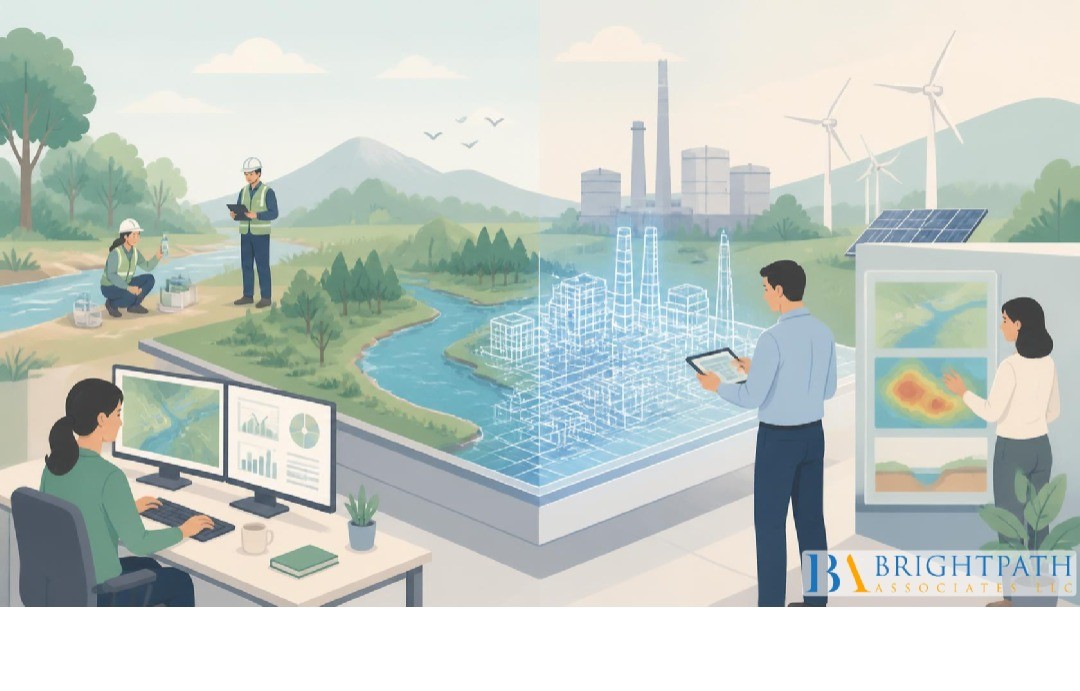
A digital twin is a dynamic, data-informed representation of a real asset, process, or environmental system. Unlike a one-time model built for permitting or a single design decision, a twin is designed to persist and improve as new information arrives. It can represent a facility, a watershed, an air shed, a treatment train, a remediation system, or an entire program portfolio, linking physical behavior to data streams, operational parameters, and constraints.
For environmental applications, the most useful way to think about a digital twin is as a continuously testable hypothesis. The twin encodes the best available understanding of how emissions disperse, how contaminants move, how treatment performance changes with influent variability, or how control equipment responds to operating conditions. As monitoring data, operating logs, and inspection findings accumulate, the twin can be recalibrated to reduce uncertainty and expose what is driving performance, not just what is being observed.
This is not a replacement for established engineering judgment, field work, or regulatory documentation. A digital twin does not eliminate the need for sampling plans, chain of custody, QA/QC, or validated methods. Instead, it makes those efforts more targeted by clarifying which measurements reduce uncertainty the most, which assumptions are sensitive, and which controls actually change outcomes. In practice, this is where Environmental innovation becomes concrete: a tighter loop between data, interpretation, and decisions that stakeholders can audit.
Digital-twin modeling also differs from conventional simulation because it is meant to be used repeatedly by a project team and a client’s operators. It is built for scenario planning and ongoing decision-making, not just for a report appendix. When implemented well, the twin becomes an asset that improves each time the firm solves a problem for that client, increasing both the quality and speed of advisory work over the long term.
Why it matters now for environmental consulting firms
The market is shifting from “prove compliance” to “prove resilience.” Clients still need Environmental compliance, but they increasingly want to know how a facility will perform under abnormal weather, supply disruptions, tightening discharge limits, changing production mixes, and evolving community expectations. Traditional deliverables often freeze reality at a point in time, while projects now unfold in conditions that change quarter to quarter.
At the same time, clean investment is accelerating. Organizations are deploying #CleanTechnology and Green technology across energy, manufacturing, and infrastructure, and those solutions introduce new interfaces between environmental performance and operations. A decarbonization project can change fuel composition, exhaust characteristics, and control strategies. A new process chemistry can change wastewater loading patterns and sludge behavior. Even beneficial upgrades can create compliance risk if the system response is not understood end-to-end.
Digital-twin modeling meets this moment because it translates complexity into actionable choices. For a consulting firm, it becomes a scalable method to standardize how problems are framed and how uncertainty is communicated. The twin offers a shared language across engineers, scientists, operators, and legal teams, helping align expectations on what “good” looks like and what trade-offs are being accepted to reach Environmental sustainability goals.
There is also a business-model dimension. Many firms have historically relied on time-and-materials work where value is implied by effort. The market is moving toward outcomes, speed, and defensibility. A well-designed twin supports more predictable delivery, clearer scope boundaries, and a stronger ability to stand behind recommendations. It can also expand the firm’s role from episodic support to ongoing Environmental services, where advisory work is tied to operational decisions and continuous improvement rather than single milestones.
Strengthening environmental services across air, water, and technology transitions
Digital-twin modeling strengthens Environmental services by making performance measurable in ways that matter to both regulators and operators. For air programs, that means moving beyond average emissions factors to a more operationally faithful view of sources, controls, and operating states. In air pollution control, a twin can link process conditions, control-device performance, maintenance history, and ambient considerations into a defensible narrative about variability, exceedance risk, and control optimization. This does not remove the need for stack testing or method compliance, but it can make monitoring strategies smarter and corrective actions more targeted.
For Water treatment and industrial wastewater management, twins can be even more transformative because treatment systems are inherently dynamic. Influent quality changes with production schedules, cleaning cycles, stormwater intrusion, and upstream process upsets. A digital twin can represent unit operations and constraints, estimate sensitivities, and stress-test how the system behaves under challenging load cases. That supports more confident design, better operator guidance, and clearer arguments about feasibility when limits tighten.
The technology transition itself is another driver. As Clean technology is deployed, environmental performance can become coupled to new equipment, control software, and data platforms that were not historically part of EHS programs. A digital twin provides a way to integrate those changes without losing traceability. It can show how a new Green technology process affects emissions speciation or wastewater treatability, and it can help quantify whether the operational changes required to realize sustainability benefits also introduce new failure modes.
Importantly, these applications strengthen Environmental innovation without drifting into speculation. Innovation in a consulting context must be usable under real constraints: limited data, tight schedules, and the need for transparent assumptions. A twin, built with clear calibration practices and change control, becomes an industrial tool that improves how firms deliver Environmental sustainability outcomes while maintaining the documentation discipline clients need for audits, permitting, and stakeholder review.
Scenario planning and risk management become decision-grade, not hypothetical
Environmental consulting has always involved scenarios, but too often scenario work is disconnected from what clients can actually change. Digital-twin modeling improves scenario planning by tying each scenario to controllable levers, measurable responses, and constraints that reflect real operations. Instead of asking a client to accept a generic sensitivity study, a firm can show how specific operating policies, maintenance choices, feedstock changes, or control settings alter outcomes under defined conditions.
This approach improves risk management in a way that resonates with executives. Risk becomes something that can be quantified, monitored, and mitigated, rather than a qualitative label. For #EnvironmentalCompliance, a twin can estimate the likelihood and drivers of excursions under different production mixes, weather patterns, or equipment degradation states. That supports more credible compliance strategies, including when to invest, when to adjust operations, and when to escalate with regulators using defensible technical reasoning.
Client decision-making also benefits because a digital twin clarifies what is uncertain and what is unknowable. Consulting recommendations often fail not because the underlying analysis is wrong, but because decision-makers cannot see which assumptions matter most. A twin can highlight which parameters dominate performance and where additional monitoring, sampling, or pilot testing reduces uncertainty meaningfully. That helps clients spend money where it buys down risk, not where it merely produces more documentation.
Finally, twins make post-project learning possible. Too many studies are filed away after commissioning or after a permit is secured. With a maintained twin, firms and clients can compare predicted versus actual performance, understand why gaps exist, and adjust strategies. Over time, that feedback loop becomes a competitive advantage for both parties: the client becomes more stable and predictable, and the consulting firm becomes faster and more accurate in future work because it is building on validated understanding rather than starting from scratch each time.
The talent shift: from report production to technical, data-driven advisory
Adopting digital-twin modeling is not only a tooling change; it is a capability change. Firms need professionals who can bridge domain science, engineering judgment, and data systems without diluting any of them. That includes modelers who understand uncertainty and calibration, engineers who can translate operations into parameters and constraints, and project leaders who can govern assumptions and communicate results in plain industrial language.
This shift puts pressure on the talent market, especially for senior roles. Many firms will need to elevate or recruit leaders who can own the digital-twin vision, set standards, and mentor teams across offices and disciplines. That is where Environmental executive search becomes a strategic tool rather than a reactive hiring channel. The goal is not to find a generic “digital lead,” but to find people who can run a technical program in an environment where deliverables must remain defensible for regulators, insurers, and internal governance.
#ExecutiveSearchRecruitment also matters because the work is increasingly interdisciplinary. A firm may need a practice leader who can align Environmental services with data architecture, cybersecurity requirements, and client IT realities. It may also need specialists who can integrate monitoring data, historian systems, laboratory outputs, and field observations into a coherent model workflow. In a market where these skills are scarce, firms that treat recruitment as part of their digital strategy will move faster and make fewer mis-hires.
Done thoughtfully, the talent shift reinforces Environmental sustainability outcomes. When teams have the skills to quantify trade-offs, validate performance, and refine models over time, they can move beyond compliance minimums and help clients make investments that hold up under scrutiny. That is the core of more technical, data-driven advisory work: not just producing analysis, but building decision systems that make environmental performance a managed, improvable part of operations.
Conclusion: digital twins are becoming essential infrastructure for modern consulting
Digital-twin modeling is moving from a niche capability to an essential method because the Environmental industry is being reshaped by volatility, tighter requirements, and technology transitions. Consulting firms that rely only on static models and one-time studies will find it harder to keep pace with client expectations for speed, clarity, and defensibility. Firms that adopt twins can deliver Environmental services that are more operationally grounded, more transparent about uncertainty, and more useful to decision-makers who have to act under constraints.
The strongest case for adoption is practical: twins support Environmental compliance while enabling Clean technology and Green technology changes to be evaluated with fewer surprises. They strengthen air pollution control strategies and Water treatment decisions by connecting performance to real operating conditions. They improve scenario planning and risk management by tying outcomes to levers clients can actually pull. And they elevate the advisory relationship from producing documents to building capability, which is increasingly what clients pay for when Environmental sustainability becomes a core business priority.
For environmental consulting firms, the question is no longer whether digital twins are “the future,” but whether the firm will build the technical foundation, governance discipline, and talent pipeline to use them responsibly. The firms that invest now, including through Environmental executive search and focused Executive Search Recruitment, will be positioned to lead as digital-twin modeling becomes the standard for credible, modern environmental advice.
Find your next leadership role in Environmental Services Industry today!
Stay informed with the latest insights on Environmental Services Industry!