
Introduction
Modern agricultural supply chains are becoming increasingly complex. Producers, processors, distributors, retailers, technology providers, and #LogisticsCompanies must coordinate multiple stages of the journey from farm inputs to finished food products.
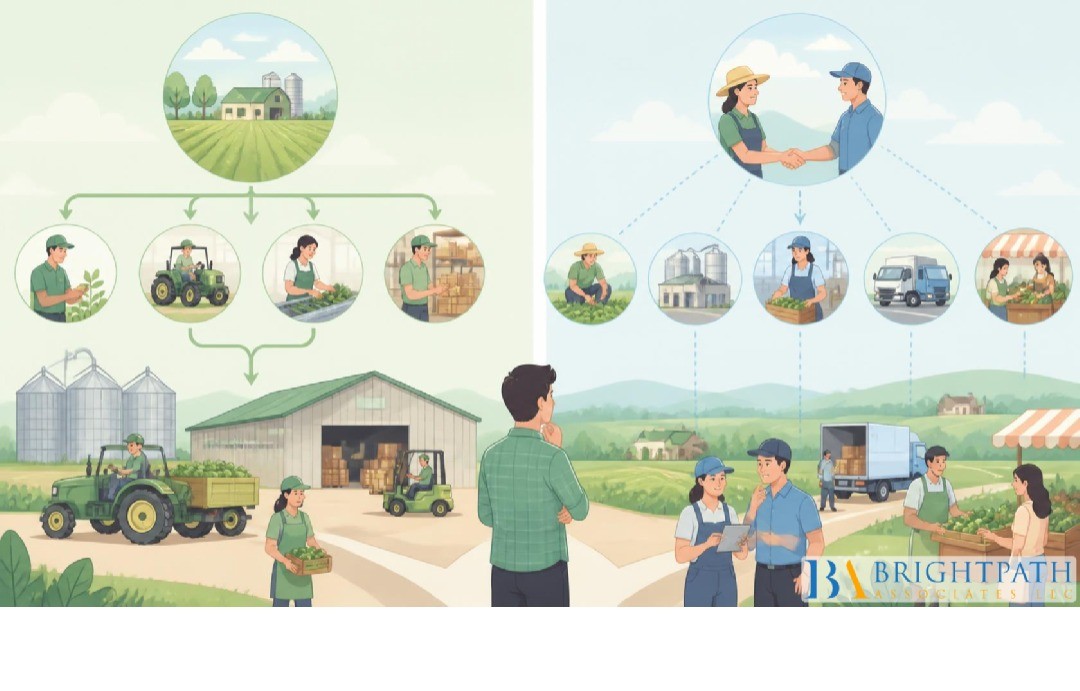
The answer depends on operational scale, capital availability, technology requirements, supply-chain complexity, and long-term strategic objectives. Vertical integration can provide greater control over logistics, data, quality, and scheduling, while strategic partnerships can provide flexibility, specialized expertise, and access to established infrastructure without requiring major capital expenditure.
This decision is becoming particularly important as #AgriculturalTechnology transforms how food is produced, stored, transported, and distributed. Connected equipment, digital platforms, automation, artificial intelligence, and real-time data are creating new opportunities to redesign agricultural logistics. Organizations must therefore evaluate not only transportation and warehousing costs but also how logistics decisions influence productivity, sustainability, customer expectations, and long-term competitiveness.
Understanding Vertical Integration in Agricultural Logistics
Vertical integration occurs when an organization takes ownership or direct control of multiple stages of its supply chain. In agriculture, this could involve a producer developing its own transportation fleet, storage facilities, processing operations, distribution centers, or logistics management capabilities.
The primary advantage is control. Companies can directly manage scheduling, quality standards, inventory movement, and service levels. This can be valuable when timing is critical, particularly for perishable agricultural products.
Vertical integration can also provide greater visibility into supply-chain performance. Instead of relying on external providers for information, organizations can collect operational data directly from their own systems.
However, control comes with significant responsibilities. Companies must invest in equipment, facilities, technology, employees, maintenance, compliance, and management systems. The decision therefore requires careful financial analysis.
Understanding Strategic Partnerships
Strategic partnerships provide an alternative approach. Rather than owning every logistics function, an agricultural business can collaborate with specialized transportation providers, warehouses, distributors, technology companies, and supply-chain service providers.
This model allows organizations to access expertise and infrastructure without making the same level of capital investment required for vertical integration.
#StrategicPartnerships can also increase flexibility. Companies experiencing seasonal demand can scale logistics capacity more easily when working with external providers. This can be especially valuable in agricultural markets where production volumes fluctuate according to harvest cycles, weather conditions, and market demand.
The primary challenge is reduced direct control. Businesses must depend on partners to meet service standards, maintain communication, protect data, and respond to operational changes.
The Impact of Agricultural Technology
The development of Agricultural technology is changing the economics of both integration and partnership models. Digital platforms can connect farms, warehouses, transportation providers, processors, and customers through shared data systems.
Sensors, GPS devices, automated equipment, drones, cloud platforms, and analytics tools can provide real-time visibility into agricultural operations. This means companies no longer need to own every physical asset to maintain access to useful operational information.
For organizations adopting advanced technology, the strategic question becomes whether technology capabilities should also be developed internally or accessed through external providers.
An organization with strong internal technology capabilities may benefit from integration, while smaller businesses may find it more economical to partner with specialized technology providers.
Food Production and Logistics Coordination
The relationship between logistics and #FoodProduction is particularly important because agricultural products can be highly sensitive to time, temperature, handling, and storage conditions.
A delay in transportation can affect product quality and create financial losses. For processors and food manufacturers, inconsistent raw-material deliveries can disrupt production schedules.
Vertical integration can help organizations coordinate transportation and production more closely. A company that controls its logistics operations may be able to prioritize urgent shipments and respond quickly to changes in production demand.
Strategic partnerships can provide similar benefits when agreements are structured around clear performance requirements. Specialized logistics providers may already possess refrigerated vehicles, warehouses, tracking systems, and experienced personnel that would be expensive for an agricultural company to develop independently.
Sustainable Farming and Supply-Chain Strategy
The growth of Sustainable farming is placing greater emphasis on resource efficiency throughout the agricultural value chain. Transportation, storage, packaging, and distribution all contribute to the environmental footprint of food products.
Vertical integration can give companies greater control over fuel consumption, route planning, vehicle utilization, packaging, and warehouse operations. This can make it easier to implement sustainability standards consistently across the supply chain.
Strategic partners can also support sustainability by providing access to efficient transportation fleets, optimized distribution networks, and specialized environmental management systems.
The critical issue is whether sustainability goals are incorporated into supplier selection and performance management. A partnership model does not inherently prevent sustainable logistics; it simply requires stronger coordination and accountability.
Precision Agriculture and Logistics Data
#PrecisionAgriculture has introduced a more data-driven approach to farming. Producers can use sensors, satellite imagery, GPS systems, weather data, and analytics to understand field conditions and optimize the use of water, fertilizers, seeds, and other resources.
These technologies also generate information that can influence logistics planning. More accurate production forecasts can help businesses anticipate harvest volumes and arrange transportation and storage capacity more effectively.
A vertically integrated company may be able to connect precision agriculture data directly with internal logistics systems. However, strategic partnerships can also provide access to sophisticated forecasting and logistics platforms without requiring the producer to build its own technology infrastructure.
The value comes from connecting agricultural data with operational decision-making rather than keeping farming and logistics information in separate systems.
Organic Farming and Supply-Chain Control
Organic farming often requires specialized handling, documentation, storage, and transportation practices. Maintaining product integrity can be essential because organic products must meet specific production and certification requirements.
Vertical integration can give companies greater control over how organic products are handled after harvest. Dedicated storage and transportation processes can reduce the risk of contamination or improper handling.
Strategic partnerships can also work effectively when logistics providers understand organic supply-chain requirements and have appropriate procedures in place.
For smaller producers, outsourcing may be more practical because building dedicated logistics infrastructure can be financially challenging. For larger organizations handling substantial organic volumes, vertical integration may provide greater long-term control and consistency.
Agricultural Innovation and Business Models
#AgriculturalInnovation is increasingly changing traditional assumptions about supply-chain ownership. New business models are emerging around automation, farm robotics, digital marketplaces, remote monitoring, predictive analytics, and connected logistics.
These developments mean that companies can create strategic advantages without necessarily owning every stage of their supply chain.
For example, a producer may partner with a technology company for predictive logistics while maintaining control over its most critical transportation operations. Another organization may outsource transportation entirely while investing heavily in proprietary data and demand forecasting.
The best structure depends on which capabilities provide genuine competitive differentiation.
Evaluating Sustainable Agriculture Investment
Capital allocation is central to the vertical integration decision. Sustainable agriculture investment increasingly requires organizations to balance financial returns with environmental and operational outcomes.
Building warehouses, purchasing trucks, implementing software, and hiring logistics teams can require substantial investment. Companies must determine whether these investments will generate sufficient long-term savings or strategic benefits.
Partnerships can preserve capital by allowing organizations to pay for logistics services based on actual usage. This can be especially attractive for smaller businesses or companies operating in uncertain markets.
However, long-term dependence on external providers can also create rising service costs. Companies should therefore compare the total expected cost of ownership with the long-term cost of outsourcing before making a decision.
Digital Farming and Supply-Chain Integration
#DigitalFarming is creating increasingly connected agricultural operations. Farmers can monitor crops, equipment, weather conditions, inventory, and production performance through digital platforms.
As farming becomes more connected, logistics can also become more responsive. Production forecasts can automatically inform transportation requirements, storage capacity, and processing schedules.
This creates an opportunity for companies to build integrated digital ecosystems. A vertically integrated organization may have greater control over these connections, while strategic partnerships can provide access to specialized platforms that connect multiple independent organizations.
The key consideration is interoperability. Technology systems must be able to exchange data effectively regardless of who owns the underlying infrastructure.
The Role of Farm Management Software
Farm management software can centralize information about crop production, inventory, field activities, resource consumption, and operational planning. When connected with logistics platforms, this information can help organizations coordinate agricultural production with transportation and distribution.
For example, harvest information can provide early visibility into expected product volumes. Logistics teams can use that information to plan vehicles, storage, labor, and delivery schedules.
Organizations considering vertical integration should assess whether their internal systems can support these integrations. Businesses using strategic partners should evaluate whether external providers can connect with their existing software platforms.
Technology compatibility should therefore be treated as a strategic consideration rather than a technical afterthought.
Agricultural Sustainability and Long-Term Resilience
#AgriculturalSustainability extends beyond farming practices. It also involves how products move through the supply chain.
Efficient transportation can reduce fuel consumption and unnecessary mileage. Better inventory management can reduce spoilage. Improved storage can protect product quality and minimize waste.
Vertical integration can give organizations more direct control over these factors, but strategic partnerships may provide access to logistics networks that are already optimized for efficiency.
The decision should therefore focus on measurable outcomes. Companies should evaluate emissions, fuel usage, waste, delivery performance, product losses, and resource utilization under both models.
When Vertical Integration Makes Sense
Vertical integration can be attractive when logistics is central to the organization’s competitive strategy. High shipment volumes, specialized handling requirements, strict quality controls, recurring transportation needs, and significant service-level concerns can justify internal ownership.
It may also make sense when external providers cannot meet specialized requirements or when supply-chain disruptions have significant financial consequences.
However, integration should not be pursued simply for greater control. If internal logistics capabilities become underutilized, the organization may end up carrying unnecessary fixed costs.
When Strategic Partnerships Make Sense
#StrategicPartnerships are generally attractive when logistics is important but not a core source of competitive differentiation. Companies can benefit from external expertise, established infrastructure, technology, and scalable capacity.
This model can be particularly useful for startups, smaller agricultural producers, seasonal operations, and businesses entering new geographic markets.
Partnerships also allow organizations to experiment with new logistics models without making irreversible capital investments.
Creating a Hybrid Logistics Strategy
The most practical solution for many agricultural organizations may be a hybrid model. Companies can retain control over strategically important activities while outsourcing functions that specialized providers can perform more efficiently.
For example, an organization might operate its own critical cold-storage facility while using third-party transportation providers. Another company might maintain proprietary logistics software while outsourcing physical distribution.
This approach combines control with flexibility and allows organizations to focus internal resources on capabilities that generate the greatest strategic value.
Conclusion
The decision between vertical integration and strategic partnership is ultimately a question of strategic priorities. Agricultural businesses must consider cost, control, scalability, technology, sustainability, risk, and the importance of logistics to their competitive position.
The rise of Agricultural technology, Precision agriculture, Digital Farming, and advanced Farm management software is making supply chains more connected and data-driven. These technologies allow businesses to coordinate production and logistics more effectively, regardless of whether physical operations are owned internally or managed through partners.
Vertical integration can deliver control, consistency, and deeper operational visibility, while strategic partnerships provide flexibility, specialized expertise, and access to established infrastructure. A hybrid model can combine the strongest elements of both.
As food supply chains become more sophisticated, the winning strategy will not necessarily be the one with the greatest level of ownership. It will be the model that delivers reliable performance, efficient resource utilization, sustainable operations, and the flexibility needed to respond to changing agricultural markets. #ExecutiveSearchRecruitment also plays an important role in this transformation by helping agricultural organizations identify experienced leaders and specialized professionals who can manage supply-chain strategy, digital transformation, sustainability initiatives, and evolving agricultural technologies.
Find your next leadership role in Farming Industry today!