
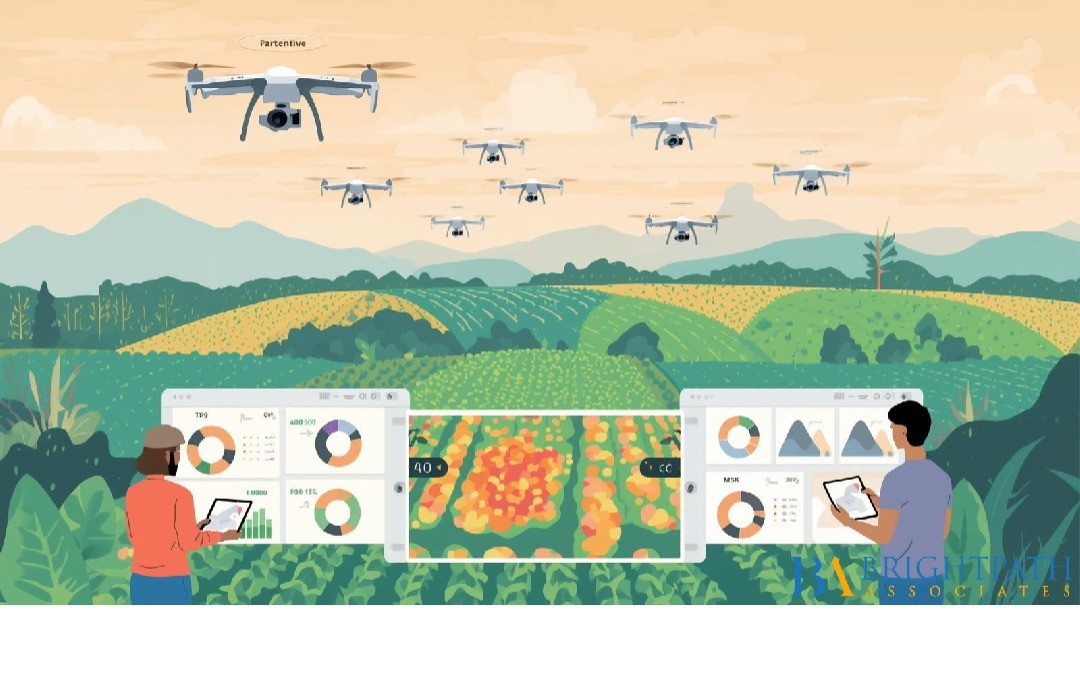
The Strategic Shift Toward Data-Driven Agriculture
Between 2023 and 2025, the agriculture and farming sector has undergone a profound transformation driven by #DigitalAgricultureTechnology. Rising input costs, climate volatility, labor shortages, and pressure to improve yields while maintaining agricultural sustainability have accelerated the adoption of agricultural technology across operations. Among the most impactful innovations is precision agriculture enabled by drone data analysis, which has moved from experimental use to a strategic investment with measurable return on investment.
For decision-makers, the value of drone-enabled digital farming extends beyond imagery and analytics. It reshapes how organizations plan, forecast, allocate capital, and manage leadership talent. As drone data becomes integral to farm management software and enterprise-level decision-making, leadership expectations are evolving just as rapidly as the technology itself.
Drone Data Analysis as a Revenue and Efficiency Multiplier
Precision agriculture powered by drones enables real-time insights into crop health, soil variability, irrigation efficiency, pest infestation, and nutrient application. Industry studies indicate that farms using drone-assisted analytics can reduce input costs by 15–25 percent while improving crop yields by up to 20 percent, depending on crop type and regional conditions. These improvements directly influence profitability in an increasingly competitive food production market.
Drone data supports sustainable farming by enabling targeted interventions rather than blanket treatments. This precision reduces chemical runoff, conserves water, and improves compliance with emerging environmental standards. For organizations focused on organic farming or regenerative practices, drone insights provide measurable proof points for sustainability claims while supporting scalable growth.
However, technology alone does not unlock ROI. The interpretation of drone data, its integration into digital agriculture technology platforms, and its translation into operational decisions require leadership with both agricultural expertise and digital fluency.
Leadership Challenges in the Age of Precision Agriculture
As #AgriculturalInnovation accelerates, many small to mid-sized farming enterprises face a widening leadership talent gap. Traditional agricultural leadership roles are expanding to include responsibilities related to data governance, technology adoption, and cross-functional decision-making. From 2023 to 2025, executive roles in agriculture increasingly demand hybrid skill sets that combine agronomy, analytics, sustainability strategy, and digital transformation.
Yet the supply of leaders who can bridge these domains remains limited. Many organizations struggle to find executives who understand drone data analysis and its implications for long-term farm economics while also navigating workforce management and regulatory compliance. This leadership shortage has become a material risk to ROI, often delaying or underutilizing investments in precision agriculture tools.
Evolving Executive Role Expectations in Agriculture
The modern agricultural executive is no longer evaluated solely on yield performance or cost control. Boards and owners now expect leaders to deliver data-backed decision-making, measurable sustainability outcomes, and technology-driven efficiency gains. Roles such as Chief Operating Officer, Head of Agricultural Innovation, and Farm Operations Director have expanded to include oversight of digital farming platforms and farm management software.
This shift has redefined executive hiring priorities. Leaders must be capable of aligning drone data insights with financial forecasting, workforce planning, and supply chain strategy. In the food production market, where margins are sensitive to small inefficiencies, leadership misalignment can erode competitive advantage quickly.
As expectations rise, many organizations discover that internal succession pipelines are unprepared for these expanded demands, further intensifying the need for strategic recruitment.
The Strategic Importance of Executive Search Recruitment
#ExecutiveSearchRecruitment has emerged as a critical solution to leadership challenges in agriculture and farming. Unlike traditional hiring approaches, executive search focuses on identifying leaders with proven experience in agricultural innovation, digital agriculture technology, and sustainable farming practices. This targeted approach is particularly valuable in a market where high-caliber talent is scarce and competition for experienced leaders is increasing.
By aligning leadership capabilities with precision agriculture goals, executive search recruitment helps organizations maximize ROI from drone data analysis investments. The right executive can ensure that agricultural technology initiatives are not siloed but integrated into enterprise-wide strategy, from capital allocation to workforce training.
For small to mid-sized companies, this alignment often determines whether drone adoption becomes a cost center or a long-term value driver.
Recruitment Trends Shaping Agriculture from 2023 to 2025
Recent recruitment trends reveal a growing emphasis on cross-industry talent. Agriculture companies are increasingly open to leaders from adjacent sectors such as manufacturing, logistics, and data-driven industries who bring strong analytical and operational expertise. This trend reflects the convergence of agriculture with digital innovation and advanced analytics.
Another notable shift is the prioritization of leaders experienced in agricultural sustainability. Regulatory scrutiny and consumer demand for transparency have elevated sustainability from a marketing consideration to a strategic imperative. Executives who can leverage drone data to support sustainable farming metrics are highly sought after, yet remain in limited supply.
These dynamics underscore why recruitment strategies must evolve alongside agricultural technology adoption.
Integrating Drone Data into Enterprise Decision-Making
Drone #DataAnalysis delivers maximum value when embedded into broader digital farming ecosystems. Integration with farm management software enables leaders to track performance metrics, predict outcomes, and adjust strategies in near real time. This integration supports more accurate budgeting, improved risk management, and stronger accountability across teams.
However, successful integration depends on leadership capable of championing change and aligning stakeholders. Executives must foster a data-driven culture while addressing workforce concerns related to automation and new skill requirements. Organizations that fail to address these human factors often see slower adoption and diminished ROI.
Leadership recruited through executive search is better positioned to navigate this complexity, ensuring technology investments translate into operational excellence.
Competitive Advantage Through Leadership Alignment
In an increasingly crowded agricultural technology landscape, competitive advantage is defined by execution rather than access to tools. Drone technology is becoming more accessible, but the ability to convert drone data into actionable strategy differentiates market leaders from followers.
Organizations with digitally fluent leadership are more agile in responding to climate variability, supply chain disruptions, and market fluctuations. They are also better equipped to scale operations, attract investment, and meet sustainability benchmarks demanded by partners and regulators.
Executive search recruitment plays a central role in building this advantage by aligning leadership capabilities with the evolving demands of precision agriculture and digital farming.
Preparing for the Future of Agriculture
Looking ahead, drone data analysis will continue to evolve with advances in artificial intelligence, machine learning, and predictive analytics. These developments will further increase the strategic importance of leadership capable of interpreting complex datasets and making informed decisions under uncertainty.
For agriculture and farming companies seeking to unlock ROI from precision agriculture, the focus must extend beyond technology acquisition. Investment in leadership through strategic executive hiring is equally critical. Organizations that proactively address leadership gaps are better positioned to capitalize on agricultural innovation, strengthen sustainability outcomes, and remain competitive in a rapidly transforming food production market.
Conclusion
Unlocking ROI from drone data analysis in precision agriculture requires more than adopting advanced tools. It demands leadership equipped to integrate agricultural technology, sustainability goals, and data-driven decision-making into a cohesive strategy. As leadership shortages persist and role expectations evolve, executive search recruitment has become a vital enabler of growth and resilience.
For C-suite leaders and founders, aligning leadership strategy with digital agriculture technology is no longer optional. It is a defining factor in achieving long-term profitability, operational efficiency, and sustainable success in #ModernAgriculture.
Find your next leadership role in Farming Industry today!