
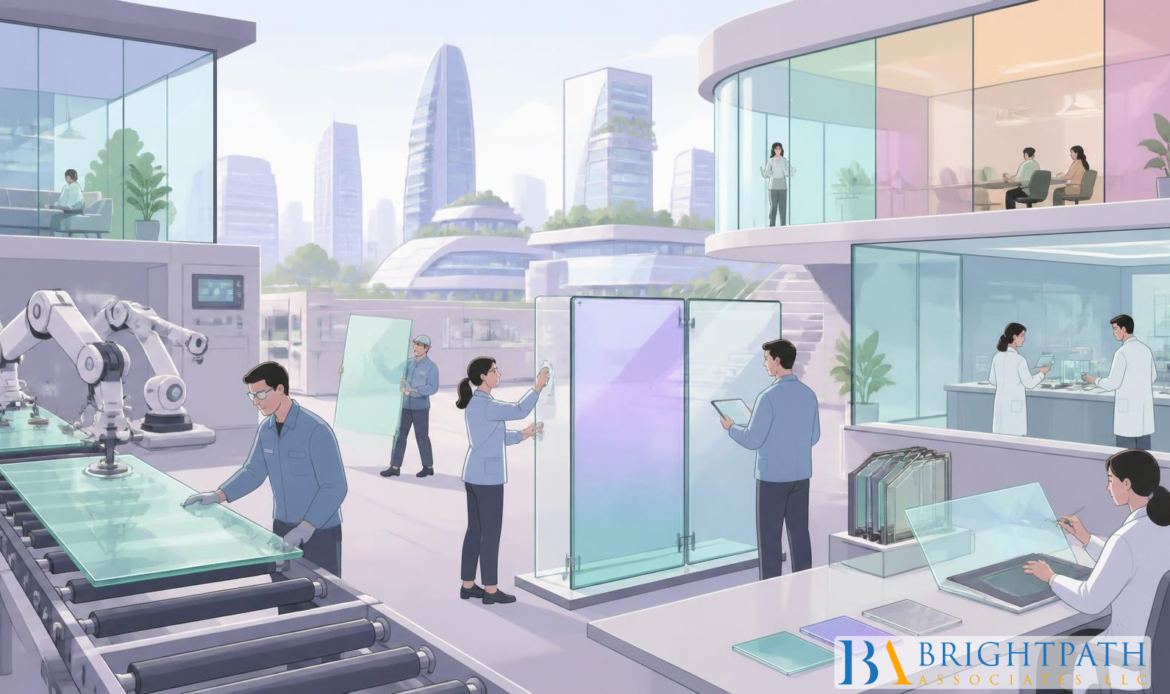
Smart glass is moving from a specialized architectural feature toward a broader technology platform with applications across construction, transportation, healthcare, automotive, energy, electronics, and #IndustrialEnvironments. As buildings become more connected and energy efficiency becomes a greater design priority, glass is no longer being viewed simply as a transparent structural material. It is increasingly becoming an active component of intelligent environments.
The development of smart glass reflects a larger transformation occurring across the materials sector. Advances in coatings, electrochromic technologies, sensors, automation, and material engineering are allowing manufacturers to produce glass that can respond to changing environmental conditions or user requirements. At the same time, architects and construction companies are seeking materials that can contribute to energy management, occupant comfort, aesthetics, and sustainability.
Understanding the future of smart glass therefore requires looking beyond the glass itself. Its development is closely connected to construction technology, advanced manufacturing, energy management, digital systems, and the evolving capabilities of the workforce.
Conventional architectural glass provides transparency, daylight, visibility, and protection from environmental conditions. Smart glass adds another dimension by allowing optical or thermal properties to change under controlled conditions.
Depending on the technology, smart glass can change its level of tint, opacity, or light transmission in response to electrical signals, sunlight, temperature, or other environmental inputs. This creates opportunities for buildings and other applications to dynamically manage light and heat.
Electrochromic glass, for example, can gradually change tint when an electrical voltage is applied. Suspended particle devices and polymer-dispersed liquid crystal technologies can provide different approaches to controlling transparency or privacy.
These technologies are opening the door to buildings where glazing can interact with automated lighting, heating, ventilation, and building-management systems.
Smart Buildings Will Accelerate Adoption
One of the most significant opportunities for smart glass is the development of intelligent buildings.
Modern buildings increasingly incorporate sensors and automated systems that monitor occupancy, temperature, daylight, energy consumption, and indoor environmental conditions. Smart glass can become another responsive element within this ecosystem.
Instead of relying entirely on blinds or shades, a building can potentially adjust glazing characteristics to control solar heat gain and daylight. During periods of intense sunlight, glass can become darker to reduce heat entering the building. Under suitable conditions, it can allow greater daylight into interior spaces.
This interaction can support energy-management strategies while improving occupant comfort.
The concept fits within broader Concrete industry trends and construction innovation, where developers are increasingly considering how individual building materials contribute to overall building performance rather than evaluating them in isolation.
Buildings account for a significant share of global energy demand, making energy efficiency an important consideration in construction and renovation.
Windows can influence heating and cooling requirements because they allow solar radiation and heat transfer between indoor and outdoor environments. Smart glass offers a potential way to actively manage these effects.
The technology could become particularly relevant in large commercial buildings with extensive glazed façades. In such structures, automated glazing systems may help manage changing solar conditions throughout the day.
However, the energy benefits depend on the building design, climate, glazing technology, control strategy, and installation. Smart glass should therefore be evaluated as part of an integrated building system rather than assumed to provide identical results in every application.
The Connection With Sustainable Building Materials
The construction industry is under growing pressure to reduce energy consumption, resource use, and environmental impact across the building lifecycle.
This is increasing interest in Sustainable building materials that can contribute to operational efficiency without compromising durability or functionality.
Smart glass can contribute to this conversation by combining conventional glazing functions with dynamic light and solar-control capabilities.
Its sustainability value, however, involves more than operational energy savings. Manufacturers and developers also need to consider the materials used in production, manufacturing energy, product longevity, maintenance requirements, electronics, and eventual end-of-life management.
This lifecycle perspective will become increasingly important as sustainability standards become more sophisticated.
Manufacturing Innovation Will Shape Smart Glass
The future of smart glass depends heavily on manufacturing capabilities.
Producing advanced glazing systems requires precise control over coatings, films, electrical components, glass surfaces, lamination processes, and quality assurance. Even small variations can influence optical performance, durability, and reliability.
Automation is therefore becoming increasingly important.
Advanced production systems can improve process consistency while reducing defects and supporting high-volume manufacturing. Machine vision can inspect surfaces for imperfections, while automated systems can monitor production parameters and identify deviations.
The evolution of smart glass consequently parallels developments in Advanced #CeramicManufacturing and other advanced-material sectors, where precision, process control, material science, and automation increasingly determine manufacturing competitiveness.
Automotive manufacturers are also exploring advanced glazing technologies.
Large panoramic roofs and increasingly sophisticated vehicle interiors create new requirements for managing sunlight, temperature, privacy, and passenger experience.
Smart glass can potentially provide dynamic control over light entering the vehicle cabin. This can improve comfort while creating new design possibilities for vehicle manufacturers.
The technology may also become relevant to electric vehicles, where energy efficiency is particularly important. Managing solar heat entering the cabin could potentially influence the energy required for climate control.
As automotive manufacturers integrate more electronics and intelligent systems into vehicles, dynamically controlled glazing can become part of a broader connected environment.
Healthcare and Privacy Applications
Smart glass also has practical applications in healthcare facilities.
Hospitals, clinics, laboratories, and medical offices require privacy while often benefiting from natural daylight. Switchable glazing can provide a mechanism for controlling visibility without relying exclusively on conventional curtains or blinds.
The ability to change transparency electronically can also support modern interior design approaches.
Similar applications can be found in corporate offices, hotels, conference rooms, financial institutions, and residential environments where privacy requirements change throughout the day.
These applications demonstrate that smart glass is not solely an energy-efficiency technology. It is also a flexible architectural and functional material.
Beyond buildings and automobiles, smart glass may find opportunities in trains, aircraft, marine transportation, and specialized infrastructure.
Passenger environments require effective management of glare, sunlight, privacy, and temperature. Dynamic glazing can provide an alternative to mechanical shades while potentially reducing maintenance associated with moving components.
Future transportation systems may integrate smart glazing with environmental sensors and automated control systems, creating more responsive passenger environments.
As infrastructure becomes increasingly connected, materials that can communicate with digital control systems may gain additional value.
Artificial Intelligence Could Make Smart Glass More Responsive
The integration of #ArtificialIntelligence could expand smart-glass capabilities.
Instead of operating according to simple schedules or manual commands, future systems could analyze weather forecasts, solar position, occupancy patterns, indoor temperature, energy prices, and historical building performance.
AI-based building-management systems could then determine when glazing should change its optical properties.
This creates an opportunity for smart glass to become part of predictive building management.
The challenge will be ensuring that these systems remain reliable, secure, cost-effective, and easy to maintain. Advanced technology creates value only when building owners and facility managers can operate it effectively over the long term.
Smart glass requires collaboration among multiple scientific and engineering disciplines.
Materials scientists work on coatings and electroactive materials. Glass manufacturers focus on production processes and durability. Electrical engineers develop control systems. Software engineers create automation platforms. Building engineers integrate glazing with larger energy-management systems.
This convergence makes materials expertise increasingly important.
Developments in the glass sector are also connected to wider Glass market analysis, particularly as manufacturers evaluate demand for energy-efficient architectural products, advanced coatings, specialty glazing, and digitally controlled materials.
Companies that can combine materials expertise with manufacturing efficiency may be better positioned to participate in emerging markets.
Smart Glass and the Broader Materials Ecosystem
Smart glass should not be considered independently from other construction materials.
Buildings increasingly combine glass, concrete, ceramics, metals, insulation, composites, and digital systems. Improvements in one material can influence the requirements placed on others.
For example, highly glazed façades may require advanced structural systems and sophisticated thermal management. Concrete and cement technologies may evolve to support new building designs and energy-performance requirements.
Developments in Advanced concrete technology and Cement industry sustainability demonstrate how traditional construction materials are also being transformed through material science, process optimization, and environmental considerations.
This broader ecosystem will influence how smart glass is designed and deployed.
Technology adoption creates another important consideration: talent.
Manufacturers developing smart-glass products need professionals who understand advanced materials, production engineering, automation, quality management, research and development, supply chains, and commercial strategy.
Construction companies and developers may also need leaders capable of evaluating emerging materials from technical, financial, and sustainability perspectives.
As Ceramic industry growth, advanced glass manufacturing, construction technology, and digital building systems converge, organizations may increasingly compete for specialized leadership talent.
This makes Construction materials recruitment and #ExecutiveSearchRecruitment strategically relevant to companies expanding into advanced materials and intelligent construction technologies.
The challenge is not simply finding executives with industry experience. Organizations may need leaders who can bridge traditional manufacturing expertise with digital transformation, sustainability, innovation, and commercial growth.
Improving Production Efficiency Will Be Essential
The commercial future of smart glass will depend partly on its ability to become more scalable and economically accessible.
Manufacturers will need to improve Concrete production efficiency, glass manufacturing productivity, quality control, energy use, and supply-chain management while maintaining product performance.
Automation can play an important role in this process.
As production volumes increase, manufacturers may use increasingly sophisticated inspection systems, robotics, process analytics, and predictive maintenance tools. These capabilities can reduce downtime and improve consistency.
The ability to manufacture advanced glass reliably at competitive costs could ultimately determine how widely smart-glass technologies are adopted.
The most significant development may be that smart glass represents a broader movement toward intelligent materials.
Materials are increasingly being designed not simply to perform a static function but to respond to environmental conditions, communicate with digital systems, and contribute to larger operational objectives.
Glass can regulate light. Building systems can respond to occupancy. Sensors can monitor environmental conditions. AI can analyze performance. #ManufacturingEquipment can adjust production parameters.
Together, these developments point toward a construction environment where materials, machines, and digital platforms increasingly operate as interconnected systems.
Conclusion
Smart glass has the potential to change how architects, manufacturers, developers, and building operators think about glazing.
Its future will depend on advances in materials science, manufacturing automation, energy management, digital controls, artificial intelligence, and sustainable design. At the same time, adoption will depend on cost, reliability, durability, maintenance requirements, and the ability to demonstrate measurable value.
The opportunity extends beyond glass manufacturing. It reaches into construction, automotive production, infrastructure, building technology, advanced materials, and industrial automation.
For businesses operating across these sectors, the competitive landscape will increasingly depend on their ability to combine technological innovation with operational excellence and specialized leadership.
As the materials industry continues to evolve, organizations that understand the intersection of Glass industry innovation, Sustainable building materials, automation, and leadership will be better positioned to participate in the next generation of intelligent construction.
Find your next leadership role in Glass, Ceramic, Concrete Industry today!
Stay informed with the latest insights on Glass, Ceramic, Concrete Industry!