
Introduction
In dairy operations, “waste” is rarely just an environmental concern; it is often a sign of untapped margin hiding in plain sight. Every liter of #MilkProcessed creates additional streams such as whey, skim, permeate, sludge, wastewater, off-spec Dairy products, packaging scrap, and energy losses that quietly accumulate as disposal fees, yield erosion, and compliance risk.
The most resilient producers are reframing these streams as inputs for new products, improved efficiencies, and circular partnerships. This article explains how to convert dairy by-products into value through process design, Food technology, Milk production technologies, and disciplined execution across plants and supply networks, with an eye toward measurable cost savings and durable, diversified revenue.
Start with a By-product Map, Not a Sustainability Slogan
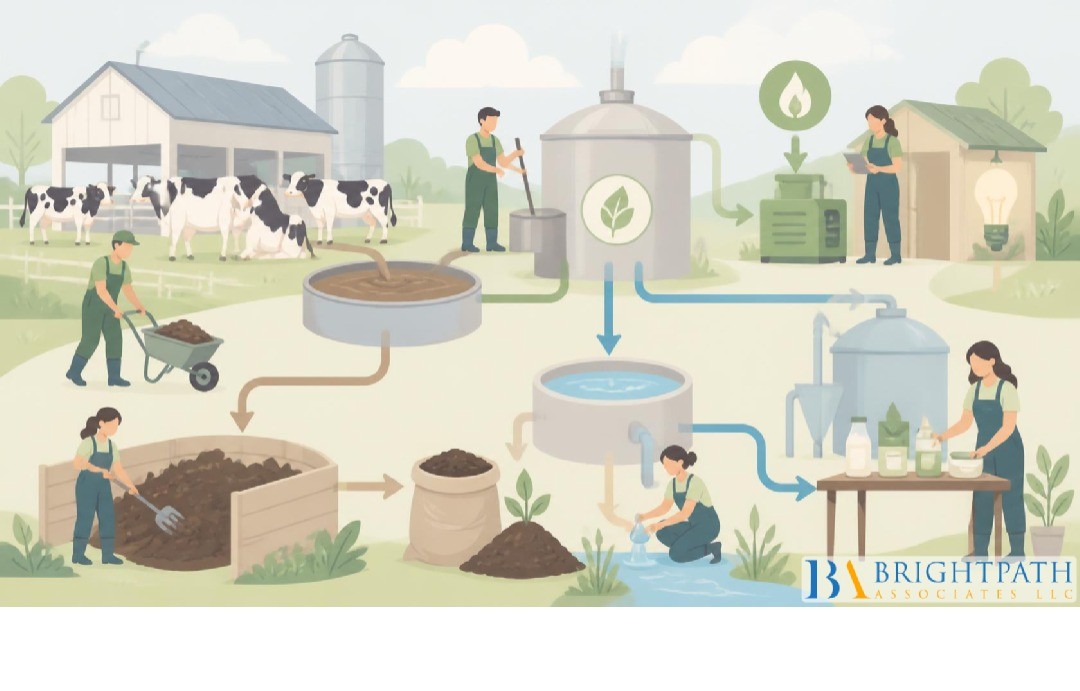
Sustainable waste management begins with precision: a clear inventory of what leaves your facility, in what condition, at what volume, and at what true cost. Many dairy businesses can quote a disposal invoice, yet few can connect that invoice to the upstream decisions that created the load in the first place. A practical by-product map traces each major stream from origin to destination, capturing variability by season, shift, SKU mix, and cleaning cycles, and separating avoidable losses from unavoidable residues.
The highest-return opportunities typically cluster in three categories. The first is recoverable product that never should have become waste, including off-spec batches, line changeover losses, and packaging-related rejects. The second is functional by-products that already have market value if they are stabilized and specified, such as whey, cream, lactose-rich permeate, or curd fines. The third is utility and treatment streams where value is captured through lower energy intensity or improved treatment outcomes, including heat recovery, biogas generation, and reduced chemical usage in wastewater processing.
The business case improves dramatically when you treat by-product strategy as part of Dairy industry growth strategies rather than a compliance task. Yield improvements increase sellable output with the same fixed cost base, while valorization creates new SKUs or ingredients that diversify revenue. Cost savings compound when fewer truckloads leave the gate, fewer surcharge thresholds are exceeded, and less downtime is triggered by unstable effluent. Done well, sustainable by-product programs become operational discipline with financial returns, not a side project dependent on a single champion.
This is where Sustainable dairy farming practices intersect with plant performance. Upstream variability in feed, animal health, and raw milk composition can change fat, protein, and solids, which then changes separation efficiency, standardization losses, and by-product composition. Aligning farm practices with processing targets supports steadier operations and more predictable by-product quality, making it easier to turn those streams into consistent revenue rather than intermittent salvage.
From Residual Streams to Sellable Ingredients: Where Food Technology Creates Value
Not every by-product belongs in a tanker headed to low-value outlets. Modern Food technology allows dairy processors to fractionate, purify, and formulate residual streams into ingredients with defined functionality and premium positioning. The key is to choose pathways that match your volume, your quality capability, and your access to customers who can use the resulting specifications consistently.
Whey is the most recognized example, but the value ladder is wide. Sweet whey, acid whey, and whey permeate each require different handling and downstream options. Concentration and drying can produce powders for bakery, beverages, or animal nutrition, while membrane processing can support higher-value fractions when there is enough scale and market pull. Similarly, lactose-rich permeate can move from being a disposal problem to a sweetener, fermentation substrate, or blending component when solids are controlled and contaminants are reduced.
Even off-spec #DairyProducts can become profitable inputs when segregation and rework rules are engineered into production. For example, a product that misses sensory targets may still meet compositional standards for an industrial ingredient channel if it is routed quickly, protected from contamination, and documented for traceability. In these cases, the value comes less from heroic reprocessing and more from operational design: clear decision trees, rapid sampling, and defined “secondary-grade” specifications that preserve safety and integrity.
Another overlooked pathway is water and mineral recovery. Dairy wastewater contains organics, fats, and minerals that drive treatment costs. With the right separation steps, certain streams can be reduced at the source so treatment becomes more stable and less expensive. Where regulations and economics align, water reuse can lower intake volumes, and recovered solids can support anaerobic digestion performance or be routed into lower-risk outlets. The point is not to chase every possible recovery technology, but to select the few that convert your highest-cost streams into either a defined product or a measurable reduction in operating expense.
Successful valorization also depends on product governance. Ingredient customers demand consistency, and your internal teams need clarity on what “good” looks like for each by-product SKU. That means documented specifications, validated shelf-life or stability assumptions, and a commercial owner who can price and position the output rather than treating it as an afterthought. When by-products are managed like products, they are more likely to become reliable revenue streams instead of occasional offsets.
Dairy Automation Technologies That Reduce Losses and Improve By-product Quality
Waste reduction in modern dairy plants is increasingly a control problem. Losses often occur at transitions: changeovers, startups, CIP cycles, and batch handoffs where human decisions, timing, and visibility determine whether product is captured or sent to drain. Dairy automation technologies address this by making losses visible in real time and by enforcing consistent operating windows that protect yield and by-product quality.
At the process level, better instrumentation and automated divert logic help prevent off-spec material from contaminating higher-value streams. Inline solids, conductivity, and flow measurement can differentiate product, rinse water, and CIP solutions more accurately, reducing unnecessary dumping while preserving food safety. When combined with recipe management and automated sequencing, plants can shorten the “gray zone” during transitions, which is where disproportionate losses often occur. This is not simply a controls upgrade; it is a disciplined approach to defining triggers, thresholds, and responsibility for decision-making.
Milk production technologies also influence downstream waste. Better cooling control, improved separation performance, and more stable standardization reduce variability that can create rework and disposal. When raw material variability is unavoidable, predictive models can help operators anticipate drift in fat or protein and adjust earlier, reducing the likelihood of creating large volumes of off-spec finished goods. Over time, these feedback loops become the backbone of Dairy industry digital transformation: data that starts as operational telemetry becomes a mechanism for continuous improvement and financial governance.
Digital tools also strengthen by-product commercial viability. If you want to sell a whey or permeate stream as a consistent ingredient, customers will expect traceability, reliable test results, and dependable logistics. A plant that can connect by-product lots to production conditions and lab results can defend specifications and troubleshoot deviations quickly. This is where operational technology and information systems converge, enabling quality assurance teams to move faster without increasing manual workload.
Importantly, automation should be designed to make the job easier rather than more complex. The strongest implementations reduce decision fatigue, standardize best practices, and empower operators with clear signals. When teams can trust the process, by-products become more predictable, and predictability is what turns residual streams into contractable, bankable revenue rather than opportunistic sales.
Monetization Depends on Supply Chain Design, Not Just Processing
Even the most elegant recovery process fails if the output cannot move consistently to a buyer. Dairy supply chain management is therefore central to by-product revenue. By-products tend to have different constraints than core finished goods: they may be produced continuously, require rapid stabilization, and have narrower storage windows. Designing the logistics system around these realities is what determines whether value is captured or lost to spoilage, rework, or discounted spot sales.
Start with segregation and handling infrastructure that protects quality. Dedicated tanks, clear line labeling, contamination prevention, and defined sampling plans are not “nice to have” when you are trying to commercialize a by-product. They are the difference between a stream that qualifies for higher-value channels and one that must be sold at a steep discount. Packaging decisions matter as well. Bulk shipments may be most efficient for large ingredient buyers, while smaller formats can unlock different customers but increase complexity. The optimal answer often varies by region and by customer mix, so it should be treated as a strategic design choice rather than a default inherited from legacy operations.
Commercial routes to market are also changing. Dairy e-commerce is expanding beyond consumer subscriptions into B2B discovery, small-batch sourcing, and regional ingredient trading, which can help mid-sized processors broaden their customer base for specialty fractions or secondary-grade outputs. While not every by-product belongs in an online channel, digital sales capabilities can reduce dependency on a single outlet and improve price transparency, especially for niche applications where buyers value rapid access to specifications and dependable fulfillment.
Circular economy benefits grow when processors look beyond the boundaries of their own facility. Partnerships with adjacent manufacturers, fermentation and biotech users, animal nutrition players, and energy developers can create stable demand for streams that are difficult to monetize alone. The most successful partnerships are built on shared operating realities: consistent specs, transparent governance, contingency planning, and mutual investment in handling or treatment infrastructure. When those elements are in place, a by-product becomes a supply input for another business, and both parties can invest in stability and scale.
Finally, #SupplyChain design should anticipate regulatory and reputational expectations. Customers want proof that sustainability claims reflect real performance, and regulators increasingly expect rigorous documentation. A mature by-product strategy therefore includes tracking systems that quantify diversion from landfill, energy recovery, and reductions in effluent load. These metrics support customer confidence and can strengthen negotiations with buyers who are building sustainability into procurement criteria.
Leadership, Talent, and Governance: Making Value Recovery Repeatable
Turning by-products into revenue is a cross-functional transformation that touches operations, quality, engineering, procurement, and commercial teams. Without strong governance, programs stall after early wins because responsibilities blur and operational priorities shift. The organizations that sustain momentum treat by-product value as a managed portfolio with clear ownership, standardized decision rights, and performance measures that sit alongside the core business.
This is also a talent challenge. Plants need practical problem-solvers who understand unit operations, sanitation realities, and quality risk, as well as commercial leaders who can translate a variable residual stream into a sellable specification. In a competitive labor market, Dairy industry executive search can be an effective approach when a business needs experienced leaders who have built valorization programs before, particularly in roles that bridge operations and commercial execution. The goal is not to add bureaucracy, but to secure capability that compresses the learning curve and reduces the risk of expensive missteps.
#ExecutiveSearchRecruitment is often associated with top corporate roles, yet the most consequential hires in by-product strategy can be technical-commercial hybrids: a valorization program lead, an ingredient sales director, or a digital operations manager who can translate plant data into actionable governance. These roles accelerate Dairy industry digital transformation because they connect technology investments to margin outcomes. They also strengthen Dairy industry growth strategies by enabling expansion into ingredient channels that are less exposed to consumer volatility than finished goods alone.
Long-term success depends on aligning incentives and capital planning. If operations is measured only on throughput, teams may view segregation and sampling as friction. If commercial teams are rewarded only for core product revenue, by-products will remain secondary. Aligning targets around yield, waste diversion, and by-product profitability helps ensure the work is prioritized. Capital planning must also be deliberate: membranes, dryers, digesters, and automation upgrades can deliver strong returns, but only when sized to stable volumes and supported by reliable offtake agreements or internal use cases.
When leadership commits to this discipline, value recovery becomes repeatable. The organization learns how to convert variability into controlled streams, how to protect quality without excessive cost, and how to build partnerships that strengthen resilience across the value chain.
Conclusion
In dairy, the path to new revenue is often already flowing through your pipes. By-products and waste streams represent material, energy, and labor that have been paid for but not fully monetized. When you map these streams accurately, apply the right Food technology, and improve control through Dairy automation technologies and Milk production technologies, you can reduce losses, stabilize quality, and create sellable outputs with credible specifications.
The strongest results come when valorization is treated as strategy rather than cleanup. With disciplined Dairy supply chain management, selective use of Dairy e-commerce routes, and leadership that builds the right governance and talent, circular economy benefits translate into measurable margin and resilience. Sustainable dairy farming practices and plant operations then reinforce each other, supporting a system where sustainability is not a cost center, but a durable engine for growth.
Find your next leadership role in Dairy industry today!