
Introduction
The #DairyIndustry has become increasingly data-driven as producers and manufacturers expand product portfolios, modernize processing facilities, and respond to changing consumer demand. A single dairy organization may manage raw milk procurement, processing, packaging, cold storage, transportation, quality control, sales, and customer service across multiple product categories. Each activity generates valuable operational data, yet many organizations still struggle to connect that information into a unified view.
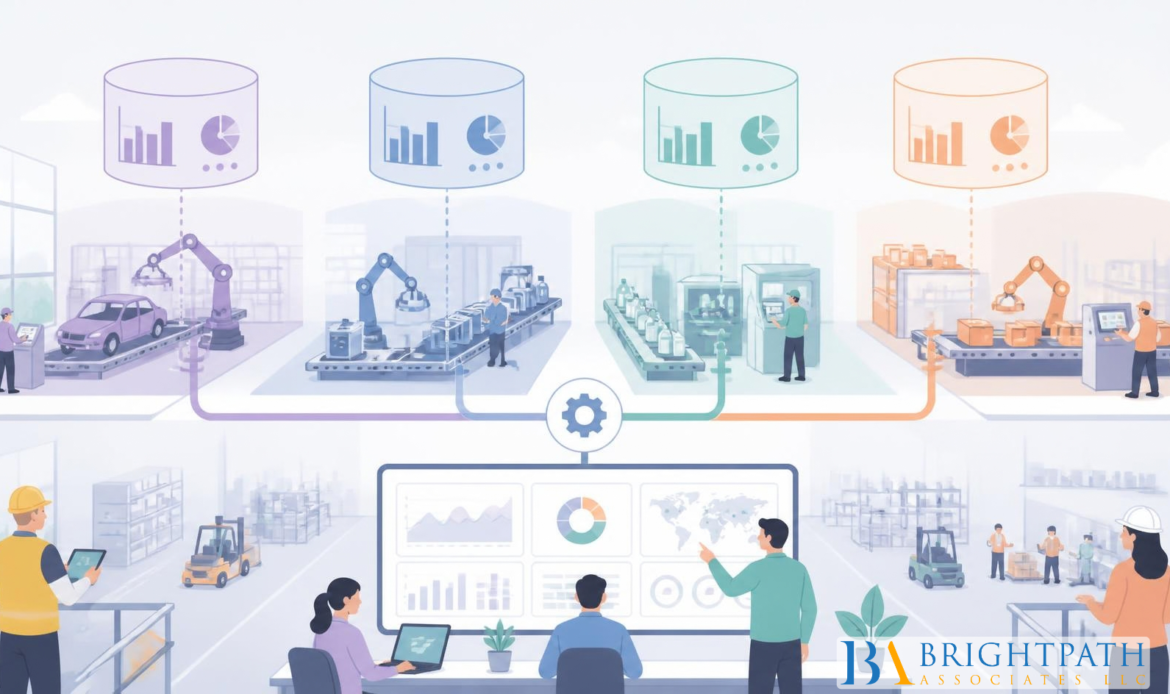
This creates the data silo problem. Production teams may maintain one set of records, quality departments another, sales teams another, and logistics teams another. When information remains separated, managers can struggle to understand what is happening across the entire business. Delayed reporting, inconsistent data, manual reconciliation, and fragmented systems can make it difficult to identify bottlenecks or respond quickly to changing conditions.
Solving data silos is therefore not simply an information technology challenge. It is an operational transformation challenge. Dairy companies need connected systems, standardized data, appropriate governance, and leadership capable of turning information into decisions. Effective Dairy industry digital transformation can create greater visibility across product lines while supporting efficiency, quality, sustainability, and growth.
Data silos develop when information is collected, stored, and managed independently by different departments or systems. In a dairy organization, procurement may track milk volumes and supplier information separately from production systems. Quality teams may maintain laboratory results in specialized applications, while sales teams track customer orders through separate platforms.
The problem becomes more complex as the product portfolio expands. A dairy company may manufacture milk, yogurt, cheese, butter, cream, flavored beverages, desserts, and other products. Each product may have different recipes, production processes, packaging formats, shelf lives, and distribution requirements.
Without integrated information, management may have difficulty determining how raw-material availability is affecting individual product lines or how changes in customer demand influence production schedules.
Operational visibility requires these data streams to become connected.
Connecting Dairy Product Development With Production
Dairy product development increasingly involves experimentation with formulations, ingredients, packaging, nutrition profiles, and consumer preferences. However, product development information often remains separated from manufacturing and commercial data.
Connecting Dairy product development with production systems can help organizations understand whether a new product can be manufactured efficiently at scale. Recipe information can be linked with ingredient availability, production capacity, packaging requirements, quality specifications, and expected costs.
This connection can reduce the gap between innovation and commercial execution. Product development teams can understand manufacturing constraints earlier, while production teams can prepare for upcoming product launches more effectively.
Integrated data also allows companies to evaluate product performance after launch. Sales volumes, production costs, returns, quality information, and customer feedback can be analyzed together to support future product decisions.
Operational visibility begins before milk reaches the processing plant. Modern Milk production technologies can generate information about herd performance, milk quality, collection volumes, animal health, feeding, and farm operations.
When appropriate information flows from farms and collection centers into broader enterprise systems, dairy processors can improve supply planning. Expected milk availability can be compared with production requirements for different product lines.
This is especially valuable when milk supply fluctuates seasonally. Production planners can use supply information to adjust manufacturing schedules, procurement requirements, and inventory strategies.
Connecting upstream data with processing operations can therefore create a more responsive dairy supply network.
The Role of Dairy Automation Technologies
#DairyAutomationTechnologies are transforming processing and packaging environments. Automated systems can monitor temperatures, flow rates, pressures, filling operations, cleaning cycles, and equipment performance.
However, automation generates limited strategic value when its data remains isolated within individual machines or production cells.
Integrating automation data with enterprise platforms can provide management with a broader view of production performance. Managers can compare production output across lines, analyze downtime patterns, and identify recurring quality issues.
Automation data can also support maintenance planning. Equipment performance information can be connected with maintenance records to identify assets requiring attention before failures disrupt production.
The technical foundation for eliminating data silos is a common data architecture. Organizations need consistent definitions for products, ingredients, suppliers, customers, production batches, quality parameters, inventory locations, and other critical information.
For example, a product should have a consistent identification structure across production, inventory, sales, and finance systems. If different departments use different product codes or descriptions, integrating their data becomes significantly more difficult.
Master-data management can address this challenge by establishing authoritative records and clear ownership responsibilities.
Data governance should also define who can create, modify, approve, and retire critical information. This reduces duplication and improves confidence in reports and dashboards.
Traditional reporting often provides information after an event has already occurred. Managers may receive production reports at the end of a shift or inventory updates after a transaction has been completed.
Modern systems can move organizations toward near-real-time visibility. Production dashboards can show output, downtime, quality deviations, inventory levels, and order status as operations progress.
Real-time visibility is particularly valuable in dairy manufacturing because products are often perishable and production schedules can be highly time-sensitive.
If a production line experiences downtime, managers can quickly evaluate its potential effect on customer orders and inventory. If a quality issue emerges, affected batches can be identified more efficiently.
The goal is not to display more data. The goal is to provide the right information at the right time for operational decisions.
Strengthening Dairy Supply Chain Management
Dairy supply chains involve multiple stages, from farms and collection centers to processing plants, warehouses, distributors, retailers, and consumers. Fragmented information can make coordination difficult across these stages.
#DairySupplyChain management becomes more effective when procurement, production, inventory, logistics, and sales data are connected.
For example, sales forecasts can influence production planning, while production requirements can influence raw-milk procurement. Inventory information can guide distribution decisions, and transportation data can help optimize delivery schedules.
Integrated systems can also improve traceability. If a quality issue occurs, organizations can use connected records to identify relevant batches, production processes, raw materials, and distribution destinations.
Food technology is increasingly connected with digital systems, sensors, automation, and analytics. Dairy businesses can use these capabilities to improve quality monitoring, production consistency, energy efficiency, and traceability.
Advanced analytics can identify relationships that are difficult to detect through manual reporting. For example, a manufacturer may discover that particular raw-material conditions correlate with production losses or that certain equipment settings influence product quality.
The value of Food technology therefore extends beyond physical processing. Digital capabilities can turn production data into actionable information.
Organizations should focus on practical use cases rather than collecting data without a defined purpose. Every major data stream should have a clear operational or strategic application.
Applying Analytics Across Multiple Product Lines
A multi-product dairy organization needs analytics that allow management to compare performance across product categories.
Managers may need to understand which product lines consume the most production capacity, generate the highest levels of waste, experience the greatest downtime, or require the most complex logistics.
Product-level profitability analysis can also provide valuable insight. Revenue alone does not indicate whether a product is economically attractive. Ingredient costs, packaging, labor, energy, storage, transportation, promotions, and product losses all influence profitability.
Integrated data makes these calculations more reliable because information can be drawn from multiple operational systems rather than manually consolidated spreadsheets.
Data integration can also contribute to sustainability. Sustainable dairy farming practices depend on understanding resource use, animal productivity, energy consumption, water use, feed efficiency, waste, and emissions.
Connecting farm-level information with processing and distribution data creates a broader sustainability picture. Businesses can identify where resources are being consumed and where efficiency improvements may have the greatest impact.
Processing plants can similarly monitor energy and water consumption across production lines. Integrated information can help identify unusual consumption patterns and evaluate the effectiveness of efficiency projects.
Sustainability data becomes more credible when it is connected to operational records rather than maintained as a separate reporting exercise.
The growth of Dairy e-commerce is creating another important source of data. Online sales platforms can provide information about consumer preferences, purchasing frequency, product combinations, geographic demand, and promotional response.
Connecting e-commerce data with production and inventory systems can improve demand forecasting. If online demand for a particular product increases, production planners can respond more quickly.
This integration can also reduce stockouts and excess inventory. Sales information can be connected with warehouse availability and replenishment requirements.
Dairy e-commerce therefore becomes more than a sales channel. When properly integrated, it becomes an important source of market intelligence.
Preparing for Dairy Industry Growth Strategies
Dairy industry growth strategies increasingly depend on the ability to scale operations without allowing complexity to overwhelm management systems.
Expanding into new product categories, geographic markets, or distribution channels creates additional data requirements. If systems remain fragmented, growth can increase administrative workload and reduce visibility.
An integrated digital architecture provides a foundation for expansion. New facilities, products, suppliers, and sales channels can be incorporated into standardized workflows.
This scalability is particularly important for organizations pursuing long-term growth because operational complexity tends to increase faster than management capacity if information systems are not modernized.
Technology cannot eliminate data silos without employee participation. Different departments may resist standardized processes because they have developed their own methods over time.
Successful Dairy industry digital transformation requires clear communication about why data integration matters and how it will improve daily operations.
Employees should receive training appropriate to their responsibilities. Production operators need to understand how data is captured, while managers need to understand how dashboards and analytics should be interpreted.
Leadership should also establish clear accountability for data quality. If inaccurate information enters the system, even advanced analytics will produce unreliable results.
Leadership and the Role of Executive Search Recruitment
Digital transformation requires leaders who can bridge traditional dairy operations with technology, analytics, automation, and supply-chain management.
Dairy industry executive search is increasingly relevant as companies seek executives with experience across manufacturing, digital transformation, operations, technology, sustainability, and commercial strategy.
Senior leaders must be capable of coordinating multiple departments around common objectives. They also need to understand how investments in automation, data platforms, analytics, and e-commerce contribute to broader business outcomes.
#ExecutiveSearchRecruitment can support organizations seeking this combination of operational and digital leadership capability.
Solving data silos should not be approached as a single software installation. Organizations need a long-term operating model that connects people, processes, data, and technology.
ERP platforms, manufacturing systems, laboratory systems, automation platforms, warehouse management tools, customer platforms, and e-commerce applications should be integrated where there is a clear business case.
Data governance should remain consistent across the organization, while analytics should focus on decisions that improve production, quality, cost, customer service, and sustainability.
A unified operating model enables dairy companies to move from fragmented reporting toward continuous operational visibility.
Conclusion
#DataSilos can significantly limit the ability of dairy businesses to manage increasingly complex product portfolios. When production, procurement, quality, logistics, sales, and farm data remain disconnected, managers may lack the information required to respond quickly to operational changes.
Solving this challenge requires more than implementing new software. Dairy organizations need consistent master data, integrated systems, connected automation, reliable analytics, and strong governance.
Integrating Dairy product development with manufacturing can improve innovation and commercialization. Connecting Milk production technologies with processing systems can strengthen supply planning, while Dairy Automation technologies can provide valuable operational information. Integrated Dairy supply chain management can improve traceability, inventory coordination, and logistics performance.
At the commercial level, Dairy e-commerce can provide valuable consumer intelligence, while analytics can support Dairy industry growth strategies. Sustainability information can also be integrated across farms, processing plants, and distribution networks to strengthen Sustainable dairy farming practices.
Ultimately, successful Dairy industry digital transformation depends on creating a shared operational view across the organization. With the right technology architecture, processes, and leadership, dairy companies can turn fragmented information into a strategic asset, improving decision-making, efficiency, resilience, and long-term competitiveness.
Find your next leadership role in Dairy Industry today!