
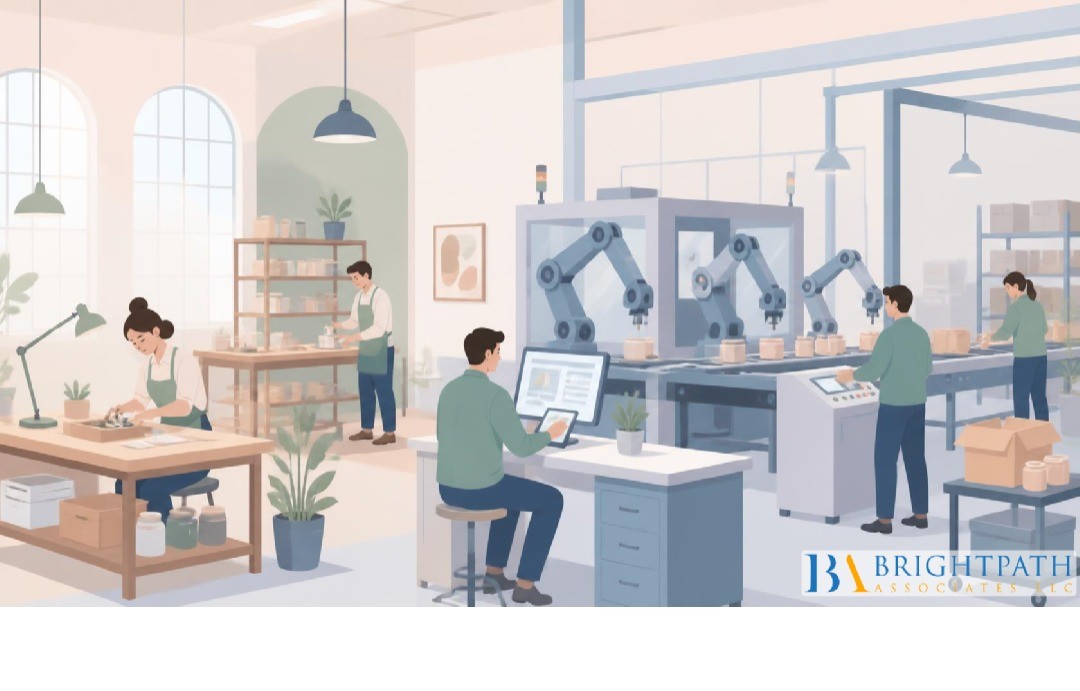
Introduction
Small-batch #IndustrialManufacturing has always lived in the tension between two virtues: the precision of craft and the efficiency of scale. Today, that tension is no longer a binary choice. With the right Industrial automation strategy, small and mid-sized producers can protect the nuanced “feel” of a process while building repeatability, throughput, and traceability that buyers and regulators increasingly expect.
This article explores how Manufacturing automation can be designed around the realities of short runs, frequent changeovers, and tight tolerances, and how modern Control systems, Robotics integration, SCADA systems, and Industrial machine vision can strengthen quality rather than dilute it. It also addresses the often-overlooked human side of execution, from a specialized PLC programming service to leadership hiring through Executive search industrial automation and Executive Search Recruitment, all in support of scalable, craft-grade performance.
Why Small-Batch Automation Is Different
Small-batch environments are defined by variability: product mixes shift, materials behave differently lot to lot, and customer specifications evolve faster than capital budgets. In these conditions, automation cannot be approached as a one-time “install and forget” project. The most effective automation solutions manufacturing programs treat flexibility as a design constraint on par with speed and cost, and they deliberately preserve the process knowledge that skilled operators carry in their hands and habits.
In small runs, quality often appears to come from individual mastery—an operator hears a vibration change, notices a surface finish at a glance, or adjusts a clamp by instinct. Yet the real asset is the underlying process window those experts are protecting. Industrial automation succeeds in this context when it captures that window in measurable variables—torque, temperature, force, dwell time, alignment—and then makes it easy to hold those variables steady across shifts, sites, and seasons without forcing the operation into a rigid, high-volume mold.
The promise of small-batch automation is not turning a custom shop into a commodity line. It is reducing the penalty of switching. When setup time, first-piece validation, and documentation are engineered into the workflow, you can accept more orders, shorten lead times, and still ship with the confidence that “one-off” does not mean “one-time quality.” This is where well-architected Control systems become the backbone: they establish standardized recipes, permissions, and data capture while leaving room for operator judgment where it truly adds value.
Control Systems That Scale Without Flattening the Process
The heart of scalable small-batch performance is not a robot or a sensor; it is the control philosophy. A thoughtful PLC strategy is what turns a collection of equipment into a coherent manufacturing capability. In practice, a mature PLC programming service for small-batch operations emphasizes modularity, clear state machines, and parameterization so that new product variants are introduced as controlled configuration changes rather than ad hoc edits made under production pressure.
When a line is built from reusable modules—feeding, clamping, dispensing, inspection, packaging—engineers can make changes without destabilizing everything upstream. This approach also helps protect craft quality because it reduces “tribal” tuning. Instead of relying on a few individuals who remember which timer must be nudged for a specific part, validated parameters live in a structured recipe system with version control and documented intent. The result is repeatability that does not erase nuance; it makes nuance explicit and auditable.
In small-batch contexts, visibility is most valuable at the point of decision. #SCADASystems that surface the right variables—actual versus target force profiles, alarm frequency, scrap reasons, temperature stability, and downtime microstops—help teams correct drift early and avoid the “mystery defects” that appear only after a few dozen units. When designed well, the interface becomes a shared language between production, quality, and maintenance, accelerating root-cause analysis without forcing every discussion into a spreadsheet after the fact.
Data is often described as a path to scale, but for small runs it is also a way to defend craft. By capturing the signature of a good build and flagging deviations in real time, the plant preserves its best methods even as experienced staff rotate, retire, or move on to new Automation jobs. That continuity is increasingly vital as customers demand traceability and as supply chains push responsibility for quality upstream to the maker of each subassembly and component.
Robotics Integration and Industrial Machine Vision for High-Mix Reality
Robotics integration has matured beyond the stereotype of fenced-off, single-purpose cells that only make sense at massive volumes. For small-batch producers, the question is not whether robots can be used, but where they can be used to remove variability without adding fragility. The best use cases tend to be the ones where consistency matters more than creativity: precise placement, repeatable dispensing, controlled handling of delicate surfaces, and ergonomically difficult motions that fatigue even the most skilled operators.
A robot alone is not a flexible system. Flexibility comes from end-of-arm tooling that can adapt, fixtures that locate parts predictably, and programs that can accept new SKUs without weeks of rework. This is where automation solutions manufacturing becomes a discipline: integrating mechanical design, sensing, and software so that the cell behaves predictably under change. In practice, many small-batch wins are achieved with a restrained approach—one well-instrumented robot doing a narrow set of tasks exceptionally well, supported by quick-change tooling and standardized recipes in the Control systems layer.
Vision is particularly powerful in small-batch settings because it can validate a wide range of variants with the right training and lighting strategy. It can confirm label content and placement, verify fastener presence, read codes, check surface defects, and measure critical dimensions without slowing the process with manual inspection. Importantly, it can also be tuned to align with craft expectations, such as surface finish thresholds that experienced inspectors recognize instantly but struggle to describe in purely verbal terms.
Vision and robotics also reinforce each other. Vision-guided pick and place reduces the need for perfect part presentation, and in turn the robot provides consistent positioning for reliable inspection. Together, they create a stable platform for quality at low and medium volumes, enabling manufacturers to scale output by adding hours, shifts, or parallel cells rather than redesigning the entire process. That is the most practical definition of scalability in a high-mix world: growth through replication of proven modules, not reinvention with every new order.
People, Talent, and the Organizational Design of Automation
Even the most elegant Industrial automation architecture depends on the people who specify, run, and improve it. Small-batch shops often underestimate this dimension because they have historically relied on a handful of versatile problem-solvers. As Manufacturing automation becomes more software-driven, the organization must deliberately cultivate a blend of process knowledge and technical depth. That includes controls engineers who can maintain standards, technicians who can diagnose sensors and networks, and production leaders who understand what quality looks like both on the screen and in the hand.
The demand for #AutomationJobs in controls, robotics, and data-enabled maintenance has intensified, and competition is no longer limited to large OEMs. Firms that want reliable outcomes increasingly use Executive search industrial automation to secure leaders who can build sustainable teams, not just deliver a single project. Done well, #ExecutiveSearchRecruitment focuses on the specific realities of small-batch operations: candidates who value structured experimentation, can translate craft expectations into engineering requirements, and can implement governance without slowing the business to a crawl.
There is also a cultural component to capture early. Automation initiatives fail when they are framed as a replacement for craftsmanship rather than an extension of it. The most resilient teams involve operators and quality staff in defining acceptance criteria, selecting alarm thresholds, and shaping the SCADA systems screens that will guide daily decisions. In this model, experts do not disappear; they become authors of the standard, and their best practices become scalable through disciplined Control systems and maintainable code maintained through a robust PLC programming service approach.
Conclusion
Small-batch automation is not about stripping character from production. It is about preserving what makes the work excellent while removing what makes it inconsistent. When Industrial automation is designed around variability—through parameterized control, operator-centered SCADA systems, and targeted Robotics integration supported by Industrial machine vision—quality becomes more predictable, not less. The operation gains the ability to scale by replicating proven modules, tightening feedback loops, and capturing process knowledge in a form that survives growth and turnover.
The balance is ultimately managerial as much as technical. The best outcomes come from treating automation solutions manufacturing as a long-term capability, investing in people as seriously as equipment, and hiring leadership with the right blend of operational empathy and engineering rigor through Executive search industrial automation and Executive Search Recruitment. In that environment, craft quality is protected, scalability is earned, and small-batch manufacturing becomes both resilient and commercially expansive.
Find your next leadership role in Industrial Automation Industry today!
Stay informed with the latest insights on Industrial Automation Industry!