
Introduction
For decades, cost efficiency has been one of the defining priorities of the #PaperManufacturingIndustry. Producers have focused on reducing energy consumption, improving machine utilization, optimizing raw-material costs, minimizing waste, and increasing production volumes. These priorities remain essential, particularly in a capital-intensive industry where margins can be heavily influenced by energy prices, fiber availability, transportation expenses, and global market conditions.
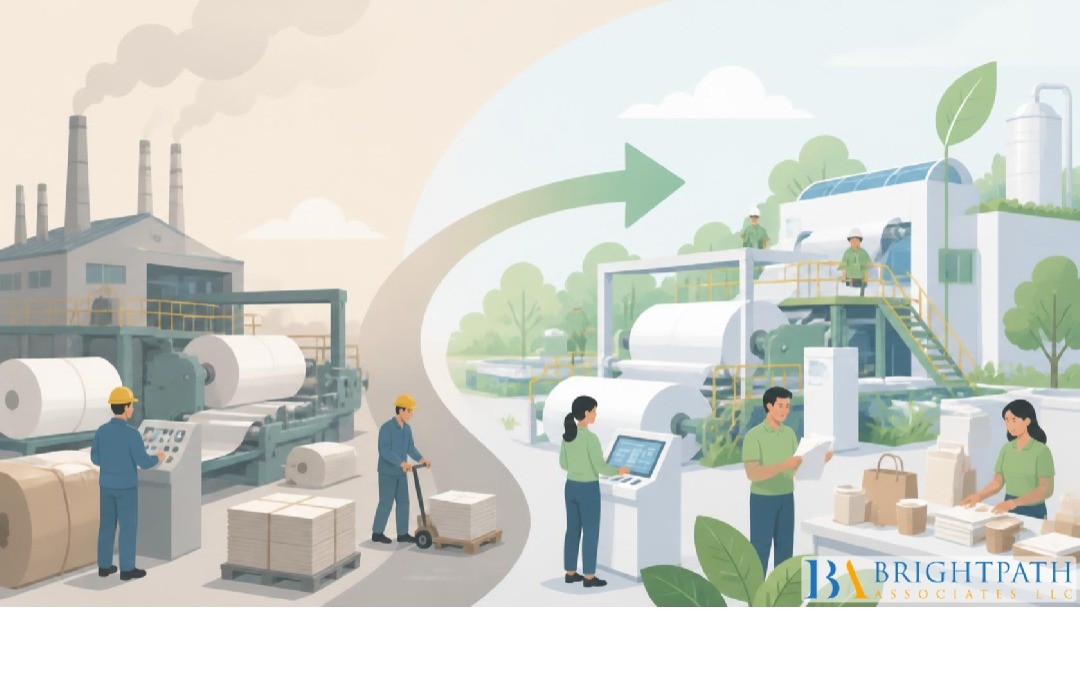
However, cost reduction alone is becoming an increasingly limited source of competitive advantage. As paper producers face changing customer expectations, sustainability requirements, digital disruption, and increasing competition, manufacturers need to consider a broader question: how can production capabilities create greater value rather than simply lower costs?
The answer increasingly lies in product differentiation, advanced technology, circular production models, operational intelligence, and customer-focused innovation. The transition from cost efficiency to value creation does not mean abandoning lean manufacturing. Instead, it means using efficiency as a foundation for creating products and services that customers are willing to value beyond their basic commodity price.
Why Cost Efficiency Alone Is No Longer Enough
Paper is often perceived as a standardized commodity, making price a major factor in purchasing decisions. When products have limited differentiation, manufacturers can become trapped in a cycle of competing on production costs and volume.
This model becomes vulnerable when raw-material prices increase, energy markets become volatile, or global production capacity exceeds demand. Even highly efficient manufacturers may struggle to protect margins when the market itself is primarily price-driven.
Value creation offers an alternative. Producers can differentiate through specialty papers, performance characteristics, customized products, recycled content, improved barrier properties, packaging applications, digital integration, and sustainability credentials.
The objective is to make the product more strategically important to customers so that purchasing decisions are based on total value rather than price alone.
Forest product innovation is becoming increasingly important as companies search for new applications for wood fiber and forest-based resources. Paper manufacturers are no longer limited to traditional printing and writing applications.
Innovation is creating opportunities in packaging, hygiene products, specialty materials, industrial applications, construction-related products, and other advanced markets.
This diversification can reduce exposure to declining segments while opening new revenue opportunities. However, innovation requires manufacturers to understand changing customer requirements and invest in research, testing, product development, and manufacturing flexibility.
The most successful companies will increasingly view fiber as a platform for innovation rather than simply a raw material for producing conventional paper.
Creating Value Through Paper Recycling Solutions
The circular economy is also changing the competitive landscape. #PaperRecyclingSolutions can help manufacturers reduce dependence on virgin fiber while responding to customer demand for more sustainable products.
Recycling is not simply an environmental initiative. It can become part of a broader value proposition when manufacturers can demonstrate responsible resource utilization, reliable recycled content, and consistent product performance.
Advances in collection, sorting, de-inking, fiber recovery, and processing technologies can improve the economics of recycled paper production.
The challenge is maintaining product quality while managing the variability that can exist in recovered fiber. Manufacturers that develop strong technical capabilities in recycling can create differentiation in markets where customers increasingly evaluate environmental performance alongside price.
Technology is one of the most important enablers of the transition toward value creation. Modern Paper and pulp technology is enabling manufacturers to monitor processes more accurately, optimize production conditions, reduce resource consumption, and improve product consistency.
Advanced process controls can continuously adjust manufacturing parameters. Sensors can detect changes in equipment performance. Data analytics can identify production patterns that may not be visible through traditional management reports.
These capabilities allow manufacturers to move toward more intelligent production environments.
The strategic advantage comes not simply from owning advanced equipment but from using technology to improve decision-making, product quality, flexibility, and customer outcomes.
The economics of paper manufacturing begin well before fiber reaches the mill. Timber harvesting practices can influence raw-material quality, transportation costs, supply reliability, and environmental performance.
Manufacturers increasingly need visibility into the origins and characteristics of their fiber supply.
Efficient harvesting and transportation can reduce costs, but value creation also depends on responsible sourcing and resource management. Companies that can demonstrate traceable and responsibly sourced fiber may have an advantage with customers seeking stronger sustainability credentials.
Long-term relationships with forestry operators and suppliers can also improve supply resilience in markets affected by changing weather patterns, regulatory requirements, and fluctuations in timber availability.
Lumber Industry Trends and the Broader Forest Products Market
Lumber industry trends can influence paper manufacturers because paper production operates within the broader forest-products ecosystem. Changes in housing construction, engineered wood demand, sawmill activity, and timber prices can affect the availability and economics of different fiber streams.
Manufacturers that monitor these trends can make better strategic decisions regarding sourcing, capacity planning, and product development.
Greater integration across forest-product markets may also create opportunities for companies to use resources more efficiently. Residual materials from one part of the forest-products value chain can potentially become inputs for another, supporting both economic and sustainability objectives.
Understanding the interconnected nature of the forest economy is therefore becoming increasingly important for paper-industry leadership.
Forestry regulations are another factor shaping the industry’s future. Governments and regulators are placing increasing emphasis on responsible forest management, biodiversity, emissions, traceability, and resource protection.
For paper manufacturers, regulatory compliance can influence sourcing strategies and operating costs. However, companies that anticipate regulatory changes can turn compliance capabilities into a competitive advantage.
Traceability systems, responsible sourcing practices, and transparent supply-chain information can help manufacturers demonstrate credibility to customers and stakeholders.
Rather than treating regulation solely as an operational burden, forward-looking companies can use regulatory readiness as part of their broader market positioning.
Understanding Paper Industry Economics Beyond Production Costs
#PaperIndustry economics are influenced by far more than the cost of manufacturing a ton of paper. Energy, fiber, transportation, labor, maintenance, capital expenditure, product mix, customer concentration, inventory, and capacity utilization all affect profitability.
A value-creation strategy requires manufacturers to understand which products and customers generate the greatest economic contribution.
A high-volume product may not necessarily be the most profitable if it requires significant energy, produces substantial waste, or faces intense price competition. A specialty product with lower volume may generate stronger margins because customers value its unique characteristics.
This creates a strategic opportunity to optimize product portfolios based on profitability and customer value rather than volume alone.
Wood product manufacturing is also expanding the range of applications for forest-based materials. Engineered wood, fiber-based products, composites, and other innovations can create opportunities for manufacturers to participate in markets beyond traditional paper.
Collaboration between paper producers and wood product manufacturers can potentially improve resource utilization and create new material applications.
As companies become more focused on circularity, the boundaries between traditional forest-product categories may become less rigid. Fiber can increasingly be viewed as a versatile industrial input capable of supporting multiple applications.
This perspective can encourage investment in research and partnerships that would not emerge from a conventional commodity-production mindset.
Automation in Paper Industry Operations
Automation in Paper industry operations is transforming both production efficiency and product quality. Automated control systems, machine vision, robotics, sensors, and predictive analytics can reduce variability and improve process consistency.
However, automation should not be viewed solely as a labor-saving investment.
When connected with data analytics, automation can enable manufacturers to develop better insights into production performance. Operators can identify deviations faster, engineers can investigate process trends, and management can evaluate performance using more reliable information.
Automation can also support flexibility. As manufacturers produce more specialized products, automated systems can help manage complex production requirements while maintaining consistent quality.
Demand for Sustainable materials is becoming a significant source of differentiation. Customers across packaging, consumer goods, retail, and industrial markets increasingly want materials that support their own sustainability commitments.
Paper manufacturers can respond by developing products with recycled content, responsible fiber sourcing, reduced material intensity, improved recyclability, and lower environmental footprints.
The opportunity is particularly strong when sustainability benefits can be connected with practical performance.
A sustainable product must still meet customer expectations for strength, printability, barrier performance, durability, appearance, and reliability. Manufacturers that combine environmental benefits with strong technical performance can create a more compelling value proposition than companies relying on sustainability messaging alone.
Moving From Selling Paper to Solving Customer Problems
The shift toward value creation requires a change in commercial thinking. Manufacturers need to understand what customers are actually trying to accomplish.
A #PackagingCustomer may be seeking stronger protection with less material. A retailer may want packaging that communicates sustainability. A food producer may require specialized barrier properties. A printing company may prioritize consistency and machine performance.
Understanding these requirements allows manufacturers to develop products around customer outcomes rather than simply selling standard grades.
Technical sales teams, product-development specialists, and customer-support professionals can therefore become important sources of competitive differentiation.
Value creation requires innovation to become a continuous organizational capability rather than an occasional project.
Manufacturers need systems for identifying emerging customer requirements, testing new materials, evaluating technologies, and bringing successful innovations into commercial production.
This requires collaboration between research and development, engineering, manufacturing, sales, procurement, and leadership.
A product cannot create commercial value if it cannot be manufactured economically at scale. Conversely, manufacturing efficiency has limited strategic impact if the resulting product does not solve an important customer problem.
The strongest organizations therefore connect innovation directly with manufacturing capabilities.
Talent and Leadership in a Changing Industry
The transition from cost efficiency to value creation also changes the skills required across the paper and forest-products sector.
Companies increasingly need leaders who understand technology, sustainability, manufacturing economics, innovation, supply chains, and changing customer expectations.
Technical expertise remains critical, but organizations also need executives capable of connecting technical capabilities with commercial strategy.
This is where #ExecutiveSearchRecruitment can become strategically valuable. As paper manufacturers diversify into specialty products, digital technologies, recycling, automation, and sustainable materials, they may require leadership talent with experience beyond traditional pulp and paper operations.
The right executive can help an organization move from incremental cost reduction toward a broader strategy centered on innovation and profitable growth.
A value-creation strategy must ultimately be reflected in how organizations measure performance.
Traditional metrics such as production volume, machine utilization, and operating costs remain important. However, companies may also need to measure product profitability, customer retention, innovation success, sustainability performance, revenue from new products, and the economic contribution of specialized offerings.
This broader measurement framework encourages managers to think about long-term value rather than short-term efficiency alone.
Employees are also more likely to innovate when they understand how their work contributes to customer outcomes and business growth.
Conclusion: From Efficient Production to Strategic Value Creation
Paper manufacturing is entering a period in which efficiency remains necessary but is no longer sufficient. Global competition, changing customer expectations, sustainability requirements, technology adoption, and shifting forest-product markets are pushing manufacturers to rethink how they create competitive advantage.
Forest product innovation can open new applications for fiber, while Paper recycling solutions can strengthen circular business models. Advances in Paper and pulp technology and Automation in Paper industry operations can improve both efficiency and flexibility. Meanwhile, Sustainable materials can provide new avenues for differentiation.
Understanding Timber harvesting, Lumber industry trends, Forestry regulations, and Paper industry economics can help manufacturers build more resilient strategies across the broader forest-products ecosystem. Wood product manufacturing can also create opportunities for cross-sector innovation and improved resource utilization.
The fundamental shift is from asking how cheaply paper can be produced to asking what additional value the manufacturer can create for customers, communities, and stakeholders.
Cost efficiency will continue to matter. But the companies most likely to build durable competitive advantages will be those that use efficiency as a foundation for innovation, sustainability, technology, and customer-focused value creation.
In the future of paper manufacturing, the strongest businesses may not simply be the ones that produce more paper at a lower cost. They will be the ones that understand how to turn forest resources, advanced technology, operational expertise, and customer insight into differentiated value.
Find your next leadership role in Paper & Forest Industry today!
Stay informed with the latest insights on Paper & Forest Industry!