
Introduction
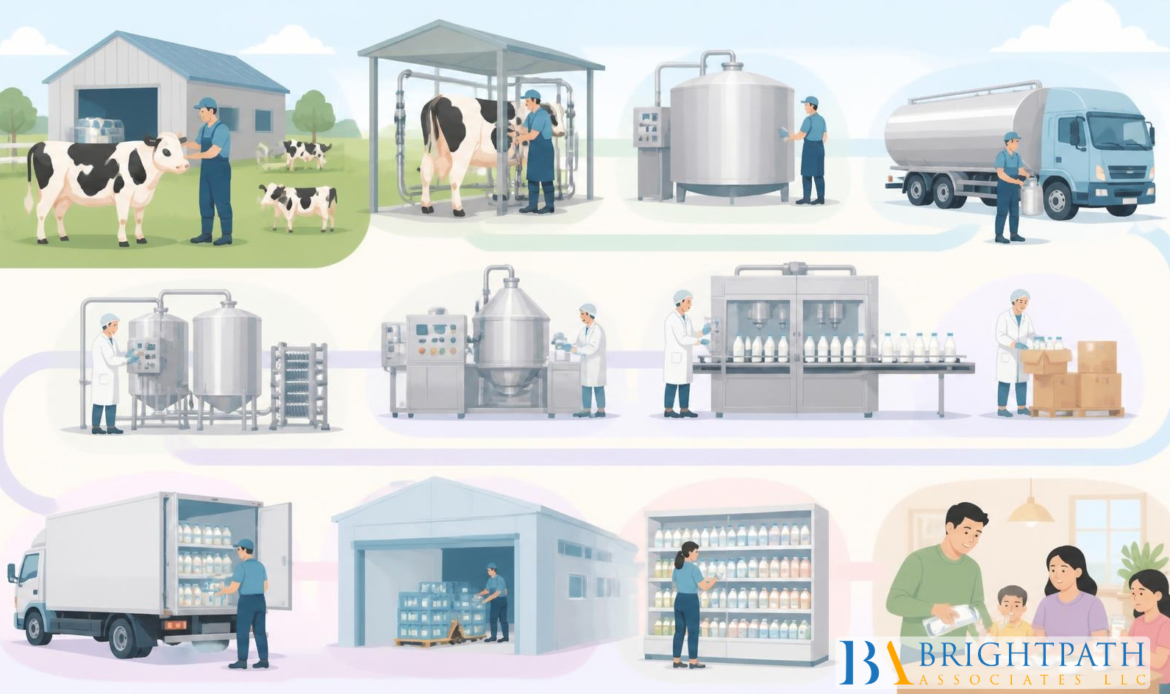
The #DairyIndustry operates within one of the most time-sensitive and interconnected supply chains in the food sector. From milk collection at farms to processing, packaging, cold storage, distribution, and retail delivery, every stage influences product quality, operational efficiency, profitability, and customer satisfaction. Rising production costs, changing consumer expectations, stricter food safety requirements, and growing sustainability concerns are pushing dairy businesses to rethink traditional operating models.
Redesigning the dairy supply chain requires more than improving transportation or upgrading processing equipment. It demands an integrated approach that connects farmers, suppliers, processors, distributors, retailers, and customers through shared information, standardized processes, and measurable performance objectives. Businesses that invest in modern Dairy supply chain management can improve traceability, reduce waste, strengthen supplier relationships, and respond more effectively to market fluctuations.
For dairy executives, the objective is to create an end-to-end operating system that balances product freshness, cost control, supply reliability, and long-term growth. Achieving this goal requires strategic investments in technology, workforce capabilities, operational planning, and sustainable production practices.
Dairy supply chains face challenges that are distinct from those of many other food industries. Raw milk is highly perishable, production volumes fluctuate with seasonal conditions, and maintaining the cold chain is essential to protecting product quality. Delays during collection, transportation, or processing can increase spoilage risks and reduce the value of the final product.
Fragmented communication between farms, processing facilities, logistics providers, and retailers creates additional complexity. When businesses rely on disconnected spreadsheets, manual reporting, and outdated inventory systems, decision-makers may lack an accurate view of available milk volumes, production capacity, warehouse inventory, and customer demand.
Demand variability presents another significant obstacle. Consumption patterns differ across product categories, regions, seasons, and customer segments. A processor may experience excess cream or milk powder inventory while facing shortages of packaged milk or yogurt. Without coordinated forecasting and production planning, these imbalances can increase operating costs and create avoidable waste.
A redesigned supply chain begins with identifying these weaknesses across the entire value network. Leaders must understand where delays occur, which processes generate unnecessary costs, and how information gaps affect decisions. This assessment establishes the foundation for targeted improvements rather than isolated technology investments.
Integrating Milk Production Technologies With Processing Operations
Farm-level efficiency directly influences the performance of the wider dairy supply chain. Milk quality, collection schedules, production consistency, and farm management practices all determine how effectively processors can plan their operations.
Modern Milk production technologies can help dairy farms monitor animal health, track milk yields, improve feeding decisions, and identify production abnormalities. Automated milking systems, digital herd management platforms, and sensor-based monitoring tools provide more consistent operational information. When appropriately implemented, these technologies can help farmers identify problems earlier and make better-informed decisions about productivity and animal welfare.
The benefits become greater when farm-level data connects with processing and procurement systems. Processors can use anticipated milk volumes to schedule collection vehicles, allocate receiving capacity, plan production runs, and coordinate labor requirements. Instead of responding to unexpected deliveries, facilities can develop more reliable daily operating plans.
Milk quality data should also be integrated into supplier management processes. Information about temperature, composition, microbial quality, and delivery timing can support transparent supplier performance assessments. Consistent standards help businesses identify improvement opportunities while encouraging stronger relationships with farmers.
Successful integration requires accessible technology and practical training. Smaller farms may not have the resources to implement complex digital systems independently. Dairy companies can support adoption through collaborative programs, simplified tools, technical assistance, and clear incentives tied to quality and reliability.
Processing facilities are central to dairy supply chain performance because they transform perishable raw milk into products with different storage, transportation, and demand requirements. Inefficient processing schedules, equipment downtime, inconsistent quality, and excessive changeover times can undermine the entire network.
Dairy automation technologies can improve process consistency through automated cleaning systems, digital temperature controls, filling equipment, packaging lines, and integrated production monitoring. Automation can also reduce repetitive manual tasks and provide operators with more reliable information about equipment performance and product quality.
However, automation alone does not guarantee better results. Businesses must connect equipment upgrades with maintenance planning, employee training, production scheduling, and quality assurance. Facilities that automate individual machines without integrating their data may simply replace manual bottlenecks with digital ones.
Food technology is expanding the opportunities available to dairy manufacturers. Advanced processing methods, improved packaging materials, real-time quality monitoring, and data-driven process controls can support product consistency and reduce losses. The most effective investments are those that address a clearly defined operational challenge and deliver measurable improvements in safety, efficiency, or product value.
Processing flexibility is equally important. A facility designed to manufacture several product categories can respond more effectively to changing demand, provided it has suitable equipment, trained personnel, and validated cleaning procedures. Production planning should coordinate raw milk availability, product specifications, packaging materials, equipment capacity, and distribution commitments.
Strengthening Cold Chain Logistics and Distribution
A dairy supply chain is only as reliable as its ability to preserve product quality during transportation and storage. Refrigerated transportation, warehouse management, #DeliveryScheduling, and temperature monitoring must operate as a coordinated system.
Businesses should establish clear temperature-control requirements for each product category and monitor compliance throughout transportation and storage. Connected sensors and digital tracking systems can provide alerts when temperatures move outside approved ranges. These alerts allow teams to investigate problems before they become larger quality or food safety incidents.
Route optimization can improve delivery efficiency by considering traffic, delivery windows, vehicle capacity, customer locations, and refrigeration requirements. More accurate planning reduces unnecessary mileage, fuel consumption, and vehicle utilization costs. It can also improve delivery reliability for retailers, food-service operators, and direct customers.
Inventory placement is another important consideration. Products with short shelf lives should move through distribution networks according to appropriate shelf-life and stock-rotation rules. First-expiring-first-out practices, accurate warehouse records, and coordinated replenishment help prevent products from remaining in storage beyond commercially useful periods.
Executives should also evaluate distribution network design. Centralized facilities may offer scale advantages, while regional distribution centers can shorten delivery times and improve responsiveness. The right configuration depends on customer density, product mix, transportation costs, and required service levels.
Using Digital Transformation to Improve End-to-End Visibility
Dairy industry digital transformation involves connecting previously separated processes into a coordinated information environment. Enterprise resource planning platforms, manufacturing execution systems, warehouse management tools, transportation systems, and supplier portals can provide a more complete view of supply chain performance.
An integrated data architecture enables decision-makers to compare milk procurement, production output, inventory levels, order fulfillment, and distribution costs. Instead of discovering a shortage after an order has been delayed, teams can identify emerging constraints and adjust plans earlier.
Demand forecasting is one of the most valuable applications. Historical sales, promotions, weather patterns, customer orders, and seasonal trends can help businesses estimate demand across product categories. Forecasts become more useful when sales teams, procurement managers, production planners, and logistics providers work from shared assumptions.
Traceability is another priority. Digital batch records can connect raw milk suppliers with processing dates, production lines, packaging information, and distribution destinations. If a quality concern emerges, the company can identify affected batches more quickly and organize targeted corrective action. This improves response readiness while reducing the risk of unnecessarily broad product withdrawals.
Cybersecurity and data governance must accompany digital investment. Businesses should define data ownership, access permissions, backup procedures, system integration standards, and incident-response responsibilities. Technology creates value when employees trust the information and use it consistently in everyday decisions.
Supply chain excellence must extend beyond operational efficiency to the products customers actually want. Dairy product development should be closely connected with market research, procurement planning, manufacturing capabilities, packaging availability, and distribution requirements.
Consumer preferences continue to evolve across traditional dairy products, flavored milk, yogurt, cheese, butter, lactose-free alternatives, and protein-focused offerings. Each category presents different requirements for ingredients, processing, shelf life, packaging, and cold storage. Developing products without evaluating these supply chain implications can introduce complexity and increase costs.
Cross-functional product development teams can reduce these risks by involving procurement, operations, quality assurance, marketing, and logistics at the beginning of the innovation process. This approach helps organizations determine whether a proposed product can be manufactured consistently, sourced economically, and distributed within its required conditions.
Standardizing ingredients and packaging components where commercially appropriate can also simplify procurement and inventory management. At the same time, businesses should avoid excessive standardization when it limits differentiation or prevents them from meeting important customer needs.
A disciplined product portfolio review can identify products that generate strong margins, products that support strategic customer relationships, and products that create disproportionate operational complexity. These insights help companies allocate capacity and working capital more effectively.
Advancing Sustainable Dairy Farming Practices
Sustainability is increasingly connected with supply chain resilience, resource efficiency, and long-term commercial performance. Sustainable dairy farming practices can support soil and water management, responsible manure handling, improved feed efficiency, animal welfare, and the reduction of avoidable environmental impacts.
Processors can encourage progress by working with farmers on practical improvement programs. Depending on local conditions, these programs may include water conservation, energy-efficient farm equipment, improved feed management, renewable energy adoption, and better utilization of agricultural by-products.
Environmental improvements should extend beyond the farm. Processing facilities can evaluate water consumption, cleaning efficiency, wastewater treatment, energy use, refrigeration performance, and packaging waste. Distribution operations can examine vehicle utilization, route efficiency, refrigeration energy consumption, and opportunities to reduce empty journeys.
Measurement is essential. Businesses should establish baseline indicators and monitor changes over time rather than relying on broad sustainability claims. Useful measures may include energy consumed per unit of product, water use per processing volume, product loss rates, and greenhouse gas emissions across defined supply chain activities.
Sustainability initiatives are most effective when they are integrated into capital planning, supplier engagement, and operational performance reviews. This allows #DairyBusinesses to balance environmental objectives with food safety, affordability, and reliable supply.
Digital purchasing channels are changing how dairy products reach households, retailers, and food-service customers. Dairy e-commerce creates opportunities for direct customer relationships, recurring orders, personalized promotions, and improved access to niche products. However, it also introduces fulfillment challenges involving small order sizes, delivery timing, packaging protection, and last-mile refrigeration.
Companies entering digital channels need accurate inventory information and dependable order management. Customers should be able to purchase products that are genuinely available, while fulfillment teams need clear instructions about picking, packing, dispatch, and delivery.
Demand forecasting must account for differences between traditional retail orders and online purchasing behavior. Online promotions can generate sudden demand spikes, while subscription models may provide more predictable order patterns. Businesses can use these signals to improve replenishment and allocate inventory across channels.
Last-mile economics require careful attention. Delivery density, minimum order values, reusable packaging options, delivery windows, and partnerships with established logistics providers can influence profitability. A digital channel should be evaluated not only by revenue growth but also by contribution margin, customer retention, order accuracy, and delivery performance.
The most successful dairy e-commerce strategies connect the customer experience with operational capabilities. Fast ordering and attractive promotions cannot compensate for unreliable availability, inconsistent product quality, or missed delivery commitments.
Implementing Practical Dairy Industry Growth Strategies
Redesigning a supply chain is a strategic transformation rather than a single technology project. Dairy industry growth strategies should begin with a clear understanding of business priorities, current operational limitations, and expected returns.
Organizations can start by mapping the complete value chain and identifying high-impact improvement opportunities. These may include reducing milk spoilage, improving forecast accuracy, increasing production-line utilization, lowering distribution costs, or improving on-time delivery. Establishing baseline measurements allows management to evaluate progress objectively.
A phased implementation model can reduce disruption. Initial projects might focus on temperature monitoring, inventory accuracy, or production scheduling before expanding into broader system integration. Pilot programs should test operational feasibility, employee adoption, data quality, and financial performance before larger investments are approved.
Performance measurement should cover the entire supply chain rather than isolated departments. Key indicators can include milk rejection rates, forecast accuracy, production yield, inventory losses, order fulfillment rates, delivery reliability, energy consumption, and cost per unit delivered. Shared accountability encourages teams to optimize overall business outcomes instead of transferring costs or problems between functions.
Leadership alignment is critical. Executives must communicate the business case, assign clear ownership, and ensure that procurement, operations, technology, finance, and sales teams collaborate. Without this coordination, even technically successful projects may fail to deliver lasting improvements.
Technology and process redesign require capable leaders who can translate strategy into operational results. Dairy businesses increasingly need executives with experience in supply chain planning, food safety, manufacturing automation, digital transformation, procurement, sustainability, and commercial growth.
Dairy industry executive search can help organizations identify leaders who understand both the technical requirements of dairy operations and the commercial pressures facing food manufacturers. The right executive can connect farm-level realities with processing economics, distribution performance, customer expectations, and investment priorities.
#ExecutiveSearchRecruitment is particularly valuable when businesses are entering new markets, modernizing legacy facilities, integrating acquisitions, or implementing enterprise-wide transformation programs. Leadership candidates should be evaluated on their ability to manage change, build cross-functional teams, interpret operational data, and deliver measurable performance improvements.
Organizations should also invest in the development of existing employees. Training in digital systems, food safety, process optimization, data interpretation, and continuous improvement helps create a workforce capable of sustaining transformation. A combination of strategic recruitment and internal talent development provides a stronger foundation for long-term competitiveness.
Conclusion
Redesigning the dairy supply chain requires an end-to-end perspective that connects farms, processing facilities, warehouses, logistics providers, retailers, and customers. Better coordination, modern technology, reliable data, sustainable practices, and capable leadership can help dairy businesses reduce waste, improve quality, control costs, and respond more quickly to changing market conditions.
The path to excellence begins with understanding existing weaknesses and prioritizing improvements that deliver measurable business value. Investments in automation, digital visibility, cold chain management, product innovation, and e-commerce should reinforce one another rather than operate as disconnected initiatives.
For dairy industry leaders, the competitive advantage will come from building a supply chain that is not only efficient but also adaptable, transparent, and resilient. Companies that combine operational discipline with strategic investment and strong leadership will be better positioned to meet evolving customer expectations and achieve sustainable growth in an increasingly demanding dairy market.