
Introduction
For manufacturing startups, acquiring entirely new production equipment can be financially difficult. Many emerging businesses instead begin operations with #RefurbishedMachinery, inherited production assets, or older equipment purchased at a lower cost. While legacy machines can remain productive for many years, they often present a major challenge: how can a startup maintain reliability when the equipment was never designed for modern data-driven monitoring?
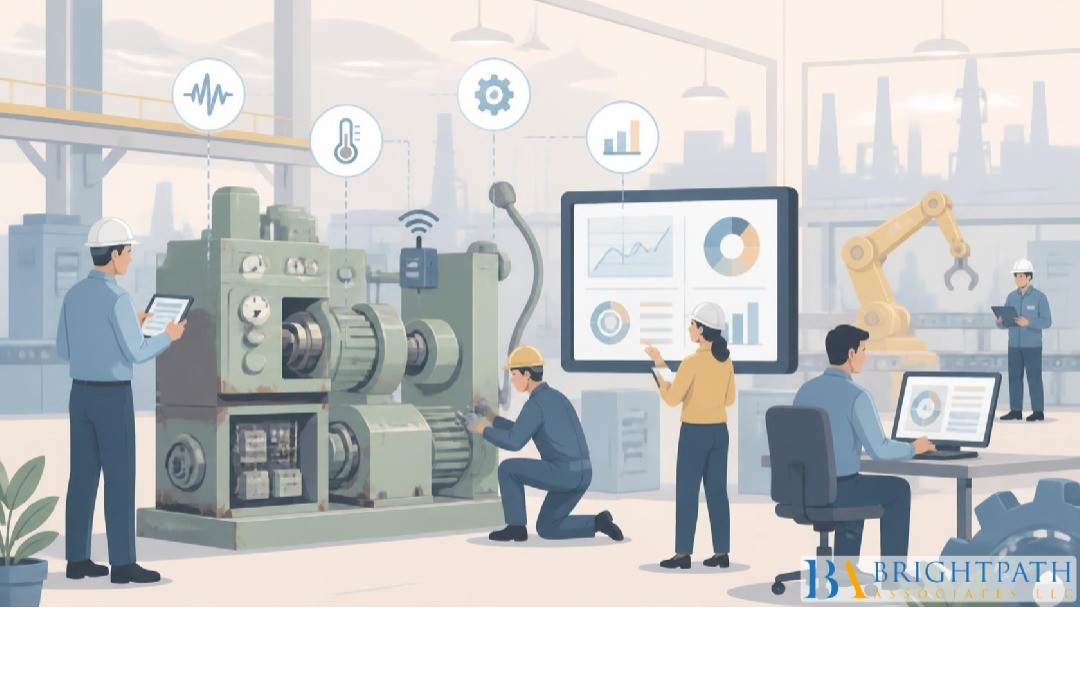
Predictive maintenance offers a practical answer. Rather than replacing every aging machine, manufacturers can combine sensors, connectivity, industrial software, automation technologies, and analytical tools to understand equipment health and identify potential failures before they interrupt production.
The opportunity is particularly significant as Industrial automation becomes more accessible to smaller manufacturers. Technologies once associated primarily with large factories can now be implemented incrementally, allowing startups to modernize selected machines without completely rebuilding their production environments.
For startups, the objective is not to make every legacy machine technologically sophisticated overnight. It is to create a practical maintenance strategy that improves uptime, reduces unexpected repair costs, and extends the productive life of existing assets.
Understanding the Challenge of Legacy Equipment
Legacy machinery presents a different maintenance challenge from modern connected equipment. Older machines may lack built-in sensors, standardized communication protocols, remote diagnostics, or digital maintenance records. Their operating information may exist primarily through physical gauges, operator experience, maintenance logs, and manual inspections.
This does not mean legacy equipment cannot participate in a modern predictive-maintenance strategy. External sensors can be installed to measure vibration, temperature, pressure, electrical characteristics, motor performance, and other indicators.
The data can then be collected and analyzed through modern monitoring platforms. In some cases, startups can modernize individual components rather than replacing entire machines.
This approach can preserve the economic value of existing assets while gradually introducing modern automation capabilities.
Unexpected equipment failure can have an outsized impact on a startup. Large manufacturers may have spare machinery, multiple production lines, or dedicated maintenance teams capable of absorbing downtime. A startup operating one or two critical machines may not have that flexibility.
A failed motor, hydraulic system, conveyor, compressor, or control component can stop production completely. The resulting costs can include emergency repairs, lost production, delayed customer orders, overtime, and reputational damage.
Predictive maintenance changes the objective from reacting to failures to identifying developing problems. If data indicates that a machine is operating outside its normal pattern, maintenance teams can investigate the issue before it becomes a major breakdown.
For a young company, this can improve both operational reliability and financial predictability.
Building an Industrial Automation Foundation
#IndustrialAutomation does not have to begin with a complete factory transformation. Startups can begin with the machines and processes that create the greatest operational risk.
The first step is understanding which assets are essential to production and which failures would create the greatest consequences. These machines should become priorities for monitoring.
Sensors can then be introduced according to the machine’s characteristics. Rotating equipment may benefit from vibration and temperature monitoring, while hydraulic systems may require pressure and fluid-related measurements.
The collected information can eventually be connected to broader automation infrastructure. This creates an incremental path toward modernization instead of requiring a major upfront investment.
Automation Solutions Manufacturing Startups Can Adopt
Automation solutions manufacturing companies can implement today increasingly include modular technologies designed to work alongside existing equipment. Edge devices, industrial gateways, wireless sensors, programmable controllers, and cloud-connected monitoring platforms can provide digital capabilities without requiring complete equipment replacement.
For startups, modularity is particularly valuable. A business can begin by monitoring a single production line, evaluate the results, and then expand the system as its needs and budget grow.
The key is interoperability. Before purchasing technology, startups should determine whether new devices can communicate effectively with existing machinery and software.
A technically impressive system that cannot exchange information with the rest of the production environment may create another isolated technology layer rather than solving the underlying maintenance challenge.
Programmable logic controllers remain central to industrial machinery. Older machines may use PLCs that still function effectively but provide limited connectivity or outdated control logic.
A professional PLC programming service can help startups modernize these systems. PLC programming can potentially improve machine sequencing, add monitoring capabilities, integrate new sensors, and establish communication with supervisory platforms.
In some cases, the original PLC can continue controlling the machine while additional hardware collects operational information. In other cases, replacing or upgrading the PLC may provide a better long-term solution.
The decision should be based on machine criticality, replacement costs, availability of spare parts, safety requirements, and expected remaining service life.
Connecting Legacy Machinery Through SCADA Systems
#SCADASystems can provide startups with centralized visibility into industrial equipment. By collecting information from controllers and sensors, SCADA platforms can present machine conditions, alarms, trends, and operational information through a centralized interface.
For predictive maintenance, this can create a historical record of machine behavior. Operators can compare current performance with previous operating conditions and identify deviations.
For example, increasing motor temperature, changing pressure patterns, or unusual operating cycles may indicate that an inspection is required.
SCADA systems can also improve communication between operators and maintenance personnel. Instead of relying entirely on verbal reports or handwritten records, teams can access a shared operational picture.
Using Control Systems to Improve Reliability
Control systems provide the operational foundation through which industrial machinery performs its intended functions. When control systems are outdated, poorly maintained, or difficult to monitor, diagnosing equipment problems can become challenging.
Modernization does not always require replacing an entire control architecture. Startups can evaluate individual controllers, sensors, communication networks, and human-machine interfaces.
Improving the quality of operational data can make maintenance decisions more precise. A machine that previously generated only a basic failure alarm might, after modernization, provide information about temperature, pressure, vibration, operating cycles, or electrical performance.
This additional context can help maintenance teams distinguish between normal operating variation and potential equipment degradation.
Industrial machine vision is commonly associated with quality inspection, but visual technologies can also contribute to equipment monitoring. Cameras and vision systems can identify changes in product positioning, component appearance, surface conditions, alignment, or machine behavior.
For certain production environments, these visual indicators can provide early warnings of mechanical or process problems.
For example, changes in component alignment or repeated product defects may indicate that a machine requires adjustment or maintenance.
Combining Industrial machine vision with other sensor data can provide a more complete understanding of equipment performance. Instead of analyzing mechanical information alone, manufacturers can connect machine condition with actual production outcomes.
Robotics Integration in Legacy Manufacturing Environments
#RoboticsIntegration is increasingly becoming part of modernization strategies, but introducing robots into a legacy factory requires careful planning.
A startup may use robotic systems for material handling, assembly, packaging, inspection, or repetitive processes while retaining older machinery elsewhere in the production environment.
Predictive maintenance becomes important because robotic systems and legacy machines must often operate together. A failure in one part of the production cell can affect the entire process.
Integrating equipment monitoring with robotic workflows can help manufacturers identify potential disruptions and coordinate maintenance around production schedules.
This demonstrates why modernization should be approached as an interconnected system rather than a collection of individual technology projects.
Creating a Data Strategy for Predictive Maintenance
Collecting data is only the beginning. Startups need to determine which information actually supports maintenance decisions.
Too little data can make predictive analysis ineffective, while excessive data can create unnecessary complexity and storage costs. Companies should identify the variables most closely associated with equipment performance and failure.
Historical maintenance records can also be valuable. Even incomplete records may reveal recurring failures, component replacement intervals, and common causes of downtime.
Over time, startups can establish equipment baselines. Once normal operating patterns are understood, deviations can trigger alerts or inspections.
The objective is to develop a maintenance system that becomes more intelligent as the company accumulates operational experience.
Startups should avoid implementing sophisticated technology simply because it is available. Predictive maintenance should solve a clearly defined business problem.
A practical implementation may begin with one critical machine, a small set of sensors, a basic monitoring platform, and a defined maintenance workflow.
The company can then measure whether the system reduces downtime, improves maintenance planning, or lowers emergency repair costs.
If the approach delivers measurable value, it can be expanded to additional assets.
This staged strategy reduces financial risk while allowing employees to become comfortable with new technology.
Workforce Skills for Modern Manufacturing
Technology adoption creates new #WorkforceRequirements. Maintenance personnel increasingly need to understand sensors, industrial networks, software interfaces, data interpretation, and automated control systems alongside traditional mechanical and electrical skills.
Production employees also need to understand how monitoring systems work and how to respond to alerts.
For startups, finding these multidisciplinary professionals can be difficult. The modern industrial employee may need knowledge spanning maintenance, automation, controls, data, and manufacturing operations.
This is contributing to increasing demand for specialized Automation jobs across the manufacturing sector.
Leadership and Executive Search Industrial Automation
Successful modernization requires leadership that can connect technology investments with commercial objectives. A startup may have access to advanced automation tools but lack the internal expertise needed to determine where those technologies will deliver the greatest value.
Executives responsible for manufacturing transformation need to understand production economics, automation architecture, workforce development, cybersecurity, maintenance strategy, and capital planning.
This is where executive search industrial automation capabilities can become valuable. Recruiting leaders with a combination of manufacturing experience and automation expertise can help startups avoid costly technology decisions and build scalable operational foundations.
#ExecutiveSearchRecruitment can also support organizations seeking senior professionals capable of managing automation expansion, maintenance transformation, engineering teams, and digital manufacturing initiatives.
Cybersecurity Considerations for Connected Legacy Equipment
Connecting older machines to modern networks creates cybersecurity considerations that startups cannot ignore. Legacy equipment may have outdated operating systems, unsupported controllers, or limited security capabilities.
Adding connectivity can increase the potential attack surface if networks are not properly segmented and protected.
Startups should therefore consider cybersecurity during the design phase. Industrial networks should be appropriately separated, access should be controlled, and connected equipment should be monitored.
Modernization should improve operational visibility without creating unnecessary security vulnerabilities.
A predictive-maintenance program should be evaluated through measurable operational outcomes. Startups can examine unplanned downtime, maintenance costs, emergency repairs, production interruptions, equipment availability, and replacement frequency.
Another useful measure is maintenance planning. If more repairs can be scheduled during planned production pauses instead of emergencies, the program is creating operational value.
Over time, companies can also compare maintenance costs between monitored and unmonitored equipment.
The objective is not to eliminate every equipment failure. No predictive system can guarantee that. The objective is to reduce preventable disruptions and improve the organization’s ability to anticipate and manage equipment problems.
The Future of Legacy Equipment Modernization
#LegacyMachinery will remain part of industrial production for many years. Economic realities, specialized equipment designs, and long asset lifecycles make complete replacement impractical for many businesses.
Industrial automation provides a pathway for these machines to participate in modern manufacturing environments. Sensors, PLC upgrades, SCADA systems, control platforms, machine vision, and robotics can gradually introduce digital capabilities.
As artificial intelligence and industrial analytics become more accessible, predictive maintenance may become increasingly sophisticated. Systems will be able to analyze larger volumes of operational information and identify subtle changes in machine behavior.
For startups, building a reliable data foundation today can make future automation upgrades easier.
Conclusion: Turning Aging Machinery into a Strategic Asset
Legacy equipment does not automatically represent a technological disadvantage. With the right strategy, older machinery can become part of a modern, connected, and data-driven production environment.
Predictive maintenance enables startups to focus resources on preventing costly failures rather than responding to them. By combining Industrial automation with Automation solutions manufacturing strategies, PLC programming service capabilities, SCADA systems, Control systems, Robotics integration, and Industrial machine vision, businesses can modernize equipment without immediately replacing entire production lines.
The most successful approach is gradual and commercially focused. Start with critical equipment, collect useful data, establish operating baselines, train employees, and measure results before expanding.
Ultimately, predictive maintenance is not simply a technology project. It is a shift in how startups think about equipment ownership. Instead of viewing legacy machines as aging assets that must eventually be discarded, companies can use modern monitoring and automation to extend their useful life, improve reliability, and extract greater value from existing investments.
With the right technical workforce, supported by strategic Executive Search Recruitment, startups can build maintenance capabilities that grow alongside their manufacturing operations. The result is a more resilient factory, better utilization of capital, fewer unexpected disruptions, and a stronger foundation for long-term Manufacturing automation.
Find your next leadership role in Industrial Automation Industry today!
Stay informed with the latest insights on Industrial Automation Industry!