
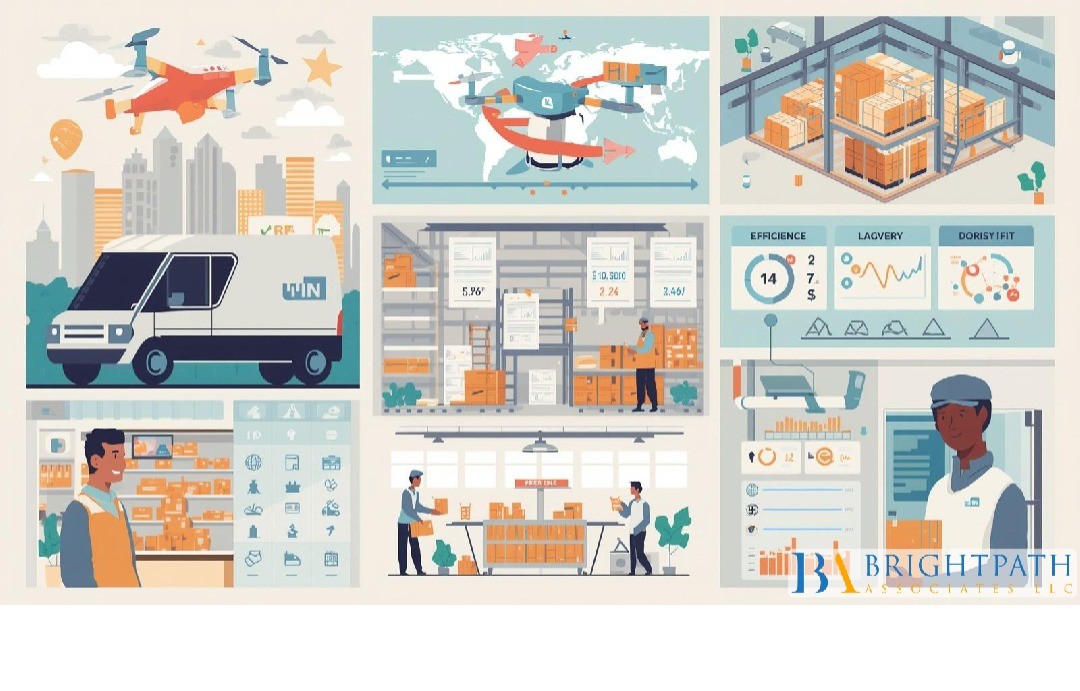
Introduction: The Last Mile as a Brand Defining Moment
#ParcelDelivery has evolved from a back-office function into a front-line brand experience. In an era where e-commerce logistics defines the rhythm of retail, customers judge companies not only by what they buy but by how reliably and transparently orders arrive. The delivery industry is also operating under intense economic and operational constraints: parcel volumes are rising, yields are tightening, consumers are more value sensitive, sustainability regulations are intensifying, and urban congestion is mounting. Excellence now requires industrial rigor—precise promises, robust networks, proactive communication, and continuous improvement—fused with delivery technology that makes the complex feel simple. This essay sets out an informative, insightful, industrial blueprint for achieving “parcel perfection” by aligning strategy, operations, and talent across the delivery sector.
Market Reality: High Volume, Tight Margins, Rising Expectations
The transportation industry trends shaping delivery are unmistakable. In the United States, parcel volume grew again in 2024 while revenue per parcel edged down, underscoring the pressure to do more with less. At the same time, competitive disruption is accelerating as alternative carriers gain share and self-managed networks expand. Peak-season volatility remains a fact of life; on-time performance during holiday periods dipped across major national carriers in 2024 compared with 2023, reminding shippers that resilient promises beat optimistic ones. On the demand side, consumers still appreciate speed, but they increasingly prioritize total value: accurate ETAs, reliable handoffs, clear options, and easy returns. Meanwhile, cities warn that without intervention, last-mile traffic and emissions could rise markedly by 2030, compelling investments in greener, denser networks. This combination—volume growth, yield compression, value-seeking customers, and sustainability imperatives—defines the delivery technology mandate for the next decade.
The Promise Engine: Accurate Over Optimistic
The first lever in optimizing parcel delivery is promise accuracy. Modern delivery technology should replace static service-level claims with dynamic delivery promises generated from real performance by lane, day of week, and season. That means fusing order management with historical carrier data, live capacity, weather, and traffic to compute realistic ETAs. Accurate promises do more than prevent disappointment; they shape conversion, reduce “Where Is My Order?” inquiries, and guide intelligent carrier selection. The checkout menu itself should be engineered to match customer use cases: a cost-efficient 2–3 day standard option, scheduled time-slot delivery where density allows, out-of-home pickup for 24/7 convenience, and premium same-day services limited to zones where they are consistently reliable. These options elevate perceived value and let customers self-select the right trade-offs between speed, cost, and convenience. In parallel, multi-carrier orchestration is now a strategic necessity. #FreightShipping and small-parcel needs should be routed to diversified providers, blending national networks, regionals, and specialized last-mile partners to optimize cost and service while hedging disruption risk.
Network Density: Distributed Inventory and Out-of-Home
The most powerful structural driver of reliability and cost is density. Distributed fulfillment strategies shrink the distance from inventory to doorstep, enabling faster cutoffs, steadier ETAs, and fewer handoffs that introduce risk. Urban micro-hubs can anchor high-density routes, particularly when paired with e-cargo bikes or vans for the final segment. Out-of-home delivery is an equally potent density lever. Parcel lockers and pick-up/drop-off (PUDO) points consolidate multiple deliveries into a single stop, raising first-attempt success rates, reducing drive time, and offering customers certainty with 24/7 pickup. Economically, they lower cost per parcel; environmentally, they reduce miles per package; operationally, they mitigate porch piracy. Europe’s rapid growth in carrier-agnostic locker and PUDO networks offers a template for broader adoption, with the strongest impact where network density is high enough that most consumers have a convenient location within a short walk.
First-Attempt Success: Prevent, Don’t Recover
First-attempt delivery failures are costly and corrosive to trust. The #IndustrialApproach aims to prevent rather than recover. It starts with address quality and geocoding hygiene, continues with configuration of safe-place and neighbor-authorized drop policies that align with local regulations, and extends to offering narrow delivery windows or in-flight redirects to lockers and PUDO. Signature and age-verification requirements should be balanced with time-slot options to prevent “recipient not home” scenarios. At scale, fielding photo proof-of-delivery clarifies chain of custody, reduces disputes, and gives customers confidence—especially when paired with immediate delivery notifications and images. Every failure mode should be measured and assigned an owner: incorrect addresses, access constraints, weather exceptions, and capacity bottlenecks are all diagnosable and, therefore, improvable with tight KPIs.
Proactive Transparency: The End of “Where Is My Order?”
Visibility is one of the most efficient levers for customer satisfaction and cost containment. Event-driven, proactive updates—order confirmed, picked, labeled, handed to carrier, out for delivery, delayed with a revised ETA, delivered with proof—dramatically reduce inbound inquiries. Retailers that implement fully automated, omnichannel notifications (SMS, email, app push) often report significant declines in WISMO contacts and measurable gains in customer satisfaction. The key is accuracy and timeliness: a proactive message that arrives before the customer notices a problem converts anxiety into trust. Internally, unifying tracking data into a single truth source allows operations and care teams to collaborate on exceptions in real time. This shift from reactive to proactive reduces cost to serve while improving perceived reliability—even when there are uncontrollable disruptions such as storms or traffic incidents.
Sustainable Delivery: Decarbonize While Improving Economics
Sustainability and efficiency are converging in the last mile. Electrifying urban delivery fleets and deploying e-cargo bikes in dense districts can reduce emissions dramatically, often with favorable total cost of ownership once route density and charging logistics are optimized. Micro-hubs and dynamic route planning cut empty miles and rebalance fleets to where demand peaks. Out-of-home delivery further consolidates stops, lowering emissions per parcel and strengthening first-attempt success. Cities are also experimenting with designated delivery zones, #CurbManagement, and time-window incentives that reduce cruising and idling. Crucially, sustainability should be visible to the customer: labeling the “greenest” option during checkout not only guides choices but signals brand values. Over time, greener operations are likely to become table stakes as regulators formalize low-emission zones and stakeholder expectations rise.
Security by Design: Beating Porch Piracy
Porch piracy remains a stark threat to brand trust even as some studies indicate recent declines in incidents. An industrial approach uses layered defenses. First, default high-risk areas to lockers or PUDO, supported by incentives and user education that highlight 24/7 convenience and reduced risk. Second, capture delivery instructions during checkout (gate codes, preferred neighbors, safe places) and propagate them to drivers. Third, enable photo proof-of-delivery with geotagging and timestamping. Fourth, require adult signature or ID verification for high-value items and offer narrow delivery windows or pickup alternatives. Finally, close the loop by analyzing incident rates by ZIP code, product category, and carrier to drive targeted countermeasures and policy changes. Customers are reassured not only by secure methods but by transparent post-incident remediation that resolves issues quickly and fairly.
Returns as a Loyalty Engine
The delivery journey does not end at receipt. Returns are an integral component of customer satisfaction and a decisive factor in repeat purchase behavior. No-label, no-box drop-offs at dense networks, QR-based kiosk returns, scheduled home pickups, and instant or near-instant refunds where feasible transform returns from friction into a loyalty moment. On the back end, an industrial reverse logistics design routes items to the optimal node for resale, refurbishment, or recycling, maximizing recovery while minimizing cycle time to refund. The most mature operators treat return reasons as a goldmine of product, packaging, and carrier insights, closing the loop with merchandising, #SupplyChain, and customer promise teams to reduce avoidable returns at the source.
The Industrial Scorecard: KPIs That Drive Outcomes
Operational excellence rests on a concise but powerful scorecard. On-time delivery rate must be tracked by lane, product, carrier, day, and season, enabling precise promise setting and carrier mix tuning. First-attempt delivery rate reflects address quality, policy configuration, and customer option design; targets above 95% are attainable with density and flexible handoffs. WISMO rate, expressed per thousand orders, should decline as proactive notifications mature. Damage and loss rates, disaggregated by packaging profile and carrier handling, steer packaging design and provider selection. Returns cycle time to refund indicates friction that undermines repeat purchases. Finally, cost-to-serve per parcel—including failed attempt cost, redelivery, care contacts, and reverse logistics—exposes hidden drags on profitability and spotlights the ROI of network densification, OOH expansion, and automation.
Technology Architecture: Orchestrating the Final Mile
A modern stack for parcel perfection integrates planning, execution, and customer experience. The order management system and warehouse management system must exchange inventory, cutoffs, and pack-out decisions in real time with a multi-carrier transportation layer that handles labels, manifests, and compliance. Promise engines compute ETAs from historical and live inputs, while routing algorithms optimize stops, capacity, and driver constraints. An event bus triggers automated notifications and feeds a unified customer tracking portal. Analytics and machine learning optimize promise accuracy, carrier assignments, packaging choices, and dispositioning of returns. The delivery technology platform should be modular, API-first, and event-driven to support rapid iteration, partner integrations, and resilience under peak loads. In freight brokerage services and freight shipping, similar orchestration principles apply: dynamic carrier selection, predictive ETAs, exception automation, and transparency from tender through proof of delivery.
People and Leadership: The Talent Advantage
Technology and process are only as strong as the people who run them. The delivery sector tech talent market is tight, with competition for data engineers, routing scientists, CX automation specialists, and sustainability program leaders. #ExecutiveSearchRecruitment in this arena increasingly focuses on hybrid profiles—leaders who blend network operations acumen with product and data fluency. High-performing organizations create joint accountabilities between supply chain, digital product, and customer care so that promise accuracy, proactive communication, and exception management are managed as unified outcomes rather than siloed metrics. Frontline teams benefit from clear playbooks, real-time dashboards, and closed-loop feedback to carriers and fulfillment nodes. Culture matters: companies that celebrate defect prevention, rapid learning from incidents, and customer-centered decision making translate operational wins into durable brand equity.
Economics and Strategy: Satisfaction That Pays
The business case for parcel perfection is compelling. Accurate promises improve checkout conversion and reduce costly appeasements. Network density and OOH adoption lower cost per stop, drive higher first-attempt success, and mitigate theft. Proactive transparency slashes care contacts and raises customer satisfaction. Sustainable delivery models reduce emissions and often total cost of ownership in dense corridors, while signaling values that matter to customers and regulators. Returns excellence shortens time to refund, recovers higher resale value, and systematically reduces future return rates by addressing root causes. In a market where revenue per parcel is under pressure, the path to profitable growth is to industrialize satisfaction: engineer reliability, remove uncertainty, consolidate miles, harden security, and make the experience effortless from click to doorstep to potential return.
Conclusion: Systemic Excellence, Customer-Centric Simplicity
Parcel perfection is not about being universally fastest. It is about being predictably good, economically sound, secure, and sustainable—and making that reliability feel simple to customers. The winning formula fuses Logistics innovation with disciplined operations across the value chain. It draws on multi-carrier Shipping orchestration, distributed inventory in E-commerce logistics, and dense OOH networks that feed reliable Parcel delivery. It leverages #DeliveryTechnology for dynamic promises, real-time visibility, and automated exceptions. It incorporates lessons from Freight brokerage services and Freight shipping to build resilience and price leverage. It invests in Delivery sector tech talent through targeted Executive Search Recruitment to lead cross-functional delivery transformations. Above all, it treats the last mile as a system to be engineered, measured, and continuously improved. In doing so, companies convert the pressures of the modern Delivery industry into a durable competitive advantage—and turn every successful delivery into the next loyal customer.
Find your next leadership role in Packaging and Freight Industry today!
Stay informed with the latest insights on Packaging and Freight Industry!