
Introduction
#PackagingIndustry has become a critical consideration for manufacturers seeking to protect product quality while reducing environmental impact. Across food processing, pharmaceuticals, consumer goods, and industrial manufacturing, packaging systems must provide reliable protection, maintain shelf-life, support efficient transportation, and meet increasingly demanding sustainability expectations. At the same time, businesses face growing pressure to reduce packaging waste, improve recyclability, and adopt materials that support a circular economy.
Packaging circularity focuses on keeping materials in productive use for as long as possible through reuse, recycling, material recovery, and waste reduction. However, achieving circularity is not as simple as replacing conventional packaging with recyclable or biodegradable alternatives. Packaging must continue to perform its primary function of protecting products from moisture, oxygen, contamination, physical damage, and other factors that can compromise quality.
For manufacturers, the challenge is to balance environmental goals with operational efficiency, product safety, and commercial viability. Industrial automation, Manufacturing automation, and advanced inspection technologies are becoming important tools in this transition. These technologies can improve packaging precision, reduce material waste, monitor production quality, and support consistent manufacturing processes.
A successful circular packaging strategy therefore requires collaboration between packaging designers, production engineers, automation specialists, sustainability teams, and supply chain professionals. By integrating material innovation with intelligent manufacturing systems, companies can improve packaging performance while progressing toward more sustainable industrial operations.
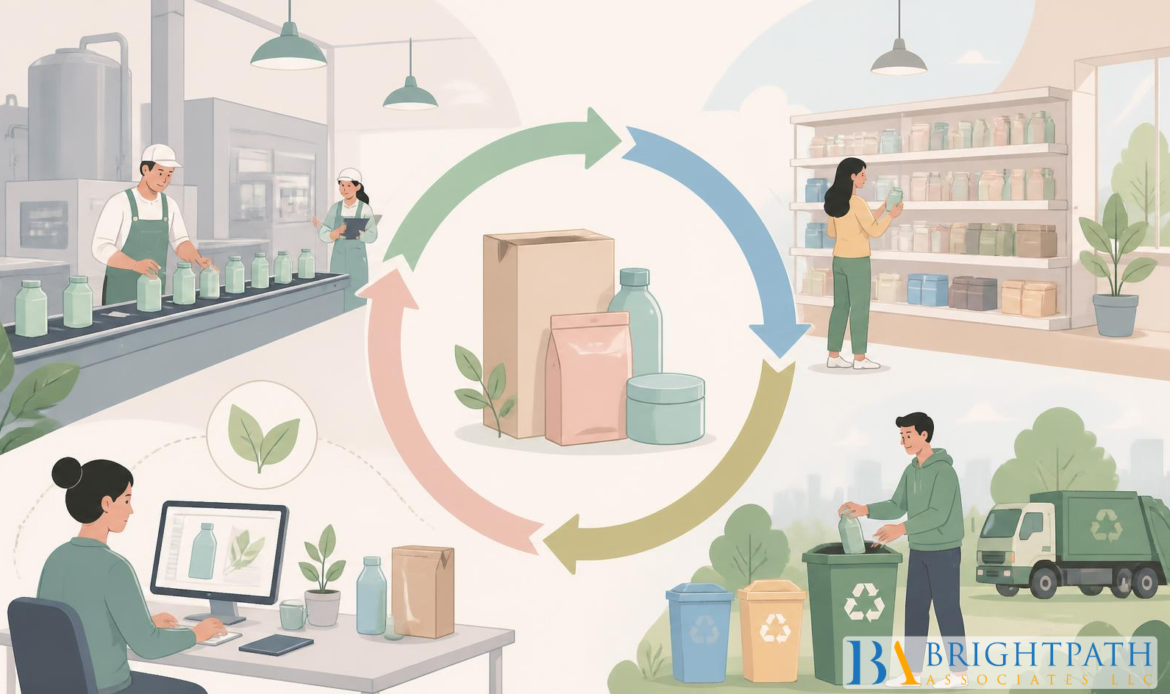
Packaging circularity represents a shift away from the traditional take-make-dispose model toward systems that prioritize resource efficiency and material recovery. Instead of treating packaging as a single-use commodity, businesses evaluate how materials can be reduced, reused, recycled, or recovered after their initial purpose has been fulfilled.
This approach requires manufacturers to consider the entire packaging lifecycle, including raw material sourcing, production, transportation, storage, consumer use, collection, and end-of-life processing. A package that appears environmentally preferable at the production stage may create challenges during recycling or require additional resources during transportation.
For example, multilayer packaging can provide excellent barriers against oxygen and moisture, helping extend the shelf-life of sensitive products. However, combining multiple materials can make separation and recycling more difficult. Conversely, a simpler recyclable structure may require careful engineering to achieve equivalent protection.
Manufacturers must therefore evaluate packaging according to its functional performance and environmental consequences rather than relying on a single sustainability characteristic. Industrial automation can support this evaluation by improving process consistency, collecting production data, and reducing avoidable waste during packaging operations.
When circularity becomes part of product development and manufacturing strategy, companies can make better-informed decisions about material selection, equipment compatibility, and long-term operational costs.
Shelf-Life Protection: Why Packaging Performance Still Matters
Shelf-life is one of the most important considerations in packaging design, particularly for food, beverages, pharmaceuticals, and other products that can deteriorate during storage or transportation. Packaging protects products from environmental exposure, contamination, oxidation, moisture migration, and physical damage.
For food manufacturers, inadequate packaging can accelerate spoilage and increase the risk of product waste. This creates an important sustainability trade-off: reducing packaging material is beneficial only when the resulting package continues to protect the product effectively.
A lightweight package that fails prematurely may increase environmental impact if it leads to damaged goods, rejected shipments, or discarded food. Similarly, an alternative material that cannot maintain the required barrier performance may be unsuitable for products with demanding storage conditions.
Manufacturers must evaluate shelf-life requirements according to product characteristics, distribution conditions, temperature exposure, humidity, and expected storage duration. Laboratory testing and real-world trials can help determine whether a new packaging format provides sufficient protection.
Packaging engineers should work closely with quality assurance and production teams to verify performance before making large-scale changes. The objective is to achieve the lowest practical packaging impact without compromising safety, product integrity, or customer satisfaction.
Industrial automation is transforming packaging operations by improving process accuracy, production speed, and material utilization. Automated filling, sealing, labeling, wrapping, and inspection systems help manufacturers maintain consistent packaging quality while reducing the variability associated with manual processes.
These capabilities are particularly important when companies introduce new materials or redesigned packaging formats. Alternative materials may respond differently to heat, pressure, tension, and forming conditions. Automated equipment with appropriate monitoring and adjustable parameters can help manufacturers maintain reliable results while reducing defects.
Automation can also support material efficiency by controlling package dimensions, monitoring consumption, and reducing unnecessary overfilling or excessive wrapping. For example, precise film handling and sealing controls can help prevent damaged packages caused by inconsistent sealing conditions.
However, automation does not automatically guarantee sustainability. Poorly configured equipment, excessive production speeds, or unsuitable process settings can increase scrap rates and energy consumption.
Manufacturers must therefore evaluate automation projects according to their ability to improve quality, reduce material losses, and support the handling requirements of circular packaging materials. Integrating sustainability objectives into production engineering can help companies achieve more consistent environmental and operational results.
Automation Solutions Manufacturing and Material Efficiency
#AutomationSolutionsManufacturing plays an important role in helping businesses adapt packaging lines to new material specifications and changing production requirements. Equipment manufacturers and system integrators increasingly need to design solutions that accommodate different packaging formats, improve changeover efficiency, and minimize material waste.
Flexible packaging equipment can allow manufacturers to switch between suitable package sizes and formats without extensive manual adjustments. Automated material feeding and tension control can reduce handling errors, while precision dispensing systems can help limit unnecessary use of adhesives, coatings, and other consumables.
Manufacturers introducing recyclable packaging may also need to modify forming, sealing, cutting, and conveying processes. These changes require careful coordination between packaging suppliers and equipment providers to ensure that material properties align with machine capabilities.
A successful implementation should include testing under realistic production conditions. Engineers must verify that packaging performs consistently at the required operating speed and that quality standards remain achievable throughout a production run.
By combining flexible equipment design with data-driven process optimization, businesses can reduce production waste while maintaining the efficiency needed to remain competitive in demanding industrial markets.
Programmable logic controllers are central to the operation of modern packaging machinery. A PLC programming service can help manufacturers develop or modify control logic to manage filling sequences, sealing temperatures, conveyor speeds, sensor inputs, and packaging inspection routines.
When companies adopt alternative materials, packaging processes may require new operating parameters. A recyclable film, for example, may need different sealing conditions from a conventional material. Properly designed control logic can help maintain these settings within validated operating limits and reduce the risk of inconsistent package quality.
PLC-based systems can also coordinate equipment interlocks, detect process abnormalities, and stop production when critical conditions fall outside acceptable limits. This supports quality assurance by preventing defective packages from continuing through downstream operations.
Manufacturers should ensure that control-system changes are properly tested, documented, and approved. Packaging performance must be validated rather than assumed simply because a machine can process the new material.
A well-designed PLC architecture supports repeatable production, efficient changeovers, and reliable monitoring. These capabilities can make it easier for manufacturers to introduce circular packaging solutions without sacrificing process stability.
Robotics Integration and Flexible Packaging Operations
Robotics integration is expanding the possibilities for flexible, precise, and efficient packaging operations. Robotic systems can perform tasks such as picking, placing, case packing, palletizing, and handling products in different formats. These applications can improve consistency while reducing repetitive manual workloads.
Circular packaging initiatives may introduce new package shapes, lighter containers, reusable transport units, or redesigned secondary packaging. Robotic systems equipped with suitable gripping tools and programmable motion control can help manufacturers accommodate these changes.
Robots can also support material-efficient operations by handling delicate packages more consistently and reducing damage during transfer between production stages. However, the effectiveness of these systems depends on proper tooling, accurate product positioning, and appropriate programming.
Packaging materials must be evaluated for their mechanical strength and compatibility with automated handling. Lightweight or flexible packages may deform under excessive gripping force or become unstable during high-speed movement.
Successful robotics integration therefore requires close collaboration between packaging designers, mechanical engineers, and automation specialists. By aligning package design with robotic capabilities, manufacturers can improve operational flexibility while supporting circularity objectives.
Supervisory Control and Data Acquisition systems provide visibility into industrial processes by collecting and presenting operational information from equipment, sensors, and control devices. In packaging facilities, SCADA systems can help monitor production speed, equipment availability, energy consumption, temperature conditions, and process interruptions.
This information can support sustainability initiatives by identifying where material losses, excessive energy use, or repeated production defects occur. For example, a facility may discover that a particular packaging line produces more scrap during startup or after frequent format changes.
With reliable data, production managers can investigate the underlying causes and introduce targeted improvements. SCADA systems can also support traceability by recording process conditions associated with particular production batches.
Nevertheless, useful monitoring depends on accurate measurements, consistent data collection, and appropriate interpretation. Manufacturers should establish clear definitions for performance indicators, including packaging material consumed per unit, scrap rates, and energy use per production run.
When connected with maintenance and quality management processes, SCADA systems can help businesses identify opportunities to improve efficiency and strengthen environmental reporting. These capabilities make operational data an important resource for managing packaging circularity.
Industrial Machine Vision and Packaging Quality Assurance
#IndustrialMachine vision uses cameras, lighting, and image-processing software to inspect products and packaging during production. These systems can identify defects such as incorrect labels, damaged seals, missing components, print inconsistencies, and packaging misalignment.
In circular packaging operations, machine vision becomes particularly valuable because alternative materials may introduce different visual characteristics or manufacturing challenges. Recycled-content materials, for example, may exhibit variations in color or surface appearance that require appropriate inspection criteria.
Machine vision can help manufacturers distinguish acceptable material variation from defects that could compromise package performance. When integrated with production controls, inspection systems can identify faulty packages and trigger rejection mechanisms before products reach distribution.
However, inspection systems must be configured and validated for the materials and defects they are intended to detect. Visual inspection alone cannot reliably establish every critical packaging property, such as internal barrier performance or microbial safety.
Combining machine vision with suitable leak testing, seal-strength testing, and other quality-control methods provides a more comprehensive approach. This reduces avoidable waste while ensuring that sustainability initiatives do not undermine product protection.
Control systems connect machinery, sensors, actuators, and supervisory software to coordinate packaging operations. Their reliability is especially important when manufacturers introduce new materials, reusable packaging formats, or more complex recycling-oriented production processes.
An integrated control architecture can coordinate filling, sealing, inspection, and downstream handling while maintaining consistent operating conditions. It can also support alarms, production tracking, and automated responses to process deviations.
For circular packaging, these systems can help maintain material specifications and reduce losses caused by incorrect machine settings. They can also make changeovers more repeatable when a production facility handles several packaging formats.
Manufacturers should consider compatibility, maintainability, cybersecurity, and future expansion when upgrading control systems. Equipment from different suppliers may require integration work to ensure that data and operating commands are exchanged reliably.
A well-designed control environment allows sustainability objectives to become part of everyday production management. Rather than treating circularity as a separate initiative, businesses can incorporate material efficiency, quality performance, and resource consumption into their normal operational controls.
Manufacturing Automation and the Circular Packaging Lifecycle
#ManufacturingAutomation can contribute to circular packaging at several stages, from material processing and package production to filling, distribution preparation, and quality monitoring. Automated systems can improve consistency, reduce rejected products, and provide the data required to evaluate operational performance.
However, packaging circularity must extend beyond the factory floor. Reusable packaging requires systems for collection, cleaning, inspection, and redistribution. Recyclable packaging depends on suitable collection infrastructure, material sorting, and processing capacity. Packaging that is technically recyclable may still fail to achieve high recovery rates when local systems cannot process it effectively.
Manufacturers must therefore collaborate with material suppliers, logistics providers, recyclers, retailers, and customers to ensure that packaging designs are compatible with real-world recovery systems.
Lifecycle assessment can help compare alternative designs by considering raw material extraction, manufacturing energy, transportation, product protection, reuse potential, and end-of-life outcomes. This prevents businesses from making decisions based on isolated environmental indicators.
The most effective circular packaging strategy combines appropriate material choices with efficient manufacturing and practical recovery arrangements. Automation strengthens this strategy by improving consistency and supplying the information needed to measure results.
The transition toward circular packaging is increasing demand for professionals who understand manufacturing processes, packaging materials, automation technologies, and sustainability performance. Industrial automation executive search can help companies identify leaders capable of connecting these technical disciplines with commercial objectives.
Manufacturers may require automation managers, controls engineers, robotics specialists, packaging engineers, sustainability directors, and operations leaders who can oversee equipment upgrades and process improvements. These professionals must understand production reliability while evaluating how design changes affect waste, energy use, and product quality.
Automation jobs are also evolving as facilities introduce more connected equipment, advanced inspection systems, and data-driven maintenance practices. Employees increasingly need skills in PLC programming, SCADA systems, robotics integration, industrial machine vision, and control systems.
#ExecutiveSearchRecruitment can help organizations identify candidates with the technical knowledge and leadership capabilities required to manage these changes. However, recruitment must be supported by continuous training and cross-functional collaboration.
Companies that develop internal talent alongside external hiring can build stronger capabilities for implementing circular packaging initiatives. By aligning workforce planning with technology investment, manufacturers can improve operational resilience and accelerate the adoption of sustainable production methods.
Conclusion
Packaging circularity requires manufacturers to rethink how packaging materials are designed, processed, used, and recovered. The central challenge is to reduce environmental impact without compromising shelf-life, product safety, quality, or commercial performance.
Industrial automation, Automation solutions manufacturing, PLC programming service, Robotics integration, SCADA systems, Industrial machine vision, and advanced Control systems can help manufacturers improve precision, reduce material losses, and monitor production performance. Manufacturing automation also supports the consistency required when introducing new packaging formats and circular material strategies.
Nevertheless, technological investment must be guided by reliable evidence, appropriate lifecycle assessments, validated packaging performance, and realistic recovery infrastructure. Recyclability alone does not guarantee circularity, just as reducing packaging weight does not automatically reduce total environmental impact.
The strongest results emerge when packaging engineers, sustainability specialists, automation professionals, and business leaders work toward shared objectives. Through strategic investment, effective workforce development, and informed Executive Search Recruitment, manufacturers can build packaging systems that protect products while using resources more responsibly.
Ultimately, circular packaging is not simply a material substitution exercise. It is an integrated manufacturing and supply chain challenge that requires technical innovation, disciplined process control, and long-term strategic thinking. Companies that balance shelf-life protection with measurable environmental progress will be better positioned to meet evolving customer expectations and build more resilient industrial operations.
Find your next leadership role in Industrial Automation Industry today!
Stay informed with the latest insights on Industrial Automation Industry!