
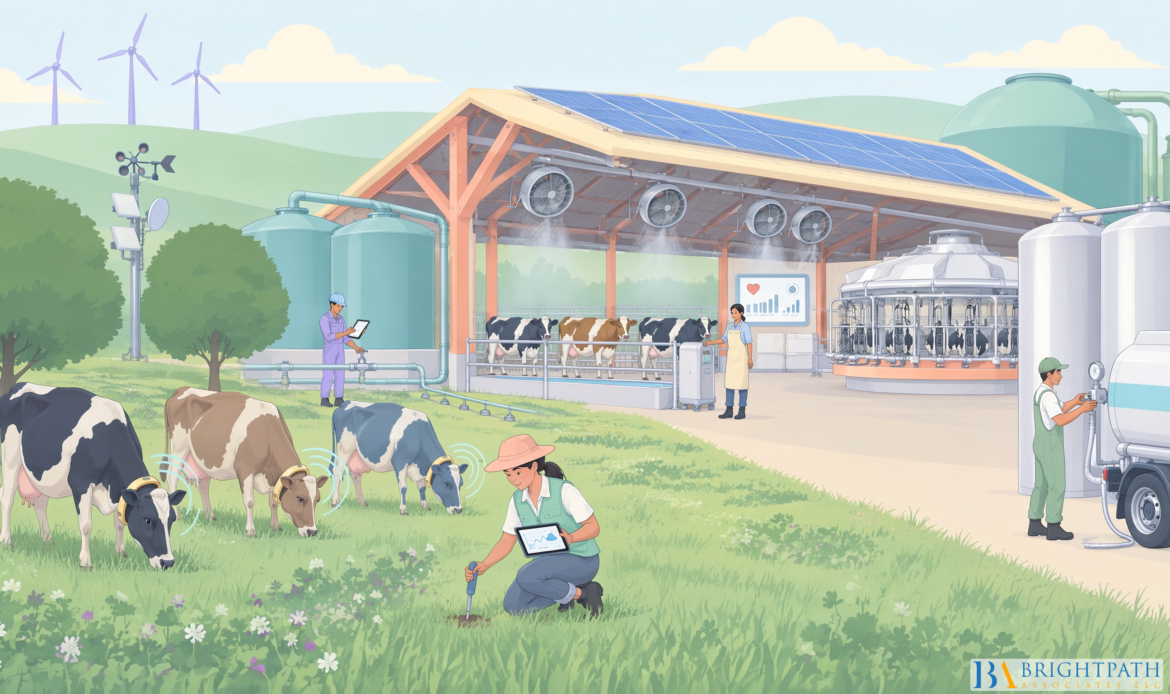
Operational Excellence in a Changing Climate: Lessons for 2026 and Beyond for Dairy Industry is not mainly about adding solar panels, sensors, or new reporting targets. It is about protecting milk output, #ProductQuality, labor capacity, water access, energy reliability, and margins when operating conditions become less predictable.
For dairy executives, the challenge is clear: climate resilience and operational performance can no longer sit in separate plans. Heat can affect herd performance. Drought can disrupt feed economics. Water limits can constrain processing. Power interruptions can threaten cold storage, sanitation, and throughput. A leadership vacancy in operations, engineering, supply chain, or sustainability can make these risks harder to manage at exactly the wrong time.
Table Of Contents
- Climate Risk Is Now an Operational Variable
- Build a Climate Resilience Operating System
- Technology and Capital Decisions Need Better Filters
- Leadership Capacity Is a Dairy Resilience Issue
- Frequently Asked Questions
- Resources and Citations
Key Takeaways
• Climate resilience should be managed as an operating discipline tied to yield, uptime, quality, water, energy, and labor metrics.
• Dairy farms and dairy plants face different failure modes, so they need different controls, investment plans, and leadership capabilities.
• The strongest first moves are often operating improvements: maintenance, cooling routines, water monitoring, scheduling, contingency planning, and clearer accountability.
• Capital projects such as heat pumps, energy storage, manure systems, and automation need climate scenarios, utility constraints, and workforce readiness built into the business case.
• Executive hiring should focus less on titles alone and more on whether leaders can connect food technology, operational data, risk management, workforce adoption, and commercial priorities.
Climate Risk Is Now an Operational Variable
Dairy Operations Need A Wider Definition Of Excellence
#OperationalExcellence in dairy has traditionally centered on yield, quality, waste, cost, safety, service, and asset utilization. Those remain essential. The difference in 2026 is that climate conditions can affect each one at once.
A hot, humid period may reduce feed intake, milk production, and fertility. A water disruption may interfere with cleaning and sanitation schedules. A severe storm can interrupt transportation, power, or milk collection. Drought can raise feed costs and increase financial pressure before a farm’s production data visibly changes.
The USDA Climate Hubs notes that heat stress can reduce dairy cattle feed intake, milk production, and fertility while projected temperatures should inform barn design and cooling capacity. That guidance has a practical implication: leaders should not plan new barns, cooling systems, or utility capacity only around historical averages.
A 2026 Cambridge University Press study similarly found that heat and drought stress were associated with lower technical efficiency and greater downside economic exposure across most analyzed European dairy climatic classes. The study concerns European farms, so its findings should not be treated as a direct forecast for every U.S. dairy operation. Still, it reinforces a useful management question: what happens to margin when climate stress reduces output while input costs rise?
Farm Gate And Plant Gate Risks Are Not The Same
Dairy leaders often group farm and processing risks under one sustainability strategy. That can blur important operating differences.
| Operating Area | Primary Climate Failure Modes | Core Operational Controls | Useful Leadership Focus |
|---|---|---|---|
| Dairy farm | Heat stress, feed disruption, water pressure, manure runoff | Cooling routines, herd monitoring, feed planning, drainage, manure containment | Animal care, agronomy, labor planning, data discipline |
| Milk collection | Road closures, temperature exposure, routing disruption | Route alternatives, fleet maintenance, collection communication | Logistics coordination, supplier relationships, contingency response |
| Dairy plant | Water limits, grid interruptions, high cooling loads, sanitation disruption | Maintenance, production scheduling, utility monitoring, backup plans | Engineering, quality, production planning, energy management |
| Commercial channels | Supply interruptions, changing demand, cold-chain exposure | Inventory visibility, supplier redundancy, customer communication | Supply chain, digital planning, customer operations |
The decision is not whether to pursue adaptation or decarbonization. It is whether a project protects production, lowers emissions, improves margins, or does more than one of those things. A manure system may primarily reduce methane and nutrient risk. Better cooling may protect animal welfare and output. A scheduling improvement may reduce utility peaks and preserve throughput without requiring a major capital purchase.
Build A Climate Resilience Operating System
Turn Climate Risks Into Process Controls
A useful resilience plan does not stop at a list of risks. It assigns each risk to an operating variable, a trigger, an owner, and a defined response. This makes climate planning visible in daily management rather than leaving it in an annual sustainability report.
| Climate Risk | Operating Variable To Watch | Example Trigger | Immediate Response | Accountable Team |
|---|---|---|---|---|
| Heat and humidity | Cow comfort indicators, milk output, cooling runtime | Sustained heat conditions or rising cooling demand | Increase cooling checks, adjust routines, monitor herd response | Farm operations and herd management |
| Drought or water restriction | Water use per unit, water availability, feed conditions | Water allocation change or declining supply | Prioritize critical sanitation and animal needs, review reuse options | Operations and facilities |
| Utility interruption | Downtime risk, refrigeration capacity, peak demand | Grid warning or recurring voltage issues | Test backup procedures, protect cold chain, reschedule noncritical loads | Engineering and production |
| Heavy rainfall | Runoff exposure, manure storage capacity, drainage | Forecasted severe rainfall or drainage overflow | Inspect controls, route water away from containment areas | Environmental and farm operations |
| Feed disruption | Feed availability, price volatility, inventory days | Supplier interruption or material price shock | Reassess rations, sourcing, inventory, and margin exposure | Nutrition, procurement, finance |
This is where precision livestock farming and #DairyAutomation technologies can help. Sensors, automated milking data, environmental monitoring, and maintenance alerts are useful only if they change a decision quickly enough to matter. Installing more dashboards without response rules can create noise rather than resilience.
For example, barn temperature data is valuable when it triggers a specific action: inspect fans, adjust sprinklers, change work schedules, or identify cows needing closer monitoring. At a plant, a spike in energy use is valuable when leaders can determine whether it comes from refrigeration, compressed air, cleaning cycles, or an equipment fault.
The workforce implications are significant. As AI and robotics transform future of dairy farm labor, dairy employers need managers who can translate automation data into safer work, better maintenance, stronger training, and more consistent decisions. Technology does not remove the need for skilled leadership. It changes the work leaders must coordinate.
Measure Joint Productivity And Climate Outcomes
Separate scorecards create weak tradeoffs. If a plant manager is rewarded only for throughput, maintenance may be deferred. If a sustainability leader is rewarded only for emissions reductions, a project may be approved without enough attention to uptime or utility reliability.
We recommend a shared operating scorecard with a limited set of measures that reveal whether resilience is improving. The exact metrics should vary by operation, but the categories should connect financial, operational, and climate outcomes.
• Milk output and quality indicators, interpreted alongside heat and herd comfort conditions.
• Energy intensity per unit of finished product, separated where possible by major utility loads.
• Water intensity, reuse performance where applicable, and sanitation-related water demand.
• Unplanned downtime, maintenance backlog, and recovery time after interruptions.
• Feed availability, price exposure, and inventory coverage for high-risk inputs.
• Emissions intensity measured with methods that remain consistent over time.
The Global Dairy Platform argues that controls, scheduling, system integration, operational discipline, and asset modernization can improve dairy-processing efficiency and climate performance. This matters because processing efficiency is not simply an emissions project. Better control of cleaning, changeovers, production time, and equipment condition can also help a plant recover faster when water, power, raw materials, or labor are constrained.
Technology And Capital Decisions Need Better Filters
Start With No Regret Improvements
#ClimateInvestments are often discussed as a choice between doing nothing and purchasing major infrastructure. That is rarely the real choice. Most dairy operations can begin with a sequence of lower-risk operating actions before committing to capital-intensive projects.
- Stabilize the operating baseline. Fix leaks, verify sensors, complete planned maintenance, document cooling and sanitation routines, and clarify emergency roles.
- Improve visibility. Measure major energy, water, downtime, and quality drivers. Use the data to identify where performance changes under stress.
- Retrofit targeted constraints. Improve controls, insulation, cooling capacity, drainage, variable-speed equipment, or monitoring where data identifies a clear bottleneck.
- Evaluate major assets. Consider electrification, heat pumps, storage, renewable power, manure systems, or major automation only after testing utility capacity, operating hours, maintenance needs, and recovery plans.
This sequence avoids a common failure mode: buying technology before the organization has defined the operating problem it is meant to solve.
The Tetra Pak Dairy Processing Handbook identifies line optimization, maintenance, automation, monitoring, scheduling, heat pumps, electrification, and energy storage as options for improving dairy resource performance. These tools are not interchangeable.
A heat pump may be attractive where usable heat sources, temperature requirements, electricity pricing, and operating hours support the business case. It may be less suitable where required process temperatures are high, electrical capacity is limited, or the facility lacks a credible maintenance plan. Energy storage can reduce exposure to some peak-demand conditions, but it does not replace a well-designed backup strategy for critical refrigeration and food safety systems.
Design For Conditions Over The Asset Life
A barn, utility system, processing line, or wastewater asset may operate for decades. Capital plans should therefore test more than current throughput and historical weather. Leaders should ask whether the equipment will still provide adequate cooling, water capacity, drainage, and energy performance under warmer conditions and different utility constraints.
That does not require pretending to know the exact climate outcome for a specific site. It requires disciplined scenario planning. Test a moderate case, a higher-stress case, and a disruption case. Then identify which investments are resilient across all three.
For a new barn, the question may be whether airflow and cooling capacity can be expanded without rebuilding the structure. For a processing plant, it may be whether refrigeration, water treatment, and electrical infrastructure can support future production and sanitation requirements at the same time.
Global demand can further complicate these choices. Product development, export opportunities, and new channels may increase the value of flexible capacity, but only if the supply chain can deliver consistently. The discussion in Global expansion creates opportunities for dairy products is relevant here: growth strategy should be tested against sourcing, cold-chain reliability, compliance capacity, and operational readiness rather than assumed to be a simple volume opportunity.
Finance, Accounting, And Adoption Cannot Be Afterthoughts
Many resilience projects cross organizational boundaries. A processor may benefit from more reliable milk supply, while the required cooling, manure, feed, or water investment occurs on farms. Without aligned incentives, the project can stall even when the value-chain logic is sound.
Research on U.S. dairy processors reports that processors are pursuing renewable energy, efficiency improvements, and electrification while harmonized accounting and sustained financial support remain important constraints. The lesson is not that every company needs the same financing model. It is that data definitions, incentive design, and capital access need to be part of the operating model.
Possible approaches include shared technical assistance, multi-year supply arrangements, cost-share structures, performance incentives, and carefully designed financing partnerships. Fair warning: incentives should reward measurable practice adoption or outcomes without shifting unreasonable risk onto producers. A program that requires complex reporting but provides little operational value is unlikely to #SustainParticipation.
Leadership Capacity Is A Dairy Resilience Issue
The Executive Role Is Becoming More Integrated
A dairy operation facing climate pressure needs more than a sustainability executive who writes targets or an operations executive who focuses only on daily output. The most valuable leadership teams can connect animal care, milk production technologies, food technology, engineering, digital systems, finance, quality, and workforce execution.
This does not mean every executive must be a technical expert in every domain. It does mean leaders need enough fluency to ask better questions, challenge assumptions, and build cross-functional accountability.
For a chief operating officer, that may mean linking production-time scheduling to water availability, refrigeration capacity, labor coverage, and customer service. For a plant engineering leader, it may mean evaluating electrification through maintenance, grid reliability, thermal demand, and food safety requirements. For a supply chain executive, it may mean treating weather disruption as a planning input rather than an occasional exception.
Why Specialized Searches Can Be Difficult
#DairyIndustry executive search becomes more demanding when a role requires both sector knowledge and broader transformation skills. A company may need a leader who understands dairy supply chain economics, manufacturing controls, automation, digital dairy strategies, environmental requirements, and frontline adoption. The candidate pool for that combination can be narrower than a conventional job description suggests.
The risk of a prolonged vacancy is not simply delayed hiring. It can mean deferred capital decisions, inconsistent accountability, slower maintenance improvement, stalled product development, or weak coordination between farms and processors. These effects are harder to quantify than a vacant salary line, but they can materially affect execution.
A stronger search process starts by defining the operating mandate before defining the title. Leadership teams should separate essential capabilities from preferences.
| Search Question | Why It Matters |
|---|---|
| What operational constraint must this executive improve first? | Prevents a broad job description from hiding the real business need |
| Which decisions will the leader own in the first 12 months? | Clarifies authority, budget, and measurable outcomes |
| What dairy knowledge is essential versus learnable? | Expands the candidate pool without lowering the bar on critical expertise |
| Can the candidate lead technology adoption with frontline teams? | Reduces the risk that new systems become underused or resisted |
| How will success be measured across cost, quality, uptime, and resilience? | Aligns hiring with business performance rather than credentials alone |
We should be cautious about assuming that external recruitment is always the answer. Internal succession may be the better path when an organization has a strong operational leader who understands its assets, culture, and risks. External executive search may be justified when the role requires capabilities the company does not currently have, when confidentiality matters, or when leadership needs a wider and more targeted market view.
Digital growth also changes the leadership mix. Direct-to-consumer channels, dairy e-commerce, and digital demand planning can create pressure on packaging, cold chain, customer service, and fulfillment. Leaders assessing those opportunities may find Digital dairy strategies drive growth through e-commerce useful as a related view of how digital channels affect dairy growth planning.
Frequently Asked Questions
What Does Operational Excellence Mean For Dairy Operations Facing Climate Change?
It means delivering safe, reliable, cost-conscious production while protecting herd performance, #MilkQuality, utilities, labor capacity, and recovery capability during climate-related disruption. The strongest approach links resilience to everyday operating controls rather than treating it as a separate sustainability initiative.
Which Climate Risks Should Dairy Leaders Prioritize First?
Start with risks that can directly interrupt production or safety: heat stress, water availability, cooling and power reliability, feed disruption, drainage, and manure-containment exposure. Priorities should reflect the site, asset condition, utility dependence, and supply-chain structure.
How Should A Dairy Farm Prioritize Cooling Investments?
First assess whether current cooling equipment is operating as designed. Maintenance, airflow, shade, water delivery, and response routines may reveal lower-cost improvements. Expand capacity when monitoring shows recurring heat-related performance risk or when future climate conditions exceed the design assumptions of current facilities.
Which Improvements Can Reduce Both Emissions And Operating Costs?
Maintenance, line optimization, controls, scheduling, leak reduction, automation, and better monitoring can reduce resource waste while improving reliability. Results depend on the site. A project should be tested against actual baseline data rather than assumed to produce universal savings.
When Do Heat Pumps Or Electrification Make Sense For Dairy Plants?
They make the most sense when process temperature needs, electricity capacity, utility prices, operating hours, maintenance capability, and backup plans support the investment. Avoid treating electrification as automatic. A plant with unreliable power or insufficient #ElectricalInfrastructure may need staged upgrades first.
What Climate Resilience Metrics Should Leaders Track?
Track a balanced set: output and quality, energy and water intensity, downtime, maintenance backlog, recovery time, feed exposure, cooling performance, and consistent emissions measures. The goal is to reveal tradeoffs early, not create an oversized reporting system.
How Can Processors Support Climate Resilience On Dairy Farms?
Processors can offer technical support, clearer data expectations, multi-year planning, cost-share structures, and incentives tied to practical outcomes. Programs work best when they reduce operational barriers for producers instead of adding administrative burden without enough value.
Resources And Citations
• USDA Climate Hubs — Weather and Climate Considerations for Dairy
• Tetra Pak Dairy Processing Handbook — Sustainability in Dairy Processing
• BrightPath Associates: Global expansion creates opportunities for dairy products
Find your next leadership role in Dairy Industry today!