
Introduction
#MiningOperations are being pushed to deliver more metal from more complex ore bodies while controlling energy, water, and reagent spend. In that environment, the biggest cost lever is often hiding in plain sight: how much waste rock you send downstream to be crushed, milled, floated, leached, and managed as tailings.
Next-gen ore sorting changes the economics of Ore extraction by making separation decisions earlier and with far greater precision. By applying Mining technology such as sensor fusion and machine learning directly to run-of-mine material, operators can upgrade feed, reject barren rock, and stabilize plant performance. The result is a measurable reduction in processing costs alongside higher recovery and a clearer path to Sustainable mining.
Why Cost Pressure Is Forcing a Rethink of “Business as Usual” Processing
Across Metals industry trends, one theme is consistent: ore grades are declining while variability is increasing. As deposits mature, the same tonnage contains less payable metal and more gangue, and it arrives with a wider range of mineralogy, hardness, and moisture. When that variability hits the plant unchecked, it shows up as unstable grind size, fluctuating recovery, higher reagent demand, and throughput losses that compound across shifts and campaigns.
Traditional responses tend to be capital intensive. Mines add milling power, expand tailings capacity, or increase blending and stockpiling to average out the feed. Those options can help, but they also lock the operation into higher unit costs, especially when energy prices rise or water constraints tighten. In many cases, the most effective move is not to process more, but to process smarter by ensuring that only the right material earns its way into the expensive stages of Metal processing.
Ore sorting is not new, but it has historically been limited by sensing capability and rigid rule sets. Today’s Mining innovation is turning sorting into a precision system that adapts to changing ore characteristics in near real time. That shift is particularly valuable in operations where small changes in head grade or mineral liberation materially affect Metallurgy and overall plant economics.
What Makes Next-Gen Ore Sorting “AI-Driven”
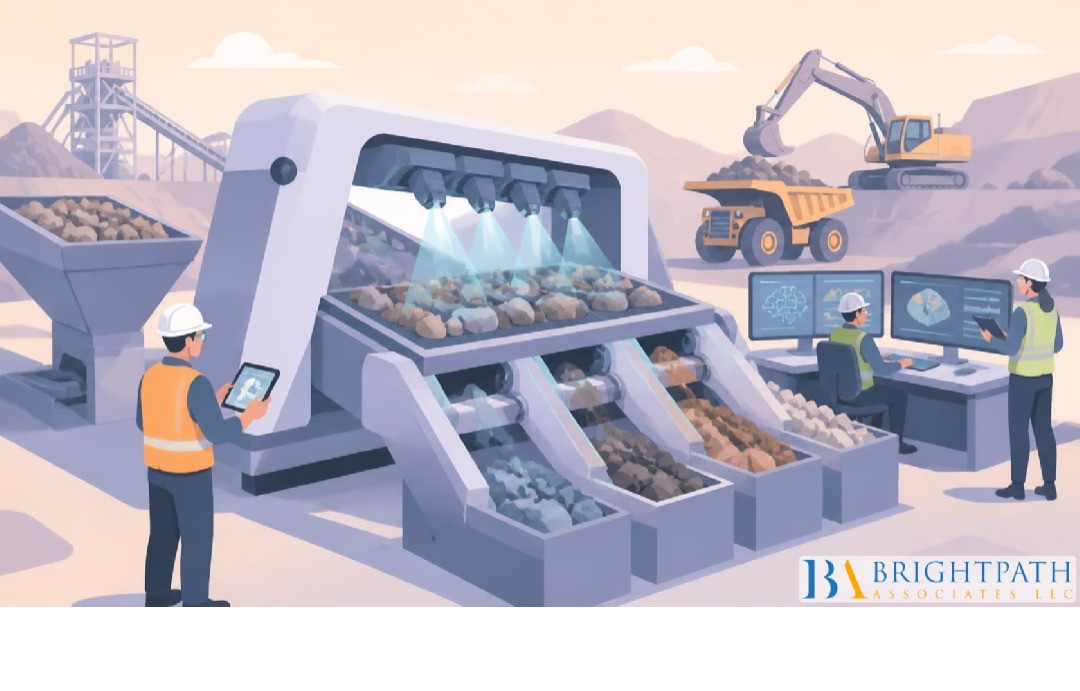
At its core, ore sorting is a decision engine: evaluate each particle or rock fragment and direct it to an accept stream or a reject stream. What has changed is the quality and breadth of information used to make that decision. Modern systems combine multiple sensing modalities such as X-ray transmission, X-ray fluorescence, near-infrared, laser profiling, color imaging, and electromagnetic responses. Each sensor sees different signatures of mineralization, density, or surface composition, and the combined picture is far richer than any single channel.
#ArtificialIntelligence enters in two complementary ways. First, machine learning models can classify material based on complex patterns that do not translate cleanly into fixed thresholds. Second, the models can be continuously tuned as ore domains shift, helping the sorter maintain selectivity without constant manual recalibration. Instead of relying on one static definition of “ore,” the system learns the local relationships between sensor signals and downstream performance outcomes such as recovery, concentrate quality, and reagent consumption.
The most successful deployments treat AI sorting as part of an integrated Mining technology workflow. Sensor calibration, sampling, and reconciliation are built into standard operating discipline so the model remains grounded in reality. When data governance is strong, the sorter becomes not just a piece of equipment, but a controllable unit operation that supports consistent Metallurgy and more predictable plant behavior.
How Precision Sorting Lowers Processing Costs
Processing cost is fundamentally driven by the mass you push through comminution and separation to recover a given amount of metal. AI-driven ore sorting targets that ratio. By rejecting low-value material early, the operation reduces the tons per payable unit, which immediately lowers electricity consumption in crushing and grinding. It also reduces wear on liners, grinding media consumption, and unplanned downtime associated with overloading mills and conveyors.
Downstream, a higher and more consistent feed grade can reduce reagent intensity and improve stability in flotation, gravity circuits, or leach. Many plants spend money not just on reagents but on variability itself, because variable feed forces conservative operating setpoints. When sorting smooths the feed, operators can tune conditions closer to optimal, reducing the “insurance” consumption that accumulates over long campaigns. The same logic applies to thickening, filtration, and tailings handling, where lower mass flow translates to lower pumping energy and more manageable water balance.
Precision also reduces the hidden costs of misclassification. In older approaches, rejecting too aggressively risks losing value to waste, while accepting too broadly dilutes the plant feed. AI helps narrow that tradeoff by increasing selectivity and adapting to ore changes. Over time, the financial impact is not just a lower cost per ton processed, but a lower cost per ton of metal produced, which is the number that matters most when margins are tight and commodity cycles turn.
These gains can be achieved without re-architecting the entire plant. Because sorting can be positioned at multiple points in the flowsheet, from coarse rock sorting after primary crush to finer particle sorting after screening, it offers a modular path to performance improvement. That modularity is increasingly attractive as Mining policy scrutiny grows around capital efficiency, land disturbance, and the long-term footprint of new infrastructure.
Reducing Waste While Improving Recovery: The Metallurgy Advantage
Ore sorting is often discussed as a cost tool, but its strategic value is equally tied to recovery and resource utilization. When barren or low-grade material is removed before milling, the plant can dedicate capacity to material with a higher probability of generating payable product. This is especially important in deposits where mineralization is finely distributed across domains and where blending alone cannot prevent low-grade dilution from consuming mill hours.
From a Metallurgy perspective, sorting can do more than upgrade head grade. It can also change the mineralogical character of the feed by preferentially rejecting fragments associated with problematic gangue. In practice, this can mean fewer penalty elements in concentrate, improved concentrate grades, or a more favorable response to grinding and flotation. When the plant sees a more consistent mineral suite, the control strategy becomes more repeatable, and the operation spends less time chasing excursions that erode recovery.
The improvement in recovery does not come from “magic” metal creation; it comes from avoiding unnecessary losses created by overload, poor liberation control, and unstable chemistry. In many circuits, recovery suffers when operators are forced to choose between throughput and selectivity. By reducing waste mass upstream, sorting creates room for both. That can allow finer grind targets when needed, better residence time control, and fewer compromises that send value to tailings during peak variability periods.
Over the life of mine, the #CumulativeEffect can be substantial. Higher recovery on marginal ore domains can extend mine life, improve reserve conversion, and shift cut-off grade decisions. Those choices sit at the intersection of Mining innovation and finance, because they determine whether value is realized today, deferred, or left in the ground as uneconomic material.
Sustainable Mining Outcomes Without Sacrificing Throughput
The case for Sustainable mining is often framed as a compliance burden, but AI-driven sorting highlights a more practical truth: sustainability improves when the operation stops doing unnecessary work. If fewer tons are milled for the same or higher metal output, energy intensity declines. If less mass becomes tailings, storage demand and long-term liability decline. If water and reagents are used more efficiently, the site becomes more resilient in regions where scarcity and permitting constraints are real operational limits.
This is where Mining policy and performance converge. Regulators and local stakeholders increasingly focus on the measurable footprint of extraction and processing, including emissions intensity, tailings risk, and cumulative water impacts. Sorting is not a substitute for responsible governance, but it can materially improve the metrics that shape approvals and community trust. It also creates a clearer narrative for how Mining technology investments translate into lower impact per unit of production.
Operational resilience improves as well. By reducing the mass burden on the plant, sorting can lower the frequency of choke points and allow maintenance windows to be planned rather than forced. In volatile commodity environments, resilience is a competitive advantage because it protects delivery commitments and reduces the likelihood of costly production interruptions. As Metals industry trends continue to reward reliability and cost discipline, the mines that stabilize performance while shrinking footprint will be positioned to outcompete peers on both price and credibility.
Making AI Ore Sorting Work in the Real World: People, Process, and Leadership
The technology is powerful, but outcomes depend on execution. Successful implementations begin with a clear definition of what “good” looks like, not only in terms of sorter accuracy but in terms of plant economics. That means linking sorting decisions to value drivers such as net smelter return, energy per ton of metal, recovery stability, and product quality. It also means aligning geology, processing, and maintenance around shared parameters so the sorter is treated as part of the flowsheet, not a standalone experiment.
#DataDiscipline is the quiet enabler. AI models require consistent calibration, representative sampling, and reconciliation against plant results. When those disciplines are weak, the model drifts and confidence erodes. When they are strong, the model becomes a living asset that improves as the orebody reveals more complexity. In many sites, this is where Mining innovation becomes an organizational capability rather than a one-time purchase.
Because the change crosses functions, talent and leadership matter more than most operations expect. Many operators are turning to Mining executive search to find leaders who can bridge digital systems with operational realities, especially where Metallurgy and production targets must be balanced under strict cost and sustainability constraints. The rise of mining and metals recruiters reflects this need for hybrid expertise: professionals who understand sensors and algorithms, but who can also run a plant, manage risk, and deliver consistent results on shift.
#ExecutiveSearchRecruitment is increasingly tied to technology roadmaps because the limiting factor is often not hardware availability, but the ability to implement, govern, and scale new workflows. Teams that can connect Mine planning, Ore extraction strategy, and Metal processing decisions into one economic model will capture more value from sorting than teams that treat it as a bolt-on upgrade. As a result, Mining technology is reshaping org charts as much as it is reshaping flowsheets, and that shift is becoming one of the defining Metals industry trends in operational excellence.
Conclusion: Precision Upstream, Profitability Downstream
Next-gen ore sorting is redefining how mines think about cost, recovery, and responsibility. By using AI-driven precision to separate value from waste earlier, operations can reduce the tons they grind, lower energy and reagent intensity, and improve stability across the processing chain. Just as importantly, they can reduce tailings generation and strengthen the case for Sustainable mining in a policy environment that increasingly rewards measurable impact reduction.
The mines that lead in this space will not treat sorting as a gadget, but as a disciplined unit operation supported by strong Metallurgy, consistent data governance, and capable leadership. When Mining innovation is paired with the right people, whether developed internally or secured through Mining executive search and experienced mining and metals recruiters, AI-driven ore sorting becomes a durable advantage that lowers processing costs while improving recovery and long-term resilience.
Find your next leadership role in Mining & Metals Industry today!
Stay informed with the latest insights on Mining & Metals Industry!